


The Netherlands is a top choice for entrepreneurs, and it’s easy to see why. When starting a Dutch company, the main steps usually involve selecting a legal structure such as a BV, working with a civil-law notary, and registering with the Dutch Chamber of Commerce (KVK). This guide will take you through the full process, giving you the confidence to set up and manage your Dutch company like a local.
Why Start Your Dutch Business Journey
There’s a real buzz around the Netherlands for global business, and it’s not just hype. The country offers a potent mix of a rock-solid, stable economy and a prime strategic location at the heart of Europe.
What really sets it apart, though, is its pro-business attitude, backed by a highly skilled and multilingual workforce. This makes it an incredibly attractive base for both ambitious startups and established corporations looking for a solid foothold in the European market. Throw in the world-class infrastructure and digital connectivity, and you have an environment where businesses can genuinely thrive.
This thriving ecosystem is clearly reflected in the numbers.
The Dutch Business Landscape at a Glance
This table gives a quick snapshot of just how active the Dutch business world is. The figures speak for themselves, painting a picture of a diverse and dynamic economic environment.
| Metric | Figure |
|---|---|
| Total Registered Entities (May 2025) | 3.85 million+ |
| Proprietorships | 1.76 million+ |
| Corporations (e.g., BVs, NVs) | 1.22 million+ |
As you can see, the landscape is a healthy mix of small enterprises and larger corporations, showing there’s space for everyone to operate and grow.
Laying the Financial Groundwork
Before getting tangled up in the legal paperwork, it’s crucial to think about the financial backbone of your new company. Securing the right level of funding is one of the most important first steps you’ll take—it influences everything from your choice of legal structure to how long you can operate before turning a profit.
My advice? Take the time to properly research your options. A common mistake I see is entrepreneurs assuming the minimum share capital is all they need. In practice, the authorities want to see a realistic financial plan that shows your business can sustain itself well beyond just covering the initial setup fees.
Your First Port of Call: The KVK
The Dutch Chamber of Commerce, known as the KVK (Kamer van Koophandel), is the central point for all business registrations in the Netherlands. This is where your company is officially born in the eyes of the law.
For international founders, their English-language portal is an absolute goldmine of information.
The portal breaks down essential topics like choosing a legal form, preparing for registration, and understanding your tax obligations. It’s laid out logically, helping you gather everything you need before you even speak to a notary. Starting your research here will make the entire registration process much smoother from day one.
Choosing the Right Legal Structure
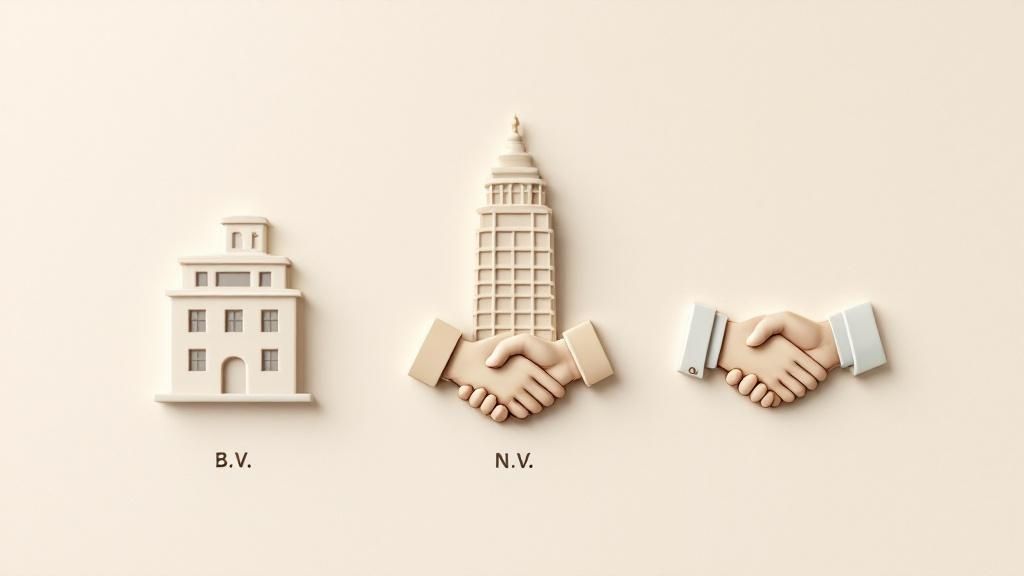
Selecting the right legal entity for your business in the Netherlands is far more than an administrative box-ticking exercise. It’s a foundational decision that dictates your liability, tax obligations, and potential for growth. The choice you make will directly influence everything from how you raise capital to the personal risk you assume.
For most international entrepreneurs, the conversation quickly turns to the Besloten Vennootschap (BV), or private limited company. Its main appeal is the clear separation between business and personal assets, offering a crucial layer of protection. But it isn’t the only path, and understanding the alternatives is key to making a truly informed decision.
A common scenario we see involves a tech startup aiming for venture capital funding. For them, the BV is a non-negotiable choice. Investors almost universally require this structure because it allows for the clean issuance of shares and protects their investment within a formal corporate framework.
The Sole Proprietorship (Eenmanszaak)
The Eenmanszaak, or sole proprietorship, is the simplest and most common structure for individual entrepreneurs and freelancers in the Netherlands. If you’re a consultant, a freelance designer, or a small-scale e-commerce operator testing the waters, this might be your ideal starting point.
Registration is straightforward and relatively inexpensive. The most significant factor to consider, however, is liability. With an Eenmanszaak, there is no legal distinction between you and your business. This means your personal assets, including your home and savings, are at risk if the business incurs debts or faces legal action.
- Best for: Freelancers, individual consultants, and small business owners with low liability risk.
- Liability: Unlimited personal liability for all business debts.
- Taxes: You pay income tax on business profits and can often benefit from specific entrepreneurial deductions.
For example, a freelance copywriter just starting out would find the Eenmanszaak perfectly suitable. Their overheads are low, and the risk of significant debt is minimal. The tax benefits for small entrepreneurs in this structure are often more advantageous than a BV in the early stages.
The General Partnership (VOF)
When two or more people decide to start a business together, the Vennootschap onder Firma (VOF), or general partnership, becomes a relevant option. It’s much like an Eenmanszaak, but for multiple partners. Each partner contributes something to the business, whether it’s cash, goods, or labour.
Like a sole proprietorship, a VOF is relatively simple to set up. You don’t need a notary to create a partnership agreement, although having one is highly advisable to clearly define roles, contributions, and profit distribution.
The main drawback is, again, liability. In a VOF, all partners are jointly and severally liable for the business’s debts. This means if the business cannot pay its debts, creditors can pursue the personal assets of any partner, regardless of who was responsible for creating the debt. This shared risk is a critical point to discuss with your co-founders. For more insights, you might be interested in this overview on setting up a company in the Netherlands, which provides additional context on these structures.
The Private Limited Company (BV)
The Besloten Vennootschap (BV) is the go-to structure for serious, scalable businesses, especially those with international ambitions. It’s a legal entity in its own right, meaning it’s separate from its owners (the shareholders). This “corporate veil” is its most significant advantage.
- Limited Liability: Your personal assets are protected. If the company fails, creditors can typically only claim the assets owned by the BV itself.
- Professional Image: Operating as a BV often projects a more professional and stable image to clients, partners, and investors.
- Scalability: It’s much easier to bring in new investors, transfer ownership, or set up employee stock option plans with a BV.
The process for a Dutch company registration as a BV is more involved. It requires the services of a civil-law notary to draft and execute the deed of incorporation. While the minimum share capital requirement is just €0.01, you must still demonstrate sufficient funding to cover initial costs.
Let’s consider an American entrepreneur looking to expand into Europe. By establishing a Dutch BV, they not only gain access to the EU market but also may qualify for attractive tax incentives. For instance, if they meet certain criteria, they could be eligible for the 30% ruling—a tax advantage for skilled migrants that significantly reduces their taxable income. This benefit requires an employment relationship, which is possible with a BV but not an Eenmanszaak. The BV structure is essential to unlock this powerful financial advantage.
Choosing between these structures isn’t just a legal formality; it’s a strategic business decision that should align with your long-term vision.
Getting Your Dutch Company on the Books
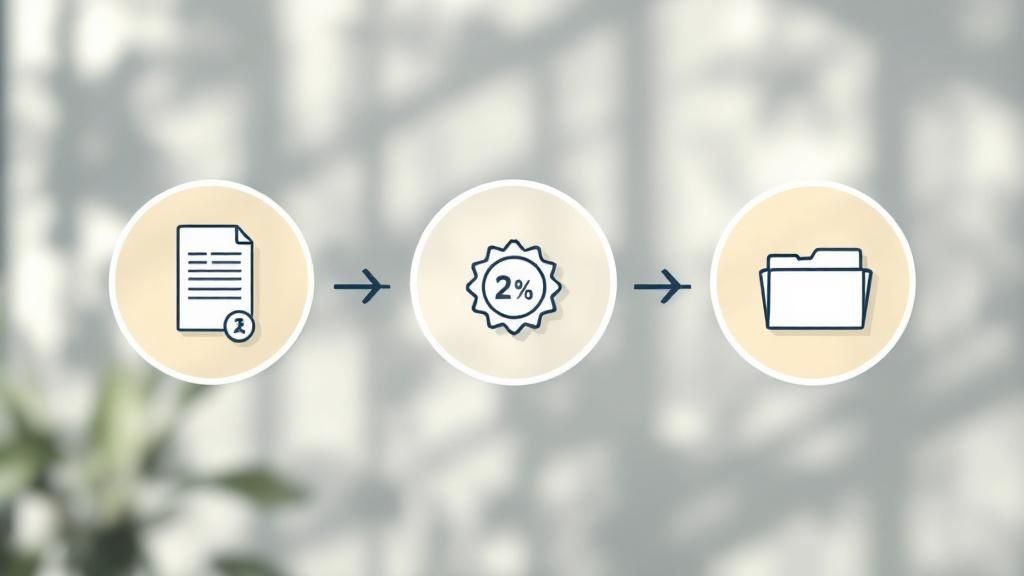
Once you’ve settled on your legal structure, it’s time to bring your company to life. This is where the paperwork begins and your business idea becomes a formal, legal entity in the Netherlands. The Dutch registration process is quite structured, but success really hinges on proper preparation for each stage. We’ll walk you through the entire workflow, sharing practical insights to make it as seamless as possible.
The journey starts with a couple of foundational tasks: choosing a unique company name and securing a valid business address. These might seem like small details, but getting them right from the outset prevents major headaches and delays down the road.
Securing Your Company Name and Address
Your company name isn’t just for branding; it’s a legal identifier. Before you get too attached to a name, you absolutely must check its availability in the Dutch Chamber of Commerce (KVK) Trade Register. A quick search will tell you if another business is already using your desired name or one that’s confusingly similar.
Imagine a new tech firm wants to register as “Dutch Tech Innovators BV.” If a “Dutch Tech Innovations VOF” already exists, the KVK will likely reject the name to avoid public confusion. It’s always a good idea to have a few alternative names in your back pocket.
Next up is your registered business address. This has to be a physical address in the Netherlands—a P.O. box won’t cut it. For many international founders and startups, using a virtual office or a business centre is a common and perfectly valid solution, as long as it permits KVK registration.
A crucial tip for international entrepreneurs: Always confirm with your address provider that they explicitly allow KVK registration. Some co-working spaces or mail services don’t, and finding this out late in the game can force you to backtrack, wasting precious time and money.
The Central Role of the Civil-Law Notary
When setting up a private limited company (BV), the civil-law notary (notaris) is absolutely essential. A Dutch notaris is far more than a witness; they are a highly qualified legal professional, appointed by the Crown, with the authority to execute legal documents like the deed of incorporation.
Your notary’s role is quite comprehensive. They are responsible for:
- Drafting the Deed of Incorporation: This is your company’s foundational legal document, which includes the articles of association.
- Verifying Identities: They will formally verify the identities of all founders and directors.
- Checking the Company Name: The notary performs their own formal check on your proposed company name.
- Submitting KVK Registration: In most cases, the notary handles the initial registration with the Chamber of Commerce for you.
To make your meeting with the notary—whether in-person or remote—as efficient as possible, you’ll need to have several key documents ready.
Essential Documents for the Notary
- Valid Identification: A passport or a valid EU/EEA identity card for every founder and director.
- Proof of Private Address: A recent utility bill or bank statement (usually less than three months old) for each person involved.
- Company Details: The chosen company name, the registered business address, and a clear description of the company’s main business activities.
Having these documents organised and ready to go will dramatically speed up the process.
The Deed of Incorporation and KVK Registration
The climax of the notary’s work is the execution of the deed of incorporation. This is the moment your company officially becomes a legal entity. Once the deed is signed, the notary will submit it and other required forms to the Dutch Chamber of Commerce (KVK).
The KVK processes the application and, once approved, lists your company in the Dutch Trade Register. This is a massive milestone. You’ll receive your unique KVK number, an 8-digit identifier that you’ll use on all business correspondence, invoices, and official documents.
The entrepreneurial drive in the Netherlands is robust, with a steady stream of new businesses entering the market. For instance, data from the Dutch Chamber of Commerce and the World Bank shows that in 2022 alone, 39,055 new limited liability companies were registered, a clear sign of the country’s supportive business climate.
At the same time as the KVK registration, your company details are passed to the Dutch Tax and Customs Administration (Belastingdienst). This automatically triggers the issuance of your tax numbers, including the crucial VAT number needed to conduct business.
Understanding the UBO Register
A non-negotiable step in the Dutch registration process is the UBO declaration. UBO stands for “Ultimate Beneficial Owner.” This is a mandatory register created to increase transparency and help combat financial crimes like money laundering.
A UBO is any person who ultimately owns or controls more than 25% of the company’s shares or voting rights, or who otherwise has effective control. You must identify all UBOs and provide their details for this register, which is managed by the KVK.
This is not just a formality. Failing to accurately register your UBOs can lead to significant fines and legal trouble. Your notary will guide you through the declaration, but it’s ultimately your responsibility to provide complete and correct information. For a deeper dive into these obligations, you can review our guide on the Dutch business register.
The whole process, from gathering your documents to receiving your official numbers, can be broken down into a typical timeline.
To give you a clearer picture, here’s a breakdown of the typical timeline and key milestones you can expect during the Dutch company registration process.
Dutch Company Registration Timeline and Key Milestones
| Phase | Key Action | Responsible Party | Estimated Timeline |
|---|---|---|---|
| Preparation | Gather documents, choose name/address | Founder(s) | 1-2 Weeks |
| Notary Engagement | Draft & execute deed of incorporation | Notary & Founder(s) | 3-5 Business Days |
| Official Registration | Submit to KVK & Belastingdienst | Notary | 1-3 Business Days |
| Finalisation | Receive KVK and VAT numbers | KVK / Belastingdienst | 1-2 Weeks |
By understanding each step and preparing everything in advance, you can navigate the core registration process efficiently and set a solid legal foundation for your new Dutch venture.
Understanding the Costs and Financials
When you’re ready to set up your Dutch company, one of the first questions that comes to mind is, naturally, “what’s this going to cost me?” No entrepreneur wants financial surprises, especially not at the very beginning of a new venture.
The good news is that budgeting for a Dutch BV (a private limited company) is pretty straightforward. The costs boil down to a few key areas: the civil-law notary, a one-off fee for the Dutch Chamber of Commerce (KVK), and any professional advice you might need. Once you have a handle on these, you can plan your launch with real confidence.
Breaking Down the Notary Fees
The biggest variable in your setup costs will be the civil-law notary’s fee for drafting and executing the deed of incorporation. These fees aren’t fixed and can swing quite a bit, typically landing somewhere between €800 and €3,500.
So, what drives this variation? A few things:
- Complexity: A standard setup with a single shareholder is on the lower end. Add more shareholders, complex share structures, or special clauses in your articles of association, and the price will climb.
- Language: If you need the deed drafted in English (or another language) alongside the official Dutch version, expect to pay more for the translation work.
- Speed: In a hurry? Many notaries offer an expedited service for a premium, getting you registered much faster.
It’s always a smart move to get quotes from a few different notaries. Don’t just compare the bottom-line price; look at their experience with international founders and how responsive they are. A slightly higher fee for a notary who understands your situation can be money well spent.
KVK and Other Essential Costs
Beyond the notary, you’ll have a couple of other standard costs to budget for. The most direct is the one-time registration fee for the Dutch Chamber of Commerce (KVK), which is a relatively small charge, usually under €100. Every new business pays this.
You should also consider budgeting for professional advice. While not strictly mandatory, getting input from a tax advisor or lawyer can be incredibly valuable. This is especially true for international entrepreneurs dealing with things like the 30% ruling or cross-border tax issues. This could add another €500 to €1,500 to your initial costs, but the long-term savings from getting it right from day one can be huge.
A critical point that trips up a lot of founders is the minimum share capital for a BV. The law says it’s just €0.01, but this number is seriously misleading. The authorities need to see that your company has enough capital to actually cover its initial operating costs and liabilities.
In practice, this means funding your company with a single cent is a major red flag. You need a realistic financial plan. Your opening balance sheet, often put together by an accountant, must show that the company is adequately funded to survive its startup phase. This proof of sufficient capital is far more important than hitting that technical €0.01 minimum.
What Happens After You Register Your Company?
Getting your Dutch company registered is a huge milestone, but it’s really just the starting line. With your KVK number in hand, the real work begins: running your business day-to-day and staying on top of your legal obligations. This next phase is all about building a sustainable, compliant company in the Netherlands.
One of the very first things you’ll need to do is open a Dutch corporate bank account. While some digital international banks can be a temporary solution, you’ll quickly find that local clients, suppliers, and especially government agencies often prefer—or even require—you to have an account with a traditional Dutch bank. It streamlines your transactions and properly anchors your company within the local financial system.
Be ready for the bank to conduct its own due diligence. They’ll want to see your KVK extract, articles of association, and proof of identity for every director and UBO. This is just another reminder of how crucial transparent financial operations are from the very beginning.
Finding Your Annual Compliance Rhythm
With your banking sorted, your focus will shift to the annual cycle of compliance tasks. This is a predictable and non-negotiable rhythm that forms the backbone of your company’s good standing with the Dutch authorities. Missing these deadlines can lead to fines and legal headaches, so it’s smart to get organised from day one.
These are the key recurring obligations you’ll face:
- Annual Financial Statements: Every BV must prepare and file annual financial statements, known as the jaarrekening. The level of detail required depends on your company’s size, but you’ll always need to file at least a balance sheet and notes with the KVK.
- Corporate Income Tax (CIT) Return: You must file a CIT return with the Belastingdienst (Dutch Tax and Customs Administration) every year to declare your taxable profits.
- VAT Administration: If your company is registered for VAT, you are required to file periodic VAT returns—usually every quarter—and pay any VAT you’ve collected. This demands meticulous record-keeping.
Keeping Your Company Details Up to Date
Compliance isn’t just about filing things once a year. It’s an ongoing responsibility to ensure your company’s information in the public registers is always accurate.
A perfect example is the UBO (Ultimate Beneficial Owner) register. If there are any changes to your company’s ownership or control structure—like a new shareholder buying more than 25% of the shares—you must report it to the KVK immediately. The penalties for not maintaining an accurate UBO register can be severe, as it’s a critical part of the country’s anti-money laundering framework. You can learn more about the regulations behind this by understanding the Dutch Money Laundering Act.
Think of your KVK registration as a living document. Any change, whether it’s a new director, a different business address, or an updated description of your activities, must be officially registered. Managing this proactively is the best way to prevent small issues from becoming big problems.
The regulatory landscape itself also changes. For instance, the Dutch government is introducing new regulations that will particularly affect foreign entrepreneurs. From January 1, 2025, many foreign founders will need to supplement their registration with a detailed business plan and proof of financing, often showing at least €20,000 in startup capital. This signals a stronger focus on ensuring new businesses are viable from the start.
Beyond Compliance: Proactive Financial Management
Truly smart financial management isn’t just about hitting deadlines—it’s about actively looking for opportunities. The Netherlands offers some very attractive tax incentives for innovative companies that can give your bottom line a significant boost.
One of the most valuable is the Innovation Box (innovatiebox). If your company develops new technology and holds a patent or an R&D certificate (WBSO) for it, the profits generated from that innovation can be taxed at a much lower effective rate. It’s a powerful incentive designed to reward R&D taking place in the Netherlands.
By treating your post-registration obligations as a strategic part of running your business, not just a chore, you can build a foundation for long-term success and fully capitalise on the opportunities the Dutch market offers.
Common Questions on Dutch Company Registration
Setting up a business in a new country always comes with a lot of questions. That’s completely natural. Based on our experience helping countless entrepreneurs, we’ve put together answers to some of the most common queries we hear.
Do I Need to Be in the Netherlands to Register a Company?
For most of the setup, no. This is a huge plus for international founders. Key steps like preparing and signing the deed of incorporation can often be managed entirely from abroad. A good civil-law notary can handle the legalisation of signatures and documents remotely, so you don’t need to be physically present for the initial formation.
However, there’s a big catch you need to know about. When it comes to opening a corporate bank account, many traditional Dutch banks will insist on an in-person meeting with the company director(s). It’s a non-negotiable part of their due diligence.
My advice is always to check this requirement with your chosen notary and your potential bank right at the start. It helps you plan any travel you might need to make and prevents frustrating delays right after your company is legally up and running.
How Long Does the Entire Registration Process Take?
Once your notary has all the correct documents in hand, you should realistically budget between one to four weeks to get your company registered and receive your KVK number. This timeline covers everything from drafting the deed to the final registration with the tax authorities.
So what slows things down? In my experience, it usually boils down to two things:
- Paperwork problems: Missing documents or certificates that haven’t been properly apostilled will stop the process in its tracks.
- Company name clashes: If you pick a name that’s too close to one already in use, the KVK will reject it, and you’ll have to start that step over.
The best way to stay on the shorter end of that one-to-four-week estimate is simply to be meticulously prepared.
What Is the UBO Register and Why Is It Important?
The UBO register is a mandatory, non-negotiable part of forming a company in the Netherlands. UBO stands for “Ultimate Beneficial Owner”—essentially, the real people who own or control the company. This isn’t just paperwork; it’s a public record.
You’re considered a UBO if you fit any of these descriptions:
- You hold over 25% of the company’s shares.
- You command more than 25% of the voting rights.
- You have effective control through other means (e.g., the right to appoint board members).
This register was created to fight financial crimes like money laundering by making company ownership transparent. It is not optional.
Your notary will help you with the declaration, but the ultimate responsibility for providing accurate information is yours. Failing to register or keeping the information outdated can lead to serious penalties, including hefty fines. It’s a critical compliance task from day one.