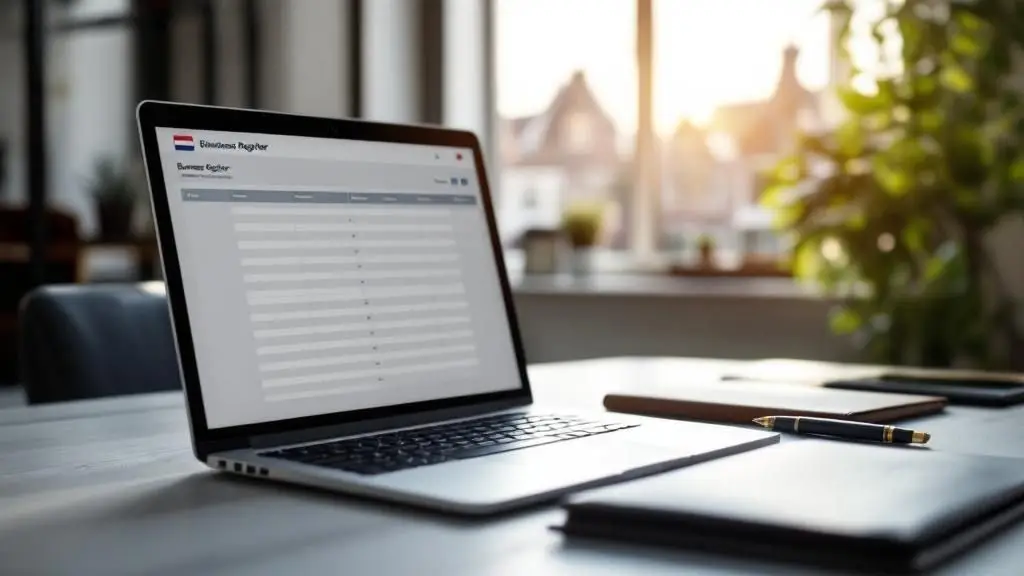
In short: the Dutch business register (Handelsregister) is the official database of every business in the Netherlands, run by the Chamber of Commerce (Kamer van Koophandel, KvK). Registration is compulsory before you start trading and gives your business its KvK number, which appears on invoices, contracts and bank applications. The register records the legal form, registered address, directors and authorised signatories, and most of that information is publicly searchable.
The business register in the Netherlands is the official, legally recognised database for every single business operating in the country. Managed by the Kamer van Koophandel (KvK), you can think of it as the foundational ‘who’s who’ for the entire Dutch market, confirming a company’s legal existence and its core details.
Unpacking the Dutch business register

Imagine trying to navigate a new city without any street signs, building numbers, or maps. That’s precisely what the Dutch economy would feel like without the KvK Business Register. It’s so much more than a simple list; it’s the single source of truth that provides legal certainty and transparency for everyone involved in commerce.
From a solo freelancer (zzp’er) working from their home office to a massive multinational corporation, every legally operating entity must be listed. This mandatory registration is the bedrock of trust in the Dutch marketplace. It ensures that anyone—a customer, a partner, a supplier—can easily verify a company’s credentials before signing a contract or making a deal.
What is its core purpose?
At its heart, the register’s purpose is to create a transparent and reliable commercial environment. It does this by making essential company information public and legally binding. The database is a living document, constantly updated to reflect the dynamic nature of business in the Netherlands.
Take the latest figures, for example. As of 31 March 2025, there were a staggering 2,578,878 organisations registered in the KvK Business Register, marking a 1.4% increase from the previous quarter. Yet, that same period saw the sharpest drop in new business starters in a decade, with just 60,448 new registrations. If you’re curious about these trends, you can dive deeper in the latest KvK report.
Key information held in the business register
The information held in the register is specific and designed to give you a clear, immediate snapshot of a company’s identity and legal standing. It’s not just a name and address; it details the very structure of the business and who holds the power within it.
Below is a quick rundown of the essential data points you’ll find for any registered entity. This table breaks down what each piece of information means for you when you’re doing your research.
Key information held in the business register
| Data Point | What It Means for You |
|---|---|
| Company Name and KvK Number | The official business name and its unique 8-digit ID. The KvK number is the most reliable way to identify a specific company. |
| Contact Details | The registered business address, postal address, and sometimes phone numbers or email. This confirms their physical presence and contact info. |
| Legal Form | Specifies if it’s a sole proprietorship (eenmanszaak), a private limited company (BV), or another structure. This reveals its legal and tax status. |
| Authorised Signatories | A crucial detail listing who has the legal authority to sign contracts and make binding decisions on the company’s behalf. |
By making these details public, the register empowers you to conduct proper due diligence, significantly reducing risk and fostering a secure marketplace for everyone.
It truly is the cornerstone of accountability in Dutch commerce. Knowing you can look up any potential business partner provides an essential layer of security and confidence.
Why KvK registration is your business lifeline
Registering with the Kamer van Koophandel (KvK) is so much more than just a bureaucratic box-ticking exercise. Think of it as giving your company its legal pulse. Without a KvK number from the business register Netherlands, your business simply cannot operate legitimately. It’s the foundational step that turns a brilliant idea into a recognised legal entity.
This registration is your key to the entire Dutch economy. It’s the official proof that your business exists, signalling to customers, suppliers, and banks that you are a credible and accountable partner. This formal status is absolutely vital for building trust and establishing your reputation in the market.
The gateway to essential Business operations
Imagine trying to build a house without a foundation. That’s precisely what operating without a KvK number is like. This unique 8-digit identifier unlocks all the essential functions you need for daily operations and long-term growth.
Once you’re registered, you can finally:
- Open a business bank account. No legitimate Dutch bank will even consider opening a corporate account without proof of your KvK registration.
- Secure financing or investment. Lenders and investors will always ask for an official KvK extract to verify your company’s legal standing before they commit any funds.
- Legally sign contracts. Your KvK number is what validates your authority to enter into binding agreements with clients, vendors, and landlords.
- Obtain a VAT number. The KvK automatically passes your registration details to the Dutch Tax and Customs Administration (Belastingdienst), a crucial step for invoicing and tax compliance.
In essence, every significant business transaction you make will hinge on this registration. It’s the single document that proves you are who you say you are in the commercial world.
“Your KvK number is the master key to the Dutch business world. It unlocks banking, contracts, and credibility, making it the single most important asset for any new enterprise in the Netherlands.”
A shield for legal protection and transparency
Beyond just enabling your operations, your KvK registration acts as a protective shield. It clearly defines who has the legal authority to act on behalf of the company. By listing authorised signatories, it helps prevent fraud and settles any disputes over who can make binding decisions.
This transparency is a two-way street. While it protects your business, it also gives others the confidence to deal with you. For instance, a potential partner can look up your entry in the business register and instantly confirm your details—a process that underpins the trust essential for successful business collaborations in the Dutch market.
Without this formal record, you could find your personal liability exposed, and your ability to enforce contracts would be severely weakened. It’s not just red tape; it’s a critical legal framework that supports and protects your entire business venture right from day one.
Your Step-by-Step guide to Dutch business registration

Ready to make your Dutch business official? It can feel like a big leap, but the process is more straightforward than you might think. We’ll walk you through everything, from choosing the right legal structure to that final, official handshake at the KvK office.
The whole system for joining the business register Netherlands is a blend of online prep and a single in-person meeting. A little bit of homework upfront will make the whole experience go smoothly.
Step 1: choose your legal form
This is your first, and arguably most important, decision. Are you setting up shop as a freelancer (eenmanszaak or zzp’er)? Or does your plan call for the liability protection of a private limited company (BV)?
Your choice here has real consequences for your taxes, personal liability, and the amount of admin work you’ll face down the line. An eenmanszaak is incredibly simple to start, but it means your personal assets are legally tied to your business debts. A BV, on the other hand, creates a protective wall but requires a more involved setup, including a trip to the notary. Think carefully about your long-term goals and what you expect to earn.
Step 2: complete the online Pre-Registration
Once you’ve settled on a legal structure, it’s time to head to the KvK website and fill out the digital registration form. You’ll need your Dutch citizen service number (BSN) to get started. If you don’t have one, your first port of call will be your local municipality (gemeente) to get that sorted.
The online form will ask for all the key details about your new venture:
- Your personal details
- The business name you’ve chosen (it’s wise to search the register first to make sure it isn’t already taken!)
- A clear description of what your business will do
Key Takeaway: The registration process is a fusion of digital prep-work and a mandatory physical appointment. Completing the online forms accurately and thoroughly beforehand is crucial to making your in-person visit efficient and successful.
Step 3: schedule and attend your KvK appointment
With the online part done, you’ll need to book an in-person appointment at a KvK office. This meeting is where it all becomes official. Be prepared to pay the one-time registration fee, which was around €80.10 as of early 2025. You’ll typically pay this during the appointment.
Make sure you bring a few essential documents along:
- A valid ID (like a passport or identity card)
- Proof of your Dutch residential address, if it needs to be confirmed
- Your BSN
At the appointment, a KvK officer will go over your details, confirm your business activities, and officially enter your company into the business register. You’ll leave with your unique KvK number in hand, fully equipped to start operating.
While it’s written for US nonprofits, this step-by-step guide to establishing a legal entity offers a great look at the kind of structured thinking needed for any official registration. It’s this structured approach that makes the entire system trustworthy.
Decoding SBI codes for your Business activities

When you finalise your registration in the business register Netherlands, the KvK will assign you one or more SBI codes. It’s best to think of these codes—which stand for Standaard Bedrijfsindeling—as the specific DNA markers for what your company actually does. They aren’t just for bureaucratic neatness; they’re strategic identifiers that tell the government and other agencies exactly how you operate.
These codes are far more than simple labels. In fact, they have a direct and tangible impact on your business. An incorrect code could mean you miss out on industry-specific subsidies or end up paying higher insurance premiums than you need to. Getting this seemingly small detail right from the very beginning is a crucial first step.
The Business Register in the Netherlands uses these SBI codes to classify all commercial activities, which helps with everything from statistical analysis to policymaking. When you register, the KvK assigns codes based on the description you provide—one for your main activity and others for any secondary operations. You can find more details on how to check and confirm these classifications by learning more about verifying your SBI codes on the official business portal.
Choosing your primary and secondary activities
Most businesses have a core function, but many also have other income streams. The KvK system is built to reflect this reality, allowing you to register both a primary activity and several secondary ones. Your primary SBI code should always represent the activity where you expect to generate the most revenue.
For instance, a freelance web developer would likely have “6201 – Computer programming activities” as their main code. But if they also offer graphic design services, they could add “7410 – Specialised design activities” as a secondary code. This distinction is vital for painting an accurate picture of your business.
Key Insight: Your SBI codes directly influence your company’s eligibility for specific financial benefits and its regulatory obligations. A web development firm might qualify for tech grants, while a construction company will face different environmental rules—all determined by these simple codes.
Why keeping your SBI codes updated is critical
Businesses change. It’s a fact of life. And as your company evolves, your SBI codes must evolve with it. If you start out as a consultancy but later pivot to selling a software product, your primary activity has fundamentally changed. Failing to update your registration can cause significant problems down the road.
An outdated code might:
- Make you ineligible for new government support programs that are relevant to your current work.
- Lead to serious issues with your business insurance if you need to make a claim for an activity that isn’t officially on your record.
- Present an inaccurate picture of your business to potential partners, lenders, or investors.
Regularly reviewing your business activities and ensuring they line up with your registered SBI codes is a simple but essential part of good business housekeeping. It makes sure your company is correctly positioned within the Dutch economy, ready to seize any relevant opportunities that come your way.
How to search and use the business register
The Dutch business register is far more than just a static list of companies; it’s a dynamic tool for gathering market intelligence and managing risk. When you know how to search it properly, you can turn publicly available data into a real strategic advantage. It helps you vet potential partners, verify suppliers, and ultimately, make much more informed business decisions.
The KvK offers a free online search that serves as an excellent starting point for any initial due diligence. You can look up a company by its name or KvK number to access basic, but essential, information. This simple lookup can instantly confirm if a company legally exists, where it’s located, and whether the person you’re dealing with is actually associated with it.
Free information vs. paid extracts
Think of the free search as looking through a shop window—you get a good sense of what’s inside, but you don’t see all the crucial details. For many day-to-day checks, this is perfectly sufficient.
However, for any actions that carry legal or financial weight, you’ll need to purchase an official KvK extract, known in Dutch as an uittreksel.
Strategic Insight: An official extract is the only legally valid proof of a company’s registration. It’s an indispensable document for critical business activities like opening a bank account, securing a loan, or finalising a significant contract.
This certified document provides a complete and verified snapshot of the business, including:
- A full list of authorised signatories, making it crystal clear who has the legal power to sign contracts on the company’s behalf.
- Information on any past insolvencies or bankruptcies, offering a vital glimpse into the company’s financial stability and history.
- The company’s complete legal history, which includes any previous names or changes to its structure.
Turning data into actionable intelligence
Using the register effectively goes well beyond simple verification. It’s about building a complete picture of both your partners and the market you operate in. Before bringing on a new client, for instance, a quick search confirms their legitimacy. When evaluating a new supplier, you can check exactly who is legally empowered to finalise the agreement. This kind of proactive step helps your team make smarter, more secure decisions, as is common practice for many Dutch professionals collaborating on business deals.

Furthermore, the data collected in the business register provides a real-time pulse on the Dutch economy as a whole. Trends in registration data can signal emerging sectors and highlight economic shifts. For example, business survey figures can show dynamic changes in key service sectors, such as the recent upward trend in ‘Renting and other business support activities’. You can explore these economic insights from CBS to better understand how the register reflects the country’s business dynamics. By learning to interpret this information, you can identify both risks and opportunities, turning a simple compliance tool into a powerful source of competitive intelligence.
Maintaining your registration and legal standing

Getting your KvK number isn’t the finish line; it’s the start of your official journey. The business register Netherlands is a living document, not a dusty file you can forget about after your first day. As a business owner here, you’re legally on the hook to keep your company’s information accurate and up-to-date.
Think of it like owning a car. You can’t just buy it and drive forever without thinking about maintenance. Regular checks and timely updates are crucial for it to run smoothly and legally. Ignoring significant changes won’t just cause headaches—it can lead to hefty fines and legal trouble, pulling the rug out from under the very legal status you worked so hard to build.
Reporting changes to the KvK
It’s your responsibility to let the KvK know when key details about your business change. Thankfully, the process is usually quite straightforward and often just a few clicks online. But make no mistake, it’s a non-negotiable legal requirement. Keeping this information fresh ensures total transparency for everyone you do business with.
So, what kind of updates are we talking about? The most common ones you must report are:
- A new business address. Whether you’re moving into a slick new office or just changing the registered home address for your sole proprietorship, this needs to be updated.
- Changes in business activities. If you add a new service or completely pivot your business model, your SBI codes need to reflect that reality.
- Altering your trade name. Decided to rebrand or operate under a new name? That has to be made official in the register.
- Changes in leadership. Appointing a new director, bringing on a partner, or authorising a new signatory are all critical updates that need to be reported right away.
Your registration in the business register is a public promise of accuracy. Keeping it current is not just a legal duty but a cornerstone of maintaining trust with your clients, suppliers, and financial partners.
Annual financial reporting obligations
Beyond just operational changes, some types of businesses have yearly financial duties to attend to. For private limited companies (BVs) and public limited companies (NVs), this is a major annual responsibility. You are legally required to prepare and file your annual financial statements with the KvK.
Once filed, these records become public, offering a clear window into your company’s financial health. This transparency is a key part of the deal when you have the protection of limited liability. It’s not just about the initial registration; maintaining good legal standing means having solid internal audit processes to boost compliance and keep things running efficiently. These annual filings are a critical piece of that puzzle, ensuring your business stays compliant long after its launch.
Choosing the right legal structure for your company

Deciding on the right legal form for your business is the cornerstone of setting up a company in the Netherlands. This decision is much more than a simple label; it directly shapes your personal liability, tax obligations, and your ability to attract future investment. Getting this right from the very beginning aligns your company's foundation with its long-term ambitions.
For most entrepreneurs and small to medium-sized enterprises (SMEs), the path almost always leads to the Besloten Vennootschap (BV), or private limited company. Its popularity is well-earned, mainly because it establishes your business as a distinct legal entity.
This legal separation acts as a crucial firewall. It means that if the business runs into debt or faces legal action, your personal assets—like your home or savings—are protected. This limited liability offers a level of security that you just don't get with structures like a sole proprietorship, where you are personally on the hook for everything.
The private limited company (BV) in practice
The BV structure is remarkably flexible, which makes it a great fit for a huge range of business models. Whether you're a solo founder or launching with partners, the shares can be held privately, giving you full control over who becomes a shareholder.
Think about a tech startup with big growth plans. They'll need to attract investors to fund product development and scale up. In this scenario, a BV is the perfect vehicle.
- Investor-Friendly: The structure allows for the straightforward issuance of shares to venture capitalists and angel investors.
- Credibility: Operating as a BV sends a strong signal of seriousness and stability that partners, clients, and banks appreciate.
- Minimal Capital: Since 2012, the hefty minimum share capital requirement was abolished. You can now establish a BV with as little as €0.01.
This mix of protection, credibility, and low entry barriers is why the BV is the default choice for over 90% of new incorporated businesses in the Netherlands. It provides a robust, yet adaptable, framework for growth.
When to consider a public limited company (NV)
While the BV is the versatile workhorse of the Dutch business world, the Naamloze Vennootschap (NV), or public limited company, serves a much more specific, high-level purpose. The NV is designed for large corporations that plan to raise capital from the general public by listing their shares on a stock exchange.
The operational and regulatory demands of an NV are significantly tougher than those for a BV. This is not the right structure for a startup or a small business. Instead, it's the domain of large, established enterprises that have the resources—and the need—for public financing.
A key difference is the financial commitment required upfront. An NV demands a minimum starting capital of €45,000. The process of setting one up is also more formal, requiring a civil-law notary to draft the articles of association. These articles, along with director details, must be filed in the Business Register with the Netherlands Chamber of Commerce. It's vital to complete this registration promptly, as directors remain personally liable for business actions until it is finalised. You can review the full requirements for the public limited company setup on business.gov.nl.
Real-World Scenario: An established multinational logistics firm wants to expand its European operations and decides to list on the Euronext Amsterdam. For them, an NV isn't just an option; it's a necessity. It provides the legal framework required to offer shares to the public and adhere to the strict governance standards of a publicly traded company.
Making the strategic decision: BV vs. NV
Ultimately, your choice boils down to your company's scale, funding strategy, and long-term exit plan. The distinction isn't about which is "better," but which is the "right fit" for your specific journey.
Let's imagine two very different companies. One is a fast-growing software-as-a-service (SaaS) business aiming for a Series A funding round within two years. The other is a family-owned manufacturing giant that has operated for decades and now wants to fund a massive expansion by going public.
| Consideration | Tech Startup | Manufacturing Giant |
|---|---|---|
| Primary Goal | Secure venture capital, scale rapidly | Raise public capital, fund major expansion |
| Liability | Must protect founders' personal assets | Must protect existing shareholders and meet public standards |
| Share Structure | Private shares issued to select investors | Publicly tradable shares on a stock exchange |
| Ideal Structure | BV (Private Limited Company) | NV (Public Limited Company) |
For the vast majority of entrepreneurs setting up a company in the Netherlands, the BV provides the ideal balance of protection, flexibility, and operational simplicity. It’s designed to support your growth from a small startup to a significant enterprise, all without the heavy regulatory burden that comes with an NV. Choose the structure that truly empowers your vision.
Critical next steps after KVK registration

Getting your KVK number is a huge milestone. It’s the moment your business officially exists in the Netherlands. But this is the starting line, not the finish. What you do right after registration is what makes your company fully operational, compliant, and ready to trade.
The good news? The Dutch system has some built-in efficiencies. Once you’re successfully registered, the KVK automatically passes your company details along to the Dutch Tax and Customs Administration (Belastingdienst). This direct line of communication kicks off your tax registration, so you don't have to file a separate application.
While this integration is a massive time-saver, you can't just sit back and relax. You need to be proactive to get all your tax and banking credentials sorted out, which is absolutely fundamental to doing business legally.
Securing your Tax identification numbers
Your first priority after KVK registration is getting your tax numbers from the Belastingdienst. These typically arrive by post within two weeks of your KVK registration date. You'll receive separate letters containing your unique identification numbers.
There are two critical numbers you'll get, and it's vital to know the difference:
- VAT Identification Number (BTW-identificatienummer): This is your public-facing VAT number. You must put it on all your invoices to clients and use it for any business dealings within the European Union.
- Turnover Tax Number (Omzetbelastingnummer): This is a separate, internal number used only for your communications with the Belastingdienst, like when you file your periodic VAT returns. Keep this one for your private records.
Once you have these numbers, you're legally able to charge VAT and must begin filing periodic returns, which are usually done quarterly. Missing these deadlines can lead to fines, so it’s essential to establish a solid administrative routine right from the start.
Opening your Dutch corporate bank account
With your KVK extract in hand, your next practical task is opening a Dutch corporate bank account. This isn't optional for incorporated entities like a BV; it's a mandatory requirement for managing business finances, paying taxes, and receiving payments from clients.
Major Dutch banks like ABN AMRO, ING, and Rabobank all offer business accounts, but their specific requirements and onboarding processes can differ. Be prepared to provide a full suite of documents.
Insider Tip: The process for non-resident directors can be more stringent. Banks have strict 'Know Your Customer' (KYC) protocols to combat money laundering. Having a local advisor or a clear, well-documented business plan can significantly streamline the approval process.
You will almost certainly need to provide:
- The official KVK extract of your company.
- Your company's deed of incorporation and articles of association.
- Valid passports for all directors and Ultimate Beneficial Owners (UBOs).
- Proof of a physical business address in the Netherlands.
For more detailed guidance on navigating these initial stages, our overview on how to start a business in the Netherlands provides additional valuable context: https://lawandmore.eu/blog/how-to-start-business-in-netherlands/
Establishing initial compliance and operations
Now that your company is registered and your bank account is active, your focus shifts to ongoing compliance and getting your operations off the ground. This is where many new entrepreneurs can stumble, but a structured approach will set you up for long-term success.
First, you need to get to grips with your corporate income tax (vennootschapsbelasting) obligations. You are required to file an annual corporate tax return. I strongly advise engaging a Dutch accountant or bookkeeper early on. They can ensure your financial records are compliant with local standards and help you take advantage of any applicable tax benefits.
Second, set up a robust bookkeeping system from day one. Using accounting software that's recognised in the Netherlands will help you track all income and expenses accurately. This discipline not only makes tax filings much smoother but also gives you clear insights into your company's financial health.
Finally, with your official registration complete, building an online presence is crucial for growth. Many new business owners find it helpful to learn about effective SEO services for small business success to start attracting customers right away. These foundational actions—tax registration, banking, and diligent bookkeeping—are the pillars that support a healthy and legally sound Dutch company.
Understanding the costs and financials

When you’re ready to set up your Dutch company, one of the first questions that comes to mind is, naturally, “what’s this going to cost me?” No entrepreneur wants financial surprises, especially not at the very beginning of a new venture.
The good news is that budgeting for a Dutch BV (a private limited company) is pretty straightforward. The costs boil down to a few key areas: the civil-law notary, a one-off fee for the Dutch Chamber of Commerce (KVK), and any professional advice you might need. Once you have a handle on these, you can plan your launch with real confidence.
Breaking down the notary fees
The biggest variable in your setup costs will be the civil-law notary’s fee for drafting and executing the deed of incorporation. These fees aren’t fixed and can swing quite a bit, typically landing somewhere between €800 and €3,500.
So, what drives this variation? A few things:
- Complexity: A standard setup with a single shareholder is on the lower end. Add more shareholders, complex share structures, or special clauses in your articles of association, and the price will climb.
- Language: If you need the deed drafted in English (or another language) alongside the official Dutch version, expect to pay more for the translation work.
- Speed: In a hurry? Many notaries offer an expedited service for a premium, getting you registered much faster.
It’s always a smart move to get quotes from a few different notaries. Don’t just compare the bottom-line price; look at their experience with international founders and how responsive they are. A slightly higher fee for a notary who understands your situation can be money well spent.
KVK and other essential costs
Beyond the notary, you’ll have a couple of other standard costs to budget for. The most direct is the one-time registration fee for the Dutch Chamber of Commerce (KVK), which is a relatively small charge, usually under €100. Every new business pays this.
You should also consider budgeting for professional advice. While not strictly mandatory, getting input from a tax advisor or lawyer can be incredibly valuable. This is especially true for international entrepreneurs dealing with things like the 30% ruling or cross-border tax issues. This could add another €500 to €1,500 to your initial costs, but the long-term savings from getting it right from day one can be huge.
A critical point that trips up a lot of founders is the minimum share capital for a BV. The law says it’s just €0.01, but this number is seriously misleading. The authorities need to see that your company has enough capital to actually cover its initial operating costs and liabilities.
In practice, this means funding your company with a single cent is a major red flag. You need a realistic financial plan. Your opening balance sheet, often put together by an accountant, must show that the company is adequately funded to survive its startup phase. This proof of sufficient capital is far more important than hitting that technical €0.01 minimum.
Registering at a virtual office address: what the KvK allows
In recent years has been noticed that a virtual office was an office where a company was located but where the actual work wasn’t executed. A couple of years ago, the Chamber of Commerce changed the rules for a virtual office. In the past it was common for so-called ‘Ghost’ companies to settle their businesses at a virtual office address.
In order to prevent illegal activities, the Chamber of Commerce checks whether the companies are having a virtual office who also carry out their activities from this same address. The Chamber of Commerce calls this sustainable business practice. This does not mean that entrepreneurs who have a virtual office must also be permanently present there, but it does mean that they must have the ability to be permanently present when needed.
If you have any questions about this blog or if you have difficulties with the Chamber of Commerce, please contact the lawyers of Law & More. We will answer your questions and provide legal assistance where necessary.
Common questions about the KvK business register
Even with a clear roadmap, it’s only natural for entrepreneurs to have lingering questions about the business register Netherlands. Let’s tackle some of the most frequent queries head-on, giving you the straightforward answers you need to handle your obligations with confidence.
Do freelancers need KvK registration?
Yes, almost every freelancer, or zzp’er as they’re known here, must register with the KvK. Think of it as the official step that turns your professional activity into a legitimate business. This registration allows you to get a VAT number from the tax authorities and legally issue invoices to your clients.
The only real exception is if your work is purely a hobby, with no real intention of turning a profit. For everyone else, registration is what separates a side hustle from a real business in the eyes of the law. Without it, you simply can’t operate professionally in the Netherlands.
A KvK extract is the official, certified proof of your company’s registration. You’ll find you need a recent copy for all sorts of crucial steps, like opening a business bank account, applying for a loan, or signing a commercial lease. It’s your business’s official ID card.
Updating your registered details
You are legally on the hook to keep your company’s information up to date. If you move your business, for example, you must report that change of address directly to the KvK. Thankfully, this can usually be handled online using your DigiD, ensuring the public record always reflects reality.
It’s also worth noting that you can have multiple trade names or list several business activities under a single KvK number. However, if you establish a legally separate entity—say, a second limited company (BV)—it needs its own unique registration from scratch. To get a better handle on how your business structure affects your legal and tax duties, you can explore the different options for entrepreneurs in the Netherlands.