


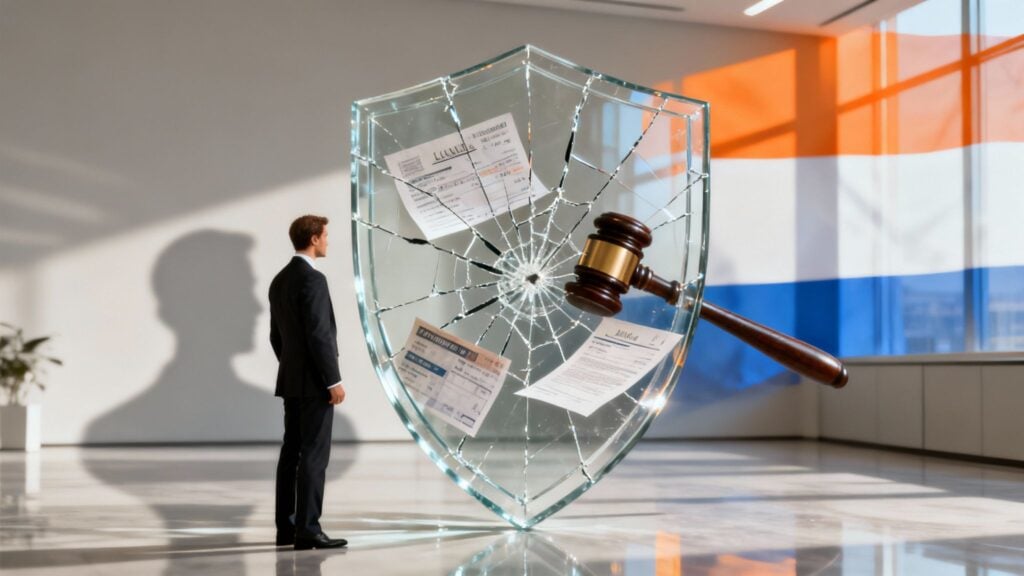
In the Netherlands, a company's legal structure is designed to shield its directors from being personally on the hook for business debts. This is often called the 'corporate veil'. But this protection isn’t bulletproof. Directors can find themselves personally liable in cases of improper management or if they carry serious personal blame, especially when their decisions end up harming the company or its creditors.
This usually happens when a director acts recklessly, knowingly takes huge, unjustifiable risks, or simply fails to keep up with basic administrative duties.
Understanding When the Corporate Shield Breaks

Think of a limited liability company (like a Dutch BV) as a ship and the director as its captain. The ship itself is built to keep the captain safe from the turbulent financial seas. This "corporate shield" is the legal wall between the company’s finances and the director's personal bank account. Under normal sailing conditions, if the company runs up debts or gets sued, only the company's assets are at risk.
However, Dutch law is clear that this shield shouldn't protect a captain who deliberately steers the ship into an iceberg. The whole point of director liability is to ensure accountability. If a director's behaviour is negligent or wrongful enough, the courts can "pierce the corporate veil," making that director personally responsible for the damage.
The Two Pillars of Director Liability
To really get your head around corporate liability in the Netherlands, you need to understand two main categories. Each one deals with a different relationship and is triggered by different situations:
- Internal Liability: This is all about the director's duty to the company itself. It comes into play when a director’s poor management causes financial damage to the very organisation they're meant to be leading.
- External Liability: This involves the director's duty to third parties—think creditors, suppliers, or the tax authorities. This kind of liability is often based on tort (a wrongful act) and happens when a director’s actions directly harm people or entities outside the company.
Making this distinction is vital because the legal tests, and who can bring a claim, are completely different. With internal liability, it's usually the company (often through a bankruptcy trustee) that sues. For external liability, it could be an unpaid creditor taking legal action directly against a director.
A key takeaway for every director is that the limited liability structure is a privilege, not a right. It is conditional upon responsible and diligent management. The moment a director's actions are deemed seriously blameworthy, that privilege can be revoked.
To give you a clearer picture, here’s a quick rundown of the most common triggers for personal liability.
Key Scenarios Triggering Director Liability
| Type of Liability | Primary Trigger | Example Scenario |
|---|---|---|
| Internal Liability | Improper Management (Art. 2:9 DCC) | A director makes a wildly speculative investment with company funds without proper research, leading to a catastrophic loss. |
| External Liability (Tort) | Misleading Creditors (Art. 6:162 DCC) | A director continues to place large orders with suppliers, knowing the company is insolvent and has no realistic prospect of paying them. |
| Bankruptcy Liability | Evident Improper Management | The director fails to keep proper financial records for years, making it impossible to determine the cause of the company's bankruptcy. |
| Tax Liability | Failure to Report Inability to Pay | A director neglects to inform the tax authorities in a timely manner that the company cannot pay its VAT or payroll taxes. |
These are not minor business mistakes we're talking about, but significant failures of judgement or duty. This guide will walk you through the specific scenarios that can shatter the corporate shield, giving you a clear map for navigating your responsibilities and protecting your personal financial future.
Your Duty to the Company: Internal Liability
At its heart, a director’s job is to steer the company toward sustainable growth while safeguarding its financial health. Simple enough, right? But under Dutch law, this responsibility has real teeth.
Internal liability comes into play when a director breaches their duties through what the law calls "serious blame" (ernstig verwijt), as laid out in Article 2:9 of the Dutch Civil Code (DCC). It’s a concept that courts interpret pragmatically, looking beyond textbook definitions to see the real-world impact of a director’s decisions on the company’s bottom line.
Key Statutory Provision for Internal Liability
So, what does this duty actually involve? According to Article 2:9 DCC, directors are expected to perform their duties with the care of a reasonably skilled professional. If they fall short of this standard, it can be deemed "improper management" (onbehoorlijk bestuur), making them personally liable for the full extent of the company’s resulting damages.
The bar isn't set impossibly high; routine missteps or honest commercial mistakes won't automatically trigger personal liability. The courts are looking for a clear pattern of negligence or recklessness.
For instance, greenlighting a high-risk venture without conducting proper due diligence is a classic trigger for personal claims if the investment goes sour. Another common scenario is when a director consistently ignores warnings from the finance department about a looming cash crisis, leading to a sudden and damaging insolvency.
It’s these kinds of concrete missteps, not theoretical errors, that push a director’s actions into the "serious blame" category.
Key Triggers for Director Internal Liability
What does "serious blame" look like in practice? Here are a few situations that should set off alarm bells:
- Approving speculative investments without properly vetting the financial projections and key assumptions.
- Disregarding repeated internal alerts about deteriorating cash flow or unresolved compliance issues.
- Failing to maintain accurate books for months (or even years), making it impossible to track financial obligations.
- Rushing major contracts through without a legal review, only to discover later that critical indemnity or exit clauses are missing.
These examples are a stark reminder that even the most experienced directors need to stay vigilant and proactive.
What Internal Liability Means in Practice
Think of a director as the pilot of a plane. Their job is to navigate changing market conditions and turbulence. If a pilot deliberately ignores storm warnings on the radar, they put the entire plane at risk. Similarly, if a director ignores clear red flags in the company's financials, they risk wrecking the entire business.
When things go wrong, the Dutch courts will essentially ask: did the director act with the care that a reasonably prudent professional would have in the same circumstances?
If the answer is no, the corporate veil—the legal shield that separates the company from its owners and directors—can be pierced. This exposes the director's personal assets to cover the company's losses.
Examples of Serious Blame
Here’s how everyday mismanagement can escalate into significant personal liabilities:
| Scenario | Mismanagement Aspect | Personal Impact |
|---|---|---|
| Unverified acquisition of a startup | Lack of strategic oversight | Director held liable for €1.2m in losses |
| Overlooking escalating trade payables | Ignoring financial controls | Personal contribution of €350,000 required |
| Missing quarterly audit deadlines | Failure of administrative duty | Presumed mismanagement in bankruptcy |
This table brings home just how quickly a poor judgment call can turn into a personal financial catastrophe.
Real-World Case Illustration
In a notable case, a Dutch court held the director of a BV personally liable after he authorised a complex joint venture without properly vetting the supplier's capabilities. When the venture inevitably collapsed, it left the company with a €2.5m debt—a debt the director had to cover from his own pocket.
The judges were clear: ignoring basic partner audits wasn't a reasonable commercial risk. It was gross negligence.
“Failing to respond to clear financial warnings invites personal liability,” notes a corporate law expert at Law & More.
Best Practices to Safeguard Your Position
So, how can you protect yourself? It comes down to embedding good governance into your daily operations.
- Keep Comprehensive Board Minutes: Always document risk discussions, dissenting opinions, and how key issues were escalated. This creates a clear paper trail.
- Establish Robust Approval Workflows: Mandate legal and financial sign-off on all material transactions above a certain threshold. No exceptions.
- Conduct Independent Risk Assessments: Bring in third-party experts to validate financial forecasts and stress-test your critical assumptions. A fresh pair of eyes can spot things you've missed.
- Monitor Financial Dashboards Continuously: Use real-time metrics for cash flow, liquidity ratios, and covenant compliance. Don't wait for the quarterly report to discover a problem.
- Maintain Up-to-Date Administration: File annual accounts and keep your bookkeeping immaculate. Being late can lead to a presumption of mismanagement if the company fails.
- Review Conflicts of Interest Policies: Regularly ensure your actions are aligned with the company's best interests. For a deeper dive, check out our article on directors’ conflict of interest.
By weaving these practices into your company's fabric, you can dramatically reduce your personal risk and build a more resilient business. Proactively aligning your governance with Dutch statutory requirements is the best way to keep that corporate shield firmly in place.
Facing Creditors and Third Parties: External Liability
While internal liability is about your duties to the company, external liability flips the script. This is about the promises and obligations your company makes to the outside world—creditors, suppliers, and even the Dutch tax authorities. When a director's actions directly harm these third parties, it can lead to serious personal financial trouble under Dutch tort law (Article 6:162 of the Dutch Civil Code).
This type of liability kicks in when a director’s conduct is seen as a wrongful act against an external party. The courts will ask a crucial question: can the director be held personally and seriously blameable for the company's failure to pay its debts? This isn't about punishing a director for a failed business venture; it's about holding them accountable when their actions knowingly mislead or harm others.
The Beklamel Standard: A Landmark Case
A cornerstone of external liability in the Netherlands is the "Beklamel standard." This legal principle comes from a landmark Supreme Court case and provides a clear test for when a director becomes personally responsible for contracts the company can't honour.
The standard is quite straightforward: a director can be held personally liable if they commit the company to an agreement when they knew, or should have reasonably foreseen, that the company wouldn't be able to pay up and couldn't offer any recourse for the damage caused.
In simple terms, you can't make promises on the company's behalf that you know are empty. Doing so isn't just bad business; it's a wrongful act against the creditor who trusted that promise.
Think of a director who signs a huge purchase order for raw materials, all while knowing the company's bank accounts are nearly dry and no significant payments are coming in. When the supplier delivers the goods and the invoice is never paid, that director could find themselves personally on the hook for the entire debt, thanks to the Beklamel standard.
Specific Triggers for External Liability
Beyond the Beklamel standard, a few other specific actions can land a director in hot water with third parties. These situations usually involve a lack of transparency or a failure to follow clear statutory duties.
Key triggers to watch out for include:
- Selective Payments: When insolvency is just around the corner, choosing to pay certain friendly creditors while knowingly ignoring others can be viewed as unfairly favouring one party over another.
- Providing Misleading Financials: Handing over inaccurate or overly rosy financial statements to a bank to secure a loan or to a supplier to get a line of credit is a classic trigger.
- Failure to Report Inability to Pay Taxes: This is a critical and surprisingly common trap. Directors have a legal duty to promptly report the company's inability to pay taxes and social security contributions to the authorities.
That last point is especially dangerous. If a director misses this notification deadline, the law automatically presumes the non-payment is their fault—a result of improper management. This makes them personally liable for the entire outstanding tax debt.
A Practical Example of External Liability
Let’s look at the director of a small construction company. The business is struggling with cash flow but needs materials to finish one last project. The director orders €50,000 worth of supplies on credit, giving the supplier assurances that the invoice will be paid within 30 days.
The problem? The director knows the company's biggest client has just defaulted on a major payment, making it virtually impossible to pay the new supplier. The company inevitably goes bankrupt. In this scenario, the supplier could sue the director personally, arguing that they committed a tort by entering into a contract they knew the company couldn't possibly honour.
This really highlights how crucial responsible financial oversight is, especially when you're dealing with external partners. The stakes are incredibly high. For context, the Dutch financial sector carries enormous liabilities. As of December 2023, total financial sector liabilities were a staggering 1077.70% of the Netherlands' GDP. You can learn more about the scale of Dutch financial sector liabilities on Trading Economics. While that figure is sector-specific, it underscores the immense financial responsibilities at play. Directors in every sector must act with the same level of diligence, because their decisions don't just create risk for the business—they create personal risk, too.
Navigating Liability When a Company Is Insolvent

When a company in the Netherlands becomes insolvent, everything changes for its directors. The declaration of bankruptcy isn't the end of the story; it’s the start of an intense period of scrutiny led by a court-appointed bankruptcy trustee. This trustee's main job is to figure out what caused the bankruptcy and sell off the company's assets to pay back creditors.
Every single decision a director made leading up to the insolvency will be put under the microscope. The trustee will dig through board minutes, contracts, and financial records, looking for any sign of "evident improper management" (kennelijk onbehoorlijk bestuur). It’s the ultimate stress test of a director’s entire history of governance and decision-making.
The Reversal of the Burden of Proof
Normally, if someone wants to hold a director liable, they have to prove the director was at fault. Dutch bankruptcy law, however, has a powerful provision that can flip this entire dynamic on its head. If a company has failed to meet its basic administrative duties, the burden of proof shifts directly onto the directors.
This dramatic reversal is typically triggered by two specific failures:
- Failure to keep proper accounts: If the company’s bookkeeping is a mess—incomplete, inaccurate, or just doesn't paint a clear financial picture—the law presumes there was mismanagement.
- Failure to file annual accounts on time: Missing the legal deadline for submitting the company's annual financial statements to the Chamber of Commerce (KvK) also triggers this presumption.
When the burden of proof is reversed, the trustee no longer needs to prove you mismanaged the company. Instead, it becomes your responsibility to prove that your management was not a significant cause of the bankruptcy. This is an incredibly difficult argument to win and makes a successful defence a real uphill battle.
This legal switch highlights just how critical diligent administration is. A simple oversight in paperwork can have devastating personal financial consequences when a company goes under.
A Hypothetical Company's Slide into Bankruptcy
Let's imagine a tech startup, "Innovate BV," which has been struggling with its cash flow for months. The directors, totally focused on product development, have let the bookkeeping slip. Invoices are paid randomly, and last year’s annual accounts were filed three months late.
Eventually, Innovate BV is declared bankrupt. The trustee appointed to the case quickly uncovers the administrative chaos.
- Presumption of Mismanagement: Because the annual accounts were filed late, the trustee can invoke Article 2:248 of the Dutch Civil Code. "Evident improper management" is now automatically presumed.
- Scrutiny of Transactions: The trustee then examines all payments made in the six months before the bankruptcy. They discover a large payment was made to a supplier owned by one director's relative, while other critical suppliers were ignored. This looks a lot like fraudulent preference (pauliana).
- Personal Liability Claim: The trustee holds the directors personally liable for the company's entire remaining deficit, which comes to €750,000. The directors are now in the near-impossible position of having to prove that their actions—and the messy administration—weren't the real reason the company failed.
This scenario shows just how fast corporate trouble in the Netherlands can turn into a personal nightmare for directors. If you want to delve deeper into the legal framework that governs these situations, you can find more information in our guide on The Bankruptcy Act and its procedures.
Ultimately, keeping immaculate records isn't just good business practice; it’s a director’s most essential line of defence against personal liability when a company faces insolvency.
When Poor Decisions Become Criminal Offences
While civil liability usually boils down to financial damages, some situations are far more serious. This is where a director’s actions cross the line from a commercial dispute into a criminal matter, putting their personal freedom on the line.
Under Dutch law, it’s crystal clear: a company, as a legal entity, can commit criminal acts. And when it does, the individuals steering the ship can be held criminally responsible for those acts. We’re not talking about simple mismanagement here. This is about intentional wrongdoing or gross negligence leading to crimes like fraud, bribery, environmental pollution, or severe safety violations.
The Path from Boardroom to Courtroom
For prosecutors to bring criminal charges against a director, they need to prove a lot more than just a bad business outcome. The legal bar is set much higher. They typically have to show that the director had a direct, knowing role in the offence.
This can be established in a few key ways:
- Direct Commission: The director personally and actively took part in the criminal act.
- Giving the Order: The director explicitly instructed others to carry out the illegal activity.
- Knowingly Accepting the Risk: The director was aware of a significant, unacceptable risk that a crime would be committed but did absolutely nothing to stop it.
That last point is incredibly important. A director can't just turn a blind eye to illegal activities happening on their watch and expect to get away with it.
A director's job goes far beyond just financial performance. When corporate actions harm society through criminal conduct, Dutch law is designed to hold the individuals in charge personally accountable. The penalties can be severe, including imprisonment.
Common White-Collar Crimes Involving Directors
While corporate crime can take many forms, certain offences pop up time and again when it comes to personal criminal liability for directors. These aren’t minor compliance slip-ups; they are serious breaches of the law that can destroy a company’s reputation and a director's career.
Several types of offences are particularly common. Article 51 of the Dutch Criminal Code establishes that a legal entity can be held liable for a wide range of crimes, from forgery and embezzlement to bribery and money laundering. As a result, both the company and its directors can find themselves facing serious criminal charges. You can find more insights on this topic in this excellent overview of corporate liability for white-collar crime in the Netherlands from Global Compliance News.
Here are a few concrete examples of conduct that could trigger criminal proceedings:
- Bankruptcy Fraud: Deliberately hiding assets from a bankruptcy trustee or inventing fake debts to siphon money away from legitimate creditors.
- Environmental Offenses: Knowingly authorising the illegal dumping of hazardous waste to cut costs, leading to significant environmental damage.
- Bribery and Corruption: Offering or accepting illicit payments to win contracts or get favourable treatment from public officials.
- Tax Fraud: Intentionally faking tax returns or creating sham corporate structures to evade corporate taxes on a massive scale.
In all of these scenarios, the director’s actions go well beyond poor judgment. They show a clear intent to break the law for corporate or personal gain. When that happens, the corporate shield offers zero protection, proving that corporate liability in the Netherlands has very real, and very personal, consequences for directors.
Practical Strategies to Mitigate Your Personal Risk

Knowing the risks of director liability is one thing; actively managing them is another. A proactive approach built on solid governance is your strongest defence against personal claims. This isn’t about complex legal acrobatics, but about embedding clear, protective habits into your daily operations.
The foundation of any solid defence starts with meticulous documentation. Your board minutes need to be more than just a quick summary of decisions; they must be a detailed record of the why behind them. Always document risk assessments, dissenting opinions, and the specific data you relied on for significant actions. That paper trail can be your lifeline if your decisions are ever questioned down the road.
Just as critical is establishing a clear and formal division of responsibilities among the board members. When every director’s duties are well-defined, it stops crucial tasks from falling through the cracks and makes accountability crystal clear.
Building Your Defensive Framework
A robust governance framework rests on several key pillars. These practices don't just shield you from liability; they contribute to a healthier, more resilient company overall.
- Seek External Counsel Early: Never hesitate to bring in legal or financial experts when facing complicated decisions, especially those involving mergers, large investments, or potential insolvency. Documenting that you sought and followed expert advice is a powerful demonstration of due care.
- Maintain Impeccable Financial Records: As we’ve seen, failing to keep proper books or file annual accounts on time can create a presumption of mismanagement in a bankruptcy. Make sure your administration is flawless and always up to date.
- Stay Informed on Emerging Risks: The world of corporate liability is always shifting. In recent years, environmental, social, and governance (ESG) factors have become a major focus. The trend of lawsuits against companies over climate obligations shows a new frontier where directors could become personally liable for not meeting environmental standards. For more on this, you can explore the insights on Dutch corporate governance and sustainability from Chambers.
A director’s best defence is a consistent track record of informed, diligent, and well-documented decision-making. Proactive governance isn't a burden; it is your shield against personal liability.
The Role of D&O Insurance
Directors & Officers (D&O) insurance is a non-negotiable part of any risk management strategy. This specialised policy is designed to cover the personal financial losses of directors and officers that come from legal claims made against them for alleged wrongful acts in their managerial capacity.
It typically covers legal defence costs, settlements, and judgements. However, it’s crucial to understand its limits. D&O policies will not cover instances of intentional fraud, criminal acts, or illegal personal profit. The policy is there to protect you from errors in judgement and negligence, not deliberate wrongdoing. For a more detailed look at what these policies involve, you can read our guide on liability insurance in the Netherlands.
By combining meticulous governance with adequate insurance coverage, you create a powerful, multi-layered defence that protects both your personal assets and your professional reputation.
Frequently Asked Questions
When you're navigating the complexities of Dutch corporate law, it's natural for specific questions to pop up, especially around director liability. Here are some clear, straightforward answers to the queries we hear most often.
Can a Non-Executive Director Be Held Liable?
Yes, absolutely. It's a common misconception that their supervisory role puts them in the clear. In the Netherlands, non-executive directors have a duty to actively oversee the management board and step in if they see things going seriously wrong.
If they know about improper management by the executive team and fail to take meaningful action, they can be found guilty of 'serious blame'. This can make them personally liable for any resulting damages, a scenario that often comes to light during a bankruptcy when their failure to supervise helped sink the company.
Does Resigning Protect Me from Past Liabilities?
No, resigning doesn't wipe the slate clean. A director's liability is fundamentally tied to the actions and decisions made during their time on the board.
A bankruptcy trustee or creditor can still come after a former director for improper management that happened on their watch. If your past decisions played a role in the company's insolvency or caused harm, you remain accountable long after you've handed in your resignation.
This highlights a core principle in Dutch law: liability is linked to your conduct as a director, not your current job title. Your responsibility for past actions doesn't just disappear when you walk out the door.
What Is a De Facto Director in Dutch Law?
A 'de facto' director is someone who was never formally appointed to the board but, for all intents and purposes, acted like one. Think of an individual who consistently set company policy, made key management decisions, and basically called the shots from behind the scenes.
Under Dutch law, especially in bankruptcy cases governed by Article 2:248 of the Civil Code, these individuals can be held personally liable just as if they were official directors. The court isn't interested in their formal title; it looks at the actual power and influence they wielded.