



Welcoming back a former employee, often called a ‘boomerang employee,’ can feel like a straightforward win. Yet for Dutch employers, this move is layered with unique legal complexities. Navigating the boomerang employees legal aspects correctly involves more than just a warm welcome—it requires a sharp focus on Dutch employment law, past agreements, and renewed contracts to sidestep potentially costly legal traps.
Why Boomerang Employees Are Back on the Radar
Rehiring former employees is no longer a rare occurrence; it has become a key hiring strategy for Dutch companies seeking to bring back proven talent. This is not merely about filling a vacancy but a strategic move to leverage familiarity with company culture, thereby reducing recruitment time and costs in a competitive market.
The challenge, however, is that this is not the same as hiring a new candidate. The pre-existing relationship means old agreements, the terms of their departure, and previously accrued rights can re-emerge, creating a legal minefield if not handled with care.
Key Legal Areas to Watch
When a former team member returns, employers must be aware of how several critical areas of Dutch law will apply:
- Employment Contracts: The old contract cannot be simply revived. A new, legally compliant agreement is essential. Special attention must be paid to the rules on successive fixed-term contracts (the ketenregeling) and the enforceability of old restrictive covenants, such as non-compete clauses.
- Termination and Settlement Agreements: The circumstances of the previous departure are significant. If a settlement agreement (vaststellingsovereenkomst) was signed, its terms regarding confidentiality, final payments, or other obligations might still be relevant.
- Immigration and Tax Law: For returning expats, it cannot be assumed they will automatically re-qualify for their work permit or valuable tax benefits like the 30% ruling. These are governed by strict conditions that must be re-evaluated from the beginning.
- Data Privacy (GDPR): Under Dutch law, strict rules govern how long old personnel files can be kept. Rehiring someone whose data should have been legally deleted raises serious compliance questions.
A Trend Driven by the Dutch Labour Market
The rise in boomerang hires is partly a result of the high mobility within the Dutch labour market. Statistics from the Dutch Central Bureau of Statistics (CBS) have consistently shown a dynamic workforce. For instance, in previous quarters, a significant percentage of the workforce has switched employers. Combined with the substantial number of employees on temporary contracts, this creates ideal conditions for talent to cycle back when market conditions shift. You can find more details on temporary employment trends in the Netherlands.
A proactive, legally informed approach is essential for managing risk. Errors in these details could lead to an employee unexpectedly gaining a permanent contract, rendering a non-compete clause unenforceable, or resulting in other significant financial liabilities.
Understanding these interconnected legal threads is the first step. It empowers employers to build a rehiring strategy that capitalises on the benefits of bringing back known talent while protecting the business from underlying legal pitfalls.
Revisiting the Employment Contract Under Dutch Law
When a familiar face returns, it is tempting to pick up where you left off. Under Dutch law, this is a risky assumption. Rehiring a former employee is not a continuation; it marks the beginning of a new legal relationship. Every aspect of their employment must be re-evaluated and documented in a new contract.
Treating the returning employee as a completely new hire is the only legally sound approach. This ensures all terms and conditions are clarified from the start, preventing old assumptions from creating new, unforeseen liabilities.
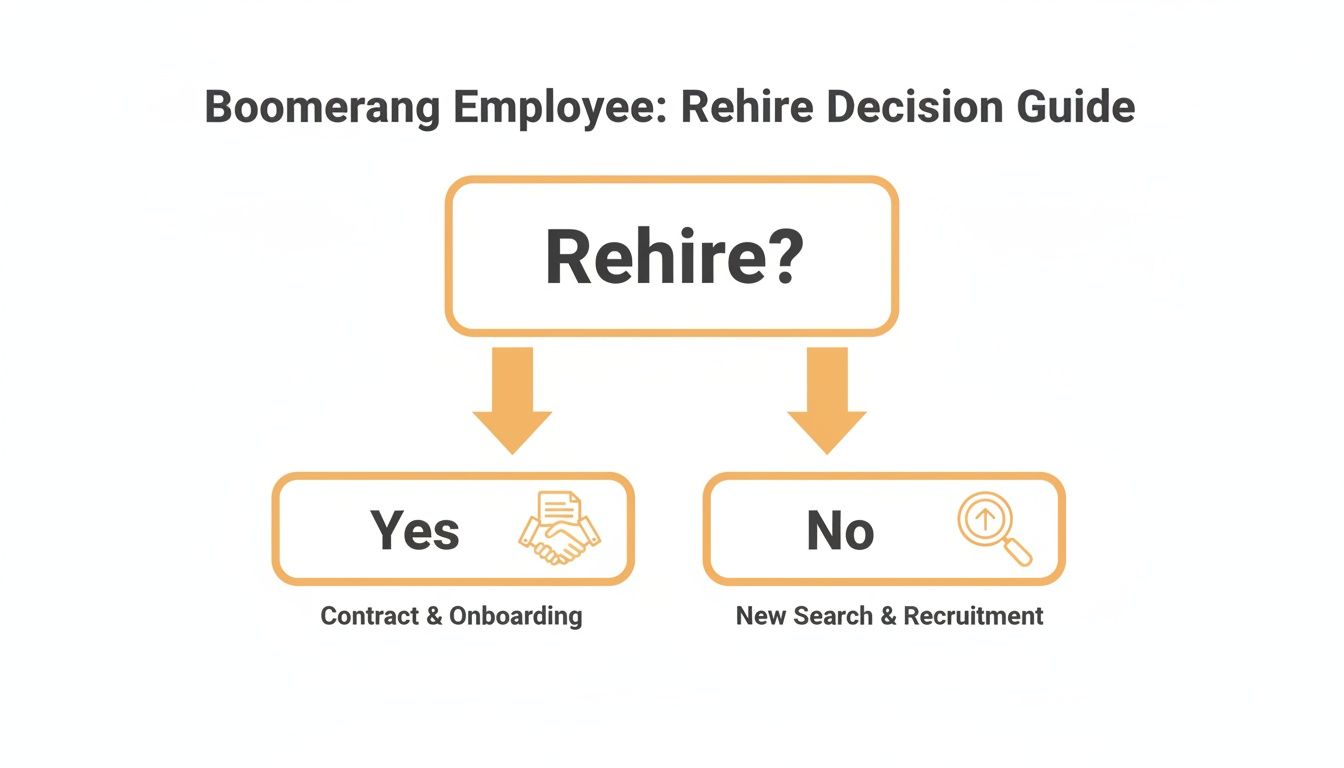
This initial decision to rehire is the first legal crossroads. The moment you proceed, you are entering a formal contractual process, not just an informal reunion.
The Chain Rule (Ketenregeling) Explained
One of the most significant pitfalls in Dutch employment law is the ketenregeling, or chain rule. This regulation is designed to prevent employers from keeping employees on a series of temporary contracts indefinitely. If a boomerang employee had previous contracts with you, this rule could be triggered upon their return, automatically converting their new fixed-term contract into a permanent one.
The rule typically applies after three successive temporary contracts or after an employee has worked for more than three years on such contracts. Crucially, the chain is only broken if there is a gap of more than six months between contracts.
If a former employee returns within six months of their departure, their previous employment period counts towards the ketenregeling. This is a common trap that can unexpectedly bind an employer to a permanent employment relationship.
For example: an employee worked on two consecutive one-year contracts. They leave but return five months later for another one-year contract. Legally, this third contract could be deemed a permanent position from day one. This highlights why a thorough understanding of employment contracts in the Netherlands is absolutely essential.
Probation Periods and Seniority Rights
A new contract typically includes a new probation period (proeftijd), which allows either party to terminate the agreement without notice. However, for a boomerang employee, this is not straightforward.
- Different Role: If the returning employee is hired for a role with clearly different skills or responsibilities, a new probation period is generally permissible.
- Similar Role: If the job is substantially the same as their previous one, a court would likely deem a new probation period invalid, as the employer has already had ample opportunity to assess their capabilities.
As for seniority, it is not automatically reinstated. Any recognition of past service—for benefits such as company anniversaries, additional holiday days, or pension accrual—must be explicitly written into the new contract. If it is not in writing, they legally start from zero.
Non-Compete and Non-Solicitation Clauses
What about the non-compete or non-solicitation clauses from their previous contract? They are no longer valid. These restrictive covenants are tied to a specific agreement and do not automatically carry over to a new one.
To have enforceable post-contractual restrictions, they must be agreed upon again, in writing, in the new employment contract. The clause must also meet the strict Dutch standards for reasonableness—meaning it must be clearly defined in scope, duration, and geographical area, and must protect a legitimate business interest. Neglecting this step leaves your business exposed if the employee leaves again to join a competitor.
Before finalising a re-hire, it is crucial to review a checklist of these key contractual points to ensure compliance with Dutch law and protect your business interests.
Contractual Checklist for Re-hiring Boomerang Employees in the Netherlands
| Legal Aspect | Key Consideration | Recommended Action |
|---|---|---|
| New Contract | Is this treated as a completely new employment relationship? | Draft a new, comprehensive employment contract from scratch. Do not amend or reinstate the old one. |
| The Chain Rule (Ketenregeling) | Did the employee return within 6 months? | Calculate the total duration of previous contracts. If the rule is triggered, decide if a permanent contract is acceptable or if the hire is not viable. |
| Probation Period (Proeftijd) | Is the new role substantially different from the previous one? | Only include a probation period if the new role requires demonstrably different skills and responsibilities. Document this justification clearly. |
| Seniority & Benefits | Will past service be recognised for benefits (e.g., extra holidays, pension)? | Explicitly state any recognition of prior service in the new contract. If not mentioned, seniority resets to zero. |
| Restrictive Covenants | Are non-compete or non-solicitation clauses needed? | Include newly drafted, reasonable, and clearly defined non-compete/non-solicitation clauses in the new contract and have them signed. |
By methodically addressing these items, you can avoid common legal pitfalls and ensure the return of a boomerang employee is a smooth and secure process for both parties.
Managing Lingering Obligations from Past Departures
When a boomerang employee returns, it is not just a new beginning. It is a continuation of a past relationship, and any unresolved issues or agreements from their initial departure can become relevant again. Ignoring these lingering aspects poses a significant legal risk.
The manner of an employee's previous departure can cast a long shadow over their return. Whether they resigned, were made redundant, or left under a mutual agreement, the terms of that exit can directly impact the new employment relationship, especially if a settlement was involved.
The Impact of Previous Settlement Agreements
In the Netherlands, departures are often finalised with a settlement agreement (vaststellingsovereenkomst). This legal document is intended as a "full and final settlement" of all claims between the employer and the employee. However, when that employee returns, its finality can be challenged in unexpected ways.
Key elements of a settlement agreement that require careful review include:
- Confidentiality Clauses: These clauses typically prevent both parties from discussing the settlement terms. Upon the employee's return, this clause legally remains in effect, but its practical application becomes complex. Care must be taken to ensure that internal discussions about the rehire do not inadvertently breach this confidentiality.
- Final Discharge (finale kwijting): This is the core of the agreement, where both parties agree not to pursue future claims related to the past employment. While this protects you from old grievances, the employee's return creates a new legal context where past events could be re-evaluated.
It is a common misconception that a new contract automatically nullifies all previous agreements. This is not the case. The terms of a prior vaststellingsovereenkomst remain legally binding unless they are explicitly addressed and superseded in the new employment contract.
Transition Payments and Future Entitlements
If you paid a transition payment (transitievergoeding) when the employee first left, this has specific consequences for their future entitlements. Under Dutch law, an employee is typically entitled to this payment if their contract is terminated or not renewed by the employer.
Upon their return, the service period for any future transition payment calculations effectively resets. However, if the employee is terminated again in the future, the law may require an accounting of the amount previously paid to prevent "double-dipping." This is a nuanced area that requires a sharp legal assessment to correctly calculate any future obligations. It is also vital to understand the rules around a non-compete clause and what you need to know from their previous contract; while these do not carry over, they can indicate past sensitivities.
Protecting Intellectual Property and Confidential Information
One of the most critical risks involves your intellectual property (IP) and confidential information. If the employee worked for a competitor during their absence, they have been exposed to different strategies, client lists, and trade secrets. A proactive approach to IP protection upon their return is essential.
- Reinforce Confidentiality Obligations: Your new employment contract must include a robust and updated confidentiality clause. It must be made clear that they are prohibited from using or disclosing any confidential information acquired from their interim employer.
- Explicitly Address Past Knowledge: While you cannot erase what they learned elsewhere, you can contractually obligate them to base their work solely on your company's information and systems.
- Monitor for Conflicts: Remain vigilant in the initial months to ensure the employee is not inadvertently (or intentionally) using proprietary information from their previous role. This is particularly crucial in R&D, sales, and strategic planning positions.
Failing to manage these lingering obligations can turn the benefit of a boomerang hire into a potential liability. By carefully reviewing past departure terms and reinforcing protective measures in the new contract, you can ensure their return is, legally speaking, a clean slate.
Navigating Immigration and Tax Rules for Returning Expats
Bringing international talent back to your Dutch company involves more than a simple contract renewal. When an expat or highly skilled migrant returns, you cannot assume their old work permits or tax benefits are still valid. For all intents and purposes, you must treat it as a new hire, navigating a specific set of rules that can be critical financially and legally.

The Dutch legal system is designed to protect employees, which extends to how it views boomerang hires, especially expats. In a job market with a high prevalence of temporary contracts, questions often arise about whether previous years of service still count when someone returns. Getting this right from the start is vital to avoid future complications for both you and your returning employee.
Work Permit and Visa Requirements
For any non-EU national, a valid residence and work permit is essential for employment in the Netherlands. A previous permit does not simply reactivate upon their return; it is a clean slate.
If the employee’s original permit expired or was cancelled when they left the country, you must initiate the application process from the beginning. This involves resubmitting all necessary documentation to the Dutch Immigration and Naturalisation Service (IND) and demonstrating that the employee and the role still meet the current criteria for a highly skilled migrant or other relevant permit.
Do not assume that a previous approval guarantees a new one. Immigration laws, salary thresholds for highly skilled migrants, and rules for recognised sponsors are subject to change. Each application is assessed based on the regulations in effect at that time.
Furthermore, any significant gap in their residency can reset the clock on their continuous stay in the Netherlands—a critical factor for those aiming for long-term residency or citizenship. You can find a detailed breakdown of the process in our guide on immigration and residence for highly skilled migrants in the Netherlands.
Re-Eligibility for the 30% Ruling
The 30% ruling is a significant incentive for expats, allowing employers to pay 30% of their salary tax-free. It is often a key component of their compensation package. However, for boomerang employees, the rules are exceptionally strict.
To qualify, an employee must be recruited from abroad. The primary test is whether they lived more than 150 kilometres from the Dutch border for at least 24 months before their new employment start date.
- Short Absence: If a former employee returns within 25 years of leaving and they lived outside the 150km zone during their absence, they might re-qualify. However, any period they previously used the ruling will be deducted from the maximum term of the new one.
- Living Within the Zone: If the employee lived just across the border in, for example, Belgium or parts of Germany, they will almost certainly be ineligible for the 30% ruling upon their return.
An incorrect assessment can be a costly error. Improperly applying the 30% ruling can lead to significant tax liabilities and penalties from the Dutch Tax and Customs Administration (Belastingdienst).
Cross-Border Social Security and Pensions
The employee’s time away from the Netherlands also affects their social security and pension status. International treaties and EU regulations determine where social security contributions are paid.
If the employee worked in another EU country, those contributions might be relevant. Upon their return to the Netherlands, their correct social security status must be determined to ensure proper contributions are made for healthcare, unemployment, and the state pension (AOW).
Similarly, their old pension plan does not automatically restart. The new employment contract must clearly specify how their pension will be managed—whether they will rejoin the old scheme and how any pension accrued abroad will be handled. Leaving these points ambiguous can create compliance issues and financial uncertainty for the employee’s future.
Ensuring Data Privacy and GDPR Compliance

When a familiar face returns, it is easy to focus on the new contract and their reintegration. However, a critical and often overlooked legal detail is their old data. Under the General Data Protection Regulation (GDPR), as implemented in Dutch law, you cannot retain old employee data indefinitely. This creates a significant compliance challenge when a boomerang employee returns.
The moment an employee departs, a legal clock starts ticking on their personnel file. Dutch law is very clear about how long you can keep different types of HR data, and once that period expires, it must be securely and permanently deleted. This is not merely good practice; it is a legal requirement with substantial fines for non-compliance.
Navigating HR Data Retention Periods
The rules are specific. While certain fiscal data must be retained for seven years, most standard personnel file information—such as performance reviews, correspondence, or the original job application—must be deleted within two years of their departure. This directly impacts the legality of your boomerang hiring process.
In practice, this means that by the time a former employee contacts you about returning, you may have already been legally required to destroy their entire personnel history. Attempting to access old performance notes, disciplinary records, or salary details could constitute a data breach if the retention period has passed.
The only safe and compliant approach is to treat the returning employee as a new data subject. You must start a fresh personnel file from scratch, collecting only the data necessary for the new role. Relying on old data that you are no longer legally permitted to hold is a clear violation of GDPR principles.
This is where rehiring boomerangs becomes particularly complex under Dutch law. HR departments have a legal duty to either retain or delete files within strict timelines. If someone returns after three years, their original performance and disciplinary records should be gone, which can complicate any internal risk assessment. This is an area where international clients often face challenges when implementing US-style boomerang programs without adapting to these Dutch-specific data protection rules.
The Risks of Referencing Old Data
Using information from an old, unlawfully retained file to make a rehiring decision is a serious compliance risk. For instance, if you decide not to rehire someone based on a poor performance review from three years ago—a document you should have deleted—that individual could potentially file a GDPR complaint against your company.
It is also important to remember that when sourcing information on potential hires, it is vital to understand the risks and safe practices in data collection to avoid legal missteps.
To ensure legal compliance, your rehiring process should include these checks:
- Verify Data Status: Before engaging with a former employee, confirm the status of their old personnel file. Has it been deleted in accordance with your data retention policy?
- Initiate a New Data Cycle: Treat their application as if they are a new candidate. Follow the standard process of collecting consent and personal data.
- Do Not Mix Old and New: Never merge any residual data from their previous employment into their new personnel file. Keeping the records separate ensures a clean and legally defensible data trail.
Adhering to these data privacy principles not only protects your organisation from fines and legal issues but also demonstrates a commitment to handling personal information ethically and lawfully.
Frequently Asked Questions About Re-hiring Employees
Even with a well-defined strategy, bringing back a boomerang employee can present tricky situations that require quick, clear answers. This section addresses some of the most common—and often nuanced—legal questions Dutch employers encounter, offering practical insights to guide your decisions.
Can We Pay a Returning Employee Less Than Their Previous Salary?
Yes, from a legal perspective, you can offer a returning employee a lower salary than they previously earned. This is because you are creating a new employment contract, and all its terms, including salary, are subject to fresh negotiation. As long as the new salary meets the Dutch statutory minimum wage and any applicable collective labour agreement (CAO), it is legally permissible.
However, proceed with caution. An offer that feels like a demotion can negatively impact the relationship from the outset. It risks damaging morale, making the employee feel undervalued, and potentially diminishing their motivation and long-term commitment. If you choose this path, you must have a clear, objective reason for it—such as changes in the role's responsibilities, shifts in market rates, or a company-wide salary restructuring that occurred during their absence. Without a transparent explanation, you risk starting this new chapter on a sour note.
What If a Boomerang Employee Leaves Again Shortly After Returning?
If a re-hired employee resigns or is dismissed soon after returning, the standard rules of Dutch employment law apply, just as they would for any other new hire. Their notice period is determined by their new contract and the law. If a transition payment (transitievergoeding) is required upon their departure, it would be calculated based only on the duration of this new, current employment period.
A critical detail is the probation period (proeftijd). If a valid probation period was included in the new contract (because the new role was substantially different from the old one), termination during that period is straightforward for both parties. If a probation period was not legally permissible, however, any dismissal by the employer must follow the standard, more complex procedures, which may require permission from the UWV or the courts.
How Should We Handle Performance Issues from Their Previous Employment?
This is a delicate balance between fair treatment and data privacy. Under GDPR, you should have deleted the employee's old performance records within two years of their departure. Legally, you should no longer possess this data. Relying on vague recollections of "old issues" to manage the new working relationship is legally risky and could be perceived as biased.
The only correct and compliant approach is to evaluate the employee based solely on their performance in the new role. They begin with a clean slate. If performance problems arise, you must address them through your standard performance management process, documenting everything in their new personnel file. Citing undocumented grievances from years ago in a formal warning would be improper and would severely weaken your position in any potential dispute. When considering rehiring, it is also advisable for employers to be aware of what employers discover during online screenings to ensure any new assessment is both thorough and privacy-compliant.
Does a Previous Redundancy Affect Their Re-employment?
Yes, this can have specific legal consequences. Dutch law includes a "re-employment condition" (wederindiensttredingsvoorwaarde). If you made an employee redundant for economic reasons and then need to hire for the same or a very similar role within 26 weeks, you are legally obligated to offer the position to that former employee first.
Rehiring them within this 26-week period essentially reverses the redundancy. This has a direct impact on any transition payment they received. If they accept the job, they may have to repay the transition payment, or an offset arrangement might be made. If you disregard this obligation and hire someone else for the role, the redundant employee could bring a legal claim against you, potentially demanding reinstatement or financial compensation.
What if They Previously Left on Bad Terms?
Rehiring an employee who left under difficult circumstances is not legally prohibited, but it requires extreme care. To prevent old conflicts from resurfacing, open communication and clear documentation are essential from the start.
Before making an offer, you must have a frank discussion about the past issues. Both parties need to acknowledge what went wrong and agree that those problems are truly in the past. Subsequently, a new, robust employment contract must be put in place that clearly outlines all expectations, responsibilities, and performance standards. This formalises the fresh start and provides a clear framework for both parties. If you skip this step and fail to address the "bad terms" directly, you risk allowing old resentments to poison the workplace once again.
At Law & More, we understand that navigating the legal complexities of boomerang employees requires precision and foresight. Our team of expert employment lawyers provides practical, no-nonsense guidance to ensure your rehiring process is both legally compliant and strategically sound. Whether you are drafting a new contract, assessing past obligations, or managing the return of an expat, we offer clear, actionable advice tailored to your business needs. Contact us today to see how we can help you turn a familiar face into a secure and valuable asset. Visit us at https://lawandmore.eu to learn more.