



In the Netherlands, if an employee is on long-term sick leave, you can’t just wait and see what happens. The law requires a proactive approach, and the cornerstone of this process is the reintegration plan. This isn't just a friendly suggestion; it's a legally binding roadmap back to work, governed by the strict Gatekeeper Improvement Act (Wet verbetering poortwachter).
Think of it as a formal project plan, collaboratively designed by both you and your employee. Its purpose is to detail every step you'll both take to ensure a successful return to work, preventing long-term disability claims and protecting your business from some pretty hefty financial penalties.
The Foundation of Dutch Sickness Absence Management
When an employee is off sick for an extended period, Dutch employment law demands a structured and forward-thinking process. At the very heart of this is the reintegration plan, a formal agreement outlining the concrete actions everyone will take. This is far more than just administrative paperwork—it’s a critical legal document that proves your commitment to your employee's recovery and your compliance with the law.
Imagine you're building a bridge to help your employee get from their period of illness back to active employment. Dutch law says both you and your employee have a legal duty to lay the planks of this bridge together. The reintegration plan is the blueprint, ensuring every step is clear, agreed upon, and properly documented.
Why This Plan Is Non-Negotiable
A reintegration plan serves two main purposes. First and foremost, it's about facilitating a responsible and sustainable return to work. This is good for the employee's well-being and for your company's stability. Second, and equally important, it serves as your primary evidence for the UWV (Employee Insurance Agency), which will eventually assess whether you’ve met all your legal obligations after two years of sickness.
A well-drafted and properly executed plan delivers on several key fronts:
- Clarity and Structure: It cuts through any ambiguity by setting clear goals, timelines, and responsibilities for everyone involved, including the company doctor (bedrijfsarts).
- Legal Compliance: It's the main way you can prove to the authorities that you have made sufficient efforts to reintegrate your employee, which is a core requirement of the Gatekeeper Improvement Act.
- Risk Mitigation: A solid plan drastically reduces the risk of the UWV imposing a costly wage sanction (loonsanctie). This sanction could force you to continue paying the employee’s salary for up to an additional year.
- A Collaborative Framework: It encourages a cooperative dynamic between you and your employee, keeping the focus on finding solutions rather than getting stuck on problems.
A reintegration plan is your legal shield. It proves to the authorities that you took every reasonable step required by Dutch law to support your employee’s return to work. Neglecting it is not an option—it is a direct path to serious financial consequences.
Understanding what this plan requires is the first step toward managing long-term employee absence effectively. It’s about protecting your business from preventable legal and financial trouble while doing right by your employee.
Understanding The Gatekeeper Improvement Act
To really get why a reintegration plan is so important, you have to look at the law that underpins it all: the Gatekeeper Improvement Act (Wet verbetering poortwachter). This piece of Dutch legislation isn’t just a friendly set of guidelines. It's a strict, time-sensitive protocol with one clear goal—to stop employees from ending up on long-term disability (WIA) by making both sides active partners in the recovery process.
The Act essentially turns the abstract idea of reintegration into a concrete series of mandatory steps and deadlines. It forces both the employer and the employee to take action right from the first few weeks of sick leave. What could easily become a passive waiting game is instead transformed into a structured, documented journey back to work. Sticking to this timeline isn't just good practice; ignoring it is a direct breach of your legal duties.
The Legal Timeline You Must Follow
The law maps out a clear path that kicks in almost the moment an employee calls in sick. Each milestone has a deadline and a specific purpose, creating a chain of accountability that keeps the process moving. Think of it as a legal project plan—missing a single deadline can put the entire effort in jeopardy.
Here are the key milestones you cannot miss:
- Week 6: A company doctor (bedrijfsarts) must complete a Problem Analysis (probleemanalyse). This is the official report that assesses the employee's limitations and what they can still do, forming the basis for their return to work.
- Week 8: Using the Problem Analysis as a guide, you and your employee must work together to create the Reintegration Plan (plan van aanpak). This is the formal roadmap, detailing the goals and specific actions you'll both commit to.
- Regular Evaluations: You are required to sit down with your employee to review the plan at least once every six weeks. This keeps the plan relevant and allows you to make adjustments as their situation evolves.
- Week 42: You must officially report the long-term sickness to the UWV (Employee Insurance Agency).
- Week 52 (First-Year Evaluation): A detailed evaluation of the first year's progress is mandatory. This review sets the stage and adjusts the strategy for the second year of reintegration.
The timeline below gives you a clear visual of these first critical steps, from the initial report of absence through to the active return-to-work phase.
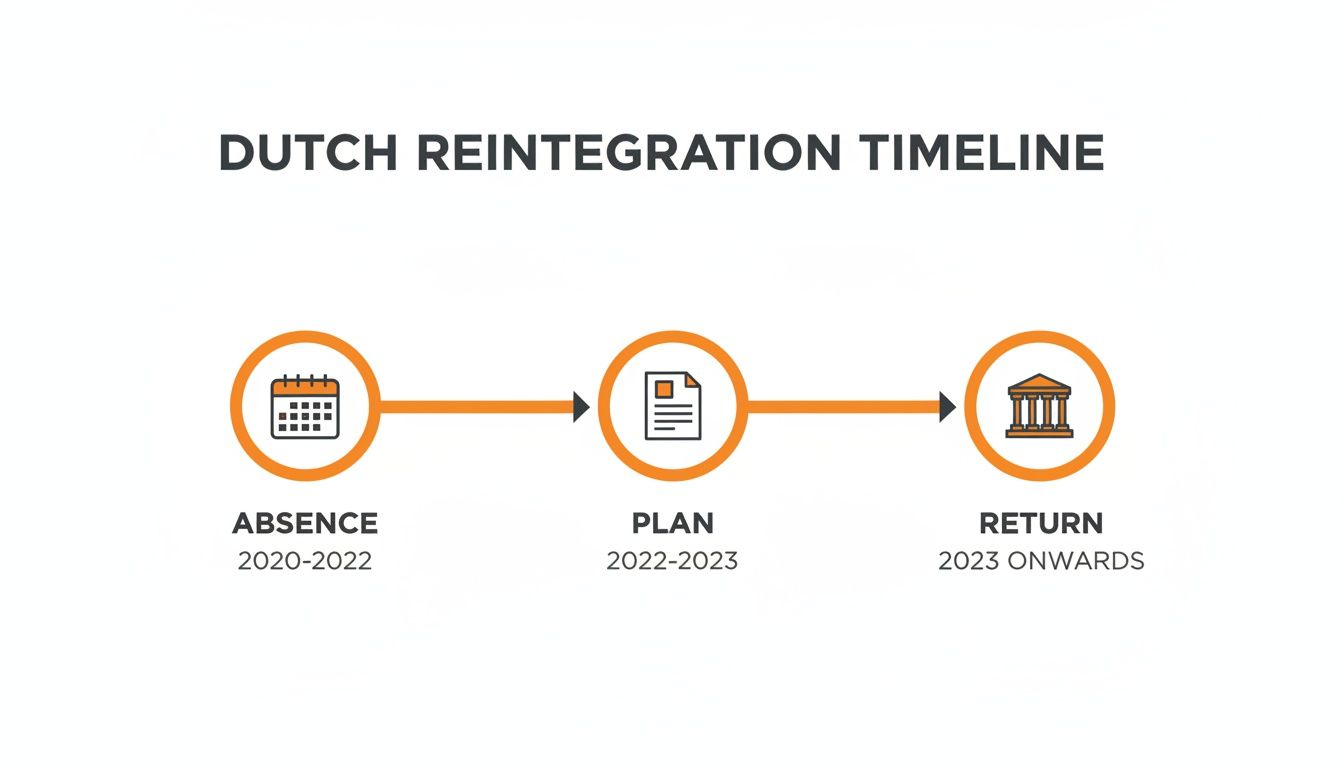
This visual really drives home just how structured and time-sensitive the process is, making it clear that immediate and consistent action isn’t just a good idea—it’s the law.
A Broader Societal Importance
The idea of structured reintegration isn't unique to Dutch employment law; it reflects a wider societal belief in helping people get back on their feet. You see similar principles at play in plans for ex-prisoners and migrants. Coordinated efforts between prisons, municipalities, and probation services, for example, have been shown to reduce reoffending by using structured 'Detention & Reintegration' plans to address fundamental needs like housing and income.
To see how Dutch laws like the Gatekeeper Improvement Act fit into the global picture, it's interesting to look at how other countries handle similar duties, such as through the comprehensive Australian workplace safety standards. While the details are different, the core principle of employer responsibility for employee wellbeing is a common thread worldwide.
The Gatekeeper Improvement Act is designed to prevent delays. Its timeline is intentionally demanding to ensure that you, your employee, and the company doctor are constantly engaged in finding a path back to work, leaving no room for inaction.
Ultimately, this law turns reintegration from a vague hope into a series of concrete, mandatory actions. Following its timeline isn't just about ticking boxes for compliance; it's about actively managing your financial risks and fulfilling your legal and ethical duties as an employer.
Navigating Employer and Employee Responsibilities
In Dutch employment law, reintegration is a shared responsibility, not a one-sided demand. Think of it as building a bridge to get your employee from sick leave back to work. For this bridge to be stable, both you and your employee must lay your planks correctly and at the right time. Truly grasping this legal partnership is the secret to a smooth process and avoiding headaches down the line.

This collaborative duty isn't just a suggestion; it's legally mandated. Neither party can simply sit back and wait for the other to make a move. If either side fails to meet their obligations, the entire process can be derailed, often leading to sanctions from the UWV or unnecessary legal fights.
The Employer's Core Duties
As the employer, the law puts you in the driver's seat of the reintegration process. You're expected to be proactive, organised, and thorough right from the start. Your main job is to facilitate the return to work by clearing obstacles and providing the framework for a successful comeback.
These responsibilities are not optional. They are enforceable legal obligations, and fulfilling them meticulously is your best evidence to the UWV that you've made a sufficient effort.
Here are your non-negotiable duties:
- Engage a Company Doctor: You must bring in a certified company doctor (bedrijfsarts) to assess the employee's situation and provide a professional Problem Analysis. This doctor’s advice forms the medical and legal foundation of the entire plan.
- Draft the Plan of Action: By week eight, you must create a detailed Reintegration Plan (plan van aanpak) together with your employee. This crucial document formalises the steps you both agree to take.
- Find Suitable Work: You have an active duty to find or even create suitable work for your employee within your organisation. This might be their old job with some adjustments, or it could be a completely different role that fits their current capabilities.
- Document Everything: You must keep a detailed reintegration file (re-integratiedossier). This file should contain all correspondence, evaluations, reports from the company doctor, and notes from meetings. It is your primary proof of compliance.
The Employee's Obligations
While you might be leading the charge, your employee has a critical and active role to play. They cannot be a passive passenger on this journey. Their cooperation is a legal requirement, and failing to engage can have serious consequences, including for their right to receive wages.
The law expects the employee to be a willing partner in their own recovery and return. For a deeper dive into their specific entitlements and duties, exploring employee sickness rights what you need to know can provide some valuable context.
An employee’s key responsibilities include:
- Cooperating with Medical Advice: They must show up for appointments with the company doctor and follow any reasonable medical advice and instructions given.
- Accepting Suitable Work: An employee is legally obliged to accept any offer of suitable work. This holds true even if it’s not their original job. Refusing a reasonable offer can lead to a wage suspension.
- Active Participation: They must actively take part in drafting and evaluating the reintegration plan. This means providing input and working towards the goals you've both agreed on.
- Providing Information: The employee has a duty to keep you in the loop about their progress and any changes that could affect the reintegration plan.
Reintegration is a two-way street. The employer must build the road, but the employee must be willing to walk on it. A breakdown on either side can lead to a dead end, which the UWV will almost certainly attribute to insufficient effort.
Ultimately, this shared responsibility framework is designed to make reintegration a dynamic, collaborative effort. When both parties understand and perform their roles properly, the chances of a successful outcome increase dramatically. This protects both the employee's well-being and the employer's financial and legal standing.
Navigating Reintegration: The Spoor 1 vs. Spoor 2 Journey
The path back to work after a lengthy illness isn't always a simple return to the same desk. Dutch law gets this, which is why it lays out two very different routes for reintegration: Spoor 1 (Track 1) and Spoor 2 (Track 2). Knowing when to follow, and when to switch between, these tracks is one of your most important legal duties as an employer. Get it wrong, and you could face serious compliance issues.
The best way to think about it is this: your first and main goal is always to get your employee back to their home base—your company. That’s Spoor 1. But if it becomes clear that route is blocked for good, the law expects you to actively help them find a new destination somewhere else. And that’s Spoor 2.
Spoor 1: The Preferred Route Home
Every reintegration process kicks off with Spoor 1. This track is all about one thing: finding a way for the employee to return to work within your own organisation. It’s the natural starting point and the preferred outcome for everyone involved. The entire focus is on exploring every reasonable possibility for the employee to come back.
This usually involves a few progressive steps:
- Returning to the Original Role: The ideal scenario. The employee comes back to their old job, maybe with a few temporary adjustments to ease them in.
- Adapting the Current Job: If the original role is now too much, you must look at modifying it. This could mean changing their responsibilities, reducing their hours, or bringing in ergonomic aids to help.
- Finding Other Suitable Work: If their old job just isn’t a viable option, even with changes, your next duty is to find another suitable role inside your company that fits their current abilities.
You're expected to make a genuine, documented effort here. Simply saying "we don't have anything" without a proper, thorough search won't cut it with the UWV.
When to Pivot to Spoor 2: Finding a New Path
You can't stay on the Spoor 1 track forever if it's leading nowhere. The law is very clear about when you need to start Spoor 2—the process of helping your employee find suitable work at a different company. This isn’t a fallback or an optional extra; it's a mandatory legal duty once it's clear that internal reintegration isn't going to work.
The trigger for starting Spoor 2 usually comes from the company doctor (bedrijfsarts), who determines that the employee is unlikely to return to their role, or any other suitable role within your company, in the long run. This conclusion is often formalised around the first-year evaluation (at week 52), but it can happen sooner if the medical outlook is clear from the start.
Waiting too long to start Spoor 2 is one of the most frequent—and expensive—mistakes employers make. The UWV views this delay as a major failure in your reintegration efforts, and it's a top reason for them to impose a hefty wage sanction.
Starting Spoor 2 doesn't mean you stop Spoor 1. The law requires you to pursue both tracks at the same time once an internal return looks unlikely. You must keep searching for opportunities within your company while also actively supporting the external job search.
To help clarify the distinct goals and actions for each track, let's compare them side-by-side.
Comparing Spoor 1 and Spoor 2 Reintegration
| Aspect | Spoor 1 (Internal Reintegration) | Spoor 2 (External Reintegration) |
|---|---|---|
| Primary Objective | Return the employee to suitable work within your own organisation. | Find suitable work for the employee at a different employer. |
| When It Starts | Immediately after the employee is reported sick (Week 1). | Typically starts around Week 52, or earlier if it's clear an internal return is not possible. Must run parallel to Spoor 1. |
| Key Actions | – Assess return to the original job. – Adapt the current role (tasks, hours). – Identify other suitable positions within the company. |
– Engage a reintegration agency. – Provide coaching for job applications and interviews. – Actively help in the search for external vacancies. |
| Who Is Responsible? | Employer, in close consultation with the employee and company doctor. | Employer, often executed by a specialised third-party reintegration company. |
Understanding these differences is crucial. While Spoor 1 is the goal, demonstrating a timely and robust Spoor 2 effort is your legal safety net, proving you've done everything required of you.
The principle that a structured plan leads to better outcomes is well-established. For instance, data from the DJI shows that proactive reintegration support for ex-detainees, linking them to probation and municipal partners, boosts successful societal returns by up to 25%. The same logic applies here: a well-executed plan is not just about compliance; it's about achieving a positive result. You can find more data insights about Dutch societal trends on the official CBS statistics website.
The High Cost of Getting Reintegration Wrong
Knowing the steps of the reintegration process is one thing, but truly understanding the financial stakes is another. Ignoring your legal duties isn't just a procedural slip-up; it's a direct route to serious financial penalties. The most significant consequence is the dreaded loonsanctie (wage sanction), imposed by the UWV (Employee Insurance Agency).
This sanction forces you, the employer, to keep paying your employee's full salary for up to an additional 52 weeks. That’s on top of the standard two-year period. A simple administrative oversight can instantly double your financial liability for an employee who isn't working, turning a difficult situation into a costly, year-long crisis.

And make no mistake, this isn't a rare occurrence. The UWV meticulously reviews every single reintegration file when the two-year mark approaches. If they decide your efforts have been insufficient, that wage sanction is almost a certainty.
What Triggers a Wage Sanction?
A wage sanction isn't just for employers who flat-out refuse to cooperate. Far more often, it's triggered by what seem like minor but critical failures along the way. The UWV is looking for a consistent, well-documented effort, and any gaps can be seen as a failure to comply.
Common mistakes that will land you with a loonsanctie include:
- Missing Deadlines: Failing to produce the Problem Analysis by week 6 or the Reintegration Plan by week 8 is a major red flag.
- Ignoring Medical Advice: Disregarding the recommendations of the company doctor (bedrijfsarts) without a very good, documented reason is a critical mistake.
- Insufficient Spoor 2 Efforts: One of the most common failings is not starting the external reintegration track (Spoor 2) on time when it's clear an internal return isn't going to happen.
- Lack of Genuine Effort: Just ticking boxes isn't enough. You must actively and genuinely explore modified roles, workplace adaptations, and other internal opportunities.
- Poor Documentation: In the eyes of the UWV, if you can't prove you did something, you didn't do it. A messy, incomplete reintegration file is a direct path to a sanction.
These failures signal to the UWV that you haven't done everything reasonably in your power to help your employee return to work, making you liable for their wages for another year. For more information on the complexities of ending an employment contract, you can read also our guide on how to terminate employment in the Netherlands.
The Broader Financial Impact
The wage sanction itself is just the tip of the iceberg. The financial fallout from a poorly managed reintegration process ripples through your business. These prolonged absences and compliance failures can have a direct impact on your insurance premiums. A key factor affecting these costs, particularly workers' compensation premiums, is your business's Experience Modification Rate, where a higher rate directly reflects greater risk and can significantly increase insurance expenses.
A loonsanctie is more than a fine; it is a declaration from the UWV that your company failed in its legal duty of care. It comes with a year of extended salary payments, continued administrative burdens, and a clear signal that your internal processes are not up to standard.
This principle of using a structured plan to prevent negative outcomes is a cornerstone of Dutch policy, reaching far beyond employment law. Take the Detention & Reintegration Plan (D&R-plan), a personalised roadmap for individuals in the justice system focusing on needs like housing and income to prevent reoffending. Research shows that failing to secure these basics leads to up to 50% higher reoffence rates. As you can see, the logic is the same: a solid, well-executed plan is essential for a successful outcome and for avoiding costly failures.
How Our Lawyers Can Safeguard Your Business
Navigating Dutch reintegration law can feel like walking through a minefield. The deadlines are incredibly strict, the paperwork is endless, and a single misstep can lead to severe financial penalties. This is where you need to move from just understanding the problem to actually solving it. At Law & More, our employment law specialists are your strategic partners, offering the practical, no-nonsense legal support needed to manage this complex process.
Our main goal is simple: to protect your business from risk while making sure you meet every single legal obligation. We bring clarity and direction, turning a daunting legal duty into a structured, manageable plan.
Proactive Legal Guidance and Support
We believe in preventing problems, not just fixing them after they happen. Our support is designed to get you ahead of potential issues before they spiral into costly disputes or sanctions from the UWV. We partner with you right from the early stages of an employee's sick leave to build a compliant and effective framework from day one.
Our services are built around the real-world challenges you face:
- Drafting Compliant Reintegration Plans: We help you create a solid plan van aanpak that doesn’t just tick all the legal boxes but is also practical and tailored to the specific situation.
- Navigating Difficult Conversations: We provide strategic advice on handling sensitive discussions with employees, company doctors, and reintegration agencies. This ensures your communication is always clear and legally sound.
- Guiding Spoor 1 and Spoor 2 Efforts: Our team offers clear guidance on managing both internal and external reintegration tracks. We’ll help you with the critical decision of when and how to start a Spoor 2 process to avoid penalties down the line.
Defending Your Business Against Sanctions
The threat of a loonsanctie (wage sanction) is easily the biggest financial risk in this process. Our lawyers are experts at building a robust reintegration file (re-integratiedossier) that serves as your best defence. We ensure every action, evaluation, and decision is meticulously documented, leaving no room for the UWV to argue your efforts were insufficient.
Having an expert legal partner isn’t just about compliance; it's about confidence. It lets you manage long-term employee absence knowing your business is protected from preventable financial and legal headaches.
Ultimately, our job is to provide the legal certainty you need to reach a fair outcome for both your company and your employee. We handle the legal complexities so you can get back to focusing on your business.
Frequently Asked Questions About Reintegration Plans
We've covered the essentials, but in practice, long-term employee sickness brings up all sorts of tricky, specific questions. This final section tackles the ones we hear most often, giving you clear, practical answers to help you navigate your obligations with confidence.
What Happens If an Employee Refuses to Cooperate with the Plan?
This is a tough, but common, scenario. What do you do when an employee simply won't engage with the reintegration plan? Maybe they’re rejecting suitable work without a good reason, or they keep missing appointments with the company doctor. The key thing to remember is that you are not powerless.
Your first move should always be a formal written warning. This letter needs to clearly state what's expected of them and what the consequences are if they continue to refuse. If that doesn’t work, Dutch law allows you to suspend their wages. This is a serious step, and you must document everything meticulously to make sure your decision holds up if challenged.
If the refusal persists, it can eventually be grounds for dismissal. Be warned, though: terminating a contract for this reason is a legal minefield. It requires a rock-solid case and is best navigated with expert legal advice to avoid a very costly mistake.
Can We Terminate an Employee's Contract During the First Two Years of Sickness?
The short answer is almost always no. Dutch employment law offers robust protection against dismissal during the first 104 weeks (two years) of an employee's illness. This is known as the opzegverbod tijdens ziekte, which literally translates to a prohibition on dismissal during sickness.
During these two years, your legal duty is crystal clear: focus all your efforts on reintegration. Any attempt to fire an employee during this protected period will almost certainly be rejected by a court.
The exceptions are extremely rare. A summary dismissal for an urgent reason completely unrelated to the illness (like being caught stealing) might be possible. But any dismissal that is even remotely connected to the employee's illness or their resulting performance won't stand a chance.
Under Dutch law, the two-year sickness period is a protected timeframe dedicated solely to reintegration efforts. The focus is on recovery and return to work, not on termination.
Who Pays for Reintegration Activities, Especially in Spoor 2?
This one is simple: the financial responsibility for all reintegration activities falls squarely on the employer. This covers everything for both Spoor 1 (internal) and Spoor 2 (external) tracks.
It's a point that often catches employers out. When you're required to start a Spoor 2 process to help your employee find a suitable job at another company, you are the one who has to pay for it.
These costs typically include:
- Fees for a specialised reintegration agency or outplacement firm.
- Any training, reskilling courses, or certifications needed to make the employee more employable elsewhere.
- Expenses for job application coaching, CV workshops, and interview preparation.
Think of these costs as a fundamental part of your legal obligation. Failing to properly invest in a Spoor 2 track is one of the biggest red flags for the UWV and a common reason they impose wage sanctions.
What Is the Role of the UWV During the Reintegration Process?
For most of the two-year period, the UWV (Employee Insurance Agency) stays in the background. Their big moment comes at the end of the 104 weeks, when they step in to conduct their critical review.
At that point, you'll submit the full reintegration file (re-integratieverslag). The UWV then performs the poortwachterstoets (gatekeeper assessment) to judge whether you did enough. If they decide your efforts were lacking, they will hit you with a loonsanctie (wage sanction), forcing you to continue paying the employee's wages for up to another full year.
However, the UWV can get involved earlier if there's a dispute. Either you or your employee can request an 'expert opinion' (deskundigenoordeel) from them on a specific sticking point—for example, is the work you're offering genuinely suitable, or is the employee doing enough to cooperate? While this opinion isn't legally binding, it often provides the clarity needed to break a deadlock.
Navigating the complexities of Dutch reintegration law requires expertise and careful planning. To ensure your business is fully compliant and protected from costly sanctions, contact the employment law specialists at Law & More. We provide the clear, practical guidance you need to manage employee absence effectively. Visit us at https://lawandmore.eu to learn how we can help safeguard your business.