



Think of a Non-Disclosure Agreement, or NDA, as a formal, legally enforceable promise to keep a secret. It’s the business world's equivalent of a trusted handshake, only this one has the full weight of the law behind it. Often called a confidentiality agreement, this document is a vital tool for anyone wanting to share valuable ideas, data, or plans without them leaking to the public or, worse, a competitor.
What Is an NDA and Why Does It Matter?
At its core, an NDA creates a secure bubble for sensitive conversations. It clearly lays out what specific information is considered confidential and what the person or company receiving it is obliged to do—or rather, not do—with it. This means everyone involved understands the rules of the game from the very beginning, which builds the trust needed for any productive collaboration.

The Core Purpose of an NDA
The main reason you'd use an NDA is simple: to protect information that gives you a competitive edge. Without this legal shield, your brilliant ideas or private data could be used freely by others, potentially sinking your business before it even has a chance to set sail.
An NDA is essential in many everyday business situations:
- Pitching to Investors: You need to share your business plan without worrying about your concept being stolen.
- Hiring Employees: New team members will inevitably get access to internal strategies, client lists, and other trade secrets.
- Exploring Partnerships: Two companies might need to review each other's financial data or technology when discussing a potential joint venture.
- Engaging Contractors: Freelancers and agencies often require access to sensitive project details to get their work done.
In the Netherlands, NDAs are a standard part of doing business. Their use has grown alongside the Dutch economy, which saw an approximate 1.5% year-on-year growth in Q2, reflecting an increase in business activities that demand confidentiality. It's estimated that over 70% of corporate deals and partnerships in the Netherlands now rely on NDAs to protect everything from intellectual property to client data. You can find more details about the economic context from the Dutch statistics office.
How an NDA Acts as Your Business's Shield
An NDA is much more than just a legal document; think of it as the security system for your most valuable assets: your ideas and information. It's not simply a piece of paper but a crucial measure that protects the very things giving your business its competitive edge. Without one, you're essentially leaving your front door unlocked.

Consider any situation where you must share sensitive details to move a project forward. Each of these moments carries a risk. An NDA helps manage that risk, turning a potentially vulnerable conversation into a controlled, professional exchange built on trust and legal accountability.
It is the difference between simply hoping your secret recipe stays safe and ensuring it does through a binding, legal commitment.
Common Scenarios Where an NDA is Non-Negotiable
While the applications for an NDA are vast, some business milestones make using one absolutely essential. Putting an agreement in place during these key moments can prevent costly mistakes and protect your company's future.
- Pitching to Potential Investors: You need to reveal your business model and financial projections, but you can't risk an investor taking your idea to a competitor.
- Collaborating with Partners: When exploring a joint venture, both parties need to share strategic information. A mutual, or bilateral, NDA ensures that both sides are equally protected.
- Engaging Freelancers or Vendors: A marketing consultant will need access to your customer list, or a developer will need to see your source code. An NDA contractually obliges them not to use that information for other clients.
- Bringing on New Employees: Team members will inevitably handle confidential data, from internal processes to client details. An NDA should be a standard part of their onboarding.
In the Netherlands, companies frequently incorporate NDAs into employment contracts for this very reason. It is estimated that more than 60% of small and medium enterprises (SMEs) have integrated these agreements into their hiring procedures to protect everything from operational data to strategic plans. This trend is partly driven by the close-knit Dutch business environment, where maintaining confidentiality is paramount.
Protecting Your Most Valuable Information
So, what exactly does this legal shield protect? The scope is intentionally broad, covering anything that has commercial value because it is not publicly known. A well-drafted NDA will clearly define what constitutes confidential information, leaving no room for ambiguity.
An NDA isn't about mistrust; it's about creating a framework for professional trust to flourish. It allows parties to share information openly and securely, knowing that their intellectual property is protected by a clear legal boundary.
The agreement acts as a powerful legal deterrent, stopping potential leaks before they can happen. It is designed to safeguard assets like customer lists, proprietary software, marketing strategies, and financial data. For those seeking a deeper understanding of these legal protections, our article on the https://lawandmore.eu/blog/dutch-law-on-the-protection-of-trade-secrets/ offers valuable insights. By defining the rules of confidentiality upfront, an NDA creates a secure environment where innovation and collaboration can thrive.
Choosing the Right Type of NDA
Not all Non-Disclosure Agreements are cut from the same cloth, and picking the right one is absolutely essential if you want real protection. Thankfully, understanding the differences is simpler than it sounds. The easiest way to think about them is to follow the flow of confidential information between the parties involved.
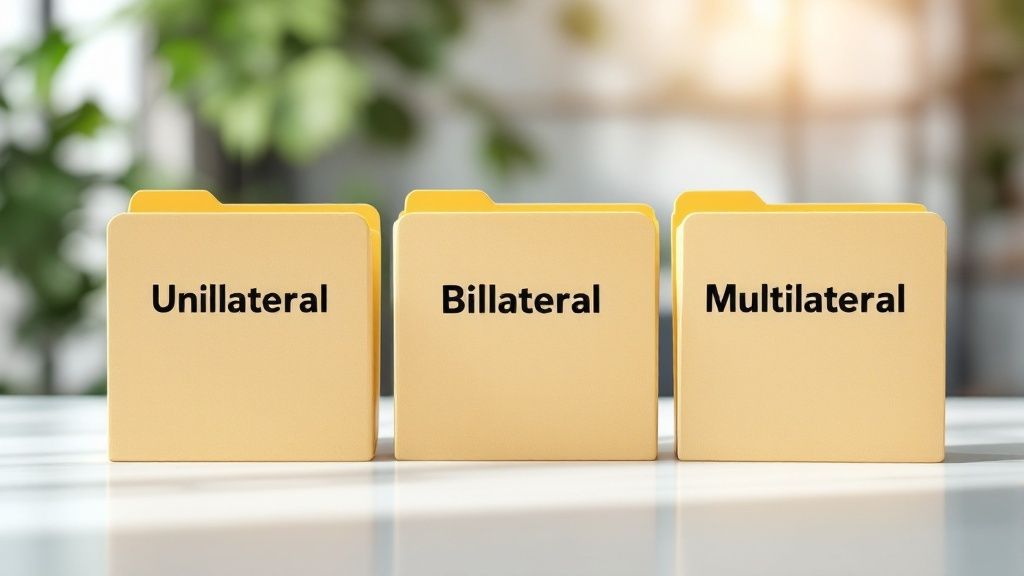
Making sure you have the correct type of NDA means your legal agreement will perfectly match your specific business situation. It gives you the precise level of protection you need without overcomplicating things. Each type is designed for a distinct purpose and relationship dynamic.
The Unilateral NDA (A One-Way Street)
First up is the unilateral NDA, which is by far the most common. Imagine it as a one-way street: confidential information flows from one person (the Disclosing Party) to another (the Receiving Party), but not the other way around. The legal duty to keep things quiet rests entirely on the recipient's shoulders.
This is the agreement you'll reach for in many day-to-day business scenarios. For instance, a startup pitching to a potential investor would use a unilateral NDA. The startup reveals its innovative business model and financial forecasts, and the investor is legally bound to keep that information under wraps.
Other typical situations include:
- Bringing on a freelancer or contractor who needs access to your project files.
- Showing a prototype of a new product to a potential manufacturer.
- Onboarding a new employee who will be privy to internal company strategies.
The Bilateral NDA (A Two-Way Street)
Next, we have the bilateral NDA. You can picture this one as a two-way street. In this case, both parties are sharing and receiving confidential information at the same time. This means both sides are bound by the same confidentiality duties, creating a level playing field.
This type of NDA is crucial whenever two companies are looking into a partnership that demands a mutual exchange of sensitive data. It ensures both sides feel secure enough to share their trade secrets.
A bilateral NDA, often called a mutual NDA, is the foundation for collaborative ventures. It establishes a circle of trust where both parties can openly share proprietary information, knowing they are equally protected under the same terms.
Think about two companies considering a merger or a joint venture. They’ll need to look at each other's financial records, customer lists, and strategic plans. A bilateral NDA is what makes this secure exchange possible.
The Multilateral NDA (A Roundabout)
Finally, there’s the multilateral NDA, which works a bit like a roundabout. It manages the flow of confidential information between three or more parties. Instead of drafting messy, separate bilateral NDAs between each party, a single multilateral agreement neatly covers everyone involved.
This structure is perfect for complex projects or ventures that involve multiple partners working together. A classic example is a team of different companies collaborating on a research and development project. Each company brings its own proprietary technology to the table, and the multilateral NDA ensures every participant is obliged to protect the confidential information shared by all the others.
To make it even clearer, let's break down when you might use each type. This table should help you quickly pinpoint the right NDA for your specific circumstances.
Choosing the Right NDA for Your Situation
| NDA Type | Information Flow | Primary Use Case | Example Scenario |
|---|---|---|---|
| Unilateral | One-Way | Protecting your information when sharing with another party. | A startup pitching its business plan to a venture capitalist. |
| Bilateral | Two-Way (Mutual) | Two parties exploring a partnership requiring mutual disclosure. | Two companies discussing a potential merger or joint venture. |
| Multilateral | Multi-Directional | Three or more parties collaborating on a project. | A consortium of tech firms co-developing a new software platform. |
Ultimately, selecting the correct NDA—whether it’s a one-way street, a two-way exchange, or a multi-party roundabout—is the first step in building a relationship based on trust and legal security. It ensures everyone knows the rules of the road before any sensitive information changes hands.
Decoding the Key Clauses in an NDA
Stepping inside a Non-Disclosure Agreement for the first time can feel like you're trying to read a map in a foreign language. The legal phrasing might seem dense, but the core components are actually quite logical once you break them down. Understanding these key clauses is absolutely essential to knowing what you're really agreeing to.
Think of an NDA as a machine with several interconnected parts. Each clause performs a specific job, and together, they build a solid framework to protect sensitive information. Let's pull apart the most critical pieces you'll find in almost any NDA.
Definition of Confidential Information
This is, without a doubt, the most important clause in the whole document. It acts as a fence, clearly marking the boundary between what is protected and what is not. If this section is vague or poorly written, it can render the entire agreement useless.
A strong definition needs to be both specific and comprehensive, often listing examples to paint a clear picture of what's covered.
- Financial data (revenue figures, profit margins, investor details)
- Business strategies (marketing plans, product roadmaps, expansion goals)
- Customer and supplier lists (contact information, contract terms)
- Intellectual property (trade secrets, patents, software code, formulas)
- Prototypes and technical specifications
Just as importantly, this clause also carves out what is not considered confidential, like information already floating around in the public domain or knowledge the other party had before signing. Precision here is everything for the NDA's enforceability.
Obligations of the Receiving Party
Once the confidential information has been defined, this clause gets down to brass tacks. It explains exactly what the person or company receiving the information must do—and, crucially, what they must not do. It lays out the rules of engagement.
The main obligation, of course, is non-disclosure. The recipient is promising not to share the information with any third party without getting explicit permission first.
This section goes beyond simply keeping a secret. It often includes an obligation to use the information only for the specific, agreed-upon purpose (e.g., to evaluate a potential business partnership) and to take reasonable steps to prevent it from being accidentally leaked.
For anyone involved in complex business arrangements, understanding the nuances of legal agreements is fundamental. To gain more insight into this area, you can learn more about the principles behind the https://lawandmore.eu/blog/drafting-of-contracts-in-the-netherlands/ and how these foundational concepts apply. This knowledge can help you appreciate the importance of each clause in an NDA.
Term of the Agreement
Every promise has a timeline, and an NDA is no different. The "term" clause spells out how long the duty of confidentiality will last. This duration can vary wildly depending on the type of information being protected.
For information with a shelf life, like details about an upcoming product launch, a term of two to five years is quite common. After all, once the product is public, the information is no longer confidential.
However, for truly timeless secrets—think of a famous soft drink recipe or a critical manufacturing process—the obligation can be indefinite. A trade secret's value lies entirely in its secrecy, so the protection has to last as long as the information remains a secret.
Consequences of a Breach
Finally, this is the clause that outlines what happens if someone breaks their promise. It sets the stakes and gives the NDA its legal "teeth." Without clear consequences, the document is little more than a polite request.
This section typically details the legal remedies available to the person who shared the information, which may include:
- Monetary Damages: Financial compensation for any losses suffered because of the leak.
- Injunctive Relief: A court order that forces the breaching party to immediately stop using or sharing the confidential information.
This clause serves as a powerful reminder that an NDA is a serious legal commitment with real-world repercussions for anyone who violates it.
Common NDA Mistakes and How to Avoid Them
Even an NDA drafted with the best intentions can be full of holes. A poorly written agreement doesn't just fail to protect you; it creates a false sense of security, which can be far more dangerous than having no agreement at all. Navigating these legal documents means being aware of the common traps that can leave your most valuable information exposed.
One of the most frequent errors we see is an overly vague or broad definition of "Confidential Information." If the scope isn't crystal clear, a court in the Netherlands may struggle to enforce it, leaving your most critical data unprotected when you need it most.
Another major pitfall is relying on those generic, one-size-fits-all templates you can download online. These documents often fail to address the specific nuances of your business or comply with local Dutch law, making them unreliable when it truly matters.
Overlooking the Agreement's Duration
It might sound obvious, but a surprisingly common mistake is forgetting to specify how long the NDA lasts. Confidentiality obligations can't go on forever unless they protect a genuine trade secret. Without a clear end date, the agreement becomes ambiguous, putting its enforceability at risk.
The key is to set a realistic timeframe that aligns with how long the information will actually be valuable. For instance, details about a forthcoming product launch might only need protection for a couple of years. A proprietary chemical formula, on the other hand, might require confidentiality for a much, much longer period.
Key Takeaway: An NDA without a defined term is like a lock without a key. It might look secure, but it fails to provide reliable, long-term protection, leaving your sensitive information vulnerable over time.
Failing to define the term properly is just asking for disputes down the line. It's essential to tailor the duration to the specific context of what you're sharing.
Failing to Define Permitted Use
Another critical oversight is neglecting to specify exactly how the receiving party is allowed to use the confidential information. A solid NDA should do more than just prohibit disclosure to others. It must also restrict the use of the information to the agreed-upon purpose, like evaluating a potential partnership or investment.
Without this clause, a recipient could technically use your secrets for their own benefit—to develop a competing product, for example—without directly sharing them with a third party.
Here are some of the most common mistakes to watch out for:
- Vague Definitions: Failing to clearly list what constitutes confidential information.
- Generic Templates: Using a standard online form that doesn't fit your specific needs or Dutch legal standards.
- Undefined Timelines: Not specifying a clear start and end date for the confidentiality obligations.
- Ambiguous Use Cases: Not restricting how the recipient can use the information for their own purposes.
These errors can seriously undermine the legal strength of your agreement. To mitigate these risks and ensure your NDAs are handled correctly, understanding robust contract management software features can be invaluable. Ultimately, paying close attention to these details is what transforms a simple document into a powerful shield for your business's most valuable assets.
What Happens When an NDA Is Broken
A Non-Disclosure Agreement is only as strong as your willingness to enforce it. When you suspect a breach, it's a serious matter that demands a measured, but immediate, response. The first step isn’t always to rush into litigation; it starts with investigation. You have to gather evidence to confirm that confidential information has actually been leaked and figure out who is responsible.
Once you have reasonable proof, the standard procedure is to issue a cease and desist letter. This is a formal communication, typically drafted by a legal professional, which demands the other party immediately stop any further disclosure. It clearly outlines the legal consequences they will face if they fail to comply, putting them on official notice. More often than not, this step alone is enough to resolve the situation without things escalating further.
Legal Remedies and Enforcement
If the letter is ignored, you may have no choice but to pursue legal action. The remedies available really depend on the specific damages caused by the breach.
- Monetary Damages: This involves seeking financial compensation for any losses your business has suffered because of the leak. We're talking about things like lost profits or a sudden decline in your market position.
- Injunctions: A court can issue an injunction, which is a powerful legal order forcing the other party to stop what they're doing. This is absolutely crucial for preventing any ongoing or future damage from the breach.
Enforcing an NDA is where the quality of the initial agreement really comes into play. It highlights exactly why a well-drafted contract is so vital from the very beginning. Handling these situations effectively often involves complex legal steps, especially when dealing with intellectual property. For a closer look, you can learn more about how to handle intellectual property disputes in the Netherlands.
Frequently Asked Questions About NDAs
Even with a solid grasp of the basics, some practical questions always seem to pop up when you're face-to-face with an NDA. Getting straight answers to these common queries can give you the confidence you need to handle these crucial legal documents.
Are Online NDA Templates Safe to Use?
Think of an online template as a starting point, a way to see what an NDA generally looks like. But for real protection? They're often far too generic. A template downloaded from the internet probably won't account for the specific kind of confidential information you're trying to protect, nor will it necessarily be compliant with Dutch law.
When anything of real value is at stake, the best move is always to have a legal professional either draft the agreement from scratch or, at the very least, review it. This is the only way to be certain it’s tailored to your unique situation and will actually hold up in court if things go sideways.
How Long Should an NDA Last?
There’s no one-size-fits-all answer here. The duration of an NDA, often called its 'term', is tied directly to the lifespan of the confidential information itself. The key is to make it reasonable.
- For something with a limited shelf life, like the details of an upcoming product launch, a term of 2-5 years is pretty standard.
- But for a genuine trade secret—think of a unique chemical formula or a proprietary manufacturing process—the obligation of confidentiality might need to last forever.
The goal is to set a timeframe that genuinely protects the information's value without placing an unfairly long restriction on the person or company receiving it.
Should I Ask a Potential Employee to Sign an NDA?
Absolutely. It’s not just common practice; it's a smart one. If your interview process involves sharing any sensitive company information, it's wise to have candidates sign an NDA beforehand.
Once you decide to hire someone, it becomes even more critical. Including a strong confidentiality clause or a full NDA in their employment contract is standard procedure. This protects your trade secrets, client lists, and internal business strategies right from their first day on the job.
For additional perspectives and detailed articles on non-disclosure agreements, explore the comprehensive content available on the PolicyPilots Blog for more NDA insights.