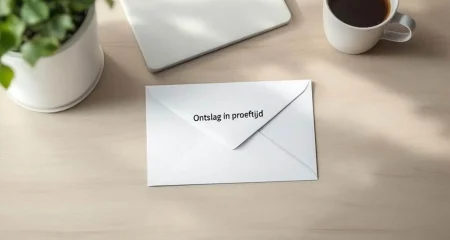
You can end a Dutch employment contract in three ways: a mutual settlement agreement, resignation by giving notice yourself, or a request to the subdistrict court to dissolve the contract. The route you choose affects your notice period and, importantly, your right to unemployment benefit (WW) if things do not work out afterwards.
Ending your contract by mutual agreement
Most employment relationships end by mutual agreement rather than by dismissal, through a settlement agreement (vaststellingsovereenkomst). You have a statutory reflection period of fourteen days after signing, during which you can withdraw from the agreement without giving a reason. If your employer does not point out this period in the agreement itself, it is extended to three weeks. The wording of the agreement matters as much as the amount: your right to unemployment benefit depends on the agreement showing that the initiative to end the contract came from your employer, and that your statutory notice period has been observed.
Termination of the employment contract by mutual consent is worth considering whenever both you and your employer see it as the best way forward, and you record the arrangement in a termination agreement. You can read more about ending a contract by mutual consent and what such an agreement should cover on our site: our page on mutual termination. If only one side wants to end the employment relationship, however, different rules apply.
You may, for various reasons, want to end the employment contract even though your employer does not agree. As an employee you then have two options: end the contract yourself by giving notice, or ask the court to dissolve it. Both routes come with limits that the law places on how and when you can use them.
How do you end your contract by giving notice?
Termination by notice is a one-sided way of ending the employment contract. If you choose this route, the law requires you to observe a statutory notice period. Regardless of how long you have worked for your employer, this notice period is usually one month. Your employment contract may set a longer period, but it may never exceed six months.
If you observe the agreed notice period, your employment ends on the last day of the calendar month in which the notice period expires. If you do not observe it, your resignation is “irregular”, and although it still ends the employment contract, your employer no longer owes wages from that point and you may owe compensation. That compensation is usually equal to the wages for the part of the notice period you did not observe.
Can you also ask the court to end your contract?
Dissolution by the subdistrict court is a second option. Instead of giving notice, you can always ask the subdistrict court to dissolve the employment contract. This route is in particular an alternative to resigning because of an urgent reason, and your employer cannot exclude it in your contract. If you choose this route, you must explain in writing why you have compelling reasons for the request, as referred to in article 7:671c of the Dutch Civil Code.
Compelling reasons are generally understood as circumstances that mean you cannot reasonably be expected to continue the employment relationship. If the subdistrict court agrees that such circumstances exist, it can end the employment contract immediately or on a later date, but never with retroactive effect. If those compelling reasons stem from intent or fault on your employer’s part, you can also claim compensation.
Do you have to resign in writing?
If you decide to resign, this usually happens in writing, in a letter or e-mail giving notice of termination. Such a letter typically states your name, the addressee, and the date on which your employment ends. To avoid disputes with your employer afterwards, it is wise to ask for a written confirmation of receipt and to send the letter by e-mail or registered post.
A written notice is not a legal requirement, though: ending your employment is form-free and can also be done verbally. You can, in principle, tell your employer in a conversation that you are resigning. Verbal resignation has drawbacks, however, such as uncertainty about exactly when your notice period starts, and it does not give you a free hand to later retract what you said just because it suits you.
Does your employer have to check that you really meant it?
Case law shows that your employer cannot simply take your word for it, especially after a verbal resignation. Your statements or conduct must clearly and unambiguously show that you actually intend to resign; where that is not obvious, your employer is expected to look into it further, and the Dutch Supreme Court has held that this duty to investigate applies in particular to verbal resignations. Before accepting a resignation at face value, your employer should weigh:
- Your state of mind at the time
- Whether you realised the consequences of what you were saying
- How much time you had to reconsider your decision
A strict standard applies when deciding whether you actually wanted to end the employment. If your employer’s investigation shows that resignation was not really your intention, your employer cannot, in principle, hold you to it, certainly not if taking you back causes no harm to the business. In that situation, there is no valid resignation and your employment simply continues.
What should you check before you resign?
Before you hand in your resignation, it is worth checking the following points.
Outstanding holiday days. If you still have holiday days left, you can usually take them in consultation with your employer before your last day, or have them paid out on your final payslip. Your employer can only refuse a request to take the days if there are good reasons for this; otherwise, any days you have not taken are paid out.
Unemployment benefit. After your employment ends, you will normally look to the Unemployment Insurance Act (WW) for income. How and why the contract ended affects whether you can claim it: if you resign on your own initiative, you are usually not entitled to unemployment benefit, because you are then considered to have caused your own unemployment. Tell us about your situation before you hand in your notice if you want to know how this applies to you.
You can also read more about dismissal, resignation and our services on our site: our dismissal pages.
In summary
- You can end your employment by mutual settlement agreement, by giving notice yourself, or by asking the subdistrict court to dissolve the contract.
- The statutory notice period for an employee is usually one month, and a contractual extension may never exceed six months.
- Court dissolution on your request requires compelling reasons under article 7:671c of the Dutch Civil Code and is not available if you simply want to leave without such reasons.
- Resignation does not have to be in writing, but a written and confirmed notice avoids later disputes about when your notice period started.
- If you resign on your own initiative, you will usually not be entitled to unemployment benefit (WW).
Frequently asked questions
Do I need to give a reason for resigning? No, you do not need a reason to end your employment contract by giving notice; you only need one if you ask the subdistrict court to dissolve the contract.
Can I take back my resignation? Not unilaterally. Once your resignation is clear and unambiguous, your employer must agree before it can be withdrawn, unless further investigation shows that resigning was not really your intention.
Unsure where you stand? Tell us about your situation. We will let you know your options within one working day.
How Law & More can help you with this is explained on our dismissal lawyer page.