Corporate legal responsibilities shape the way every organisation operates, from small Dutch startups to multinational giants. Companies are not just ticking boxes.
Dutch regulatory bodies like the AFM can impose severe financial penalties and even recommend corporate dissolution for serious breaches. This sounds intimidating, but legal obligations are fast becoming a secret weapon for ethical growth and genuine trust.
Table of Contents
Quick Summary
| Takeaway |
Explanation |
| Corporate legal responsibilities are essential for ethical operations |
These responsibilities encompass legal obligations, ethical practices, and social commitments that organisations must fulfil to operate effectively. |
| Proactive compliance mitigates legal risks |
By implementing robust internal systems, companies can anticipate and address potential legal challenges, providing a strategic advantage. |
| Transparency enhances stakeholder trust |
Accurate financial reporting and ethical business practices build credibility, attracting investors and maintaining positive relationships. |
| Regulatory bodies enforce legal compliance rigorously |
Institutions like the Dutch Authority for the Financial Markets actively monitor compliance, imposing penalties for violations to ensure accountability. |
| Legal responsibilities drive organisational transformation |
Embracing corporate legal responsibilities leads to significant changes in culture, practices, and commitment to societal development. |
What are Corporate Legal Responsibilities?
Corporate legal responsibilities represent the comprehensive set of legal obligations and duties that organisations must fulfil to operate ethically, transparently, and in compliance with national and international regulations. These responsibilities extend far beyond merely following basic legal requirements and encompass a broader framework of governance, accountability, and social commitment.
To help clarify the different dimensions that make up corporate legal responsibilities, the following table summarises the core elements and their organisational focus.
| Core Element |
Organisational Focus |
| Financial Reporting & Disclosure |
Ensuring transparency and accuracy |
| Employee Rights & Workplace Safety |
Protecting staff wellbeing |
| Ethical Business Practices |
Promoting integrity |
| Environmental Regulations |
Reducing ecological impact |
| Anti-Fraud & Corruption Measures |
Preventing unethical behaviour |
| Stakeholder Rights |
Safeguarding interests of all parties |
Understanding the Core Framework
At their fundamental level, corporate legal responsibilities are structured around several critical dimensions that define an organisation’s legal and ethical operating parameters. These dimensions include regulatory compliance, financial transparency, employee protection, environmental stewardship, and stakeholder rights. Dutch corporate law, in particular, places significant emphasis on creating a robust legal environment that balances business interests with broader societal considerations.
Key Elements of Corporate Legal Responsibilities:
- Ensuring accurate financial reporting and disclosure
- Protecting employee rights and workplace safety
- Maintaining ethical business practices
- Respecting environmental regulations
- Preventing fraudulent or corrupt activities
Compliance and Governance Mechanisms
The implementation of corporate legal responsibilities requires sophisticated governance mechanisms. In the Netherlands, this involves comprehensive regulatory oversight by institutions like the Dutch Authority for the Financial Markets (AFM) and the Netherlands Enterprise Court. These bodies ensure that corporations maintain high standards of legal and ethical conduct.
Organisations must develop internal compliance frameworks that proactively identify potential legal risks, implement robust monitoring systems, and create transparent reporting mechanisms. This approach goes beyond mere legal adherence and represents a strategic commitment to responsible corporate citizenship.
Understanding corporate legal responsibilities is not simply about avoiding legal penalties but about creating a sustainable, ethical business ecosystem that generates trust among stakeholders, investors, employees, and the broader community. By embracing these responsibilities, corporations demonstrate their commitment to responsible economic participation and social development.
Why Corporate Legal Responsibilities Matter for Businesses
Corporate legal responsibilities are not merely administrative obligations but strategic imperatives that fundamentally shape an organisation’s operational integrity, reputation, and long-term sustainability. In the complex and interconnected business landscape of the Netherlands, understanding and proactively managing these responsibilities can mean the difference between organisational success and potential legal or financial catastrophe.
Strategic Risk Management
By embracing comprehensive legal responsibilities, businesses create robust protective mechanisms that mitigate potential risks and vulnerabilities. This approach involves developing sophisticated internal systems that anticipate and address potential legal challenges before they escalate into significant problems.
Proactive legal compliance becomes a strategic advantage, allowing organisations to navigate complex regulatory environments with confidence and precision.
Primary Risk Management Benefits:
- Preventing costly legal disputes
- Protecting organisational reputation
- Ensuring continuous operational stability
- Minimising unexpected financial liabilities
- Building stakeholder trust
Financial and Reputational Implications
The financial consequences of neglecting corporate legal responsibilities can be profound. Regulatory penalties, legal settlements, and potential business interruptions can result in substantial monetary losses. Moreover, organisations that demonstrate consistent legal compliance and ethical behaviour attract more investors, retain top talent, and develop stronger relationships with customers and stakeholders.
In the Dutch business context, where transparency and accountability are highly valued, legal responsibilities extend beyond mere compliance. They represent a fundamental commitment to ethical business practices that contribute to a sustainable and trustworthy economic ecosystem.
Ultimately, corporate legal responsibilities are not a burden but a strategic opportunity. By viewing legal compliance as an integral part of business strategy, organisations can transform potential challenges into competitive advantages, demonstrating their commitment to responsible and sustainable business practices.
How Corporate Legal Responsibilities are Enforced
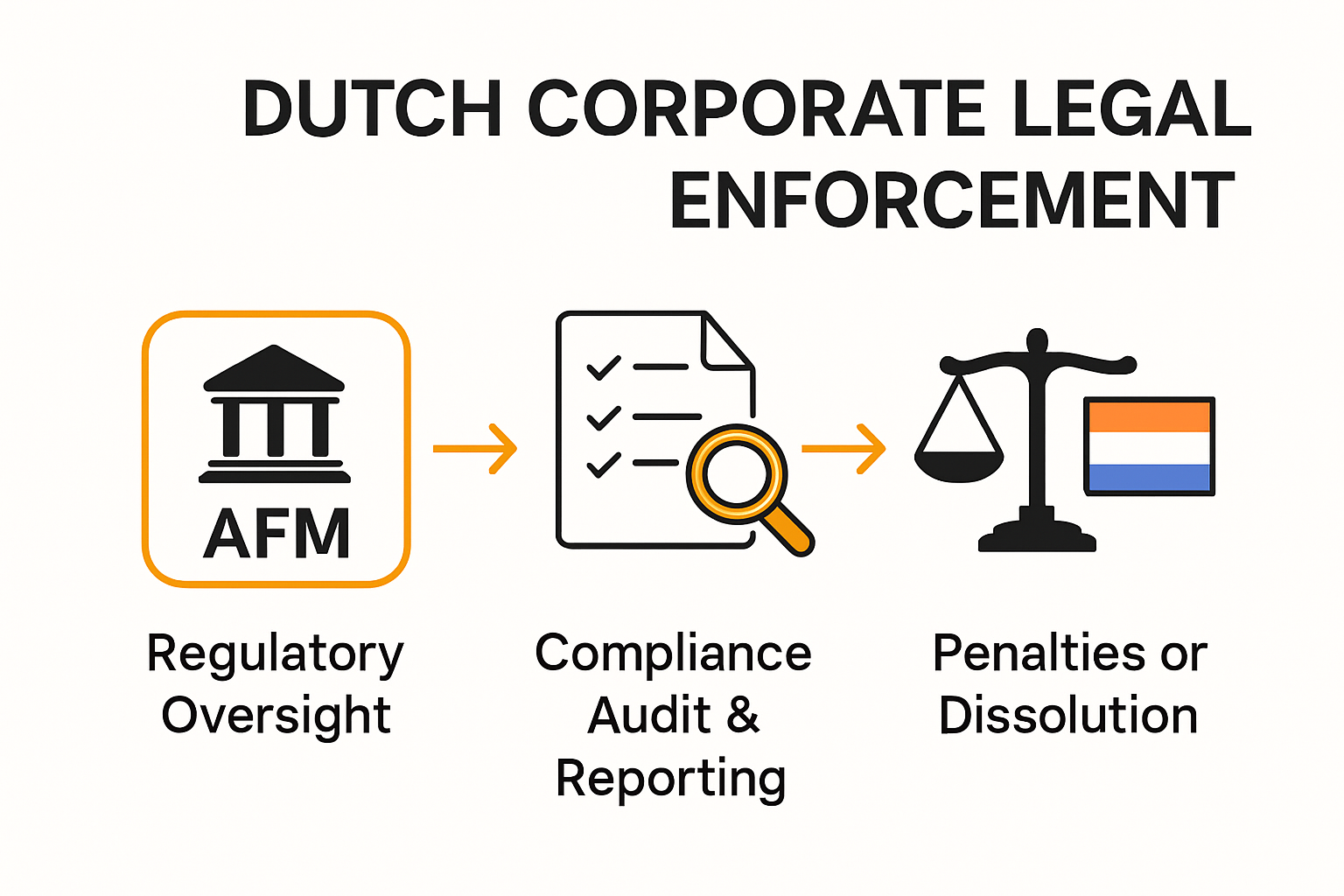
Enforcement of corporate legal responsibilities represents a sophisticated multilayered system involving governmental regulatory bodies, judicial mechanisms, and institutional oversight. In the Netherlands, this complex framework ensures that businesses operate within established legal and ethical boundaries, with multiple channels available to monitor, investigate, and address potential corporate misconduct.
Regulatory Oversight Mechanisms
Governmental institutions play a critical role in enforcing corporate legal responsibilities. The Dutch Authority for the Financial Markets (AFM) and the Netherlands Enterprise Court serve as primary regulatory bodies with extensive powers to investigate, assess, and penalise corporate non-compliance. These institutions conduct systematic reviews, audit corporate practices, and have the legal authority to impose significant financial penalties and operational restrictions.
Key Enforcement Strategies:
- Mandatory periodic corporate reporting
- Comprehensive financial transparency requirements
- Regular compliance audits
- Strict documentation and verification processes
- Immediate intervention mechanisms
Legal and Judicial Enforcement
The Dutch legal system provides robust mechanisms for addressing corporate legal responsibility violations. Judicial enforcement occurs through multiple channels, including civil litigation, administrative proceedings, and criminal prosecution. Courts can impose substantial financial penalties, mandate corrective actions, and in severe cases, recommend corporate dissolution or executive liability.
The following table compares the two primary enforcement approaches for corporate legal responsibilities in the Netherlands, highlighting their mechanisms and implications.
| Enforcement Approach |
Mechanisms Involved |
Possible Outcomes |
| Regulatory Oversight |
AFM audits, documentation reviews, compliance audits |
Financial penalties, operational restrictions |
| Legal & Judicial |
Civil litigation, administrative proceedings, prosecution |
Fines, corrective actions, potential dissolution |
Beyond formal legal structures, social and market pressures also contribute significantly to enforcement. Media scrutiny, stakeholder activism, and investor expectations create additional accountability layers that compel corporations to maintain high standards of legal and ethical conduct.
Enforcement is not merely about punishment but about creating a sustainable ecosystem of corporate responsibility. By implementing comprehensive monitoring systems, providing clear guidelines, and maintaining transparent accountability mechanisms, the Netherlands demonstrates a progressive approach to ensuring that businesses operate with integrity, respect legal frameworks, and contribute positively to societal development.
Key Concepts in Corporate Legal Responsibilities
Corporate legal responsibilities encompass a complex network of principles, obligations, and standards that define how businesses must operate within legal and ethical frameworks. These concepts provide the foundational architecture for responsible corporate governance, ensuring organisations function transparently, equitably, and in alignment with broader societal expectations.
Fundamental Legal Principles
At the core of corporate legal responsibilities lie several critical principles that guide organisational behaviour.
Fiduciary duty represents a primary concept, requiring corporate leadership to act in the best interests of shareholders and stakeholders. This principle mandates that corporate decision makers prioritise organisational welfare, exercise prudent judgment, and maintain the highest standards of professional conduct.
Core Legal Principles Include:
- Protection of shareholder rights
- Transparency in financial reporting
- Accountability for corporate actions
- Ethical decision making processes
- Balanced stakeholder considerations
Governance and Accountability Frameworks
Corporate governance structures establish the mechanisms through which legal responsibilities are implemented and monitored. In the Netherlands, these frameworks are meticulously designed to ensure comprehensive oversight, with clear delineation of roles, responsibilities, and decision making processes. Supervisory boards, independent directors, and internal audit mechanisms play crucial roles in maintaining organisational integrity and legal compliance.
The concept of
corporate personhood introduces another significant dimension to legal responsibilities. This principle recognises corporations as legal entities with rights and obligations distinct from their individual members, thereby creating a complex landscape of legal accountability that extends beyond personal interactions.
Understanding these key concepts is not merely an academic exercise but a practical necessity. They provide the blueprint for responsible corporate behaviour, ensuring that businesses operate not just within the letter of the law, but in its spirit. By embracing these principles, organisations create sustainable value, build trust with stakeholders, and contribute positively to the broader economic and social ecosystem.
Real-World Impact of Corporate Legal Responsibilities
Corporate legal responsibilities transcend theoretical frameworks, generating tangible and profound consequences that reshape business practices, societal interactions, and economic landscapes. In the Netherlands, these responsibilities function as dynamic mechanisms that drive organisational transformation, influence strategic decision making, and create meaningful accountability across multiple domains.
The real-world impact of corporate legal responsibilities manifests through fundamental changes in organisational behaviour and strategic planning. Companies are compelled to develop comprehensive internal systems that proactively address potential legal and ethical challenges.
Strategic compliance becomes an integral component of corporate culture, moving beyond mere regulatory adherence to a holistic approach of responsible business conduct.
Significant Organisational Transformations:
- Enhanced risk management protocols
- More transparent decision making processes
- Increased investment in ethical training
- Robust internal reporting mechanisms
- Proactive social responsibility initiatives
Broader Societal Implications
Corporate legal responsibilities generate cascading effects that extend well beyond individual organisations. By establishing clear standards of conduct, these legal frameworks create systemic pressures that drive broader social and economic improvements. Dutch corporations increasingly recognise that legal compliance is not simply about avoiding penalties but about contributing positively to societal development.
The impact is particularly evident in areas such as environmental sustainability, labour rights, and corporate governance. Companies are now expected to demonstrate measurable commitments to social responsibility, with legal frameworks providing both the motivation and the mechanism for meaningful change.
Ultimately, corporate legal responsibilities represent a powerful instrument for reshaping business practices. They transform abstract legal principles into concrete actions that drive innovation, foster trust, and create sustainable value for businesses, employees, and society at large.

Confidently Navigate Dutch Corporate Legal Responsibilities with Law & More
Meeting your corporate legal responsibilities in the Netherlands is a demanding challenge. Whether you are striving for financial transparency, prioritising regulatory compliance, or building strong risk management systems, the cost of a misstep can be high. The article above has explained how Dutch law requires businesses to go beyond basic legal requirements, placing special emphasis on accurate reporting, ethical conduct and effective governance. Many organisations struggle with the complexity of evolving regulations and the need for tailored, proactive solutions to avoid costly litigation or reputational damage.
You do not need to manage these responsibilities alone. At
Law & More you will find a team of experienced Dutch corporate lawyers who understand what it takes to build strong internal frameworks and protect your business interests. Our client-centred approach ensures you receive practical advice and direct support with compliance, governance and strategic risk management. Ready to protect your business and meet your legal obligations with confidence? Visit
Law & More to discover our full suite of legal services or book an appointment to discuss your specific needs today.
Frequently Asked Questions
What are corporate legal responsibilities?
Corporate legal responsibilities refer to the set of legal obligations that organisations must fulfil to operate ethically and in compliance with regulations, covering areas such as financial transparency, employee protection, and environmental stewardship.
Why are corporate legal responsibilities important for businesses?
Corporate legal responsibilities are crucial as they help mitigate risks, protect organisational reputation, ensure financial stability, and build trust among stakeholders, ultimately contributing to long-term business success.
How are corporate legal responsibilities enforced in the Netherlands?
Enforcement of corporate legal responsibilities in the Netherlands involves regulatory oversight by bodies like the Dutch Authority for the Financial Markets (AFM) and judicial mechanisms, including civil litigation and administrative proceedings, to address violations effectively.
What are the core principles underlying corporate legal responsibilities?
The core principles include fiduciary duty, protection of shareholder rights, transparency in financial reporting, and ethical decision-making processes, ensuring that businesses operate within legal and ethical frameworks.