


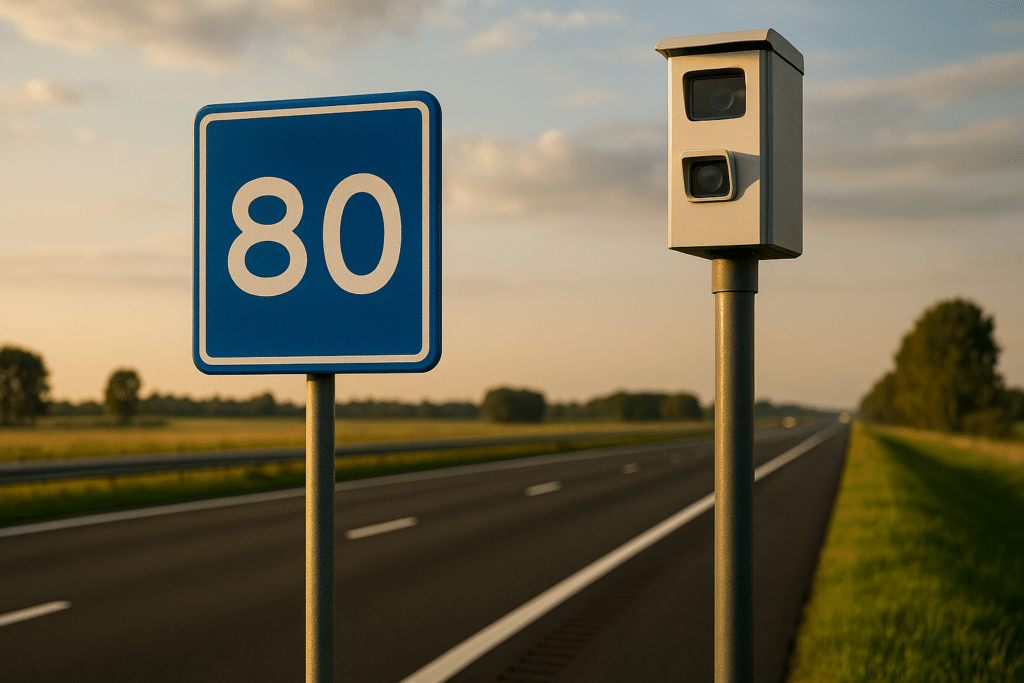
It happens in a flash—literally. You are driving along the A2 or navigating the ring road in Eindhoven, perhaps slightly distracted or in a rush, when you notice the tell-tale flash of a speed camera. A few weeks later, an envelope from the Central Judicial Collection Agency (CJIB) lands on your doormat.
For many drivers, the immediate reaction is resignation: pay the fine and move on. However, the Dutch system regarding speeding offences (snelheidsovertredingen) is complex. It involves a distinct separation between administrative law and criminal law, strict procedural deadlines, and specific rights that protect you as a citizen.
Whether you are facing a minor administrative penalty or a severe speeding offence that threatens your driving licence, understanding your legal position is essential. This guide provides a comprehensive analysis of the Dutch legal framework surrounding speeding fines, the objection procedure, and the risks of a driving ban.
The Legal Question
To navigate this landscape, we must answer the following core question: What are the statutory rules governing speeding fines in the Netherlands, how does the objection procedure against a fine function, and under what specific circumstances can a driving ban be imposed?
The Legal Framework: Understanding the Legislation
The Dutch approach to traffic enforcement is bifurcated. Depending on the severity of the offence, you will deal with either administrative law or criminal law. Understanding which regime applies to your situation is the first step in determining your legal strategy.
1. The Wahv (Wet Mulder)
The vast majority of speeding fines in the Netherlands are handled under the Wet administratiefrechtelijke handhaving verkeersvoorschriften (Wahv), commonly known as the “Wet Mulder”. This law decriminalised minor traffic offences, turning them into administrative sanctions rather than criminal acts.
If you exceed the speed limit by a few kilometres per hour, you are not considered a “suspect” in a criminal sense, but rather a “person concerned” (betrokkene). The CJIB acts as the administrative body responsible for collecting these fines, but legally, the imposition of the sanction falls under the authority of the Public Prosecutor.
Key characteristics of Wahv fines:
- Fixed Penalties: The fines are standardised based on the measured speed and location (urban areas, rural roads, or motorways).
- Registration: These fines are registered on the vehicle’s licence plate owner, regardless of who was driving (registration liability).
- No Criminal Record: Paying a Wahv fine does not result in a criminal record entry.
2. The Road Traffic Act 1994 (WVW 1994)
When a speeding violation becomes excessive—generally exceeding the limit by more than 30 km/h (or 40 km/h on motorways)—the strict regime of the Wahv no longer applies. These cases are handled under the Wegenverkeerswet 1994 (WVW 1994).
Here, the stakes are significantly higher. You are no longer dealing with a standard administrative fee but a criminal transaction proposal or a summons to appear in court.
- Article 179 WVW 1994: This article provides the legal basis for disqualifying a driver from holding a driving licence.
- Article 5a WVW 1994: This relatively new article targets intentionally dangerous driving behaviour. If speeding is combined with other reckless acts, such as dangerous overtaking, you may be prosecuted for causing danger on the road.
- Article 77r Criminal Code: This allows for specific sanctions regarding driving bans.
3. The Objection Procedure
The General Administrative Law Act (Algemene wet bestuursrecht, Awb) governs the procedural aspect of fighting a fine. Specifically, Article 6:7 to 6:9 of the Awb dictates strict deadlines. You must submit your objection within six weeks of the date printed on the fine (the dagtekening).
It is a common misconception that you object to the CJIB. While you may send the letter to them, you are legally lodging an objection with the Public Prosecutor (Officier van Justitie).
The Objection and Appeal Procedure in Detail
If you believe a fine is unjust, the Dutch legal system provides a three-stage remedy: objection, appeal to the District Court, and appeal to the Higher Court.
Stage 1: Administrative Objection (Bezwaar)
Under Article 7 of the Wahv, you submit your objection to the Public Prosecutor. This is your first opportunity to present counter-evidence. Crucially, Article 7:4 of the Awb grants you the right to inspect your file. This includes the photo of the offence and the official report (zaakoverzicht). Never skip this step; without the file, you cannot effectively argue your case.
Furthermore, under Article 7 Wahv, you have the right to be heard. While often skipped for efficiency, requesting a hearing can be a strategic move, especially in complex cases where written arguments fail to capture the nuance of the situation.
Stage 2: Appeal to the Subdistrict Court (Beroep)
If the Public Prosecutor rejects your objection, you can appeal to the Subdistrict Court (Kantonrechter) under Article 9 of the Wahv. To initiate this, you must usually pay the fine as a “security deposit” (zekerheidstelling). If you win, this money is refunded.
The procedure is generally written. However, recent case law, such as ECLI:NL:RBNHO:2025:12641 and ECLI:NL:RBDHA:2025:24943, confirms that a strictly written procedure is standard unless a party explicitly requests a hearing. Under Article 12 of the Wahv, you are entitled to be assisted by a legal representative or lawyer during this phase.
The judge will assess the case fully (“full review”), but when it comes to the amount of the fine, they test marginally against the principle of proportionality. Since fines are fixed by law, judges rarely deviate from the standard amounts unless there are exceptional circumstances.
Stage 3: Higher Appeal (Hoger Beroep)
If the District Court rules against you, one final option remains: the Court of Appeal in Arnhem-Leeuwarden. Under Article 14 of the Wahv, this is only possible if the fine exceeds €110. The procedural requirements here are strict, as emphasised in ECLI:NL:HR:2020:563; failing to meet specific formatting or deadline criteria will result in the case being declared inadmissible.
Burden of Proof and Evidence
In Dutch traffic law, the burden of proof operates differently than in standard criminal law.
The Statement of the Official
The starting point is that the statement of the investigating officer (verbalisant) is deemed correct. In ECLI:NL:RBDHA:2025:20703, the court reaffirmed that the official report combined with the photo provides sufficient evidence. The court stated that a mere denial by the driver is insufficient to set aside the officer’s sworn statement.
Furthermore, ECLI:NL:RBZWB:2025:9653 clarifies that the officer does not need to be personally heard or cross-examined in court for their written statement to be valid evidence.
The Reversal of Burden
This creates a difficult position for the driver. To win, you must provide concrete facts that cast doubt on the accuracy of the measurement or the observation.
- ECLI:NL:RBZWB:2025:9425: The court ruled that without concrete evidence contradicting the official report, the fine stands.
- ECLI:NL:RBNNE:2025:4748: In cases of digital enforcement (cameras), the technical registration is assumed accurate unless specific technical flaws are proven.
Successful arguments in case law include:
- Doubts regarding measurement equipment: In ECLI:NL:GHARL:2025:8205, the appellant successfully raised doubts about the calibration or operation of the measurement device.
- Incorrect signage: ECLI:NL:RBZWB:2025:8275 is a prime example where a fine was voided because the speed limit signs were placed incorrectly or were obscured, meaning the driver could not reasonably know the limit.
Nuances and Exceptions
While the system is rigid, it is not flawless. There are specific nuances where legal intervention can lead to a reduction or annulment of the fine.
Procedural Errors and the Hearing Duty
The government must follow its own rules. If they fail to do so, the court may reduce the fine to compensate for the violation of your rights.
- ECLI:NL:RBZWB:2025:9429: In this notable case, the fine was partially mitigated (lowered) because the Public Prosecutor violated the duty to hear the accumulated party (hoorplicht) and exceeded the reasonable term for handling the case.
- ECLI:NL:RBZWB:2025:5192: Failing to provide the case documents (procedural files) to the accused in a timely manner is a breach of the principles of proper administration.
The Principle of Proportionality
Under Article 9 Wahv, sanctions must be proportionate. However, because fines are fixed rates, this is a high bar to clear.
- ECLI:NL:RBDHA:2025:22428: The court ruled that the fixed fine amount is the starting point. Personal financial hardship is generally not a valid reason to lower a fine, as the rates are set by the legislature.
- ECLI:NL:RBZWB:2025:9610: The court illustrated that only in truly “special” circumstances—such as a medical emergency where no ambulance was available—might the principle of proportionality lead to a reduction.
Serious Offences and Recidivism
When speeding moves into the territory of criminal law (High speeding), the Prosecutor looks at your history. Recidivism (repeat offending) leads to significantly higher fines and longer driving bans.
Recklessness (Roekeloosheid):
Courts look at the “totality of behaviours” (ECLI:NL:HR:2022:1859). Speeding alone is rarely legally “reckless” in the strict sense of Art 5a WVW, but speeding plus tailgating plus running a red light is.
- ECLI:NL:HR:2024:1398: The Supreme Court clarified the high threshold for establishing recklessness.
- ECLI:NL:RBOBR:2025:7705: A driving ban was imposed after a traffic accident caused by “considerably careless” driving, applying Articles 5a and 179 WVW 1994.
Practical Application: What to Do If You Receive a Fine
If you receive a fine, do not ignore it. Follow this structured approach to determine your next steps.
Step 1: Verification
Upon receiving the letter from the CJIB, verify the following details immediately:
- Identity: Is the name and licence plate correct?
- Location & Time: Were you actually there?
- The Speed: Check the measured speed versus the corrected speed (after the flash margin).
- Documents: Request the photo immediately via the CJIB website.
Step 2: Assessing Grounds for Objection
Ask yourself if you have a valid legal ground.
- High Chance of Success: You have proof you were elsewhere; the car was stolen; signs were missing (photo evidence needed); procedural errors (documents not sent).
- Low Chance of Success: “I didn’t realise I was speeding,” “The road was empty,” or “The fine is too expensive.” These are not valid legal arguments.
Step 3: Drafting the Objection
You must submit your objection to the Public Prosecutor within the six-week deadline.
- Cite the fine number and dossier number.
- Clearly state why you object.
- Attach evidence (photos, witness statements).
- Explicitly request to see the procedural documents (Art 7:4 Awb).
- Explicitly request a hearing if you have complex arguments.
Step 4: The Driving Ban Scenario
If you have been stopped by the police and your licence has been confiscated (invordering):
- Act Fast: The Public Prosecutor has 10 days to decide whether to keep your licence for months.
- Hardship Clause: If you are a professional driver (truck driver, sales rep), you may appeal for the return of the licence based on the disproportionate impact on your livelihood. This requires immediate legal assistance.
Cost-Benefit Analysis: When to Hire a Lawyer?
At Law & More, we believe in transparent legal counsel. It is vital to weigh the costs of legal assistance against the potential benefits.
For Standard Wahv Fines:
If you receive a standard administrative fine for driving 10 km/h too fast, the cost of hiring a specialised lawyer will almost certainly exceed the fine itself. In these cases, it is usually more economical to:
- File the objection yourself using the CJIB digital portal.
- Utilise your legal expenses insurance (rechtsbijstandverzekering) if you have coverage or subsidized legal aid.
When Legal Assistance is Essential:
However, there are scenarios where professional legal intervention is an investment, not a cost. You should consult a lawyer if:
- Your Driving Licence is at Risk: If your licence has been confiscated or you face a long-term ban, the loss of mobility can cost you your job or business revenue.
- Criminal Prosecution: If you are summoned to court for a crime (excessive speeding/dangerous driving), you risk a criminal record. This can impact your ability to get a Certificate of Conduct (VOG).
- Complex Procedural Issues: If the measurement method is technically disputed or there are complex liability issues regarding who was driving.
- Recidivism: If you are a repeat offender facing escalated penalties.
Conclusion
Speeding offences in the Netherlands are processed through a highly streamlined, efficient system designed to handle millions of violations. While the Wahv system uses fixed penalties, this does not mean you are without rights.
You have the right to challenge the evidence, the right to procedural fairness, and the right to an independent judicial review. As demonstrated by recent case law, procedural errors by the prosecution or lack of concrete evidence can and do lead to the annulment of fines.
Summary of Actionable Rights:
- Deadlines: Strictly adhere to the 6-week objection period.
- Evidence: Always demand to see the photo and official report.
- Burden of Proof: You must provide concrete facts to overturn an officer’s statement.
- Legal Support: Evaluate the severity. For minor fines, DIY is best. For driving bans and criminal charges, professional counsel is crucial.
Whether you drive in Eindhoven, Amsterdam, or across the border, complying with traffic laws is the best prevention. However, when errors occur or sanctions are disproportionate, the law provides a path for recourse.
Do you need assistance with a complex traffic case, a confiscated driving licence, or a summons to court? Law & More has extensive experience in Dutch traffic law and administrative procedures. Contact us today for a consultation to discuss your legal options.
FAQ: Speeding Fines & Legal Rights
How much does a speeding fine cost in the Netherlands?
Fines are not random; they are fixed annually by the government. The exact amount depends on your speed, the road type (motorway vs. urban), and whether roadworks were present. You can verify current rates on the CJIB website.
How do I object to a speeding fine?
You must submit a written or digital objection to the Public Prosecutor (Officier van Justitie) within six weeks of the date on the fine. Note: You do not object to the CJIB directly, though they process the mail.
When will I get a driving ban?
A driving ban is usually risked if you exceed the limit by 50 km/h (or 40 km/h on motorways), or if you engage in dangerous driving behaviour (Art 5a WVW 1994).
What is the ‘flash margin’ or correction?
To account for potential minor inaccuracies in equipment, a correction is deducted from your measured speed. For speeds under 100 km/h, this is usually 3 km/h. Above 100 km/h, it is 3% of the measured speed.
Do I need a lawyer for a speeding ticket?
For Wahv fines, it is rarely cost-effective, except in case of legal aid insurance or subsidized legal aid. However, if your licence has been confiscated, or you face criminal prosecution for reckless driving or recidivism, legal assistance is highly recommended to protect your rights and livelihood.