



For a long time, compensation has been a confidential matter, discussed behind closed doors. Salary transparency legislation is changing all of that, bringing pay scales out into the open. These new rules require employers to disclose salary ranges for open positions and report on pay data, marking a fundamental shift towards a more open and equitable model. The main goal? To finally close persistent pay gaps.
The Shift to Salary Transparency in the Netherlands
Imagine if every job advertisement you saw came with a clear salary range. This is the new reality taking shape in the Netherlands thanks to salary transparency legislation. At its heart, this legal movement is a strategic tool designed to tackle one of the most stubborn issues in the modern workplace: the gender pay gap. It effectively moves the responsibility for fair pay from the employee, who had to guess and negotiate, squarely onto the employer, who must now be proactive and transparent.

This shift isn't just about posting numbers on a job ad. It's fundamentally changing the dynamics of how Dutch businesses hire and manage compensation.
Why Is This Change Happening Now?
The push for salary transparency in the Netherlands isn't happening in a vacuum; it's a direct response to a persistent economic problem. The principle of equal pay for equal work has been part of European law since 1957, yet a significant gender pay gap remains.
According to Statistics Netherlands (CBS), Dutch women still earn, on average, 13% less per hour than their male colleagues. This isn't just an abstract statistic. For a woman earning €25 per hour, this gap means she loses out on about €3.25 for every single hour she works. Over a full-time year, that adds up to more than €6,000.
Policymakers argue this disparity continues because a lack of transparency makes it nearly impossible for workers to know if they're being underpaid and to effectively stand up for their rights. You can learn more about how the Dutch implementation of the Pay Transparency Directive directly addresses these issues.
The New Rules of Engagement for Employers
This new legal framework introduces several non-negotiable changes for employers. Two of the most significant are:
- Proactive Pay Disclosure: Employers will now be required to provide the starting salary or the salary range for a position right in the job vacancy notice. This ensures every candidate has the same crucial information from day one.
- Ban on Salary History Questions: Companies can no longer ask candidates about what they earned in past jobs. This is a critical measure designed to break the cycle of underpayment, where a lower past salary is often used to justify a lower offer in a new role.
This legislation forces a move away from a system of individual negotiation—which often puts women and minorities at a disadvantage—to a system based on the objective, pre-determined value of a specific role. It's about paying for the job, not for the person's previous earnings.
Ultimately, these changes represent a foundational overhaul of Dutch employment practices. They require businesses to be more deliberate, structured, and fair in how they approach compensation, setting a new standard for trust and equity in the workplace.
Understanding the EU Directive and Dutch Timeline
The push for salary transparency in the Netherlands is part of a much larger European movement. The new Dutch rules are a direct result of the EU Pay Transparency Directive, a major piece of legislation designed to enforce equal pay for equal work across all member states. This means that when Dutch businesses adapt, they're not just meeting a local requirement—they're aligning with a new, continent-wide standard.
Think of the EU Directive as the main blueprint. It sets the overarching goals, like requiring companies to disclose pay ranges and report on gender pay gaps. However, it leaves the specific details of implementation up to each individual country. That's where the Dutch legislation comes in, translating the EU's principles into concrete legal duties for any employer operating here. Understanding this connection is vital, because it signals that these changes are permanent and will likely influence court decisions and workplace norms well before the final Dutch law is officially on the books.
The Official Timeline for Dutch Implementation
For any business, knowing the deadlines is key to getting prepared. The Dutch government has laid out a clear schedule. The Netherlands will bring the EU Directive into law through new legislation that will formally take effect no later than 1 January 2027. This date gives businesses a firm deadline to work towards for full compliance.
It’s worth noting that this timeline is a bit different from the original plan. The government initially hoped to have everything in place much sooner, by 7 June 2026. However, the Minister of Social Affairs and Employment later declared this "unfeasible," which led to the postponement. This delay isn't a reason to put things off; it's a crucial window for companies to get their systems, job classifications, and pay structures in order. You can read more on how the Netherlands delayed its implementation on employmentlawworldview.com.
What Happens During This Interim Period
So, what does the time between now and 2027 actually mean for employers? It’s certainly not a "grace period" where you can simply ignore these principles. While the mandatory reporting and strictest recruitment rules aren't yet legally enforceable, the spirit of the legislation is already starting to shape the legal landscape.
In this interim phase, Dutch courts are widely expected to start interpreting existing equal-pay laws through the lens of the new EU Directive. This has some very real, practical implications:
- Employee Disputes: If an equal pay dispute goes to court, a judge may look favourably on an employer who has already made good-faith efforts to be transparent about pay, even if it wasn't technically required yet.
- Legal Precedent: Judges can—and likely will—refer to the Directive’s principles to guide their decisions, setting a precedent for how these laws will be applied once they are fully active.
- Reputational Risk: Companies that wait until the very last minute risk being seen as behind the curve on fairness and equity, which can seriously impact their ability to attract and keep top talent.
The delay to 2027 is best viewed as a compliance runway, not a waiting period. The legal expectations around fair pay are evolving now, and proactive employers who start adapting their internal processes will be at a significant advantage, both legally and competitively.
This proactive approach fits with a broader understanding of current regulations. For a complete picture of what’s expected from businesses today, it’s helpful to review an overview of employment laws in the Netherlands for 2025.
Key Milestones on the Road to 2027
To turn this legal shift into a practical action plan, businesses should mark their calendars with these key milestones:
- Now – 2026 (Preparation Phase): This is the time for action. Conduct internal pay equity audits, review your job architecture, and start developing transparent salary bands. It's also the perfect time to begin training HR staff and hiring managers on the new rules.
- 1 January 2027 (Legislation in Force): The Dutch salary transparency law officially goes live. At this point, key requirements—like including pay ranges in job ads and the ban on asking candidates about their salary history—become legally binding.
- 2028 (First Reporting Deadline for Large Companies): Companies with 150 or more employees will likely need to submit their first gender pay gap reports, based on the salary data they collected throughout 2027.
This timeline offers a clear roadmap. Using the next couple of years to prepare strategically will not only ensure a smooth transition but will also position your organisation as a fair, forward-thinking employer.
Key Employer Obligations Based on Company Tiers
The new salary transparency legislation isn’t a one-size-fits-all rulebook. Instead, it takes a tiered approach, tailoring obligations to the size of your organisation. The very first step toward compliance is understanding which rules apply to your specific employee headcount.
This system is designed to keep the administrative load proportionate. It places the most significant reporting duties on larger companies with more resources, while smaller businesses face fewer requirements. Still, some core principles apply universally.
It's crucial to grasp how these rules come into play. The EU Directive sets the stage, which is then translated into specific Dutch laws. These laws, in turn, create direct obligations for employers like you.
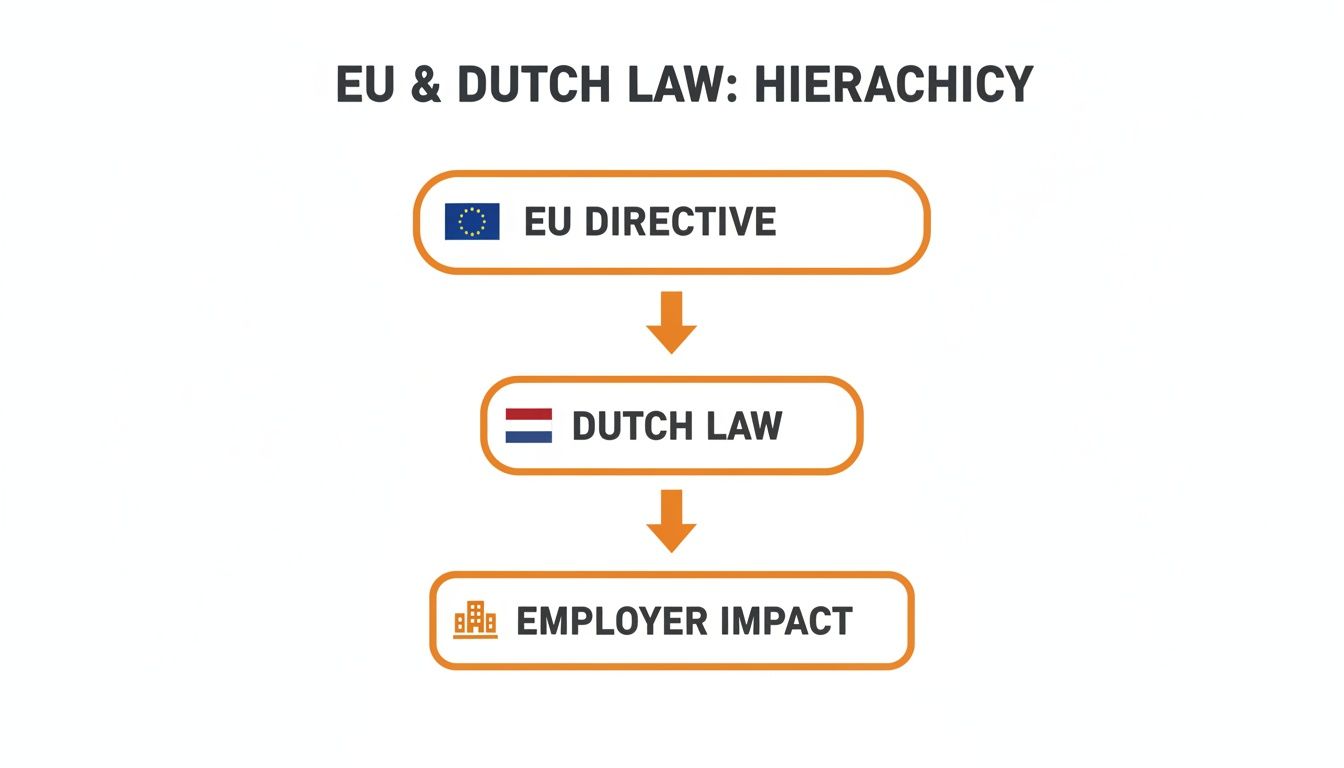
This flowchart makes it clear: while the principles start at the EU level, it’s the Dutch implementation that dictates the precise rules your business must follow.
Universal Duties for All Employers
No matter your company’s size, two foundational rules are set to become standard practice. These changes target the recruitment process directly, aiming to level the playing field for all candidates from their very first interaction.
- Ban on Salary History Questions: You will no longer be allowed to ask job applicants about what they previously earned. This rule is designed to break the cycle of pay inequality, where a lower salary in the past could unfairly drag down future offers.
- Pay Range Disclosure in Job Postings: All job vacancy notices must include the starting pay level or a clear salary range for the role. This proactive step ensures every candidate starts with the same baseline information, shifting the conversation from what a person used to make to what the job is actually worth.
These two requirements form the bedrock of the new legislation. They are straightforward but powerful tools for promoting fairness. For a broader overview of what’s expected, you can read our guide on general employer's obligations under Dutch law.
Tiered Reporting Based on Headcount
Beyond these universal duties, the legislation introduces specific reporting obligations that scale with your company's size. This is where the most significant administrative tasks come in, particularly for larger organisations.
The draft Dutch framework outlines a clear schedule. Companies with 150 or more employees will be the first to report, publishing gender pay gap information based on their 2027 pay data, with reports due in 2028.
Those with 100–149 employees have a lighter and less frequent schedule. They must report every three years, with their first submission covering 2030 pay data, due to be filed in 2031. For now, companies with fewer than 100 employees are exempt from this mandatory pay gap reporting.
The core idea behind this tiered system is proportionality. While every company must foster transparency in hiring, the burden of detailed statistical reporting is reserved for larger employers whose pay practices have a broader impact on the workforce.
To make these distinctions easy to follow, here is a breakdown of the key obligations by company size.
Employer Obligations by Company Size
This table provides a quick summary of the main salary transparency and reporting duties your company will face based on its employee headcount in the Netherlands.
| Obligation | Fewer than 100 Employees | 100–149 Employees | 150+ Employees |
|---|---|---|---|
| Pay Range in Job Postings | ✅ Required | ✅ Required | ✅ Required |
| Ban on Salary History Questions | ✅ Required | ✅ Required | ✅ Required |
| Mandatory Pay Gap Reporting | ❌ Exempt | ✅ Required (Every 3 years) | ✅ Required (Annually) |
| First Reporting Year | N/A | Based on 2030 data | Based on 2027 data |
| First Report Due | N/A | By end of 2031 | By end of 2028 |
| Joint Pay Assessment Trigger | ❌ Not Applicable | ✅ Triggered by >5% Gap | ✅ Triggered by >5% Gap |
This table serves as a quick reference, allowing you to instantly see which rules apply to your business. By focusing on your tier, you can direct your compliance efforts efficiently and ensure you are fully prepared for the changes ahead.
Building Your Practical Compliance Roadmap
Knowing the rules of the upcoming Dutch salary transparency legislation is one thing, but putting them into practice is where the real work begins. With the 2027 deadline on the horizon, creating a clear, step-by-step action plan is essential for a smooth transition. This isn't just about avoiding penalties; it's a chance to build a more robust, fair, and modern compensation system.

Think of the next few years as a project with distinct phases. Each one is designed to get you fully prepared. Approaching this proactively will turn what feels like a legal mandate into a genuine competitive advantage.
Phase 1: Conduct a Thorough Pay Equity Audit
Before you can build a transparent system, you need an honest look at your current one. An internal pay equity audit is your starting point—a confidential analysis designed to spot any existing pay disparities between employees doing similar work.
The process involves gathering and analysing compensation data—base salaries, bonuses, benefits—across different demographics like gender. The goal here is to find any statistically significant gaps that can't be explained by objective factors like experience, performance, or specific qualifications. Uncovering these gaps now lets you address them quietly and proactively, well before they become a public reporting headache.
This audit also provides the raw data you'll need to build your new salary structures, ensuring they are equitable from day one. Of course, handling this kind of sensitive employee data is critical, as it falls under strict privacy regulations. For more on this, our article on the role of the Dutch Data Protection Authority offers valuable insights.
Phase 2: Develop a Structured Job Architecture
A common source of pay inequity isn't malice, but a messy or poorly defined job structure. To properly comply with salary transparency, you absolutely need a clear job architecture. Think of it as a logical framework that organises every single role in your company into distinct levels.
This involves a few key steps:
- Defining Job Families: Group similar roles together (e.g., Marketing, Engineering, Sales).
- Creating Career Levels: Establish clear tiers within each family, such as Junior, Mid-Level, Senior, and Lead. Each level needs specific criteria for skills and responsibilities.
- Writing Consistent Descriptions: Ensure job descriptions for roles at the same level are standardised across departments. This is how you accurately reflect "work of equal value."
This structured approach removes ambiguity. It ensures that a "Senior Marketing Manager" and a "Senior Software Engineer" are evaluated on a consistent set of principles, even if their day-to-day tasks are completely different.
Phase 3: Establish Objective Salary Bands
With a solid job architecture in place, the next logical step is to create objective salary bands for each level. A salary band is the target pay range—from minimum to maximum—that your company decides is fair for a specific job level.
Crucially, these bands should be based on objective market data, not on what someone was paid in their last job. They provide a consistent framework for all your compensation decisions, whether you're hiring someone new or promoting from within. This structure gives you the flexibility to reward top performers with salaries at the higher end of the band while guaranteeing a fair and equitable baseline for everyone else in that role.
Phase 4: Update Policies and Train Your Team
The final piece of the puzzle is to embed these changes into your company's DNA. That means updating your internal policies and, just as importantly, training the people who have to implement them.
Your recruitment policies will need to be rewritten to explicitly forbid asking candidates about their salary history. All your job description templates must be updated to include the new salary bands. To ensure this all lands properly, your compliance roadmap must include robust training. You can explore actionable compliance training best practices to get started. The goal is to ensure your hiring managers understand the new rules and the "why" behind them, empowering them to navigate conversations about pay with confidence and consistency.
What Happens If You Don’t Comply? Navigating Enforcement and Penalties
Understanding the new salary transparency rules is one thing, but knowing what happens when things go wrong is just as critical. Falling short on compliance isn't a passive risk; it sets off a very specific and public enforcement process designed to root out and correct pay disparities. It’s always better to be proactive than to find yourself reacting to an official investigation.
The main enforcement body for these new rules will be the Netherlands Labour Authority (Nederlandse Arbeidsinspectie). This is the agency tasked with overseeing compliance, and it has the power to investigate companies that fail to meet their reporting and transparency obligations. Their involvement usually starts when a significant pay gap comes to light.
To get ahead of potential enforcement actions and penalties, it is crucial to have solid risk management strategies in place. A clear framework can help you spot, assess, and control threats to your organisation's compliance. For more on building such systems, you can check out a practical guide to risk management which offers valuable insights.
The Joint Pay Assessment Process
The most powerful enforcement tool under the new Dutch law is the Joint Pay Assessment. This isn’t just a simple fine or a warning letter. It’s a mandatory, deep-dive investigation into your company’s entire pay structure.
This assessment is triggered automatically if your pay gap report shows an average pay difference of more than 5% between genders that can't be justified by objective, non-discriminatory factors. When you cross that line, you're required to take immediate, structured action to fix it. It’s a formal process with tight deadlines and clear expectations.
What the Assessment Involves
Once triggered, the Joint Pay Assessment forces an employer to work directly with employee representatives—like a works council or union officials—to analyse and fix the pay gap. This is a hands-on, collaborative effort, not just a paperwork exercise.
Here are the key steps involved:
- Detailed Analysis: The company and employee representatives must team up to conduct a thorough investigation into what’s causing the pay gap.
- Developing an Action Plan: Based on that analysis, a concrete plan must be created to close the gap. This might mean adjusting salary bands, re-evaluating job roles, or changing promotion criteria.
- A Strict Six-Month Deadline: The whole process—from the initial analysis to finalising the action plan—has to be completed within six months. Missing this deadline can lead to more penalties.
This process effectively turns an internal compliance problem into a semi-public negotiation. It forces employers to not only find pay inequities but to work directly with their staff to build a fairer system, all under the watchful eye of regulators.
Fines and Reputational Damage
Beyond the Joint Pay Assessment, the legislation packs a financial punch. Companies that fail to submit their pay gap reports on time or don't meet their obligations during an assessment can face hefty fines from the Labour Authority.
But the financial cost might not be the worst part. The law includes provisions for publicly naming companies that have an uncorrected pay gap or have failed to comply with an assessment. Being put on that list can seriously damage a company’s brand, making it much harder to attract and keep top talent in the competitive Dutch market.
Turning Compliance into a Competitive Advantage
It’s easy to look at the new salary transparency legislation as just another legal hoop to jump through. But that’s a missed opportunity. Forward-thinking businesses are treating this shift not as a burden, but as a strategic tool to build a stronger, more competitive organisation. Embracing transparency can give you a real edge in the fierce war for talent.
Think of it like pricing in a shop. When a company clearly displays its prices, it signals confidence in its product and respect for its customers. The same principle applies here. Being open about pay shows confidence in your compensation structure and respect for your current and future employees.
Building Trust and Boosting Morale
For years, pay has been a taboo topic, often breeding suspicion and a feeling that the system isn’t fair. When employees don't know how their salary compares to their colleagues, they tend to assume the worst. This can quickly erode morale and trust in leadership.
Openness about compensation changes this dynamic completely. By implementing clear, objective salary bands, you remove the mystery and bring several key benefits:
- Increases Perceived Fairness: When staff understand the logic behind their pay, they're far more likely to see it as fair—even if they aren't at the top of their salary band.
- Boosts Motivation: A clear structure shows employees what they need to do to advance to the next level. It creates a tangible career path and motivates them to develop new skills.
- Reduces Workplace Gossip: Transparency minimises speculation and reduces the corrosive effect of rumours about who earns what.
This simple shift fosters a culture where employees feel valued and respected, leading to higher engagement and lower turnover. After all, a workforce that trusts its employer is a more productive and loyal workforce.
Enhancing Your Employer Brand
In today's competitive job market, your employer brand is one of your most valuable assets. Top-tier talent, especially in the Netherlands, has choices. More and more, they are drawn to companies that demonstrate a real commitment to fairness and equity.
Salary transparency is no longer just a perk; it's becoming a baseline expectation for many skilled professionals. Companies that resist this change risk being seen as outdated and untrustworthy, making it much harder to attract the best candidates.
By proactively publishing clear pay ranges, you send a powerful message to the market: we are a fair, modern, and confident employer. This simple act can dramatically improve the quality and quantity of your applicant pool. You’ll find yourself with access to talent your less transparent competitors may never even see.
Navigating Salary Negotiations with Confidence
One of the biggest anxieties for managers is how to handle salary negotiations under these new rules. The good news is that transparency actually makes these conversations easier and more objective.
With established salary bands, negotiations are no longer an open-ended haggle. The conversation is immediately grounded in a pre-defined, equitable range. This allows managers to focus the discussion on a candidate's specific skills, experience, and potential contributions to figure out where they fit within that band. It shifts the dynamic from a contest of wills to a collaborative discussion about value, creating a more positive experience for both sides right from the start.
Frequently Asked Questions About Salary Transparency
As businesses in the Netherlands get ready for the new salary transparency legislation, a lot of practical questions are coming up. Getting into the finer points of compliance can feel daunting, but a clear understanding of the key details will help make the transition much smoother. This section tackles some of the most common concerns we hear from Dutch employers.
How Do We Define Work of Equal Value?
Defining "work of equal value" is one of the core challenges. This isn't about comparing identical job titles. It's about looking deeper and assessing roles that demand a similar mix of skills, responsibilities, effort, and working conditions.
To get this right, you have to look beyond departmental silos. For instance, a Data Analyst in your IT department and a Financial Analyst in Finance might handle different day-to-day tasks, but both roles could require comparable levels of analytical skill, problem-solving, and responsibility. Under the new law, these could very well be considered "work of equal value," and their salary ranges should reflect that.
A solid job architecture, with clearly defined levels and objective criteria for evaluation, is your best defence for making these calls consistently.
Can We Still Offer Merit-Based Raises?
Absolutely. Salary transparency is not the end of performance-based pay. The crucial thing is to structure your salary bands to allow for that flexibility while keeping the system fair.
A properly designed salary band should have a minimum, a midpoint, and a maximum. New hires might start closer to the bottom of the range, while your experienced, high-performing employees can progress towards the top. This approach ensures everyone doing similar work is paid within a consistent, equitable range, but it still gives you room to reward individual performance and expertise.
The goal is to shift from subjective, ad-hoc pay decisions to a structured system. You can still reward excellence, but it has to happen within a transparent framework that applies to everyone in that role.
What Are the GDPR Implications?
Handling sensitive pay data correctly is non-negotiable. The General Data Protection Regulation (GDPR) requires a legitimate reason for processing personal data, and complying with this new legislation provides that basis. However, you must still stick to the core principles of GDPR.
This means you need to focus on:
- Data Minimisation: Only collect and analyse the pay data strictly necessary for your equity audit and reporting. Don't go beyond what's required.
- Access Control: Tightly restrict who in your organisation can see detailed, individual-level salary information.
- Purpose Limitation: Use the data only for pay equity analysis and legal compliance. It should not be used for other, unrelated purposes.
Being open with your team is essential. You should inform your employees that you are processing their data to meet your legal obligations on pay equity.
How Should We Handle International Employees?
Managing pay for international employees, particularly remote workers based outside the Netherlands, adds another layer to consider. If an employee is on a Dutch employment contract, this legislation covers them—no matter where they are physically located.
For employees hired on local contracts in other countries, Dutch law may not apply directly. However, maintaining internal equity is simply good practice. Many global companies are already aligning their compensation strategies with transparency principles. They often use location-based salary bands that factor in different market rates and living costs, all while ensuring the underlying job levels are valued consistently across the entire organisation.
At Law and More, our expert employment lawyers can help you navigate the complexities of the new salary transparency legislation. We offer practical guidance on conducting pay audits, structuring compliant salary bands, and updating your HR policies to ensure you are fully prepared for the 2027 deadline. Contact us today to build your compliance roadmap.