


When your reputation is on the line, especially online, understanding your rights is the first step toward defending yourself. Under Dutch law, online defamation isn’t just a vague concept; it’s defined by two specific offences found in the Dutch Criminal Code: ‘smaad’ (defamation) and ‘laster’ (libel). Knowing the difference is crucial for building a solid strategy to manage your reputation and fight back against harmful online statements.
Decoding Defamation Under Dutch Law
Think of your personal or business reputation as a digital storefront you’ve spent years building. Every positive review, professional milestone, and client testimonial adds to its value. Online defamation is like someone spray-painting graffiti all over it overnight. False or damaging statements can scare off potential customers, business partners, and employers, wrecking the credibility you worked so hard to establish.
To get to grips with online defamation and reputation management under Dutch law, you first need to understand the two legal pillars it rests on: ‘smaad’ and ‘laster’. People often use these terms interchangeably, but they have very precise legal meanings under Articles 261 and 262 of the Dutch Criminal Code. Getting this distinction right from the start will shape your entire legal approach.
The Core Concepts of Smaad and Laster
‘Smaad’, or defamation, is all about intentionally damaging someone’s honour or good name by publicising a specific accusation. What’s interesting here is that the statement doesn’t even have to be false. If someone spreads a damaging fact with the main intention of hurting you, it can still be considered ‘smaad’.
‘Laster’, or libel, is a step up in severity. This involves making a defamatory statement that you know is a lie. The key ingredients are malicious intent mixed with a proven falsehood. The need to prove the publisher was fully aware they were spreading a lie is what makes ‘laster’ a more serious offence. Digging into the legal solutions for insult, defamation, and slander can give you a clearer picture of where you stand.
Why the Battleground Is Now Online
The internet has completely changed the game. A single negative blog post, a nasty social media comment, or a fake review can spread to a global audience in the blink of an eye. This shift is clearly reflected in legal cases today. Online platforms have become the main arena for reputational battles, with an estimated 68% of defamation cases in the Netherlands now involving digital content. This trend underscores just how vital it is for individuals and businesses to understand their rights online.
Under Dutch law, the focus is less on whether a statement is strictly true or false, and more on the intention behind publishing it and the damage it does to a person’s or company’s honour and reputation.
To effectively manage an online attack, you have to know what you’re dealing with. Are you a victim of ‘smaad’ or ‘laster’? The table below breaks down the key differences to help you figure it out.
Key Differences Between Defamation (‘Smaad’) and Libel (‘Laster’)
Here’s a straightforward comparison to help you distinguish between the two. Understanding this framework is the first move in building an effective response.
| Legal Term | Dutch Criminal Code Article | Definition | Key Element |
|---|---|---|---|
| Defamation | Article 261 (Smaad) | Intentionally harming someone’s reputation by publicising an accusation. | The primary intent is to cause harm, even if the statement is factually true. |
| Libel | Article 262 (Laster) | Knowingly making a false public accusation with the intent to defame. | The statement is demonstrably false, and the publisher knows it is false. |
This isn’t just legal nitpicking; it dictates your entire strategy. With ‘laster’, you have a higher burden of proof because you must show the publisher knew what they were saying was false. With ‘smaad’, the case hinges on proving their intent was to harm your reputation, regardless of whether the statement was true. Figuring out which path applies to your situation is fundamental to successful online defamation and reputation management under Dutch law.
The Dutch Legal Framework for Reputation Protection
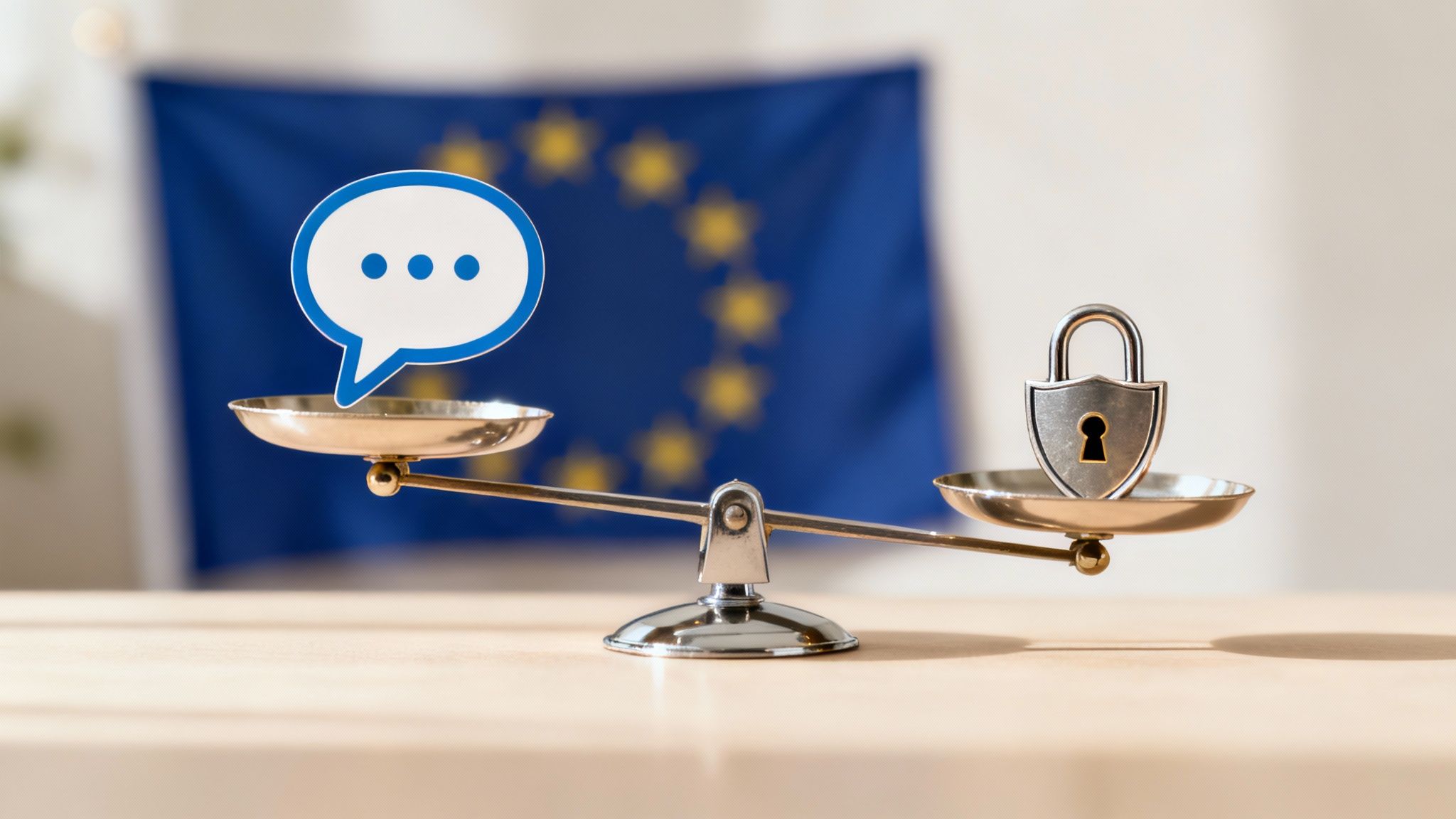
When you find yourself the target of online defamation, your first step toward taking back control is understanding the legal terrain. In the Netherlands, this isn’t a simple case of right versus wrong. Instead, Dutch courts perform a delicate balancing act between two fundamental rights, both protected by the European Convention on Human Rights (ECHR).
On one side of the scales, you have Article 10, the right to freedom of expression. On the other, there’s Article 8, the right to respect for private life, which is the cornerstone of your reputational rights. Every online defamation case boils down to a careful weighing of these competing interests. There’s no automatic winner; context is everything. The nature of the statement, its relevance to public debate, and the intent behind it are all thrown onto the scales.
This balancing act is the core principle you need to grasp about online defamation and reputation management under Dutch law. A statement that might be clearly unlawful in a private context could be protected speech if it touches on a matter of significant public interest.
Civil vs Criminal Proceedings
Now, while defamation is technically a criminal offence under the Dutch Criminal Code, prosecutions are surprisingly rare. For a criminal case to even get off the ground, the victim has to file a formal report with the police—a step many people are understandably hesitant to take. The process can feel slow and cumbersome, and the results are often limited to fines or community service, not the immediate removal of the harmful content.
This is precisely why the vast majority of defamation victims in the Netherlands turn to civil proceedings instead. This route is typically faster, more direct, and laser-focused on getting practical results. Think of things like:
- Content Removal: An injunction forcing the publisher to take down the defamatory statements.
- Rectification: A court order compelling the publisher to issue a public correction or apology.
- Damages: Financial compensation for the harm done to your reputation.
The civil court system is generally the most effective arena for reputation defence in the Netherlands. It offers swifter remedies tailored to stop the spread of harmful information and repair the damage, which is the primary goal for most victims.
This reality shapes the entire strategy for dealing with online attacks. While the threat of criminal charges exists in the background, your most powerful tools are found in civil law. It’s here that you can actively pursue injunctions and corrections to restore your good name. It’s still useful to understand the criminal liability for statements on social media, but the civil path is where most battles are actually won.
The Influence of European Law
The Dutch approach to defamation doesn’t exist in a vacuum; it’s heavily shaped by European legal standards. Dutch courts must align their rulings with the principles laid down by the European Court of Human Rights. This ensures that decisions in local cases respect the broader European protections for both privacy and free expression.
Leveraging GDPR and Data Protection
Beyond traditional defamation law, the General Data Protection Regulation (GDPR) gives you another powerful tool for your reputation management toolkit. If the defamatory content contains your personal data—like your name, photo, or other identifying details—it immediately falls under the scope of data protection law.
The Dutch Data Protection Authority, the ‘Autoriteit Persoonsgegevens’, is the body that oversees GDPR compliance here. You can leverage your rights under GDPR, such as the “right to erasure” (often called the “right to be forgotten”), to demand the removal of inaccurate or unlawfully processed personal data from websites and even search engines.
This approach can be incredibly effective because it shifts the argument. Instead of focusing on the publisher’s intent to defame, the focus becomes the lawfulness of them processing your personal information in the first place. It provides a distinct legal avenue for content removal, perfectly complementing the remedies available through civil defamation claims.
Your Action Plan for Removing Defamatory Content

Discovering that someone has posted defamatory content about you or your business online can be shocking, even paralysing. But a cool head and a methodical approach are your best allies. The key is to act quickly without being reckless. This means following a clear path that starts with simple requests and escalates toward formal legal action only if necessary. Taking this route gives you the best shot at getting the content removed quickly, while also building the paper trail you’ll need if things end up in court.
So, where do you begin? Always with the simplest, most direct option. Before you even think about lawyers, try reaching out to the person or organisation who published the content. A calm, professional email explaining why their statement is harmful and asking for it to be taken down can often do the trick. Many people, once faced with the potential fallout, will simply remove what they wrote.
If that doesn’t work, or if direct contact isn’t appropriate, your next stop is the platform itself. Big players like Google, Facebook, and X (formerly Twitter) all have “notice-and-takedown” procedures. These are built-in tools for reporting content that breaks their rules, which almost always include clauses against harassment and defamation. When you file a report, be specific. Point out the exact material and clearly explain how it violates the platform’s own policies.
Escalating to Formal Legal Measures
When those informal steps fail, it’s time to raise the stakes. The first formal move in online defamation and reputation management under Dutch law is sending a cease and desist letter, known locally as a ‘sommatiebrief’. This is much more than just an angry email; it’s a formal legal document that carries real weight.
Think of the ‘sommatiebrief’ as drawing a line in the sand. It officially notifies the publisher that you view their content as unlawful and are prepared to take legal action if they don’t remove it. This letter has two main jobs: first, to get the content down without going to court, and second, to create a crucial piece of evidence for any future legal fight.
A well-drafted ‘sommatiebrief’ needs to be firm, clear, and legally solid. To be effective, it absolutely must include:
- Specific Identification: Pinpoint the exact defamatory statements with URLs and screenshots.
- Legal Basis: Briefly explain why the content is unlawful under Dutch law (e.g., it constitutes ‘smaad’ or ‘laster’).
- Clear Demands: State exactly what you want them to do, like immediately removing the content and providing written confirmation.
- A Strict Deadline: Give them a reasonable but firm deadline for compliance, usually just a few days.
- Consequences of Non-Compliance: Make it clear that you will start legal proceedings if they miss the deadline.
In the Netherlands, sending this letter is a critical first step. It shows the court you made a good-faith effort to solve the problem before asking for their intervention.
Seeking Urgent Relief Through Court Action
What if the ‘sommatiebrief’ is ignored and the damaging content stays online, continuing to harm your reputation? Your next move is to start preliminary relief proceedings, known as a ‘kort geding’. This is essentially a legal fast-track, designed for urgent situations where you need a judge’s decision immediately to prevent more damage.
The ‘kort geding’ is tailor-made for online defamation cases. Harmful content spreads like wildfire on the internet, so a slow, traditional court process often isn’t enough. While normal legal proceedings can drag on for months or even years, a ‘kort geding’ can get you a hearing in just a few weeks.
A ‘kort geding’ provides a powerful, expedited path to a court-ordered solution. Its primary objective is to secure a provisional judgment, such as an injunction forcing the immediate removal of the defamatory content, while a more comprehensive case (if needed) proceeds on a longer timeline.
In the hearing, the judge will weigh the competing interests: your right to a good name versus the publisher’s freedom of expression. If the judge agrees that the content is clearly unlawful and that the situation is urgent, they can issue an order that takes effect immediately. This might be an order to take the post down, publish a correction, or even face financial penalties for failing to comply. Knowing how this process works is a vital part of any strategy for online defamation and reputation management under Dutch law.
Navigating these steps can feel overwhelming, which is why having a clear checklist is so helpful. It keeps you focused on the logical progression from simple requests to decisive legal action.
Online Defamation Response Checklist
| Step | Action | Objective | Typical Timeframe |
|---|---|---|---|
| 1 | Informal Contact | Reach out directly to the publisher via email or message. | Resolve the issue amicably and quickly. |
| 2 | Platform Takedown | Use the platform’s (e.g., Google, Facebook) official reporting tools. | Have the content removed for violating terms of service. |
| 3 | Cease & Desist Letter | Instruct a lawyer to send a formal ‘sommatiebrief’. | Put the publisher on legal notice and demand removal. |
| 4 | Preliminary Proceedings | Initiate a ‘kort geding’ for an urgent court order. | Secure an immediate injunction to remove the content. |
| 5 | Full Proceedings | (If necessary) Pursue a full court case for damages and a final ruling. | Obtain a final judgment and potential compensation. |
This checklist provides a clear roadmap. By following it, you ensure that you are taking measured, effective steps to protect your reputation without escalating the situation unnecessarily.
Dealing With Google And Social Media Platforms
Going after the person who posted the defamatory content is one way to tackle the problem, but let’s be realistic: the real power often rests with the platforms hosting it. Giants like Google, Facebook, and X (formerly Twitter) are the gatekeepers of online information. Knowing how to navigate their rules and legal obligations is a cornerstone of modern online defamation and reputation management under Dutch law.
These platforms are legally considered intermediaries or ‘hosting providers’. Under both Dutch and EU law, this gives them a special status. They generally aren’t liable for what users post on their sites unless they are formally notified that the content is unlawful and then fail to act. This is the basis for the ‘notice-and-takedown’ system, which is your most direct tool for getting harmful content removed.
The process involves sending a formal notice to the platform. This isn’t just a simple complaint; it’s a specific legal request. You must clearly identify the defamatory material (with URLs and screenshots) and explain precisely why it is unlawful according to Dutch law. If the illegality is clear-cut, the platform has a legal duty to take it down promptly.
When Takedown Requests Are Denied
Of course, it’s not always that simple. Platforms are often wary of removing content, fearing they might be accused of wrongfully censoring legitimate free speech. If a platform denies your takedown request, your next step is likely getting a court order. A formal ruling from a Dutch court declaring the content unlawful puts immense pressure on the hosting provider to comply and remove it.
Beyond a single defamatory post, you might find yourself targeted by a wider online harassment campaign. These situations require swift action on multiple fronts, often with support from specialised services like online harassment investigations. Understanding the platform’s role is absolutely key to fighting these broader battles for your online safety.
Defamatory business reviews are a particularly thorny issue. Knowing how to handle a flood of negative or outright false Google reviews is a critical skill in reputation management. For specific advice on this common business challenge, have a look at our detailed guide on the consequences of posting false Google reviews.
The Public Interest Defence
One of the biggest hurdles you might encounter is the ‘public interest’ defence. Dutch courts have consistently shown that even if content is damaging to someone’s reputation, it might be allowed to stay online if it serves a greater public good. This principle forces a constant balancing act between an individual’s right to privacy and the public’s right to information.
The ‘right to be forgotten’ isn’t a magic wand to erase your past. When personal history crosses into matters of public concern, Dutch courts will often prioritise the public’s right to access that information, even if it causes significant reputational harm.
A landmark case brought this into sharp focus. In Plaintiff v. Google Netherlands BV, the Amsterdam Court of Appeal ruled that Google did not have to remove search results linking to a person’s conviction for a very serious crime: soliciting murder. The plaintiff argued the information was old and was destroying his ability to rebuild his life. The court, however, saw it differently.
It concluded that the public’s interest in knowing about such a severe crime outweighed the individual’s privacy rights. The court essentially said the plaintiff had to “bear the consequences of his own actions” because the crime was still relevant to public discourse and safety. You can find more details about this crucial case and its impact on the Global Freedom of Expression site at Columbia University. This ruling sets a powerful precedent, proving that successful online defamation and reputation management under Dutch law requires a clear-eyed assessment of whether the content in question touches on a matter of genuine public interest.
Building a Resilient Online Reputation
While reacting to defamatory content is a crucial part of defending your reputation, the most effective long-term strategy is always a proactive one. Instead of just putting out fires, the aim is to build a digital fortress that can easily weather future attacks. It’s about creating a strong, positive online footprint that you command, making it far harder for negative content to ever get a foothold.
Think of your online reputation like a digital garden. If you actively cultivate positive content, you create a thick canopy that starves any weeds of sunlight before they can even sprout. The more positive assets you own and control on the first page of Google, the less impact a single negative article or review will have.
This forward-thinking approach to online defamation and reputation management under Dutch law is about shifting from defence to offence. It’s about taking control of your own narrative so powerfully that isolated attacks simply fail to make a dent.
Securing Your Digital Assets
The bedrock of a strong online reputation is ownership. The very first step is to secure the key digital properties connected to your name or your business’s brand. This creates a buffer of controlled content that you can fill with positive, accurate information.
Your immediate focus should be on securing these core assets:
- Domain Names: Go out and purchase the .nl, .com, and other relevant domain extensions for your name or brand. Even if you don’t plan to build a full website on each one, owning them stops anyone else from doing so.
- Social Media Handles: Claim your name on major platforms like LinkedIn, X (formerly Twitter), Instagram, and Facebook. For professionals and executives, a complete and polished LinkedIn profile is particularly powerful.
- Professional Profiles: Set up profiles on directories or platforms relevant to your industry. For businesses, this absolutely includes a Google Business Profile.
By owning these key pieces of digital real estate, you start to dominate the search engine results pages (SERPs) for searches of your own name. This naturally pushes down uncontrolled or potentially negative content, making it far less visible.
The Power of Proactive SEO
Search Engine Optimisation (SEO) isn’t just a marketing tool; it’s an essential weapon for reputation management. The goal here is to create and promote high-quality content that ranks at the very top of Google for searches related to you or your business. When you control the top results, you control the conversation.
Consider creating content like:
- A professional personal or corporate website.
- Thought-leadership articles published on platforms like Medium or LinkedIn.
- Positive media mentions or press releases.
- Guest posts on reputable blogs within your industry.
Every piece of positive content you create is another asset pushing negative items further down the search results, into the territory where over 90% of users will never venture. Looking beyond specific instances of defamation, proactively building a strong online presence is absolutely critical. For more in-depth strategies for lawyer reputation management, there are many valuable resources that detail these SEO-driven tactics.
Monitoring and Constructive Engagement
A resilient reputation demands constant vigilance. You can’t defend against threats you don’t know exist. Putting a media monitoring strategy in place is non-negotiable for catching negative mentions early, before they have a chance to spiral.
Early detection is the cornerstone of effective reputation management. It transforms a potential crisis into a manageable issue, giving you the critical advantage of time to respond strategically rather than emotionally.
Simple tools like Google Alerts can be set up for free to monitor mentions of your name or brand. For more comprehensive tracking, paid services can monitor conversations across social media, forums, and news sites in real-time.
When you do come across criticism, how you respond is everything. Reacting defensively or aggressively almost always backfires; it amplifies the original complaint and makes you look unprofessional. A far more effective path is a constructive one. Acknowledge the feedback, try to take the conversation offline, and focus on finding a resolution. This shows transparency and a commitment to doing right by your clients or customers, often turning a negative into a positive. This measured response is a key skill in any long-term plan for online defamation and reputation management under Dutch law.
Frequently Asked Questions About Dutch Defamation Law
When you’re staring down the barrel of online defamation, the legal side of things can feel overwhelming. Let’s cut through the noise and answer some of the most common questions that come up when dealing with reputation management under Dutch law.
How Much Does It Cost To Pursue A Defamation Case?
The costs really depend on how complex the situation is and which path you decide to take. Your first, and most cost-effective, legal move is usually sending a formal cease and desist letter, known in Dutch as a ‘sommatiebrief’. This step can cost anywhere from a few hundred to a couple of thousand euros.
If things escalate to preliminary relief proceedings (‘kort geding’), the costs will naturally go up. You’ll be looking at court fees, your lawyer’s hours, and possibly fees for a bailiff (‘deurwaarder’). It’s worth knowing that in the Netherlands, the losing party is usually ordered to pay a portion of the winner’s legal costs, but this rarely covers the entire bill. The best advice? Have a frank conversation about all potential costs with your lawyer right from the start.
How Long Does The Legal Process Take?
The timeline can vary wildly. If you can sort things out informally or if a cease and desist letter does the trick, you could have the matter resolved in just a few weeks. This is always the best-case scenario.
A ‘kort geding’, however, is specifically designed for urgent matters. You can typically get a court hearing and a provisional ruling within two to six weeks, which makes it a powerful tool for getting defamatory content offline quickly. Full-blown traditional court proceedings are a different story; they are much slower and can take anywhere from six months to over a year to reach a final judgment.
What If The Attacker Is Anonymous?
Facing an anonymous attacker is a common headache in online defamation, but it’s not a dead end. While you can’t sue a ghost, Dutch law provides clear ways to unmask them.
Your lawyer can file a request with the court to order the hosting provider, internet service provider (ISP), or social media platform to hand over the identity of the anonymous user. To get the court to agree, you’ll generally need to show that:
- You have a plausible claim that what was said is defamatory.
- You have a legitimate reason for needing their identity.
- There isn’t a less intrusive way to solve the problem.
This procedure, often handled through an ex parte order, is a surprisingly effective way to deal with anonymous online harassment.
Anonymity is not a guaranteed shield in the Netherlands. The law provides clear pathways for victims of serious online defamation to identify their attackers by compelling online platforms to disclose user data through a court order.
How Do I Know If I Have A Strong Case?
Whether you have a strong case boils down to a few key elements under Dutch law. First, you have to be able to prove that a specific, damaging statement was made in public and that it’s clearly about you or your business.
Second, the court will perform a crucial balancing act. It will weigh your right to protect your reputation (under Article 8 of the ECHR) against the other party’s right to freedom of expression (Article 10 of the ECHR). Your case gets stronger if the statement is presented as a fact rather than an opinion, isn’t part of a legitimate public debate, and has caused real, demonstrable harm to your honour or good name. This is why gathering solid evidence like screenshots and witness accounts is absolutely vital.