


Here's a critical detail about NFTs that catches many people by surprise: under Dutch law, buying a Non-Fungible Token (NFT) does not automatically mean you own the copyright to the artwork it represents. It’s a common and costly misconception.
What you acquire is undisputed ownership of the digital token itself—the unique, verifiable entry on the blockchain. But the rights to the creative work it links to? That’s a completely different legal matter, one governed by the specific terms of a contract. Think of it like owning a certificate of authenticity for a famous painting, not the right to reproduce it.
The Crucial Split: Understanding Token vs. Asset
When you purchase an NFT in the Netherlands, you are dealing with two legally distinct components. Grasping this separation is the single most important step in understanding what you've actually bought and how to protect your investment.
To fully appreciate this, it helps to understand the broader context of What Is a Digital Asset? A Practical Explainer, as NFTs are just one piece of a much larger puzzle. Under Dutch law, the two parts of your NFT purchase are treated very differently:
- The NFT Token: This is what you own in the traditional sense. It’s a cryptographic token on a blockchain that serves as a secure and verifiable digital ledger entry. You have full control—you can hold it, sell it, or transfer it to another party.
- The Underlying Asset: This is the creative work itself—the digital art, music file, or video clip. Your rights here are not about ownership. Instead, they are typically a set of permissions, known as a licence, granted to you by the original creator.
This relationship is where the legal nuances lie. Let’s break it down further.
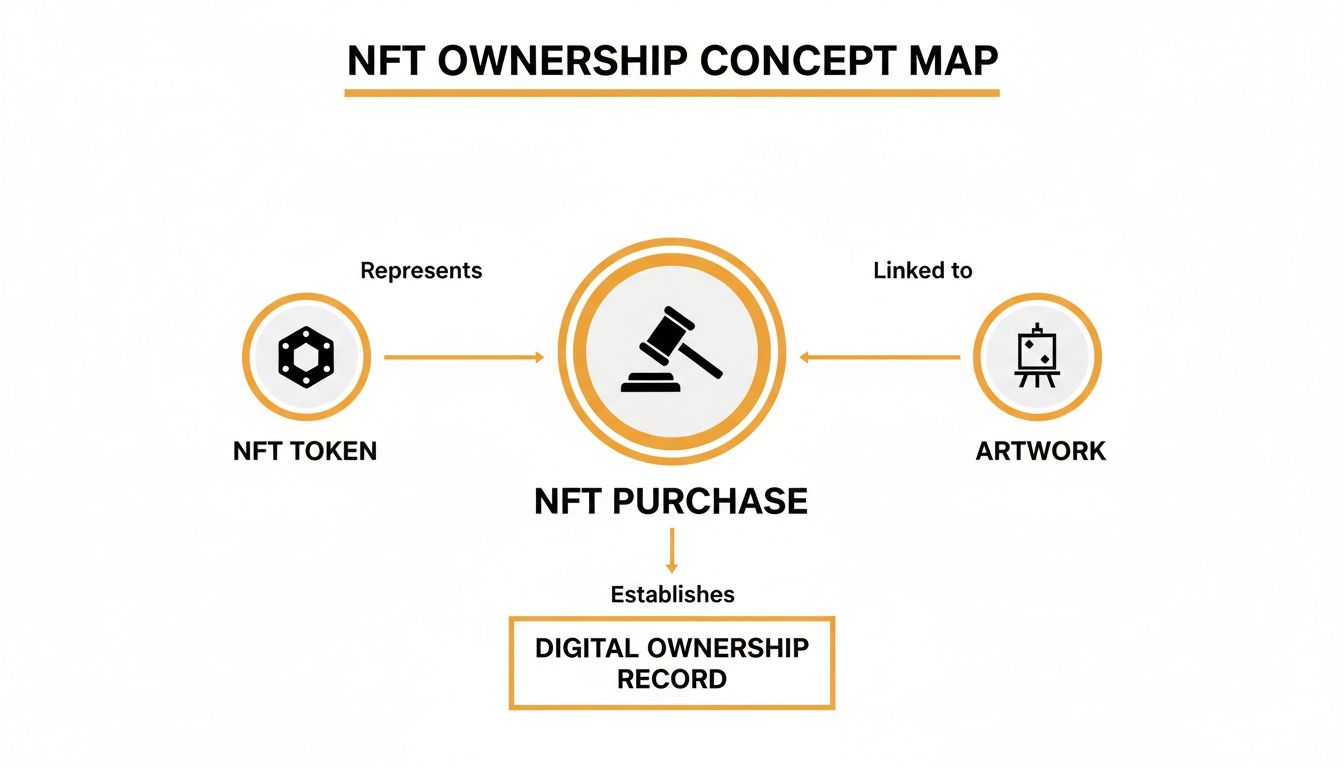
As this illustrates, the NFT is simply the verifiable link to the artwork; it is not the artwork itself.
What You Get vs. What You Don't Get With Your NFT
To make this distinction clear, let's compare the rights you have over the token versus the rights you acquire for the underlying asset.
| Legal Aspect | Your Rights to the NFT Token | Your Rights to the Underlying Asset (e.g., Artwork) |
|---|---|---|
| Ownership | Full and absolute ownership. You can hold, sell, or transfer it. | Typically none. The creator retains legal ownership and copyright. |
| Control | You have complete control over the token in your digital wallet. | Very limited. Your actions are restricted by the licence terms. |
| Usage Rights | N/A (It's a record of ownership, not a usable asset itself). | Defined by the licence. This could be for personal display only, or in rare cases, limited commercial use. |
| Commercialisation | You can sell the token for profit, just like any other asset you own. | Usually prohibited. You cannot reproduce, modify, or sell copies of the artwork unless explicitly permitted. |
| Transfer of Rights | When you sell the token, ownership of that token transfers to the new buyer. | When you sell the token, the new buyer only acquires the same limited licence rights that you held. |
This table highlights why you must always scrutinise the terms and conditions. The real value and utility of your NFT are defined within that licence agreement.
Analogy: Owning a Print vs. Owning the Copyright
A helpful way to understand this is by looking at the traditional art world. Imagine you buy a limited-edition, signed print from a famous photographer.
You own that specific piece of paper. You can frame it, hang it on your wall, or sell it to another collector. It is your property.
However, you do not own the copyright to the photograph. You cannot legally start making your own copies to sell at a market. You cannot use the image in an advertisement for your business. And you certainly cannot stop the photographer from selling more prints from the same negative.
Your NFT functions in almost the exact same way. It is a unique, verifiable 'print' of the work, but the creator retains all significant intellectual property rights.
The core of NFT ownership rights in the Netherlands lies not in the token itself, but in the specific terms of the license agreement attached to it. This contract dictates what you can—and, more importantly, what you cannot—do with the associated artwork.
This means your focus as a buyer or creator must always be on the contractual terms of the sale. Those terms define the scope of the licence, which could range from simple rights for personal display to broader commercial usage rights. Without a clear contract that explicitly transfers copyright, you must assume the creator holds all key rights under Dutch law.
Navigating Dutch Intellectual Property and Copyright Law for NFTs
Now that we have established the distinction between the token and the asset, we must examine the most critical legal area shaping NFT ownership rights in the Netherlands: intellectual property law. This is where the real value—and the potential pitfalls—of your NFT truly lie.
Under the Dutch Copyright Act (Auteurswet), the creator of an original work automatically holds the copyright from the moment of its creation. This is a powerful, automatic protection that requires no formal registration to be valid.
When an artist mints a digital painting as an NFT and sells it, they are not selling the copyright. This is a crucial legal point. Unless a formal, written agreement explicitly states otherwise, the artist retains the full copyright to their work. In Dutch law, this is the default position.
What You Are Actually Buying Is a Licence
If you are not acquiring the copyright, what do you own? You are acquiring a licence. The best way to think of this licence is as a specific set of permissions detailing exactly how you can use the artwork linked to your NFT.
The terms of this licence are paramount. You will typically find them in the description on the NFT marketplace, in a separate document linked from the page, or sometimes coded directly into the smart contract itself. Overlooking these terms is like buying a house without reading the deed—you may face unpleasant surprises later about what you can and cannot do.
For example, a licence might grant you the right to:
- Display the artwork on your personal social media profiles.
- Use it as your avatar in virtual worlds.
- Print a single copy for display in your home.
Conversely, that same licence will almost certainly forbid you from:
- Creating merchandise (like t-shirts or posters) using the artwork.
- Using the art in a commercial project or an advertisement.
- Altering the original piece or creating derivative versions.
This is precisely why a firm grasp of Dutch intellectual property is essential. For a broader overview, please review our comprehensive guide to intellectual property law in the Netherlands.
Practical Scenario: An Artist Sells a Digital Painting
Let's consider a real-world example. An Amsterdam-based digital artist creates a unique piece of generative art and lists it for sale as an NFT on a major marketplace. A collector in Eindhoven purchases it.
The collector now owns the NFT token, providing verifiable proof of their purchase on the blockchain. The licence terms clearly state they have the right to non-commercial display. Consequently, the collector uses the image as their Twitter profile picture and displays it on a digital frame in their living room. All of this is perfectly permissible.
However, if that collector then decides to print the artwork on hoodies and sell them online, they would be infringing on the artist’s copyright under Dutch law. The artist would have every right to take legal action, because the copyright was never transferred. The NFT only ever granted a limited, personal-use licence.
Under Dutch law, the transfer of copyright must be explicit and in writing. The mere sale of an NFT is insufficient to transfer these fundamental rights, making the licence agreement the single source of truth for a buyer's permissions.
The Dutch NFT market is growing rapidly, with forecasts indicating significant revenue increases. This growth brings critical legal questions to the forefront, especially where intellectual property rights intersect with the Dutch Civil Code (Burgerlijk Wetboek). While buyers receive tokenised proof of ownership, their legal title to the underlying work depends entirely on clear copyright transfers and enforceable contracts—areas that are often a source of dispute.
Structuring Rights for Creators
If you are a creator, understanding these rules is fundamental to protecting your work and securing your long-term income. When you mint an NFT, you must carefully structure the licence terms to match your intentions. Do you want to permit commercial use? Do you wish to earn a royalty on every resale?
Conditions such as a 10% royalty on all secondary sales can be coded directly into the smart contract. This setup ensures that every time the NFT changes hands on a compatible marketplace, a percentage of the sale price is automatically transferred to your digital wallet. This is a powerful feature unique to NFTs, but its legal enforceability depends on a well-drafted initial agreement. By defining the licence clearly, creators can protect their intellectual property and build a secure, ongoing revenue stream.
How Dutch Contract Law Shapes Your NFT Transactions
When you click “buy” on an NFT, you are doing more than acquiring a digital item; you are entering into a legally binding contract. Under Dutch law, this digital transaction is governed by the same core principles that apply to any other agreement, even though it occurs almost instantaneously on the blockchain.
A legally binding agreement, according to the Dutch Civil Code (Burgerlijk Wetboek), requires three key elements: an offer, an acceptance, and a clear understanding of what is being exchanged. In the NFT world, the marketplace listing constitutes the offer, your click to purchase is the acceptance, and the smart contract executes the exchange—swapping the token for your payment. This automated process is generally considered a valid and enforceable contract in the Netherlands.
Is an NFT a ‘Good’ or Something Else Entirely?
A crucial question under Dutch law is how to classify an NFT. Is it a tangible ‘good’ (zaak), like a physical painting? Or is it something different, such as a service or a digital right? The answer is significant because it affects your legal protections, particularly concerning consumer rights.
Currently, Dutch law does not have a specific category for digital assets like NFTs. They are not considered ‘goods’ because they are not tangible. Instead, they are typically treated as a unique type of property right (vermogensrecht). This distinction is key, as many consumer protection rules that automatically apply to purchases of physical items may not cover your NFT transaction.
This legal ambiguity makes the terms of sale critically important. The contract must be explicit about what is being sold, what rights are included, and the responsibilities of both the buyer and the seller.
The Smart Contract as Your Legal Agreement
The smart contract that executes your NFT purchase is more than just code; it is the engine of your legal agreement. It performs its function perfectly: transferring the NFT to your wallet as soon as your payment is confirmed. However, the code itself rarely tells the whole story. It will not cover matters like warranties, specific usage rights, or dispute resolution.
In the eyes of Dutch law, a transaction is a contract. A smart contract automates the execution, but the underlying legal principles of offer and acceptance remain paramount. Any ambiguity or dispute will be resolved by examining the broader terms presented at the point of sale, not just the code.
Dutch courts are becoming more familiar with blockchain-based agreements. The legal landscape for NFT ownership rights in the Netherlands has been shaped by a progressive approach to intellectual property. Since 2021, court precedents have emerged that acknowledge blockchain records as strong evidence of ownership. A pivotal 2022 decision, influenced by the Dutch Supreme Court, further cemented the binding nature of smart contracts. This gives NFT buyers rights that are analogous to traditional deeds, though with important differences. You can find more details on these developments and explore in-depth NFT statistics and legal precedents on electroiq.com.
Practical Advice for Clear and Sound Transactions
To ensure your NFT dealings are legally robust under Dutch law, clarity is essential. Relying solely on a marketplace’s standard terms and conditions is a risk for both parties.
For creators and sellers, it is vital to:
- Draft Explicit Licence Terms: Specify exactly what the buyer can and cannot do with the art. Is it for personal display only, or does it include commercial rights? Be precise.
- Include Warranties and Disclaimers: State clearly that you are the original creator and have the right to sell the NFT. Where permitted by law, define the limits of your liability.
- Define Dispute Resolution: Decide upfront how disagreements will be handled. Specify the governing law and the jurisdiction where legal action may be brought.
For buyers, the advice is even simpler:
- Read Everything: Review all terms and conditions before you purchase. If the usage rights are unclear, the safest assumption is that they are highly limited.
- Verify the Seller: Conduct due diligence on the creator. A legitimate artist will have a verifiable track record and online presence.
- Document the Purchase: Keep your own records. This includes screenshots of the listing, the transaction hash on the blockchain, and a copy of the terms you agreed to.
By treating every NFT purchase as the formal contract it is, you can better protect your rights and avoid potential pitfalls in this complex legal domain.
Handling Disputes and Enforcing Your Rights in the NFT Space
When an NFT transaction goes wrong, the decentralised nature of the market can make you feel powerless. Perhaps you bought a counterfeit, discovered your art was minted without permission, or you are a creator not receiving promised royalties. Whatever the issue, it is crucial to understand that you have tangible legal options under Dutch law.
Of course, NFT disputes present unique challenges. One of the biggest hurdles is identifying the counterparty, as many users operate pseudonymously. Another is jurisdiction—which country's courts should hear the case? Despite these complexities, you are not without recourse.
Your First Legal Step: The Notice of Default
Before considering court action, the standard first step in a Dutch contractual dispute is to send a formal notice of default, known as an ingebrekestelling. This is a written demand giving the other party a final, reasonable opportunity to fulfil their side of the agreement.
This notice serves two important functions. First, it legally places the other party in default, a prerequisite for claiming damages. Second, it often resolves the issue without the need for further legal proceedings.
The blockchain’s immutable ledger, often seen as a purely technical feature, can become your strongest piece of evidence in a legal dispute. Every transaction, timestamp, and smart contract is permanently recorded, providing a Dutch court with a clear, verifiable trail of events.
Taking the Matter to a Dutch Court
If the notice of default is ignored, your next option is to initiate legal proceedings. While the challenge of anonymity remains, it is not insurmountable. Dutch courts have the authority to order NFT marketplaces or crypto exchanges to disclose user information when a legitimate legal claim is presented.
When building a legal case, the ability to clearly articulate your position is essential. If you find yourself in this situation, understanding the principles of drafting persuasive legal briefs can be invaluable.
Common NFT Disputes and How They Are Handled
Different conflicts require different legal strategies. Here is a brief overview of how some common issues are typically approached in the Netherlands:
- Counterfeit NFTs: If someone sells you an NFT linked to artwork they do not own, this constitutes a clear breach of contract and potentially fraud. You have the right to sue for the return of your payment plus any additional damages.
- Copyright Infringement: Has someone used your copyrighted work to mint an NFT without your permission? You can demand they cease the infringing activity and seek financial compensation. Our firm provides more detail on how to handle intellectual property disputes in the Netherlands.
- Unpaid Royalties: For creators, this is a significant concern. If a smart contract was designed to pay you royalties on secondary sales but is failing to do so, that is a breach of the sales agreement. You can enforce this right through the courts.
Successfully navigating a dispute requires a strategy that combines solid blockchain evidence with established Dutch legal principles. By taking organised, methodical steps, you can effectively protect your assets and enforce your rights in this new digital frontier.
Understanding Tax and AML Rules for Dutch NFT Holders
Engaging with NFTs in the Netherlands involves more than just contracts and copyright; it also requires navigating a web of financial regulations. Every transaction, from minting a new token to selling it on a marketplace, can have tax implications. Furthermore, the platforms you use must adhere to strict anti-money laundering (AML) rules. A firm grasp of these obligations is crucial to remain compliant and avoid significant penalties.
The financial side of NFT ownership rights in the Netherlands demands careful attention. Like any other valuable asset, NFTs are subject to taxation, and the Dutch Tax and Customs Administration (Belastingdienst) has specific rules for how they must be declared.
Navigating Dutch Tax Obligations
For individuals, your NFT activities will most likely fall into two tax categories: wealth tax and income tax. If you operate as a business, you will also need to consider VAT. Determining where your activities fit is the first and most important step.
-
Value Added Tax (VAT / BTW): When a creator or a business sells an NFT, Dutch law generally classifies this as a digital service. This means VAT (known as BTW in the Netherlands) is usually applicable. The standard rate is 21%, and it is the seller's responsibility to charge this to the buyer and remit it to the tax authorities.
-
Income Tax from Trading: Are you buying and selling NFTs regularly for profit? If your trading activity resembles a business endeavour rather than simple asset management, any profits could be classified as income from other activities (resultaat uit overige werkzaamheden). If it is a more organised operation, it could even be considered business income. In either case, these profits are taxed in Box 1 of the Dutch income tax system, where rates can be as high as 49.50%.
-
Wealth Tax (Box 3): For most casual investors, NFTs are considered assets that contribute to your net worth. You are required to declare the fair market value of your entire NFT collection as of 1 January each year as part of your Box 3 assets. This figure is then used to calculate your annual wealth tax. While valuing a volatile asset like an NFT can be challenging, the rule is clear: you must use the market price on that specific reference date.
Anti-Money Laundering (AML) Compliance
The often-anonymous nature of crypto transactions has put regulators on high alert for potential misuse. Consequently, the Dutch Anti-Money Laundering and Anti-Terrorist Financing Act (Wwft) has been extended to cover the digital asset space.
While individual NFT traders are not directly regulated by the Wwft, the platforms and exchanges they use are. These companies have a legal duty to monitor transactions and report any suspicious activity to the authorities.
In practice, this means that any NFT marketplace operating in the Netherlands has significant compliance obligations. They must:
- Conduct Customer Due Diligence (CDD): This involves verifying the identity of their users, often through "Know Your Customer" (KYC) checks.
- Monitor Transactions: Platforms must implement systems to detect unusual trading patterns that could indicate money laundering.
- Report Suspicious Activity: If a transaction raises a red flag, they are legally required to report it to the Dutch Financial Intelligence Unit (FIU-Nederland).
For you as a user, this means you should expect to provide personal identification to use a compliant platform. It also means that very large or unusual transactions might trigger additional scrutiny.
Dutch Tax Obligations for NFT Holders and Creators
Here is a quick overview of the primary tax considerations for individuals and businesses involved in NFT transactions in the Netherlands.
| Tax Type | Who It Applies To | Key Considerations and Rates |
|---|---|---|
| Value Added Tax (VAT/BTW) | Creators and businesses selling NFTs. | Considered a digital service. The standard rate is 21%. Sellers must charge and remit this tax. |
| Income Tax (Box 1) | Individuals actively trading NFTs for profit. | Profits may be taxed as 'resultaat uit overige werkzaamheden' or business income. Rates can reach up to 49.50%. |
| Wealth Tax (Box 3) | Individuals holding NFTs as investments. | NFTs must be declared as assets. Their fair market value on 1 January is used to calculate the annual wealth tax. |
Understanding these points is fundamental for anyone participating in the NFT ecosystem in the Netherlands, whether as a creator, seller, or investor.
Staying informed about these regulations is essential, especially as the EU continues to implement broader frameworks. You can learn more about how new rules are shaping the digital asset world by reading our article on crypto and blockchain law under the EU's MiCA regulation. By understanding your tax duties and the AML framework, you can navigate the NFT market with confidence.
A Practical Checklist for Dutch NFT Creators, Buyers, and Sellers
Navigating the legal complexities of NFT ownership in the Netherlands can be challenging. To provide clarity, this guide has been distilled into a straightforward checklist. Use it to mitigate common risks, make informed decisions, and engage with the Dutch NFT market with greater confidence that your interests are protected.
Checklist for Buyers
Before you consider purchasing an NFT, conducting thorough due diligence is essential. It is not just about protecting your investment; it is about understanding precisely what you are acquiring.
- Scrutinise the Licence Terms: This is the most critical step. Read the licence agreement as if your investment depends on it—because it does. What can you actually do with the art? Is it for personal display only, or can you use it commercially? If the terms are ambiguous, assume your rights are extremely limited.
- Investigate the Creator’s Background: Who are you buying from? Research their history. A verifiable on-chain track record and a credible presence on social media or other platforms are positive indicators. This simple step can help you avoid counterfeits and scams.
- Confirm Smart Contract Details: Ensure the smart contract on the blockchain matches the one being advertised. Details matter, so look for elements like creator royalties and verify they align with the marketplace listing.
- Document Everything: Keep a comprehensive record of your purchase. Take screenshots of the sales page, any seller promises, and the full licence terms. Save the blockchain transaction hash. This documentation will be invaluable if a dispute arises.
Checklist for Creators and Sellers
If you are creating or selling NFTs, your primary goals are protecting your intellectual property and ensuring legal compliance. Addressing these points from the outset can prevent future complications and safeguard your revenue.
- Be Explicit on Licence Scope: Do not leave terms open to interpretation. Clearly define the rights you are selling. An unambiguous agreement stating what the buyer can and cannot do is the cornerstone of protecting your copyright.
- Warrant Your Originality and Ownership: Your terms of sale must include a warranty. This is your formal declaration that you are the original creator of the work and that you possess the full legal right to mint and sell it as an NFT.
- Ensure VAT Compliance: In the Netherlands, NFT sales are typically classified as digital services and are subject to 21% VAT (BTW). You must be registered and prepared to collect and remit this tax to the Belastingdienst. Do not overlook this obligation.
- Embed Royalties in the Smart Contract: If you wish to earn from future sales, ensure this royalty mechanism is correctly coded into your smart contract from the beginning. While the technology automates payments, the initial sales agreement must support it for it to be legally enforceable.
Frequently Asked Questions
Here we address some of the more specific, practical questions that arise concerning NFT ownership rights in the Netherlands, providing straightforward answers to common legal issues.
What Happens to My NFT If the Marketplace Shuts Down?
If an NFT marketplace ceases operations, your direct ownership of the NFT token itself remains secure. This is because the token exists on the blockchain—a decentralised network—not on the marketplace’s private servers. You can still access and manage it through your personal crypto wallet.
The primary risk, however, relates to the metadata—the link to the actual artwork or digital file. If the marketplace hosted that file, its disappearance could leave your token pointing to a dead link, effectively severing the connection to the art. This highlights the importance of decentralised storage solutions like IPFS for protecting the long-term value of your asset.
Can I Use My NFT as Collateral for a Loan Under Dutch Law?
Yes, it is legally possible to use an NFT as collateral for a loan in the Netherlands. Dutch law classifies an NFT as a property right (vermogensrecht), which means it can be subject to a right of pledge (pandrecht), a standard form of security interest.
To make it legally binding, you and the lender must execute a formal pledge agreement. This contract must clearly identify the specific NFT being used as collateral and detail the terms of the loan. While the legal framework exists, practical challenges often lie in valuation and enforcement in the event of a default.
Do Moral Rights Still Protect NFT Artists in the Netherlands After a Sale?
Absolutely. Under the Dutch Copyright Act, moral rights (droit moral) are entirely separate from economic copyrights and are non-transferable. Even after selling an NFT, the original creator retains these fundamental protections.
These rights include:
- The right of attribution: The creator can always demand to be identified as the artist.
- The right of integrity: The creator can object to any alteration of the work that could harm their reputation or honour.
This means a buyer cannot alter the underlying artwork or display it in a prejudicial context without risking legal action for infringing the artist's moral rights.
How Is Fractional NFT Ownership Legally Structured?
Fractional ownership, where multiple individuals own shares in a single NFT, is typically structured as a form of joint ownership under Dutch law. Legally, this creates a "community of property" (gemeenschap) among the co-owners.
The rights and obligations of each owner are governed by an agreement between them. This contract is crucial. It should clearly define decision-making processes (such as voting on a sale), how profits are distributed, and the procedure if a co-owner wishes to sell their share. Without a robust agreement, disputes are almost inevitable and become exceedingly difficult to resolve.
At Law & More, our team of legal experts provides clear, pragmatic advice on the complex intersection of technology and law. If you are dealing with an NFT dispute or require guidance on structuring a digital asset transaction, contact us for a consultation.