



Dutch employment law can puzzle even seasoned professionals, especially with its uniquely detailed terms and protections. Here is something not many anticipate. The mandatory holiday allowance offers each employee an extra 8 percent of their annual gross salary on top of regular pay. Dutch rules do not just pile on paperwork; they quietly shape one of the fairest and most structured workplaces in Europe.
Table of Contents
- Key Employment Law Terms Explained
- Unique Dutch Employment Concepts To Know
- Essential Terms For Employers And Employees
- How To Use Employment Law Terminology In Practice
Quick Summary
| Takeaway | Explanation |
|---|---|
| Understanding Employment Contracts is Crucial | The arbeidsovereenkomst (employment contract) is the fundamental document that defines the employer-employee relationship, detailing job responsibilities, compensation, and termination conditions. |
| Importance of Notice and Probation Periods | Employers and employees should be aware of the opzegtermijn (notice period) and proeftijd (probationary period) as they outline the legal requirements for terminating contracts. |
| Employee Protections are Robust | Concepts like ontslagbescherming (dismissal protection) require employers to have substantial reasons for termination, preventing arbitrary dismissals and ensuring fair treatment. |
| Collective Agreements Shape Industry Standards | The cao (collectieve arbeidsovereenkomst) establishes sector-wide working conditions, impacting minimum wages and employee rights beyond individual contracts. |
| Effective Communication is Key | Utilizing precise legal terminology in workplace discussions, such as transitievergoeding (transition compensation) and vergoeding (allowance), helps clarify roles, rights, and expectations. |
Key Employment Law Terms Explained
Understanding employment law terminology is crucial for both employers and employees navigating the complex legal landscape of workplace relations in the Netherlands. This comprehensive guide breaks down essential terms that are fundamental to comprehending employment rights, obligations, and legal protections.
Foundational Employment Contract Terminology
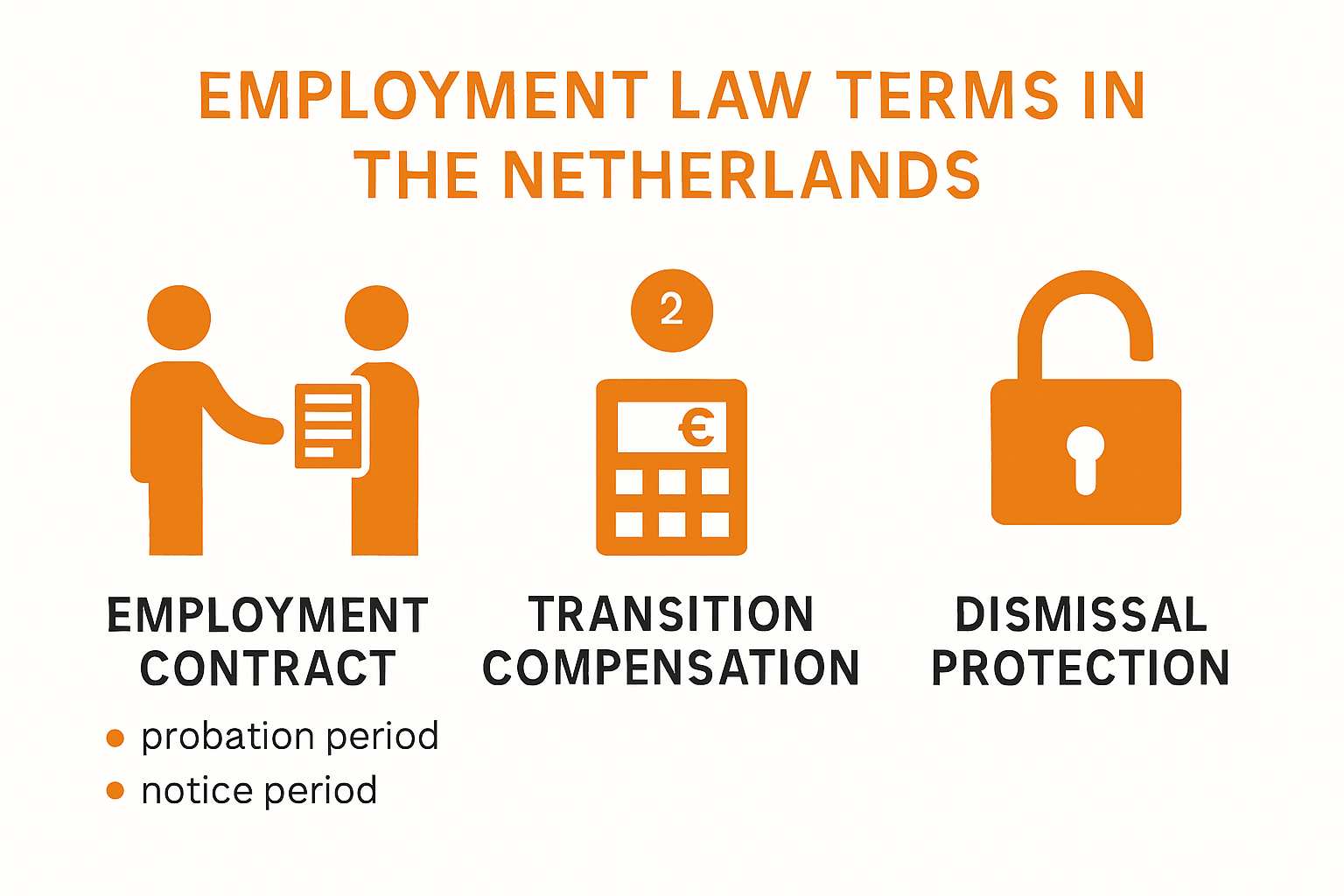
At the core of Dutch employment law are several key terms that define the relationship between employers and employees. An arbeidsovereenkomst (employment contract) is the primary legal document establishing the working relationship. This contract outlines critical elements such as job responsibilities, compensation, working hours, and potential termination conditions.
The concept of proeftijd (probationary period) is particularly significant. During this initial phase, both employer and employee can terminate the contract with minimal notice. Typically lasting one to two months for permanent contracts, this period allows both parties to assess mutual suitability. For temporary contracts of less than two years, the probationary period is often shorter or may not apply at all.
Another critical term is opzegtermijn (notice period), which defines the required time between contract termination notification and the actual end of employment. The length varies depending on the employee’s tenure and contract type. Employers must adhere to statutory notice periods, which increase with the employee’s years of service.
Before proceeding, here’s a table summarising the foundational employment contract terminology and their main features for quick reference.
| Term | Dutch Name | Key Details/Comments |
|---|---|---|
| Employment Contract | Arbeidsovereenkomst | Defines job, pay, hours, termination terms; must be provided in writing within one month |
| Probationary Period | Proeftijd | Initial phase (1-2 months); easier termination; may not apply to contracts under two years |
| Notice Period | Opzegtermijn | Required notice before contract ends; length depends on tenure and contract type |
Compensation and Protection Terminology
Employment law terminology extends to compensation and worker protections. Transitievergoeding (transition compensation) is a legally mandated payment made to employees terminated through no fault of their own. This compensation helps workers transition between jobs and is calculated based on years of service and salary level.
The term ontslagbescherming refers to employee dismissal protection. Dutch law provides robust safeguards against arbitrary dismissal. Employers must have valid, substantiated reasons for termination and often require permission from the UWV (Employee Insurance Agency) or court.
Wage-related terminology is equally important. Minimumloon represents the statutory minimum wage, which is adjusted annually to reflect economic conditions. As of 2025, this provides a baseline for fair compensation across various industries and job roles.
Specialized Employment Relationship Terms
Certain terms describe unique employment arrangements. Oproepcontract refers to on-call contracts where working hours are not fixed, providing flexibility but less job security. Payrolling involves an employee technically employed by a third-party agency but working for another organization, with specific legal implications for rights and responsibilities.
The term cao (collectieve arbeidsovereenkomst) represents collective labor agreements that negotiate standard working conditions for entire industry sectors. These agreements cover aspects like minimum wages, working hours, holiday entitlements, and additional benefits beyond standard legal requirements.
Navigating employment law terminology requires careful understanding. Whether you are an employer establishing contractual frameworks or an employee seeking to understand your rights, these terms form the linguistic foundation of workplace legal relationships in the Netherlands. Professional legal consultation can provide personalized guidance through these complex regulatory landscapes.
For comprehensive insights into your specific employment situation, consulting with experienced employment law professionals remains the most reliable approach to interpreting and applying these critical terms.
Unique Dutch Employment Concepts to Know
The Dutch employment landscape is characterized by distinctive legal concepts that set it apart from other European labor markets. Understanding these unique approaches provides crucial insights into the sophisticated and employee-friendly regulatory environment of the Netherlands.
Flexibility and Protection in Employment Relationships
One of the most distinctive Dutch employment concepts is Flexicurity. This innovative approach balances labor market flexibility with robust social security protections. Unlike traditional models, flexicurity allows employers significant hiring flexibility while simultaneously ensuring comprehensive employee rights and social safety nets. This concept enables companies to adapt quickly to economic changes while protecting workers from sudden income loss.
The Ondernemingsraad (Works Council) represents another groundbreaking Dutch employment concept. Mandatory for companies with 50 or more employees, these councils provide a structured mechanism for employee participation in corporate decision-making. Works councils have substantial rights, including information, consultation, and sometimes consent powers on significant organizational changes. Another unique concept is Schijnzelfstandigheid (False Self-Employment), which addresses the growing complexity of modern work arrangements. This legal framework prevents companies from misclassifying workers as independent contractors to avoid providing standard employment benefits. Regulatory mechanisms ensure that workers who functionally operate as employees receive appropriate protections, regardless of their technical employment classification.
Below is a table summarising three unique Dutch employment concepts and the protections or mechanisms they involve.
| Concept | Description | Main Protection/Mechanism |
|---|---|---|
| Flexicurity | Combines flexibility for employers with strong employee security | Social security for workers and adaptable hiring |
| Works Council | Employee-elected body mandatory in firms with 50+ employees | Co-determination rights and consultation requirements |
| False Self-Employment | Prevents misclassification of workers as independent contractors | Ensures standard rights/benefits for qualifying staff |
Innovative Employment Contract Structures
Dutch employment law introduces sophisticated contract structures that differ significantly from traditional models. The Oproepcontract (on-call contract) exemplifies this innovation, providing remarkable flexibility for both employers and employees. These contracts allow workers to be available for work without guaranteed hours, reflecting the dynamic nature of modern labor markets.
The Payrolling concept represents another distinctive Dutch approach. In this arrangement, an employee is technically employed by a third-party agency but works directly for another organization. This structure offers enhanced administrative efficiency while maintaining clear legal responsibilities and worker protections.
Collective Labor Agreements and Worker Rights
The Cao (Collectieve Arbeidsovereenkomst) represents a sophisticated approach to sector-wide employment standards. These collective labor agreements transcend individual employment contracts, establishing comprehensive guidelines for entire industries. They systematically regulate aspects like minimum wages, working conditions, holiday entitlements, and additional benefits, ensuring standardized protection across various professional sectors.
Dutch employment concepts fundamentally prioritize a balanced relationship between employer flexibility and worker protection. The legal framework demonstrates a nuanced understanding that successful employment relationships require mutual respect, adaptability, and comprehensive social support.
These unique concepts reflect the Netherlands progressive approach to labor relations. By balancing economic efficiency with robust worker protections, the Dutch system offers a model of employment regulation that many countries seek to emulate. Understanding these concepts provides valuable insights into a legal framework that simultaneously supports business innovation and employee welfare.
Essential Terms for Employers and Employees
Navigating the complex landscape of Dutch employment law requires a comprehensive understanding of key terms that define rights, responsibilities, and operational frameworks for both employers and employees. This section breaks down critical terminology essential for maintaining legally compliant and mutually beneficial workplace relationships.
Contractual Foundations and Documentation
The arbeidsovereenkomst (employment contract) serves as the fundamental legal document establishing workplace relationships. This critical document must explicitly outline essential details including job responsibilities, compensation structure, working hours, and potential termination conditions. Employers must provide a written contract within one month of employment, ensuring transparency and legal protection for both parties.
Employers are required to maintain detailed personeelsdossier (personnel files) documenting employee information, performance records, training histories, and critical communications. These comprehensive records serve as crucial evidence in potential legal disputes and demonstrate compliance with regulatory requirements.
Critical documentation includes the loonstrook (payslip), which must transparently detail gross salary, tax deductions, pension contributions, and other financial components. Discover comprehensive insights into employer obligations to ensure full compliance with documentation standards.

Compensation and Benefits Terminology
Compensation terminology extends beyond basic salary. The bruto jaarsalaris (gross annual salary) represents the total compensation before tax deductions, serving as a fundamental metric for financial planning and contractual negotiations. Employers must clearly communicate this figure, including potential bonuses and variable compensation components.
The vakantietoeslag (holiday allowance) is a mandatory benefit where employees receive 8% of their annual gross salary as additional vacation compensation. This statutory requirement ensures workers have financial resources during designated holiday periods. Similarly, reiskostenvergoeding (travel expense compensation) represents another critical financial term, with many employers providing tax-efficient transportation allowances.
Workplace Rights and Protective Terminology
Specific terminology defines employee protections and workplace rights. Ontslagbescherming represents comprehensive dismissal protection, requiring employers to demonstrate legitimate, substantiated reasons for termination. This framework prevents arbitrary workforce reductions and ensures fair treatment.
The concurrentiebeding (non-competition clause) allows employers to restrict employees from working with direct competitors for a specified period after employment termination. However, these clauses must be reasonable in scope and duration, typically limited to one year and specific geographical regions.
Ziektewet (Sickness Law) provides another critical protective framework. Employers must continue salary payments for employees unable to work due to illness, typically covering 70% of the regular wage for up to two years. This approach balances worker protection with organizational sustainability.
Understanding these essential terms transforms employment interactions from potential legal minefields into structured, mutually respectful relationships. Both employers and employees benefit from clear communication, comprehensive documentation, and a nuanced appreciation of their respective rights and responsibilities.
Navigation of these complex legal frameworks requires careful attention to detail and, often, professional legal guidance. Consulting with employment law experts can provide tailored insights into applying these terms within specific organizational contexts, ensuring compliance and minimizing potential disputes.
How to Use Employment Law Terminology in Practice
Employment law terminology is more than academic language. It represents a critical communication tool that bridges understanding between employers, employees, and legal professionals. Mastering these terms transforms complex legal concepts into practical workplace guidance.
Effective Communication Strategies
Understanding employment law terminology requires strategic communication approaches. When discussing contractual matters, precision becomes paramount. Instead of using vague language, employees and employers should explicitly reference specific legal terms like arbeidsovereenkomst (employment contract) or opzegtermijn (notice period) to ensure mutual clarity.
Professional communication involves translating complex legal terminology into accessible language. For instance, when discussing potential contract termination, using terms like ontslagbescherming (dismissal protection) helps frame the conversation objectively.
Documentation plays a crucial role in practical terminology usage. Maintaining personeelsdossier (personnel files) with accurate, standardized terminology ensures legal compliance and provides clear evidence in potential dispute resolution scenarios. Consistent language use reduces misunderstandings and establishes professional communication standards.
Practical Application in Workplace Scenarios
Real-world application of employment law terminology requires contextual understanding. During salary negotiations, referencing bruto jaarsalaris (gross annual salary) instead of net income provides a comprehensive compensation perspective. Understanding nuanced terms like vakantietoeslag (holiday allowance) helps employees comprehend their total compensation package.
Employers must strategically implement terminology in employment contracts. Clearly defining concurrentiebeding (non-competition clause) protects business interests while respecting employee rights. Similarly, articulating reiskostenvergoeding (travel expense compensation) demonstrates transparent compensation practices.
Workplace conflict resolution benefits significantly from precise terminology. When addressing potential dismissal scenarios, using specific legal terms like transitievergoeding (transition compensation) frames discussions objectively. This approach transforms potentially contentious interactions into structured, professional dialogues.
Legal Compliance and Terminology Mastery
Mastering employment law terminology extends beyond communication. It represents a fundamental approach to legal compliance. Understanding terms like Ziektewet (Sickness Law) enables employers to navigate complex worker protection regulations effectively.
Professional development involves continuous learning of evolving legal language. Attending workshops, consulting legal professionals, and staying updated on regulatory changes ensure terminology remains current and accurate. This proactive approach minimizes potential legal misunderstandings.
For individuals and organizations, employment law terminology serves as a critical navigational tool. It transforms complex legal frameworks into actionable workplace guidance. Precise language bridges communication gaps, establishes clear expectations, and creates a foundation for respectful, legally compliant workplace relationships.
While mastering these terms requires dedication, the benefits are substantial. Effective terminology usage reduces potential conflicts, enhances professional communication, and demonstrates a sophisticated understanding of workplace dynamics. Ultimately, language becomes a powerful tool for creating transparent, mutually beneficial employment relationships.
Frequently Asked Questions
What is an arbeidsovereenkomst?
An arbeidsovereenkomst, or employment contract, is the primary legal document that outlines the relationship between an employer and an employee, detailing job responsibilities, compensation, working hours, and conditions for termination.
What does the term proeftijd mean in Dutch employment law?
The term proeftijd refers to a probationary period during which either party can terminate the employment contract with minimal notice. Typically lasting one to two months, it allows both employers and employees to assess mutual compatibility.
What is the significance of ontslagbescherming in the Netherlands?
Ontslagbescherming translates to dismissal protection. This legal concept requires employers to demonstrate valid reasons for terminating an employee’s contract, protecting workers from arbitrary dismissal and ensuring fair treatment.
How do collective labour agreements (cao) work in the Netherlands?
A collective labour agreement (cao) is a negotiated contract that establishes working conditions, minimum wages, and other employee rights across entire sectors, ensuring consistent standards that go beyond individual employment contracts.
Take Uncertainty Out of Dutch Employment Law
Are you struggling to navigate complex Dutch employment law terminology and worried about making costly mistakes in your contracts or workplace procedures? The article has highlighted how easily misunderstandings can arise over terms like arbeidsovereenkomst, ontslagbescherming or even requirements for vakantietoeslag. Misinterpreting these could put your business at risk or leave your employee rights unprotected. If you want peace of mind and clarity, Law & More offers direct access to expert legal guidance tailored to your situation. We have extensive experience helping both local and international clients understand, communicate and apply Dutch employment law terms with confidence.
Ready to resolve legal uncertainties and put strong protections in place for your work or organisation? Visit our main website to book a consultation or explore our employment law solutions. Take the next step now and let our dedicated team ensure you comply with Dutch regulations and fully understand every critical legal term.