


Metaverse legal frameworks are the rulebooks governing interactions, trade, and ownership within immersive virtual worlds. As this digital frontier expands, it creates complex legal grey areas. Existing laws for property, contracts, and liability do not neatly apply, compelling us to draft new rules for this emerging reality.
Why the Metaverse Needs a Legal Map
The metaverse is not merely a futuristic game; it is a rapidly evolving space for commerce, socialising, and creation, often operating beyond conventional legal boundaries. To grasp the challenges ahead, it is crucial to view the metaverse from a practical, legal perspective. This new domain merges virtual reality (VR), augmented reality (AR), and blockchain technology, creating persistent online worlds where users interact as avatars.
These digital interactions carry real-world consequences. Is buying virtual land with cryptocurrency a legally recognised property transfer? Does avatar harassment constitute a crime? These are no longer hypothetical questions but urgent legal dilemmas. Our existing laws, designed for a physical world, struggle to keep pace with the rapid evolution of these virtual environments.
The Emerging Digital Economy
The high economic stakes amplify the need for clear governance. The Netherlands, in particular, is positioning itself as a significant hub in this new economy.
The Dutch metaverse market is projected to reach US$32.1 billion in 2025, a figure driven by the country's exceptionally high rates of digital adoption. This growth highlights the urgent need for robust legal frameworks to manage this burgeoning virtual economy.
This substantial market size is supported by the Netherlands' unique position as a tech-forward nation. As of late 2025, the country boasts 18.2 million internet users—a staggering 99.0 percent internet penetration rate. Combined with 15.3 million active social media users, this creates fertile ground for metaverse engagement and, consequently, a new set of legal challenges. You can explore more insights about the Netherlands' metaverse market on Statista.com.
Key Legal Gray Areas
Several core legal principles are being tested by metaverse developments:
- Property Rights: Digital assets, such as NFTs and virtual real estate, challenge traditional definitions of ownership and transfer.
- Contract Law: Agreements made between avatars or executed via smart contracts raise questions about enforceability and applicable jurisdiction.
- Personal Safety and Liability: New risks are emerging, from virtual harassment and data privacy in VR to determining accountability when issues arise on a platform.
Without clear metaverse legal frameworks, businesses and individuals navigate uncharted territory. Establishing these rules, especially within forward-thinking regulatory environments like the Netherlands and the EU, is essential to foster innovation while protecting users.
How the EU Is Building Its Rulebook for Virtual Worlds
The European Union is proactively establishing rules for the metaverse, building a governance strategy anchored in landmark regulations like the Digital Services Act (DSA). The core principles of platform accountability and user safety, sharpened for the traditional internet, are now being applied to these new immersive worlds.
The European Commission's approach aims to balance innovation with robust consumer protection, fair competition, and the safeguarding of fundamental rights. For any business operating in the Netherlands, understanding this evolving legal framework is essential for compliance.
The Digital Services Act as a Cornerstone
The DSA is becoming the EU’s primary tool for regulating the metaverse. Though drafted to tackle illegal content and increase transparency on online platforms, its principles are a natural fit for virtual worlds. The regulation requires platforms to establish clear content moderation processes and provide users with a straightforward way to report harmful or illegal activities.
In practice, this means a metaverse platform in the EU will have a legal duty to address issues like virtual harassment, the sale of counterfeit digital goods, or the spread of disinformation. The DSA’s tiered system, which imposes stricter rules on larger platforms, can be easily applied to dominant metaverse worlds. You can learn more about your obligations under the EU Digital Services Act (DSA) and Digital Markets Act (DMA).
The EU’s strategy is built on a clear vision: what is illegal offline must also be illegal online. This principle extends directly to the metaverse, ensuring that virtual spaces are not lawless frontiers but are subject to the same standards of safety and accountability as the physical world.
The diagram below visualises the key legal gaps in property, the economy, and safety that current regulations are designed to address.
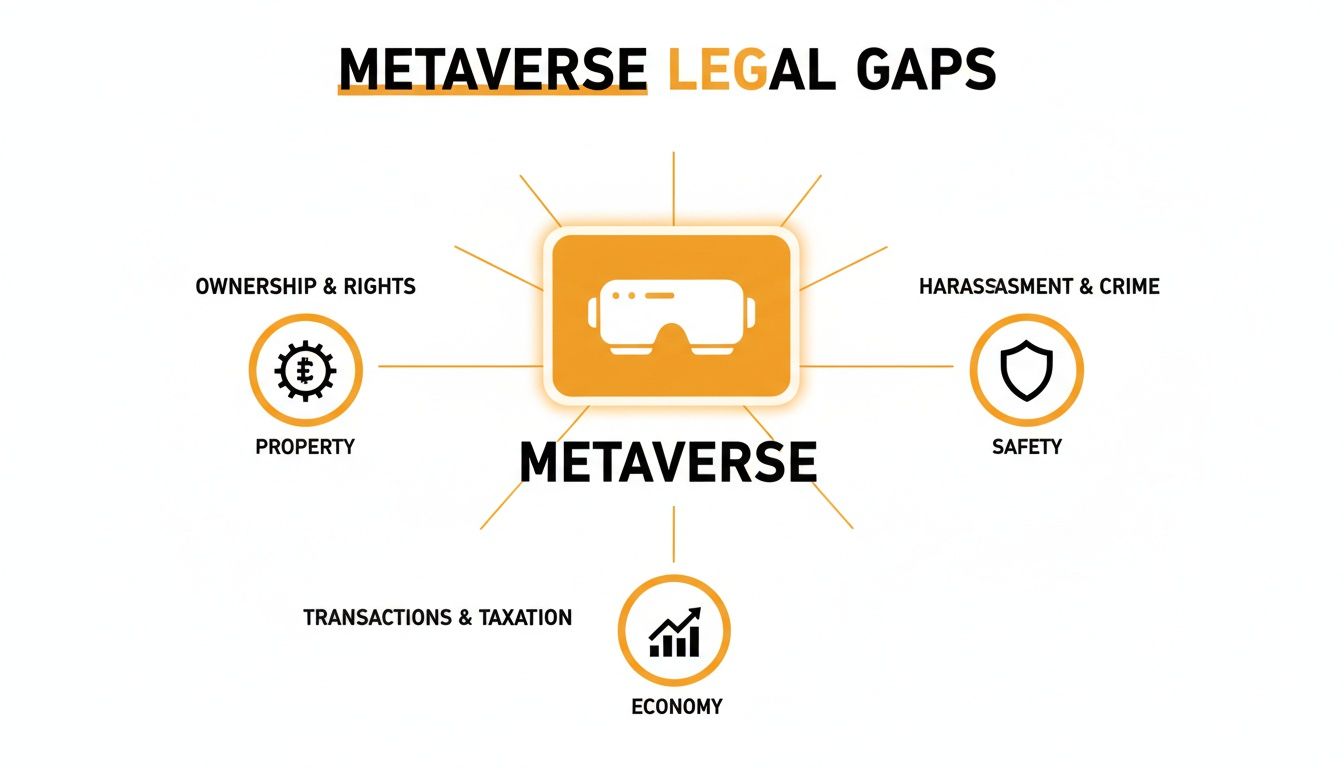
As the image shows, these legal challenges are interconnected, highlighting why a comprehensive regulatory approach is necessary to create a stable and trustworthy virtual environment.
A Four-Pillar Strategy for Governance
The European Commission is building its regulatory approach around four key pillars. Government regulation is seen as the most critical from a legal standpoint, with a sense of urgency driven by projections that by 2026, a quarter of the global population will spend at least one hour a day in the metaverse.
The EU's framework is designed to tackle several core areas:
- People: Protecting users, safeguarding fundamental rights, and equipping people with the necessary skills.
- Technologies: Nurturing an open and interoperable ecosystem to prevent market domination by a few large companies.
- Business: Fostering a fair commercial environment that stimulates innovation and prevents anti-competitive behaviour.
- Government: Supporting the delivery of public services and infrastructure within virtual worlds.
A foundational element of this new rulebook is the strong emphasis on EU data sovereignty within these digital realms. This regulatory push signals that the EU intends to shape the metaverse according to its values. For businesses, the message is clear: prepare for a regulatory environment where user rights and platform responsibility are paramount.
The Netherlands' Proactive Approach to Digital Enforcement
While the EU defines broad digital policy, the Netherlands is implementing practical and robust enforcement. The country is not passively adopting EU regulations but is actively preparing its legal landscape for new frontiers like AI-driven metaverse platforms. This makes the Netherlands a critical jurisdiction for businesses building virtual worlds.
The Dutch government is upgrading its regulatory infrastructure. A key initiative is the planned regulatory sandbox for artificial intelligence systems, set to be operational by August 2026. This will create supervised testing environments under the European AI Act, allowing innovators to build within clear legal boundaries. Additionally, the Dutch Data Protection Authority (Autoriteit Persoonsgegevens or AP) continues to provide crucial guidance; its fifth AI and Algorithms Report, published in July 2025, offers a clear compliance path for businesses navigating complex European regulations.
The Role of the Autoriteit Persoonsgegevens
The Autoriteit Persoonsgegevens (AP) is central to this proactive stance. It has evolved from reacting to GDPR breaches to offering forward-looking advice on the responsible use of algorithms and AI. For companies developing metaverse platforms, this guidance is invaluable, establishing clear expectations around data processing, algorithmic transparency, and user rights from the outset.
The AP focuses on ensuring that automated systems are designed with "privacy by design," an enforceable expectation rather than a mere suggestion.

The image above captures the Dutch strategy: creating a controlled, structured environment for safe innovation, balancing technological advancement with strong regulatory oversight.
Enforcement with Real Consequences
The Netherlands has demonstrated that its legal frameworks have teeth. Dutch courts are willing to impose substantial financial penalties on companies that compromise user protection, sending a clear message that non-compliance carries significant financial and reputational risk.
For companies in the metaverse, this has several implications:
- Terms of Service are Critical: Vague or one-sided terms will not stand up in court. They must be clear, transparent, and compliant with Dutch and EU law.
- Data Handling is Paramount: The collection and processing of user data, especially sensitive biometric data from VR/AR hardware, will be scrutinised.
- Jurisdictional Awareness is Key: Assuming a company is beyond the reach of Dutch law due to global operations is a dangerous gamble. Understanding how to avoid jurisdiction and enforcement issues is fundamental.
The Dutch approach proves that a tech-forward nation can foster innovation while demanding accountability. For metaverse developers, proactive compliance is not optional—it is the only sustainable path forward.
Ultimately, the Netherlands' proactive stance teaches a clear lesson: innovation and regulation go hand-in-hand, and a failure to respect the latter can bring serious consequences.
Protecting Intellectual Property in Virtual Economies
The question of who owns a digital creation is at the heart of the metaverse's most complex legal battleground: intellectual property (IP). As virtual economies flourish, traditional IP rights like trademarks and copyrights are stretched by digital assets, NFTs, and user-generated content (UGC), blurring the line between inspiration and infringement.
For creators and businesses, this new world presents both opportunities and risks. Protecting a brand or digital work in a decentralised space requires a fresh approach rooted in Dutch and EU intellectual property law.

Digital Trademarks and Virtual Goods
The market for virtual goods, from designer avatar skins to digital art, is a multi-billion-dollar industry. High-fashion brands like Gucci and giants like Nike have entered this space, creating branded virtual products. This has also opened the door for counterfeit virtual items, which can dilute brand value and confuse consumers.
The Nike v. StockX lawsuit in 2022 highlighted this conflict. StockX sold NFTs tied to images of Nike trainers, igniting a legal battle over whether this constituted trademark infringement. Nike argued that such unauthorised digital merchandise created a false impression of official endorsement.
In response, smart companies are now filing for trademarks that specifically cover digital goods and virtual environments—a critical defensive move to protect their brands in both physical and virtual worlds.
The Copyright Conundrum of User-Generated Content
The metaverse is powered by user creativity. Platforms like Roblox and Decentraland allow users to design everything from virtual art to entire worlds, raising thorny copyright questions.
- Who owns the copyright? While the creator of a work traditionally owns the copyright, many platform terms of service require users to grant the platform a broad licence to use, reproduce, and distribute their content. This raises concerns about creators being stripped of their ownership rights.
- How is infringement prevented? Platforms face a monumental task in preventing copyright infringement. Users might create virtual replicas of famous landmarks or design avatars with branded clothing, both of which could trigger copyright claims. Automated content recognition systems are imperfect and often struggle with nuances like fair use.
The decentralised and often anonymous nature of some metaverse platforms makes enforcement even more challenging, as it can be difficult to identify and act against infringers operating across multiple jurisdictions.
Enforcement in a Borderless World
The borderless nature of the metaverse dismantles traditional IP enforcement, which relies on national jurisdictions. This can create a safe haven for counterfeit digital goods and unauthorised reproductions. The rise of Web3 loyalty programs involving tokens and NFTs presents new challenges for digital ownership and IP. You can explore strategies for Web3 loyalty programs to understand these complexities.
The core challenge is that IP laws differ significantly between countries. A lack of international harmonisation makes it difficult to enforce rights consistently across the fragmented legal landscape of the metaverse.
A strategic combination of technology and robust legal frameworks is vital. Smart contracts can automate IP rights enforcement. For example, an NFT can be linked to a smart contract that dictates its use and resale, ensuring creators receive royalties.
However, technology alone is not a solution; it must be backed by clear, enforceable legal agreements. To navigate this environment, it is essential to understand the latest developments in intellectual property enforcement in the Netherlands. Without a proactive legal strategy, creators and businesses risk losing control over their valuable assets.
The Legal Standing of Virtual Agreements and Corporate Risk
Is a deal made by your avatar legally binding? This question highlights how traditional legal systems are scrambling to keep up with virtual worlds. The metaverse blurs the line between simple in-game actions and genuine contractual agreements. For businesses in these spaces, navigating this complex landscape is not optional.
Pressing issues include the validity of avatar agreements under Dutch law, the legal standing of smart contracts, and consumer protection. The ultimate question is liability: when something goes wrong, is it the platform owner, a third-party content creator, or the user who is responsible? Answering this requires a solid framework for managing corporate risk in a world still under construction.
Are Avatar Agreements Legally Binding?
Under Dutch law, a contract generally requires an offer, an acceptance, and a "meeting of the minds" (wilsovereenstemming). The form is often flexible. An agreement made between two avatars—through text chat, a virtual handshake, or clicking "Agree"—could be seen as a binding contract.
The deciding factor is the intent of the parties. If two users clearly intend to create a legally enforceable obligation, a Dutch court could recognise the agreement, regardless of the virtual setting. However, proving intent and the specific terms of a deal made in a fast-moving virtual world can be incredibly difficult.
The Rise of Smart Contracts
Many metaverse transactions run on smart contracts—self-executing agreements with terms written directly into code. These contracts automatically perform actions, like transferring NFT ownership, once conditions are met.
While efficient, their legal status remains a grey area. Dutch and EU law do not have specific legislation covering smart contracts; they are measured against existing contract law principles.
A major hurdle is their rigidity. Once set, they cannot be easily changed. Traditional contract law allows for interpretation and remedies like termination or damages, concepts difficult to apply to automated code. For a smart contract to hold up in court, it must meet the foundational requirements of a traditional contract, including a clear offer and acceptance.
The central legal question is whether code can truly represent the "meeting of the minds" a valid agreement requires. As they become more common, courts will have to set clear precedents for their interpretation and enforcement.
Navigating Corporate Liability and Consumer Protection
Pinpointing liability in the metaverse is a major challenge. Responsibility is often blurred between several parties:
- Platform Owners: They are generally responsible for the safety and operation of their virtual world. Their liability often hinges on the terms of service. Under the EU's Digital Services Act, large platforms have a greater duty to police content and protect users.
- Content Creators: A business selling virtual items could be liable for defects, false advertising, or IP infringement.
- Users: Users can be held responsible for their actions, such as harassment, fraud, or violating platform rules.
This layered environment creates unique consumer protection headaches. If you buy a faulty virtual item, do you file a claim against the creator or the platform? If your digital assets are stolen due to a security flaw, who covers the loss?
For any company entering the metaverse, drafting clear, comprehensive, and legally sound terms of service is the first line of defence. These documents must spell out the rights and responsibilities of all parties, define the rules, and outline a clear dispute resolution process. Without this, businesses face significant legal and financial risk.
Practical Steps for Navigating the Legal Metaverse
Knowing the theory is one thing, but action is what counts. Stepping into the metaverse requires a proactive legal mindset to sidestep risks while seizing opportunities. This practical checklist provides a launchpad for ensuring compliance with Dutch and EU regulations.
Conduct a Digital Asset Audit
Before launching a virtual presence, inventory your digital intellectual property: trademarks, copyrighted materials, and any digital assets you plan to use or sell. You cannot protect what you do not know you have.
Once you have a list, build an IP enforcement strategy for the virtual world. This involves registering trademarks for digital goods and services and setting up internal policies to spot potential infringement.
Update Your Legal Frameworks
Your current legal documents are likely unfit for the metaverse. It is crucial to update key agreements to specifically cover virtual interactions.
- Terms of Service (ToS): Your ToS needs a rewrite. It must explicitly govern user behaviour, clarify ownership of user-generated content, and establish clear dispute resolution procedures.
- Privacy Policies: Your privacy policy must be updated to cover unique data collected through VR/AR hardware, such as biometric data, and must be GDPR compliant.
A well-drafted legal framework is your first line of defence. It sets clear expectations and provides a solid foundation for managing liability and enforcing your rights in a decentralised environment.
Prioritise Proactive Legal Guidance
The legal landscape of the metaverse is dynamic, with new regulations and court rulings emerging constantly. Specialised legal counsel is an ongoing necessity, not a one-off task. A legal partner with expertise in technology and Dutch/EU law can help you navigate these changes, ensuring your business stays compliant and protected.
Frequently Asked Questions About Metaverse Law
As legal frameworks adapt to the metaverse, specific questions arise for businesses and individuals. This section addresses common queries with practical insights grounded in Dutch and EU law.
What is the Legal Status of Virtual Land?
Currently, "virtual land" does not have the same legal standing as physical real estate under Dutch law. When you buy a plot in a metaverse, you are acquiring a licence—a contractual right to use a specific part of that virtual world, governed by the platform's terms of service. While ownership is often represented by an NFT, the legal strength of these rights is still being tested. It is best to view it as a contractual asset, not real property.
Are Businesses Liable for AI-Controlled Avatars?
Yes, a business can be held liable for the actions of its AI-controlled avatars (NPCs). If a corporate NPC provides misleading information causing financial loss or makes defamatory comments, the company that deployed the AI could be held responsible. Liability could arise from Dutch contract law (for misrepresentation) or tort law (for causing harm). Businesses must ensure their AI systems are programmed to follow legal and ethical rules.
How are Cross-Border Disputes Handled?
Resolving cross-border disputes is a major challenge. If a user in Germany has an issue with a Dutch company on a platform hosted in Ireland, which country's laws apply? The answer is usually found in the platform's terms of service, which specify the governing law and jurisdiction. EU regulations like the Brussels I Regulation (Recast) may allow a consumer to sue in their home country. However, enforcement remains complex, making clear contract terms and arbitration clauses vital.
Does GDPR Apply to VR and AR Data?
Absolutely. The General Data Protection Regulation (GDPR) applies to personal data collected from people in the EU, including in the metaverse. VR and AR headsets can gather sensitive biometric data like eye movements and emotional responses. Under GDPR, this is "special category data," requiring explicit consent and stronger protection. Companies must be transparent about what data they collect, why, and how it is secured, as failure to comply can lead to massive fines.
At Law & More, our team combines deep technological insight with robust legal expertise to help you navigate the complexities of metaverse law. Whether you are drafting terms of service, protecting your intellectual property, or ensuring data privacy compliance, we provide the clear, actionable guidance your business needs to thrive in this new digital frontier. Contact us to learn how we can secure your virtual ventures. Find out more at https://lawandmore.eu.