


A Comprehensive Guide to the Evidentiary Value of Induction Loops and Your Legal Remedies as a Suspect
If you have been involved in a serious traffic accident or charged with a significant traffic offence in the Netherlands, you may have encountered the term lussenonderzoek (loop research). For many suspects and even some legal professionals, this technical term remains shrouded in mystery. Yet, in modern Dutch traffic criminal law, data from induction loops often forms the cornerstone of the prosecution’s evidence.
It is a common misconception that this technical evidence is infallible. While induction loops rely on physics, their application in a criminal trial is subject to human interpretation, system maintenance, and strict legal safeguards.
This guide provides a deep dive into the technical and legal aspects of loop research. We will analyse how Dutch judges evaluate this evidence, explore key jurisprudence from the Hoge Raad (Supreme Court), and outline a concrete, step-by-step defence strategy. Whether you are a defendant, a legal professional, or simply interested in forensic traffic research, this analysis will empower you with the knowledge to challenge technical evidence effectively.
Section 1: What is Loop Research? Technical Background
To defend against loop evidence, one must first understand the mechanics of the system. It is not ‘magic’; it is simply electromechanics, subject to the same failures as any other technology.
1.1 How Do Induction Loops Work?
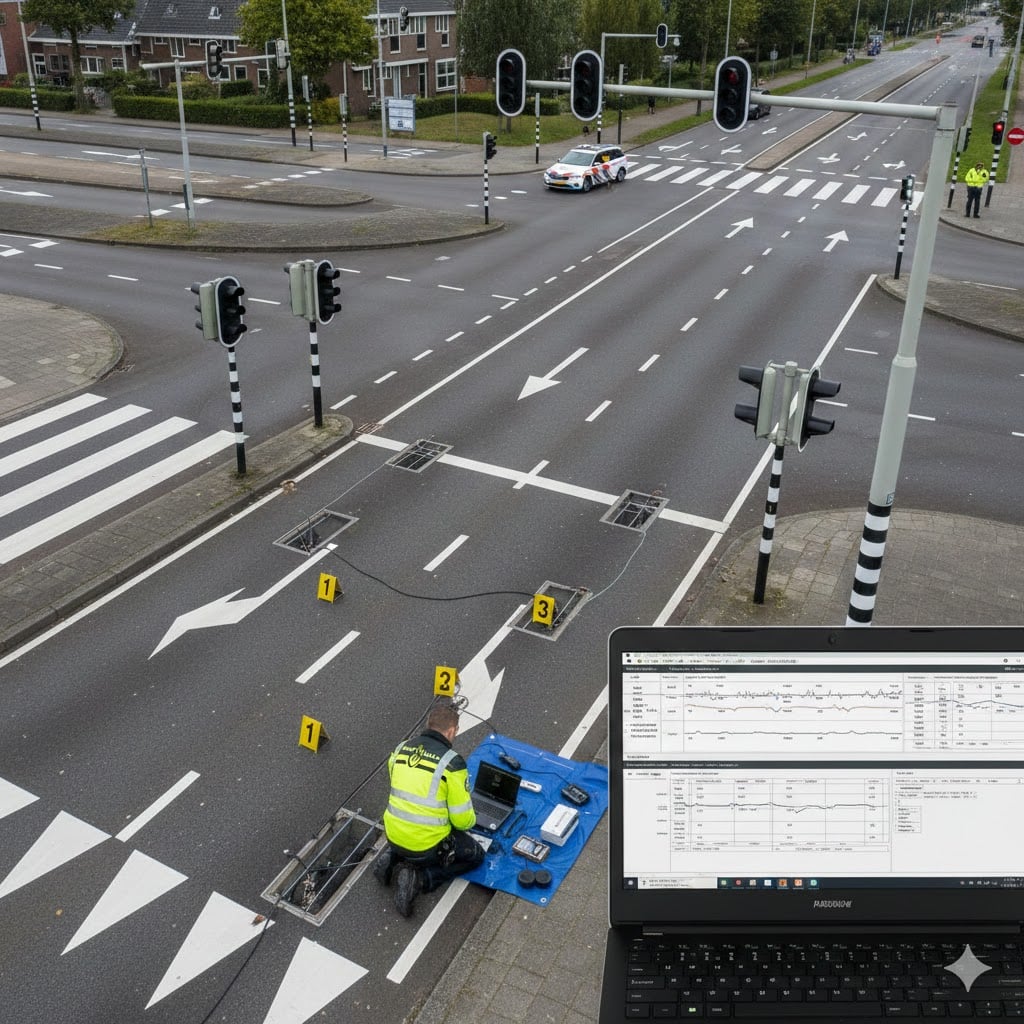
Induction loops are essentially coils of wire embedded into the asphalt of the road surface. These loops are connected to a roadside detector card. They operate on the principle of electromagnetic induction.
When an electrical current flows through the wire, it creates a magnetic field. When a large metal object—such as a vehicle—passes over the loop, the metal disturbs this magnetic field (a change in inductance). The detector card registers this disturbance as a ‘detection’.
These systems are primarily designed for traffic flow management: controlling traffic lights (making them turn green when a car approaches) or measuring congestion. However, in criminal cases, this operational data is repurposed as forensic evidence. The data is typically collected automatically and stored in the traffic controller’s log files.
1.2 What Data is Collected?
Crucially, a simple loop system does not ‘see’ a car in the way a camera does. It registers specific data points:
- Timestamp: The exact millisecond a disturbance begins (entry) and ends (exit).
- Presence: The duration a vehicle was over the loop.
- Speed (Calculated): If two loops are placed in sequence (a ‘trap’), the system calculates speed based on the time it takes to travel the fixed distance between Loop A and Loop B.
- Vehicle Classification: Based on the ‘magnetic signature’ or length of the vehicle, the system may estimate if it is a passenger car, lorry, or bus.
1.3 Use in Forensic Traffic Research
In a courtroom setting, this raw data is interpreted by experts to reconstruct events. Typical scenarios include:
- Intersection Accidents: Determining the sequence of events. Did Vehicle A enter the intersection before Vehicle B?
- Traffic Light Analysis: Establishing whether a light was red or green at the precise moment of passage.
- Speeding: verifying speed in serious speeding offences where laser or radar was not present.
- Corroboration: Using loop data to verify or refute witness statements (e.g., a witness claims they waited for 5 seconds, but the loops show continuous traffic).
Example:
In a collision at a controlled intersection, loop data might show that Vehicle A crossed the stop-line loop at 14:32:15.234, while Vehicle B crossed their respective loop at 14:32:16.891. This 1.6-second difference, combined with the traffic light phasing logs (the ‘conflict matrix’), can scientifically prove who ran the red light.
Section 2: Legal Framework: Statutory Provisions
Understanding the technical side is only half the battle. The admissibility and weight of this evidence are governed by the Dutch Code of Criminal Procedure (Wetboek van Strafvordering or Sv).
2.1 Means of Evidence in Criminal Law
Under Article 338 Sv, a judge can only convict a suspect if they are convinced of the suspect’s guilt based on “legal means of evidence” (wettige bewijsmiddelen). This is the bedrock of Dutch criminal law: no conviction without legal evidence and judicial conviction.
Article 339 Sv lists the five exclusive types of legal evidence:
- The judge’s own observation.
- Statements by the suspect.
- Statements by witnesses.
- Statements by experts.
- Written documents (schriftelijke bescheiden).
Loop research typically enters the trial via category 4 (expert report) or category 5 (written documents containing the raw logs).
2.2 Free Evaluation of Evidence (Vrije Bewijswaardering)
Unlike some legal systems with rigid rules on what evidence ‘trumps’ other evidence, Dutch law follows the principle of free evaluation of evidence (Articles 152 and 339 Sv).
This means the judge determines the value of the loop research. They are not obliged to accept the computer’s output as absolute truth. They must assess its reliability, especially if the defence challenges it. However, under Article 359 Sv, the judge has a motivation requirement. If the defence presents a well-argued stance on why the loop data is unreliable, the judge cannot simply ignore it; they must explain in their ruling why they accepted the evidence despite the defence’s arguments.
2.3 Expert Research – The Legal Framework
Loop research is technical; judges are not engineers. Therefore, they rely on experts.
- Article 51i Sv: The investigating judge or public prosecutor appoints an expert. This person must possess specific knowledge and must be objective and impartial.
- Article 51l Sv: This is critical for the defence. The expert must provide a “reasoned report” (een met redenen omkleed verslag). It must contain:
- The assignment description.
- The materials examined.
- The methods used.
- The considerations leading to conclusions.
If an expert report says “The car was speeding” without explaining how that was calculated from the loop data, it fails the requirement of Article 51l Sv.
Section 3: Right to Counter-Expertise (Contra-Expertise)
This is arguably the most important section for any defendant. If you disagree with the prosecution’s technical findings, you have a fundamental right to check them.
3.1 Statutory Basis
Article 150a of the Code of Criminal Procedure is your primary tool. It states that a suspect or their counsel can request a counter-investigation.
The requirements are strict:
- Time Limit: You must submit the request within two weeks after being notified of the expert report’s results.
- Format: It must be a written request to the Public Prosecutor (Officier van Justitie).
- Motivation: You cannot simply say “I disagree”. You must motivate why a counter-check is necessary.
- Proposal: You should propose which expert should conduct the counter-investigation.
If the prosecutor refuses, Article 150b Sv allows you to appeal to the investigating judge (Rechter-Commissaris). Under Article 150c Sv, the counter-expert has the right to access the same materials as the original expert.
3.2 Jurisprudence on Counter-Expertise
ECLI:NL:HR:2025:1711 (Supreme Court)
In a recent ruling, the Supreme Court (Hoge Raad) reiterated that the right to counter-expertise is a vital component of a fair trial. The Court held that requests should generally be granted when they are timely, properly motivated, and pertain to evidence significant to the case. The refusal of such a request without solid grounds can lead to the annulment of a conviction.
ECLI:NL:HR:1992:AD1610 (The Standard Judgment)
This older but leading case established the right to counter-expertise as part of the “equality of arms” principle. The defence must have an equivalent opportunity to challenge technical evidence as the prosecution had to generate it.
ECLI:NL:RBLIM:2025:11395 (Rechtbank Limburg)
Here, the court offered a compromise. Instead of a full (expensive) counter-investigation, the defence was allowed to submit written questions to the original expert. While cost-effective, this is not always sufficient if the underlying methodology is fundamentally flawed.
3.3 Practical Application in Loop Research
When should you request counter-expertise in loop cases?
- When raw data interpretations are complex (e.g., multiple cars passing in seconds).
- When speed calculations are based solely on loop data without radar confirmation.
- When there are doubts about the synchronization of the clock system.
- When technical documentation regarding calibration is missing.
Template Motivation for Your Lawyer:
“We request counter-expertise because: (1) The technical documentation regarding the calibration of the loops is absent; (2) The expert provides no insight into the error margin of the time registration; (3) The interpretation of raw data in this complex traffic situation is insufficiently substantiated; (4) [Name of proposed expert] possesses specialized knowledge of loop research and can test the reliability of these conclusions.”
Section 4: Reliability of Loop Research: Strengths and Weaknesses
To defend yourself, you must understand where the system is strong and where it cracks.
4.1 Strengths (Why Judges Accept It)
- Objectivity: Unlike a witness who might be biased or forgetful, a loop system is an automated machine. It has no opinion.
- Precision: It registers time to the millisecond.
- Tamper-Resistance: Retrospectively manipulating log files is difficult and requires high-level access.
- Corroboration: It often aligns with physical damage or final rest positions of vehicles.
4.2 Weaknesses and Lines of Attack
A. Technical Inaccuracy and Interference
Loops are sensitive. Water ingress, ice, or extreme temperatures can alter the inductance. Heavy vehicles can physically damage loops. Nearby electrical systems can cause interference.
- Defence Angle: Request maintenance logs and error logs for the specific date.
B. Limited Specificity
A loop detects “a metal object”. It does not read a license plate. If two cars are close together, or if a motorcycle is lane-splitting, the system may attribute the data to the wrong vehicle.
- Defence Angle: In multi-vehicle scenarios, challenge the identification. How does the expert know Signal A was your car?
C. Time Registration and Synchronization
The internal clock of the traffic controller must be synchronized (usually via GPS or NTP). If the clock drifts even by two seconds, it can make the difference between “running a red light” and “crossing on amber”.
- Defence Angle: Demand proof of time synchronization protocols.
D. Interpretation of Raw Data
Raw data is just a list of numbers. It requires human assumption to say “The car accelerated at X rate”. Assumptions can be wrong.
- Defence Angle: Challenge the assumptions regarding acceleration/deceleration between loops.
E. Lack of Documentation
Frequently, the prosecution provides the expert conclusion but fails to provide the calibration certificates or maintenance history of the specific loop installation.
- Defence Angle: Invoke Article 51l Sv. If the research is not verifiable due to missing docs, it is not reliable.
Section 5: Jurisprudence Analysis: When Does Loop Research Succeed or Fail?
Analyzing case law (Jurisprudentie) helps us predict how judges will rule.
5.1 Successful Applications
ECLI:NL:RBZWB:2022:7122 (Rechtbank Zeeland-West-Brabant)
In an intersection accident dispute, loop evidence showed the precise timing of both vehicles. The court accepted the evidence because the technical documentation was complete, the expert explained the methodology clearly, and the results matched witness statements.
- Takeaway: When properly documented and corroborated, loop evidence is very persuasive.
ECLI:NL:GHARL:2025:2243 (Gerechtshof Arnhem-Leeuwarden)
A speed violation based on two loops 50m apart. The evidence held up because the expert demonstrated proper validation of the system, current calibration certificates, and disclosed the error margin.
- Takeaway: Transparency strengthens credibility.
5.2 Rejected or Weakened Evidence
ECLI:NL:PHR:2024:611 (Advocate General Opinion)
The AG argued that evidence exclusion is on the table when research is not controllable or reproducible. If documentation gaps make it impossible for the defence to verify the findings, the evidence is problematic.
ECLI:NL:GHSHE:2024:2899 (Gerechtshof ‘s-Hertogenbosch)
The defence was denied access to raw data and system specifications. The court ruled this a violation of Article 6 ECHR (Fair Trial). The conviction was overturned because the defence must be able to challenge technical evidence meaningfully.
- Takeaway: Access to underlying data is a right, not a privilege.
ECLI:NL:GHARL:2025:5294
Here, loop evidence was used but challenged due to a lack of recent calibration and undocumented synchronization. The court did not exclude the evidence entirely but gave it “reduced weight”, requiring corroboration from other sources before convicting.
5.3 Lessons from Case Law
The pattern is clear. Loop evidence fails when:
- Documentation is missing.
- Methodology is opaque (black box).
- The defence raises concrete, specific technical challenges rather than general denials.
Section 6: Exclusion of Evidence: When and How?
Can you get the loop evidence thrown out of court entirely?
6.1 Legal Basis for Exclusion
Article 359a Sv allows the court to attach consequences to procedural violations. The Supreme Court (ECLI:NL:HR:2023:975) established strict criteria. Exclusion is reserved for cases where:
- A serious procedural violation occurred.
- There is a direct causal link between the violation and the evidence obtained.
- The suspect’s right to a fair trial (Article 6 ECHR) is compromised.
6.2 Application to Loop Research
Exclusion is possible in scenarios such as:
- Missing Essential Documentation: If there are no calibration certificates or maintenance logs, the evidence is not verifiable. This violates Article 51l Sv.
- Refusal of Access: If the defence is denied raw data or the algorithm is declared “proprietary”, the equality of arms is violated.
- Unjustified Refusal of Counter-Expertise: If a timely, motivated request is denied without valid grounds, the trial may be deemed unfair.
6.3 Practical Strategy
Full exclusion is rare. It is more common for a judge to state that the evidence has “reduced value”. However, if the loop data is the only evidence (e.g., in a speeding case with no witnesses), reduced value effectively leads to acquittal (vrijspraak).
Section 7: Practical Defence Strategy
If you are facing charges based on loop data, pass this workflow to your legal counsel immediately.
7.1 Step-by-Step Action Plan
STEP 1: Immediate Action (Days 1-3)
Engage a specialized traffic law attorney. Review the case file specifically to identify if loop research is being used. Identify missing technical docs.
STEP 2: Request Documentation (Week 1)
Via your lawyer, formally request (under Article 30 Sv):
- The complete expert report with methodology.
- Calibration certificates and maintenance logs.
- System error logs for the date in question.
- Proof of time synchronization.
- Raw data (not just the processed conclusion).
STEP 3: Analysis and Decision (Week 1-2)
Assess: Are there gaps? Is the methodology sound? Is there an alternative explanation (e.g., lane change)? If yes, prepare for counter-expertise.
STEP 4: Request Counter-Expertise (Within 2 Weeks!)
Submit the motivated request under Article 150a Sv.
- Tip: Do not wait. This deadline is fatal.
STEP 5: If Refused
Appeal to the Rechter-Commissaris (Article 150b Sv). Alternatively, request to question the expert at the hearing.
STEP 6: Challenge at the Hearing
Even without a counter-expert, you can cross-examine the prosecution’s expert:
- “What is the error margin?”
- “How did you identify that specific signal as my client’s car?”
- “Can you produce the calibration certificate?”
STEP 7: Closing Argument
Argue that the evidence is unreliable due to the identified gaps. Request exclusion (Art 359a Sv) or argue for insufficient proof leading to acquittal.
7.2 Common Mistakes to Avoid
- Responding too late: Missing the 2-week deadline for counter-expertise.
- Vague objections: Saying “It’s wrong” instead of “The calibration certificate is missing”.
- Focusing only on loops: Failing to address other evidence like witnesses.
Section 8: Conclusion
Loop research (lussenonderzoek) is a powerful tool in the prosecutor’s arsenal, but it is not infallible. It is technical evidence subject to mechanical failure, interpretation errors, and procedural strictures.
Key Takeaways:
- You have rights: Specifically, the right to counter-expertise (Art 150a Sv) is your strongest shield. Use it.
- Documentation is king: If the prosecution cannot prove the system was calibrated and synchronized, the evidence is vulnerable.
- Jurisprudence supports the critical defendant: Courts are increasingly excluding or disregarding technical evidence that cannot be verified or reproduced.
If you are facing a traffic criminal case involving loop evidence, do not assume the computer is right. With the right legal strategy and a critical technical eye, the “objective” evidence can often be successfully challenged.
Action: Contact a specialized lawyer immediately. The two-week clock for counter-expertise is likely already ticking.
Section 9: Frequently Asked Questions (FAQ)
FAQ 1: How reliable is loop research really?
It varies. Ideally, it provides precise timestamps. However, technical malfunctions, lack of calibration, or incorrect interpretation can lead to false conclusions. Courts accept it if the expert is transparent and documentation is complete. If documentation is missing, reliability is compromised.
FAQ 2: What is the deadline for requesting counter-expertise?
You have two weeks from the moment you or your lawyer are notified of the expert report’s results (Article 150a(3) Sv). This is strict. Late requests are almost always rejected unless you can prove ‘special circumstances’ (force majeure).
FAQ 3: What must be in my request for counter-expertise?
It must be written, directed to the Public Prosecutor, and include:
- Motivation: Specific technical reasons why you dispute the findings (e.g., missing calibration, unclear methodology).
- Proposed Expert: The name and credentials of a qualified, independent expert.
- Necessity: Why this check is vital for your defence.
FAQ 4: What if the prosecutor refuses my request?
You can appeal to the Investigating Judge (Rechter-Commissaris) within 14 days (Article 150b Sv). The judge will hear the prosecutor and decide. Alternatively, you can ask to question the original expert at the court hearing.
FAQ 5: Can I hire my own expert without the judge’s permission?
Yes. You can hire a private expert. Their report can be submitted as a “written document” (Article 339(5) Sv). While it carries slightly less weight than a court-appointed expert, it is often essential for finding the flaws in the prosecution’s case.
FAQ 6: Who pays for the counter-expertise?
If granted via Article 150a Sv, the State initially pays. If you hire a private expert, you pay. If you are acquitted (vrijspraak), you can request the court to compensate these costs (schadevergoeding), provided they were reasonable and necessary.
FAQ 7: Can loop research be the only evidence for a conviction?
Legally, Dutch law does not have a “minimum evidence rule” for technical proofs. However, judges are reluctant to convict on loop data alone without corroboration (like witnesses or damage analysis), especially if the defence raises valid doubts.
FAQ 8: What if the technical documentation (calibration logs) is missing?
This is a strong defence. Article 51l Sv requires research to be verifiable. If documents are missing, argue that the reliability cannot be tested. Courts have excluded evidence or reduced its weight in such cases (e.g., ECLI:NL:GHARL:2025:5294).
FAQ 9: How long does counter-expertise take?
It typically adds 2 to 6 months to the process. It depends on the complexity and the expert’s availability.
FAQ 10: What if multiple vehicles passed quickly?
This is a major weakness of loop systems. They detect “a vehicle”, not “your vehicle”. If cars are close together, identifying which signal belongs to whom is difficult. Demand the raw data and challenge the identification process.
FAQ 11: Can I challenge the expert’s impartiality?
Yes. If the expert has a conflict of interest or lacks specific expertise in loop systems, you can challenge them. You can request their recusal (wraking) if there is objective doubt about their impartiality.
FAQ 12: What is the difference between evidence exclusion and reduced value?
Exclusion: The evidence is thrown out and cannot be used at all (rare, for serious violations).
Reduced Value: The judge keeps the evidence but gives it less weight, usually requiring other proof to back it up. Both can lead to acquittal.
FAQ 13: Do I need technical knowledge to defend myself?
No. Your lawyer handles the legal side, and a counter-expert handles the technical side. Your job is to provide your clear recollection of events and authorize the request for experts.
FAQ 14: What if I want to confess but the loop report is technically wrong?
Discuss this with your lawyer. You can admit to what you actually did (e.g., “I drove fast”) while disputing the flawed evidence (e.g., “But I did not drive 90 km/h as the report says”). This shows integrity while protecting you from an unjust sentence based on bad science.
FAQ 15: Can I check the loops myself?
You can visually inspect the road for visible cuts in the asphalt and request public records (via the Open Government Act/Woo) regarding maintenance. However, do not interfere with the road or equipment. Visual inspection can reveal if loops are damaged or if roadworks occurred recently.