


In the Netherlands, the conversation around gun ownership starts from a very different place than in many other countries. The law is built on a simple, incredibly strict premise: owning a gun is illegal. Full stop.
Legal ownership isn't a right you can claim; it's a rare privilege the state grants under a microscope of scrutiny. This privilege is almost exclusively for specific, controlled activities like sport shooting and hunting, all governed by the formidable Weapons and Ammunition Act. This distinction isn't just a fine point of law—it's the bedrock of how firearms are regulated here.
Understanding the Line Between Legal and Illegal Gun Ownership
So, where does that bright line between legal ownership and criminal liability actually sit? In the Dutch system, it's defined by absolute, unwavering compliance.
Think of legal gun ownership not as a wide-open field, but as a very narrow, brightly lit path. The moment you step off that path—even by an inch—you are immediately in illegal territory. The guiding principle is straightforward: possession is forbidden unless you have explicit permission. This permission, called a verlof (permit), is only granted after a long and demanding vetting process. Illegality kicks in the second any rule is bent or broken.
To give you a clearer picture, this table breaks down the core differences.
Legal vs Illegal Gun Possession at a Glance
This table offers a quick comparison, contrasting what it takes to legally own a firearm against the actions that immediately push you into the realm of illegality under Dutch law.
| Aspect | Legal Requirement | Illegal Action |
|---|---|---|
| Authorisation | Possessing a valid, up-to-date verlof (permit) for a specific, registered firearm. | Holding any firearm without the required permit. |
| Justification | Demonstrating a state-approved reason, such as verified membership in a shooting club or a hunting licence. | Citing personal protection or any reason not explicitly sanctioned by the state. |
| Background | Passing extensive police checks on criminal history, mental stability, and personal conduct. | Having a disqualifying record or failing any aspect of the background investigation. |
| Storage & Handling | Adhering to strict regulations, including storing the firearm in a certified, locked gun safe. | Storing a weapon improperly, such as in a bedside table or an unlocked cabinet. |
| Usage | Using the firearm only for the specific purpose outlined in the permit (e.g., at a registered range). | Carrying a sport pistol for self-defence or using a hunting rifle outside of a hunt. |
| Transfers | Transferring a firearm only to another individual who holds the proper, valid licence. | Selling, lending, or giving a firearm to any person who is not licensed to possess it. |
As you can see, the legal framework leaves no room for interpretation. Compliance must be total and continuous.
The Foundation of Legal Ownership
To even begin walking that narrow path of legality, a person has to navigate a maze of requirements designed to weed out anyone who isn't 100% committed to safety and compliance. It’s a process that shows just how easily you could end up on the wrong side of the law.
Key steps to getting a permit include:
- Proving a Genuine Need: You must have a credible, verifiable reason. This almost always means being a certified member of a shooting club or holding a valid hunting licence. Self-defence is explicitly not a valid reason.
- Passing Rigorous Background Checks: The police dig deep. They scrutinise your criminal record, personal behaviour, and psychological fitness. Any red flag, big or small, is grounds for denial.
- Completing Mandatory Training: For sport shooters, this means finishing a probationary period at a registered club. You have to prove your skill, your knowledge of safety protocols, and your ongoing commitment.
This intense process underscores the state’s cautious stance. The system is intentionally designed to filter out everyone but the most responsible, vetted individuals.
The Netherlands has one of the lowest rates of legal gun ownership in Europe. As of 2019, there were just 197,357 legally registered firearms, equating to about 114 guns per 10,000 residents—a figure that has steadily declined due to stricter controls. You can learn more about the specifics of Dutch gun laws from this detailed overview on iamexpat.nl.
When Legality Instantly Becomes Illegality
The switch from legal owner to criminal isn't always a dramatic event. More often, it's a simple failure to follow the rules to the letter. Illegality begins the instant a condition of your permit is breached.
This could be as simple as:
- Letting your permit expire, even by a day.
- Storing your weapon outside its certified gun safe.
- Using your firearm for something other than its approved purpose (like taking a sport pistol for personal protection).
- Letting an unlicensed friend handle your firearm.
Each of these actions completely voids the legal protection your permit provides. In that moment, your status flips from lawful to criminal. There is no grey area here; compliance is absolute. Understanding this strict interpretation is the first step in knowing exactly where the legal path ends and the criminal cliff begins.
How Dutch Law Classifies Different Weapons
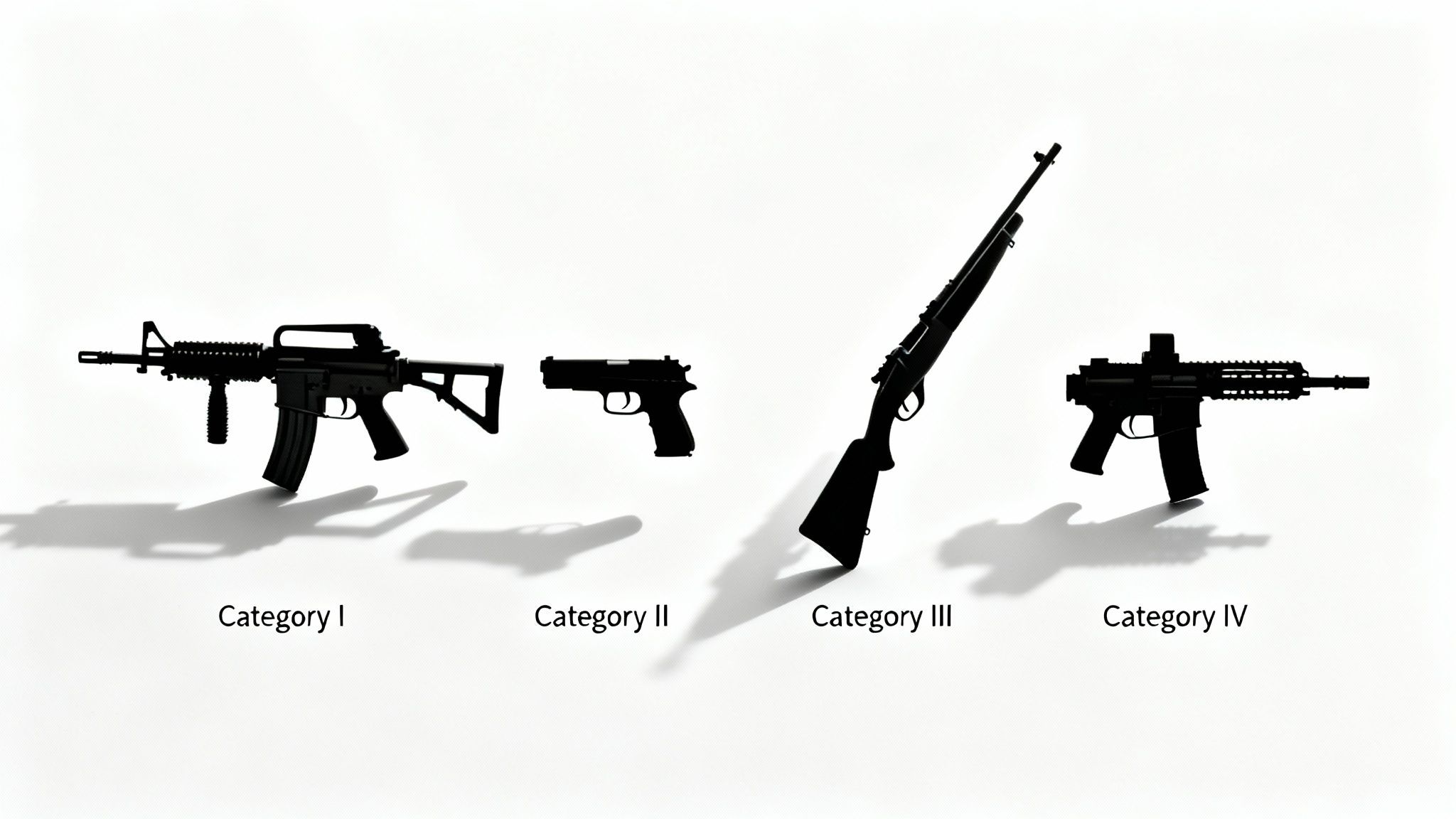
To really get to grips with where legal gun ownership ends and criminal activity begins, you first have to understand how the Dutch Wet wapens en munitie (Weapons and Ammunition Act) views different types of weapons. The law isn't a blunt instrument; it doesn't treat all weapons the same. Instead, it sorts them into four distinct categories, each based on the perceived risk to public safety.
You can think of this as a tiered risk system. The higher the category number, the tighter the restrictions. This classification is the absolute foundation of Dutch gun law, clearly defining what's completely banned, what might be allowed with a hard-to-get licence, and what you can own under specific conditions.
Category I: The Most Dangerous and Prohibited Weapons
This category is crystal clear: it covers weapons that have practically no legitimate use for a private citizen and are considered a grave threat. Possession of any item on this list is almost universally illegal for the public, and the penalties for breaking this rule are severe.
These aren't tools or sporting equipment; they are items designed purely for combat and lethality, which is why they sit at the very top of the prohibition list.
Items in Category I include:
- Fully Automatic Firearms: This means machine guns and any other firearm capable of continuous fire with a single pull of the trigger.
- Explosive Devices: This is a broad term covering everything from bombs and grenades to mines.
- Weapons Disguised as Other Objects: Think of a pen that's secretly a pistol or a walking stick that conceals a blade. Their deceptive nature makes them exceptionally dangerous.
- Brass Knuckles and Nunchucks: These are specifically named as prohibited because their sole purpose is for offence.
There’s virtually no scenario where an ordinary person can legally own a Category I weapon. Just having one is a serious breach of criminal law.
Categories II and III: Permit-Required Firearms
Here’s where things get more nuanced, and the line between legal and illegal becomes conditional. Categories II and III cover most of the firearms people typically imagine when they think of gun ownership—pistols, revolvers, shotguns, and rifles. The crucial difference is that possessing them is only legal if you have a specific, difficult-to-obtain permit, known as a verlof.
Category II generally includes military-style firearms or those posing a significant risk, like semi-automatic weapons that look like their fully automatic counterparts. Category III covers the more common firearms used for sport shooting and hunting.
To get a verlof for these firearms, you have to go through an intensive process. You need to prove a legitimate reason, like being a long-standing member of a certified shooting club or holding a valid hunting licence. It is this single piece of paper that separates a lawful sportsman from a criminal.
Category IV: Conditionally Legal Weapons
The final category is a bit of a mixed bag. It covers a wide range of items that are legal to own but come with very strict rules about how you can use and transport them. You can keep these items in your home without a specific permit, but carrying them in public is strictly forbidden.
This is a critical distinction in weapons law: ownership is not the same as the right to carry.
Here are a few examples of Category IV weapons:
- Airsoft and Paintball Guns: While you can own these for recreational use, they must be transported in a way that they aren't immediately usable (e.g., in a sealed case).
- Ceremonial Swords and Antique Firearms: These decorative or historical pieces are fine to own, but you can't carry them around in public.
- Crossbows and Harpoons: Perfectly legal for private ownership, but taking one into a public space is a criminal offence.
The logic behind the law for Category IV is all about preventing public fear and intimidation. An airsoft gun that's a perfect replica of a real pistol can cause just as much panic, so carrying it is treated very seriously. The moment you take one of these items outside your private property improperly, you step over the line from legal possession into a criminal act.
When a Lawful Gun Owner Becomes a Criminal
Holding a valid firearm permit (verlof) isn't a permanent shield from criminal law. It’s a conditional privilege, and the line separating a responsible owner from a criminal is often crossed through simple, everyday mistakes. Legal ownership is an ongoing responsibility where your behaviour, not just the licence in your wallet, determines your status.
These aren't extreme, far-fetched scenarios we’re talking about. They are common misjudgements with severe legal consequences, showing just how quickly gun ownership and criminal law can intersect. A single poor decision can instantly erase the distinction between lawful and unlawful possession.
Common Paths to Criminal Liability
Even the most diligent gun owner can find themselves on the wrong side of the law. The rules are absolute, with no leniency for ignorance or carelessness. Let’s walk through some real-world examples of how a legal owner can suddenly become a criminal.
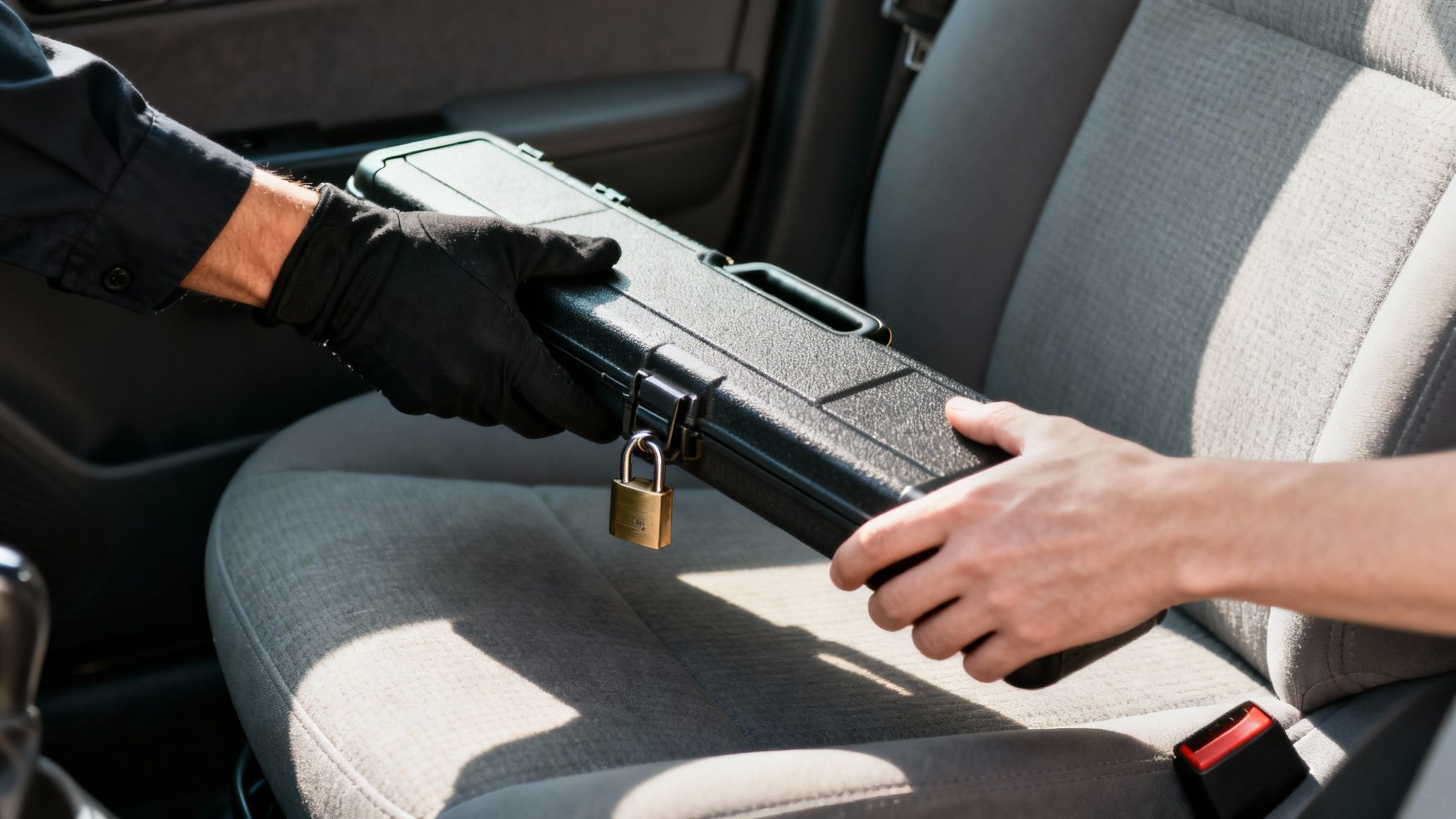
Imagine a sport shooter heading to the range. They place their unloaded handgun in a case in the boot of their car but leave the ammunition in the glove compartment for convenience. This small act of improper separation during transport is a direct violation of the Weapons and Ammunition Act. For the duration of that journey, their legal possession has turned into a criminal offence.
Another frequent mistake involves storage. A collector with a beautiful antique rifle might display it on a wall mount, believing its age makes it exempt from strict storage rules. But unless that firearm has been professionally and permanently deactivated, it must be stored in a certified gun safe. Failing to do so constitutes illegal possession, no matter the owner's intent.
The core principle is simple: legal permission is tied to perfect compliance. Any deviation from the strict rules governing storage, transport, or use immediately invalidates that permission, turning a lawful owner into an illegal possessor.
These errors can have lasting impacts. Breaching firearm regulations can lead not only to losing your permit but also to prosecution. Depending on the severity, this could mean a hefty fine, community service, or even prison time. A conviction like this has profound effects on your life; you can learn more about the consequences by reading our guide on what a criminal record entails.
Transfer and Access Violations
One of the most serious ways to cross the line is by allowing an unauthorised person to access your firearm. This is an area where the law is particularly unforgiving.
Consider these scenarios:
- Lending to a Friend: A hunter allows his unlicensed friend to borrow his rifle for a weekend trip. Even if the friend is experienced and responsible, this act of lending is a serious crime for both individuals.
- Showing a Weapon at Home: A proud gun owner shows their pistol to a guest and allows them to hold it. Without proper supervision at a licensed range, this simple act of handling can be interpreted as an illegal transfer.
- Leaving a Gun Unsecured: If a firearm is not properly secured and a family member gets their hands on it, the owner is held criminally responsible for failing to prevent that access.
The law sees the licensed owner as the sole gatekeeper of that weapon. Any action that compromises this exclusive control is a severe breach.
Illegal Modifications and Prohibited Use
Another clear boundary is the physical state of the firearm and how it's used. Making unauthorised changes or using the weapon outside its permitted context are quick ways to find yourself in criminal territory.
Illegal Modifications
It might be tempting to improve a firearm's performance, but many modifications are flat-out illegal. Attaching a silencer, converting a semi-automatic rifle to be fully automatic, or even adding a laser sight can be a criminal offence. Any modification you make must be approved and documented.
Prohibited Use
A permit is granted for a specific purpose. A sport shooter cannot carry their pistol for self-defence, and a hunter cannot use their rifle for anything other than licensed hunting activities. Using a firearm outside this narrow, approved context is a direct violation of the law. Remember, your permit is for a specific activity, not general possession.
The Growing Problem of Illegal Firearms
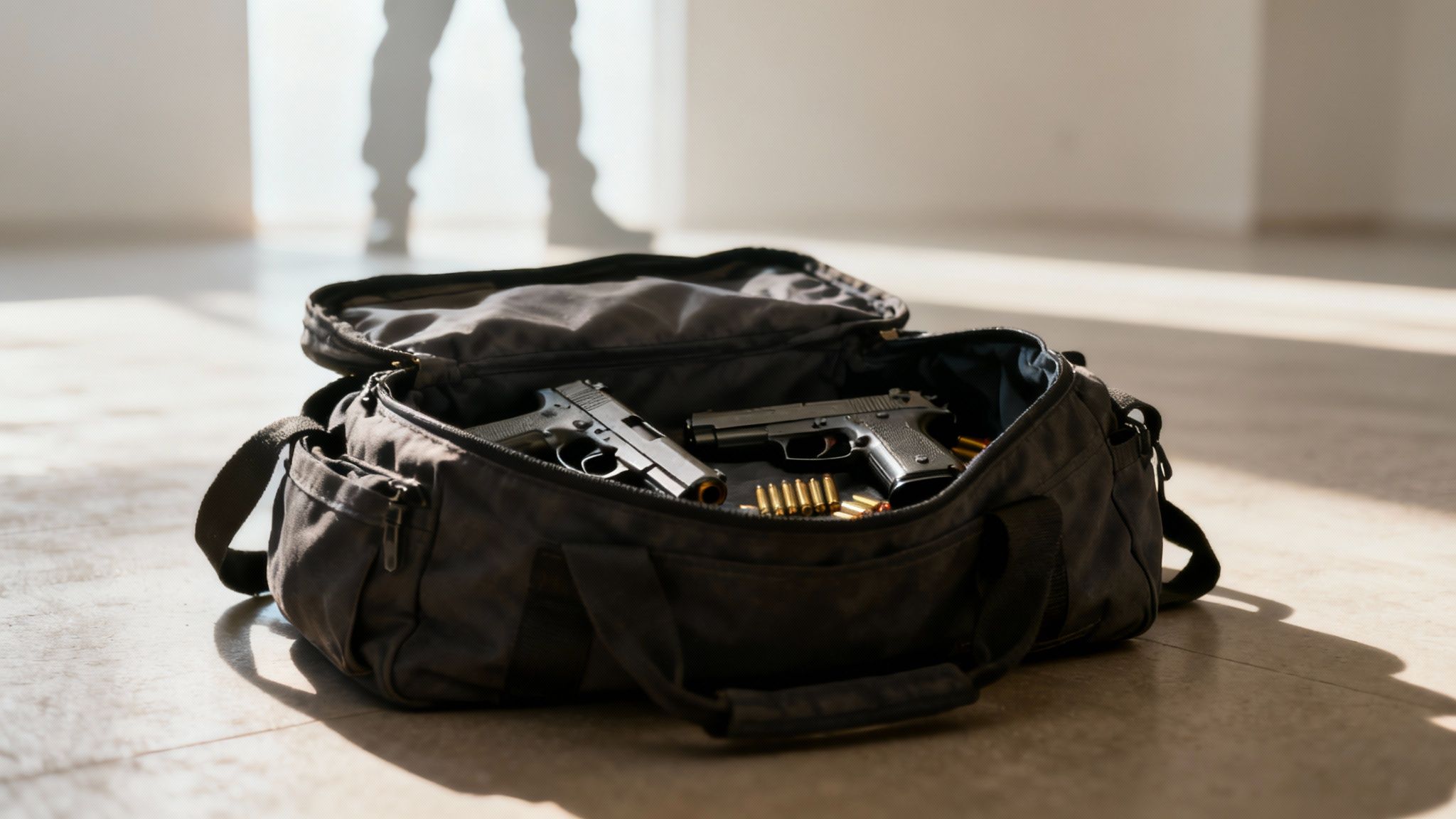
While the Netherlands keeps a tight grip on legal gun ownership, a dangerous and expanding illegal market is thriving in the shadows. This illicit trade is the primary battleground for criminal law, far removed from the world of licensed sport shooters and hunters.
The real threat to public safety comes not from rule-breaking hobbyists, but from a steady flow of unregistered weapons arming criminal networks. To understand the full picture of gun crime, you have to look at this illegal market. Law enforcement’s focus is squarely on this underworld, where firearms are just commodities for organised crime, fuelling violence and instability. These weapons aren't bought through legal channels; they are smuggled, stolen, and sold entirely outside the law.
The Scale of the Unseen Arsenal
The number of illegal firearms in circulation is alarming and shows just how big a challenge the authorities are facing. Legal guns are meticulously tracked, but the illegal ones exist completely off the books, making them incredibly difficult to count. Still, expert analysis paints a stark picture.
Estimates from 2017 suggested there were approximately 236,653 unregistered firearms in civilian hands. That number surpasses the 205,347 legally registered guns at the time. This means for every legal firearm, there is likely at least one illegal counterpart in circulation. You can find more insights in the detailed report on firearms possession by the Flemish Peace Institute.
This hidden arsenal isn't spread out evenly. While legal gun ownership is more common in rural areas, illegal possession and the violence that comes with it are concentrated in major urban centres like Amsterdam, Rotterdam, and The Hague.
Trafficking Routes and the Black Market
So, where do all these illegal weapons come from? The Netherlands' strategic location, with its major ports and extensive road networks, makes it a prime target for international arms traffickers. Many illegal firearms are brought in from other parts of Europe, especially the Balkans, where weapons from past conflicts are still circulating.
These trafficking operations are often highly sophisticated and intertwined with other forms of organised crime, like drug and human trafficking. The routes are fluid and the methods constantly evolve to evade detection. This reality often leads to complex police work, and you can learn more about the challenges of cross-border criminal investigations and your defence rights in our dedicated article.
Once inside the country, these weapons enter a thriving black market. They are sold through encrypted networks or personal criminal contacts, arming everyone from street-level gangs to major organised crime syndicates. The availability of these firearms has a direct link to increases in violent crime.
A Disturbing Trend Among Young People
One of the most concerning aspects of the illegal firearms problem is the rising trend of weapon possession among young people, especially in the larger cities. Police and social workers have noted an increase in incidents where teenagers and young adults are found with firearms, often linked to gang rivalries, drug disputes, or simply for status.
This trend is a direct and serious threat to public safety. It normalises violence and puts incredibly dangerous weapons into the hands of individuals who may be impulsive or simply don't understand the severe consequences. For law enforcement and the justice system, tackling this issue is a top priority. It sits at the dangerous intersection of youth crime and organised violence, turning the abstract concept of criminal law into a very real effort to protect communities from immediate harm.
What Happens When You Break Gun Laws
If you cross the line from legal firearm ownership into criminal territory in the Netherlands, you need to understand that this isn't taken lightly. The consequences are severe, designed to reflect the very real risk that illegal weapons pose to public safety. The justice system treats these offences with the utmost seriousness, which means that any violation of gun laws leads to tangible, life-altering penalties.
The punishments aren’t one-size-fits-all; they operate on a spectrum that matches the nature of the offence. A simple administrative slip-up, like forgetting to store a licensed firearm in its mandated safe, might land you a substantial fine and the immediate loss of your permit. From there, however, the penalties escalate sharply. The system is built to make the consequences of breaking gun laws painfully clear.
The Spectrum of Penalties
When you fall foul of the Weapons and Ammunition Act, the penalties can range from financial sanctions all the way to long-term imprisonment. The Dutch legal system carefully weighs factors like the type of weapon, your intent, and the specific context of the crime.
Here’s a realistic look at what you can expect:
- Heavy Fines: For less severe infractions, such as a licensed owner transporting or storing a weapon improperly, courts often impose significant fines intended as a harsh deterrent.
- Community Service: In some situations, particularly for first-time offenders in more minor cases, a judge might order community service on top of other penalties.
- Prison Sentences: This is where the law truly shows its teeth. Simply possessing an illegal firearm, like an unregistered pistol (Category II or III), will typically result in months behind bars. For prohibited weapons like automatic firearms (Category I) or for trafficking, sentences can stretch to several years.
The Role of Law Enforcement and Prosecution
Firearms offences aren't just handled by general police patrols. The Netherlands has specialised police units and prosecutors who are experts in investigating and trying these complex cases. The moment a firearms crime is suspected, these dedicated teams take over, bringing a high level of scrutiny and significant resources to the investigation.
Their involvement right from the start signals just how seriously these crimes are viewed. They build their cases methodically, gathering every piece of evidence to present to the court. The entire process is designed to be robust and thorough. To get a full picture of how a case moves through the system, you can explore the details of the criminal procedure in the Netherlands from investigation to verdict.
A key point to remember is that intent isn't always the deciding factor. While deliberately arming yourself for criminal activity is punished most severely, even simple negligence or ignorance of the law can lead to a criminal record and significant penalties. The courts' primary focus is always public safety.
Real-World Court Decisions
Looking at actual court cases makes these consequences much more concrete. Dutch courts consistently hand down firm sentences to send a clear message. For instance, individuals caught with a loaded firearm in a public place can expect an unconditional prison sentence, even if the weapon was never actually used.
In cases involving firearms trafficking, the sentences become even more substantial. The courts recognise that traffickers are the primary source fuelling organised crime and violence. Sentences of four years or more are not at all uncommon for those convicted of smuggling or selling illegal weapons. These real-world outcomes show that the line between legal and illegal is protected by a justice system with very little tolerance for those who cross it.
Staying Compliant and Reporting Illegal Guns
Understanding the line between legal gun ownership and criminal law is one thing. Actively staying on the right side of it is a different ball game entirely. This responsibility, for both licensed owners and the public, is absolutely critical for community safety. Thankfully, the law provides clear pathways for compliance and empowers everyone to help get dangerous weapons off the streets.
This really comes down to two distinct roles. If you're a licensed owner, your job is to maintain perfect, ongoing adherence to some very strict regulations. For everyone else, it means knowing how to safely and effectively report any suspected illegal activity. Both are vital in upholding the Netherlands' firm stance on firearm control.
A Practical Checklist for Legal Gun Owners
For anyone holding a verlof (permit), compliance isn't a one-time thing you sort and forget. It's a continuous duty. Just one slip-up can instantly flip your status from a lawful owner to a criminal offender. It helps to think of your permit as being conditional on your good behaviour at all times.
To make sure you remain fully compliant, it’s a good idea to regularly check in on these key areas:
- Secure Storage: Is your firearm always locked away in its approved, certified gun safe? And are you storing the firearm and ammunition separately, just as the law requires?
- Permit Validity: Is your verlof current? Don't wait until the last minute. Mark the renewal date on your calendar well in advance, because an expired permit immediately makes your possession illegal.
- Proper Transportation: When you're heading to a shooting range or hunting ground, are you following the strict rules for transporting your firearm? This means unloaded, secured in a locked case, and taking the most direct route possible.
- Restricted Access: Are you the only person with access to your weapon? You must never allow an unlicensed individual to handle or use your firearm outside of a supervised, approved environment.
How to Report Illegal Firearms Safely
Every citizen has a part to play in public safety. The authorities absolutely rely on community vigilance to get a handle on the problem of illegal firearms. Knowing how and where to report your concerns safely is essential—and you never have to put yourself at risk to make a real difference.
If you suspect someone has an illegal firearm or is involved in weapons trafficking, you have clear, safe options for reporting it.
Your information, no matter how small it might seem, could be the missing piece of the puzzle in a much larger investigation. Reporting what you know helps authorities take dangerous weapons off the streets, directly preventing potential violence and making your community safer for everyone.
The main resource for this is Meld Misdaad Anoniem (Report Crime Anonymously). This is an independent organisation that guarantees your identity will never be revealed to the police or anyone else. You can call them or submit a report online without any fear of reprisal. This service is a powerful tool in the fight against gun ownership that crosses into criminal law, allowing you to act responsibly while completely protecting your own safety.
Frequently Asked Gevraagd Over De Nederlandse Wapenwet
The world of gun ownership and criminal law is a minefield of complex rules. People often have pressing questions, so to bring some clarity, this section tackles the most common queries head-on. Here are some straightforward answers that draw the line between where legal gun ownership ends and criminal activity begins under Dutch law.
Can I Own a Gun for Self-Defence in My Home?
The answer to this is a firm and simple no. In the Netherlands, personal protection or self-defence is not considered a valid reason to own a firearm. The entire legal system is built around the idea that having a gun is a privilege, one granted only for specific, state-approved activities like sport shooting and hunting.
Trying to get a firearm for protection won't just get your permit application denied; possessing an unlicensed weapon for this reason is a serious criminal offence. The law draws a very clear line here, prioritising public safety and state control far above any individual's desire for personal weapons.
What Happens if I Inherit a Firearm?
Inheriting a gun puts you in a tricky legal spot. You don’t automatically inherit the right to keep it, even if the family member who passed away was a fully licensed owner. The second you take possession of that weapon without a valid permit (verlof) in your own name, you are breaking the Weapons and Ammunition Act.
You have a few legal pathways forward:
- Apply for a permit yourself, but you'll have to meet all the strict criteria for being a sport shooter or hunter.
- Transfer the firearm to someone else who already holds the correct, valid permit.
- Surrender the firearm to the police. They will legally register it and then destroy it.
It's absolutely crucial to contact the police the moment you find an inherited firearm. Reporting it proactively shows you intend to follow the law and can save you from facing criminal charges for illegal possession. Simply ignoring it is not an option and will land you in serious legal trouble.
Are Antique or Deactivated Guns Legal to Own?
Whether an antique or deactivated gun is legal comes down entirely to its specific classification and condition. An antique firearm, which generally means one made before 1870, might fall under an exemption, making it legal to own without a permit. This is a very technical area, though, and the weapon has to meet some incredibly strict criteria to qualify.
It's a similar story for deactivated firearms. A gun is only legally considered "deactivated" if it has been made permanently useless according to precise EU and Dutch standards. It must also come with an official deactivation certificate to prove it. Any weapon that could be easily made to fire again is treated just like a live firearm under the law. Just taking out the firing pin isn't nearly enough; the deactivation has to be complete and irreversible. If you're caught with an improperly deactivated weapon, you're committing a criminal offence.