


If you're grappling with the regret of a whirlwind marriage, you're likely asking one question above all: how quickly can this be undone? In the Netherlands, the answer can be remarkably fast. Dutch law operates on a 'no-fault' system, which means you don't need to prove wrongdoing or wait through a mandatory separation period before filing for divorce.
For couples who can agree on the terms, a mutual consent divorce can sometimes be finalised in just a few months. This makes it one of the more pragmatic and efficient processes in Europe, offering a clear path forward when a swift decision needs an equally swift resolution.
How Fast Can You Really Get a Divorce in The Netherlands?

When the initial rush of romance gives way to the hard reality of a mismatched partnership, figuring out the exit strategy becomes paramount. The Dutch legal system is built for pragmatism, especially for couples who are on the same page about separating.
The entire timeline hinges on one core question: is the divorce by mutual consent, or is it contested? A shared agreement to divorce and a clear plan for separating your lives will streamline everything. On the other hand, if you can't agree on key issues like finances, property, or children, the process will naturally take longer as it requires court intervention.
Understanding the Timelines
Imagine marrying quickly, only to realise months later that it was a mistake. In the Netherlands, you can start the legal process almost immediately. This is thanks to the 'no-fault' divorce system in place since 1971. Unlike in many other countries, you don't have to live apart for a set time before you can file.
All that's required is for one spouse to state that the marriage has "irretrievably broken down" (duurzame ontwrichting). That is the only legal ground needed. This approach prioritises a dignified resolution over assigning blame, which is a cornerstone of Dutch family law.
Of course, the actual calendar time can vary. To give you a clearer picture, let's break down some realistic timeframes. Keep in mind these are estimates; complex situations involving international assets, business ownership, or significant disputes will add time. For a deeper dive into the specific steps, you can read our detailed guide on how a quick divorce works.
The single biggest factor determining the speed of your divorce in the Netherlands is cooperation. A jointly filed petition with a complete, signed divorce agreement can move through the court system with remarkable efficiency, often without you ever needing to step foot in a courtroom.
To help you set expectations, here’s a look at what you can generally expect for different types of divorce proceedings.
Estimated Divorce Timelines in The Netherlands
This table outlines the typical timeframes for different divorce scenarios under Dutch law, providing a clear comparison for readers.
| Divorce Scenario | Typical Timeframe | Key Requirements |
|---|---|---|
| Mutual Consent (No Children) | 1-3 Months | Full agreement on all terms; Signed divorce agreement. |
| Mutual Consent (With Children) | 2-4 Months | Full agreement; Signed divorce agreement and mandatory parenting plan. |
| Contested (Unilateral Petition) | 6-12+ Months | One spouse files; Court hearings required to resolve disputes. |
| Complex Contested (Assets/Custody) | 12-24+ Months | Disputes over international assets, business ownership, or custody. |
As you can see, the path of least resistance is always mutual agreement. When you and your partner can work together with your respective lawyers to settle matters beforehand, the court's role becomes largely administrative, which saves everyone time, stress, and money.
The Dutch Approach: A 'No-Fault' Divorce System
The speed of a Dutch divorce comes down to one core legal idea: irretrievable breakdown (duurzame ontwrichting). It’s the one and only reason you need to end a marriage in the Netherlands. This "no-fault" approach fundamentally changes the entire process compared to many other jurisdictions.
Unlike legal systems that demand proof of bad behaviour—like adultery, abandonment, or cruelty—Dutch law is not interested in assigning blame. You don’t have to prove who was at fault for the marriage failing. There's no need to gather evidence of wrongdoing or endure a long, mandated separation period before you can file. If one or both of you genuinely feel the marriage is over, that's enough for the court.
This system steers the process away from contentious court battles over who did what. Instead, it allows everyone to focus their energy on the practical side of separating. It makes for a much more dignified and less confrontational experience—a massive relief when you're already dealing with the emotional fallout of a quick marriage gone wrong. The entire system is built for resolution, not for revenge.
Two Main Roads to Divorce
With this no-fault principle as the starting point, the process splits into two distinct paths. The route you end up taking is the biggest single factor that will dictate the speed, cost, and stress level of your divorce.
-
Joint Petition (Gemeenschappelijk Verzoek): This is by far the fastest and simplest option. It’s for couples who both agree the marriage is over and have managed to work out all the details together. You file a single, joint application to the court.
-
Unilateral Petition (Eenzijdig Verzoek): This path is taken when one person wants the divorce but the other doesn't, or—more commonly—when you cannot agree on the terms. In this case, one spouse files the petition alone. This process is naturally more involved and takes longer because it creates a formal legal disagreement that a judge will have to resolve.
Getting a clear idea of which path your situation is likely to take is the first step in setting realistic expectations for how quickly things will move.
The Power of the Divorce Agreement
For anyone taking the joint petition route, the divorce agreement (echtscheidingsconvenant) is the most important document you'll create. Think of it as a detailed, legally binding contract that maps out every single aspect of your separation. You’ll draft it with your lawyer or mediator, and it has to be completely agreed upon before anything is sent to the court.
A solid, well-thought-out divorce agreement is the absolute key to a quick divorce. When you settle everything in advance—from how you'll split your assets to any partner alimony—you're essentially handing the court a finished puzzle. There's very little left for a judge to do besides grant the official decree.
If you have children under 18, a parenting plan (ouderschapsplan) is a mandatory part of this agreement. Because you’ve made all the tough decisions outside of the courtroom, the legal part becomes more of an administrative check. The court simply reviews the paperwork to ensure it complies with Dutch law and then issues the divorce decree, often without you ever having to appear in court. It's this collaborative, front-loaded approach that allows a divorce to be finalised in just a few months.
What Speeds Up or Slows Down Your Divorce

Think of your divorce timeline not as a fixed date, but as a journey with express lanes and potential traffic jams. Several key factors can either put you on the fast track to a final decree or slow the entire process to a crawl, adding months of stress and expense. Understanding these variables from the outset is the best way to manage expectations for the road ahead.
The single most powerful accelerator is, without a doubt, mutual agreement. When you and your spouse can communicate and reach a consensus on the big issues—finances, children, the house—you do most of the heavy lifting outside the courtroom. This collaborative approach keeps the court’s role minimal and purely procedural.
On the other hand, conflict is the ultimate brake pedal. Every point of disagreement, no matter how small it seems, creates a hurdle. Each one requires legal negotiation, formal responses, and possibly a judge's ruling to overcome, adding significant time and cost to the process.
Accelerating Factors (Faster Process)
Certain elements can dramatically shorten the time it takes to finalise your divorce. If your situation includes most of the following, you're well-positioned for a quicker, more efficient process.
-
A Complete Divorce Agreement: Having a fully signed echtscheidingsconvenant (divorce covenant) and parenting plan before you even file is the number one way to speed things up.
-
No Minor Children: Without children involved, you skip the mandatory—and often sensitive—negotiations needed for a parenting plan, which covers everything from custody and visitation to child support.
-
Simple Financials: A straightforward financial situation with easily divisible assets (like bank accounts) and minimal debt avoids the long process of valuing complex holdings like a business or international property.
-
Using a Mediator: A neutral mediator can help you find common ground efficiently, resolving disagreements before they escalate into a formal court battle that adds months to the timeline.
-
A Prenuptial Agreement: A clear, legally sound prenuptial agreement provides a pre-approved roadmap for dividing assets, which can prevent prolonged disputes from ever starting.
While the number of divorces in the Netherlands has decreased over the past two decades, thousands still occur annually. This trend is influenced by factors like marrying later in life. However, for those facing a sudden end to a marriage, the Dutch system provides a relatively efficient path compared to many other countries. You can learn more about these 25-year marriage and divorce trends on bringbackdata.com.
Delaying Factors (Slower Process)
Conversely, several factors can turn a straightforward divorce into a lengthy legal marathon. These issues introduce layers of complexity that require detailed investigation, expert valuations, and judicial intervention. If these apply to your situation, it’s wise to prepare for a longer timeline.
-
Disputes Over Children: Disagreements about the parenting plan—like where the children will live or who makes major decisions—are a primary cause of delays and often require a court hearing.
-
Alimony Disagreements: Arguments over the amount or duration of partner alimony can be highly contentious and frequently need a judge to make the final call.
-
Complex or International Assets: Dividing a family business, international real estate, pensions, or significant investment portfolios is a complicated process that requires financial experts and can take many months to sort out.
-
An Uncooperative Spouse: If one partner refuses to communicate, sign documents, or provide financial information, your lawyer will have to use formal legal procedures to compel them, which will delay the process.
To help you see where you might stand, here’s a quick overview of what helps and what hurts your timeline.
What Speeds Up vs. Slows Down Your Divorce
This table offers a comparative look at the factors that can either fast-track or significantly prolong divorce proceedings in the Netherlands.
| Accelerating Factors (Faster Process) | Delaying Factors (Slower Process) |
|---|---|
| Full agreement on all major issues. | Conflict over finances, children, or assets. |
| No minor children involved. | Disputes over the parenting plan. |
| A simple, shared financial portfolio. | Complex assets like a business or international property. |
| A valid prenuptial agreement is in place. | No prenuptial agreement, leading to disputes. |
| Both partners are communicative and cooperative. | One partner is uncooperative or unresponsive. |
| Using a mediator to resolve issues. | Refusing mediation and insisting on litigation. |
By realistically assessing which of these factors apply to your marriage, you can gain a much clearer picture of what to expect and how quickly you might be able to move forward.
Navigating Custody, Alimony, and Assets as an Expat
While the legal filing process can be quite straightforward, the real substance of any divorce boils down to three core pillars: children, finances, and assets. For expats and internationals, these areas bring unique layers of complexity. How you navigate them is often the difference between a clean break and a drawn-out, expensive legal fight.
These are the cornerstones of your new life post-divorce, each governed by specific Dutch legal principles that might be very different from what you're used to in your home country.
Child Custody and the Mandatory Parenting Plan
When children are involved, Dutch law is clear: the child's best interests (belang van het kind) are the top priority. This principle guides every court decision about custody, living arrangements, and contact.
In the Netherlands, joint parental authority is the default, even after a divorce. This means both parents typically continue to share responsibility for major decisions in a child’s life, from schooling to healthcare.
A non-negotiable part of any Dutch divorce with minor children is the parenting plan (ouderschapsplan). This is a strict legal requirement, not a suggestion. This document must thoroughly map out:
-
How you will divide daily care and visitation schedules.
-
How you will communicate and consult on important matters concerning the children.
-
How the costs of raising the children will be split (this forms the basis for child support).
A court will not grant the divorce until a complete and practical parenting plan is submitted. For expat families, this plan must also account for international factors like holidays abroad, travel permissions, and potential future relocations.
Alimony and Financial Support
Dutch law distinguishes between two types of alimony: partner alimony and child support. The calculation for both hinges on two key ideas: the need (behoefte) of the recipient and the financial capacity (draagkracht) of the payer.
Child support is considered the child's fundamental right, and parents cannot waive it. The court calculates the child's needs and assesses what each parent can contribute financially.
Partner alimony is intended to support a spouse who cannot fully provide for themselves after the divorce and would otherwise face a significant drop in their standard of living. The rules have changed recently; the duration of partner alimony is now typically half the length of the marriage, capped at a maximum of five years. For expats, calculating income can be complex, especially with foreign salaries, international bonuses, and varied tax situations.
Dividing Assets: The Community of Property Rule
This is often the most complex puzzle for international couples. For marriages that took place after 1 January 2018, the default system in the Netherlands is a limited community of property. This means that all assets and debts acquired during the marriage are considered joint property and are usually divided 50/50.
A prenuptial agreement (huwelijkse voorwaarden) is the most effective way to bypass this default rule. For any expat with assets in different countries, a business, or significant pre-marital wealth, a prenup is vital to protect those assets from being automatically split.
Without a prenup, a Dutch court will apply Dutch law to the division of assets, which can lead to surprising outcomes for property or investments you hold overseas. A divorce can also have a major impact on your legal status here; it's vital to understand the link between divorce and your residence permit.
Your Step-by-Step Guide to the Dutch Divorce Process
Navigating a divorce can feel overwhelming. Understanding the official procedure in the Netherlands, however, can bring much-needed clarity. Every divorce here, whether amicable or contentious, follows a structured legal path.
The journey always begins with one mandatory first step: you must hire a lawyer. In the Netherlands, you cannot file for divorce yourself. The petition must be submitted to the court by a registered attorney, ensuring the process meets all legal standards from the outset.
Stage 1: Filing the Divorce Petition
With a lawyer on your side, the first official document is the divorce petition (verzoekschrift tot echtscheiding). If you and your spouse are filing jointly, this petition will include your signed divorce agreement and, if applicable, your parenting plan.
If you are filing alone, the petition will state that the marriage has irretrievably broken down and outline your requests regarding children, finances, and property. Your lawyer then files this with the district court, which officially begins the legal proceedings.
Stage 2: The Response Period in Contested Cases
This is where the paths for amicable and contested divorces diverge. If you filed a unilateral petition, the court serves the papers to your spouse. They then have a standard period of six weeks to hire their own lawyer and file a defence (verweerschrift).
In a mutual consent case, this stage is skipped. But in a contested divorce, this response period can be extended, adding weeks or even months to the timeline.
Stage 3: The Court Hearing
If you and your spouse cannot agree on everything, the court will schedule a hearing (mondelinge behandeling). This is an opportunity for both of you, along with your lawyers, to appear before a judge and present your arguments.
A hearing is not always necessary. For joint petitions where all paperwork is complete and correct, the judge often grants the divorce based on the documents alone. You likely will not need to go to the courthouse, which is a key reason mutual consent divorces are so much faster.
Stage 4: Receiving the Divorce Decree
After reviewing all documents—or after the hearing—the judge issues a final decision. This is the divorce decree (echtscheidingsbeschikking).
This decree makes all decisions on alimony, asset division, and the parenting plan official and legally binding. Receiving this decree can take anywhere from a few weeks for a straightforward case to several months if the judge has complex issues to consider. For a more detailed look at this part of the timeline, our article on the divorce applications process provides extra insight.
Stage 5: Finalising the Divorce
Receiving the court's decree is a huge milestone, but it is not the final step. Your marriage is not officially over until the decree is registered with the Registry of Births, Deaths, Marriages, and Registered Partnerships (Basisregistratie Personen or BRP).
This must be done within six months of the decree becoming final (after the three-month appeal period has passed). Your lawyer handles this registration for you. Once that decree is officially on the books, your divorce is legally complete.
Preparing for Your Next Steps and Getting Expert Help
Knowing the legal landscape is one thing, but taking clear, decisive action is what truly matters when you're grappling with flash marriage regret. While the Dutch system is efficient, it requires careful preparation. Let’s walk through a practical action plan.
First, get your documents in order. This goes beyond just your marriage certificate; it's about creating a complete and honest financial picture. Taking this step seriously is crucial for a smooth process.
Your Immediate Checklist
Start by gathering these essential items. Having them ready will save significant time and help your legal counsel provide accurate advice from your first conversation.
-
Financial Statements: Collect recent bank statements, investment portfolio summaries, and a clear record of any debts—for both you and your spouse.
-
Proof of Assets: Compile all documents related to property (deeds), vehicle registrations, and any other valuable assets acquired before or during the marriage.
-
Income Verification: This includes recent payslips, employment contracts, or if you are self-employed, your business’s profit-and-loss statements.
-
Residency and Personal IDs: Ensure your passports, residence permits, and your BSN (citizen service number) are all easily accessible.
Seeking expert legal guidance isn't about escalating conflict; it's a strategic move to ensure fairness and efficiency. A lawyer who specialises in family law for internationals can anticipate the cross-border complications that a general practitioner might miss, protecting your assets and rights under Dutch law.
Why Specialised Legal Help Is Crucial
You are legally required to have a lawyer to file a divorce petition with the court in the Netherlands. For expats, the need for specialised guidance is even more acute.
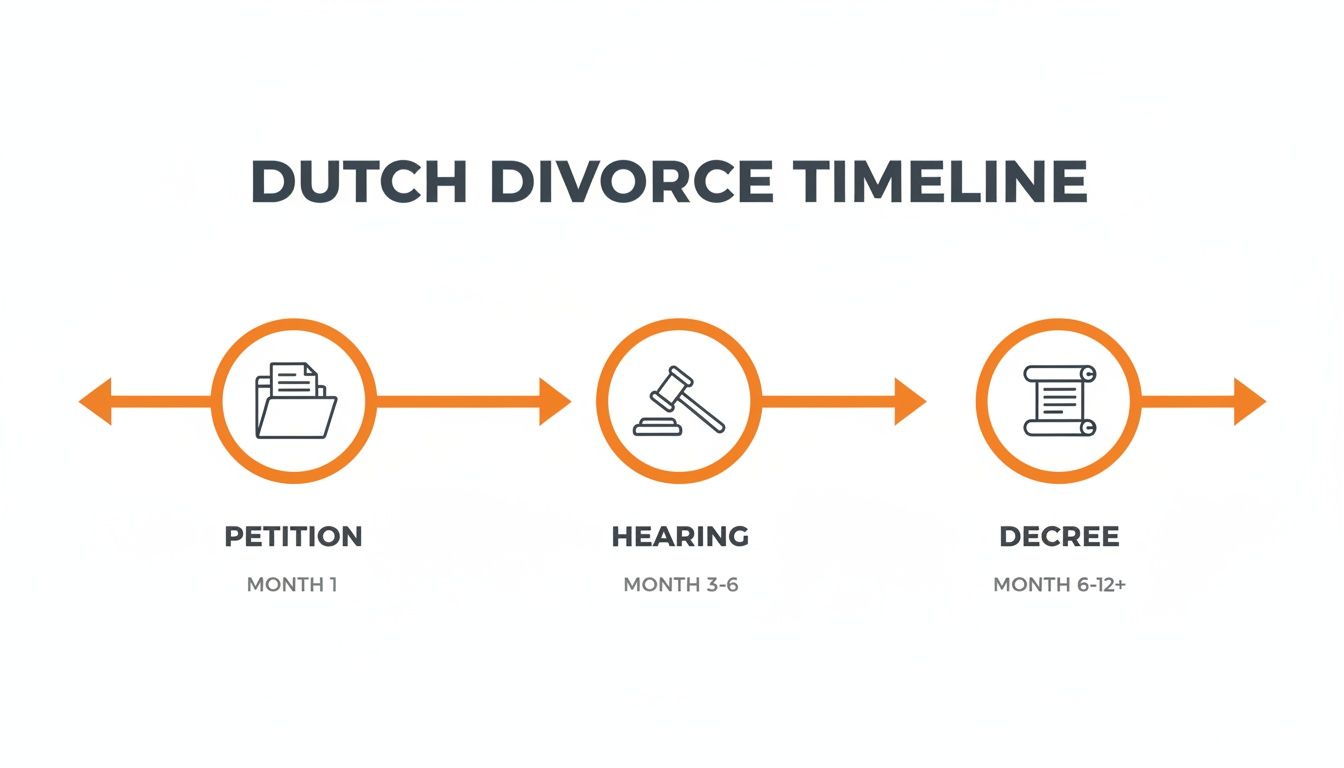
As you can see, the process is structured, but key decisions can drastically change the timeline. This is where having an expert guide you becomes so important.
A firm with a deep understanding of international family law can tackle complex issues like dividing foreign assets, sorting out pension rights across different countries, and addressing the implications for your residence permit. They are your advocate, making sure any agreement is not just fair, but legally watertight.
The next step is getting advice that’s tailored to you. Contact Law & More for a consultation. We can discuss your specific circumstances and map out the best path forward for you.
Frequently Asked Questions
Even with a clear roadmap, specific questions always arise during the stress of a sudden divorce. This section tackles some of the most common practical concerns we hear, especially from expats navigating the Dutch legal system for the first time. The answers are direct and designed to give you immediate clarity.
Can We Use the Same Lawyer to Save Time and Money?
Only in case of a joint divorce. In all other cases, the answer is a firm no. In the Netherlands, one lawyer cannot legally represent both spouses in a divorce. Each party must have their own independent legal counsel to ensure there is no conflict of interest and that both individuals receive advice focused solely on protecting their own rights.
However, you can jointly hire a divorce mediator. A mediator is a neutral third party who facilitates negotiations to help you reach a mutual agreement. If you succeed, each of you will still need your own lawyer to review the final agreement and submit the joint petition, but the overall time and legal fees will be significantly lower than in a contested divorce.
Do I Have to Be in The Netherlands for the Entire Process?
Not necessarily. One of the advantages of the Dutch system, particularly for mutual consent divorces, is that much of the process can be handled remotely. Your lawyer can manage all court filings and communications on your behalf.
You will likely need to be physically present for initial meetings with your lawyer, to sign key documents, and potentially to attend a court hearing if the divorce is contested. But for a straightforward, agreed-upon divorce, you will not need to remain in the country for the entire duration, which is a significant relief for expats with international obligations.
What if My Spouse Is Not a Dutch Citizen or Lives Abroad?
The Dutch court can still have jurisdiction over your divorce even if one or both of you are not Dutch citizens. Jurisdiction is typically established if the Netherlands was your last marital residence and one of you still lives here. It can also apply if the person filing the petition has been living in the Netherlands for a certain period—usually six to twelve months, depending on their nationality.
If your spouse lives abroad, the process becomes more complex but is still manageable. Your lawyer will arrange for the divorce petition to be officially served to them in their country of residence, following international legal protocols. While this adds time to the process, it does not prevent the divorce from moving forward.
Navigating the complexities of an international divorce requires specialised knowledge. At Law & More, our team is experienced in guiding expats through every stage of the process with clarity and efficiency. If you're facing the difficult reality of a flash marriage regret, contact us for a consultation to understand your rights and map out the quickest, fairest path forward.