


You need a commercial agreement for your business in the Netherlands. Maybe you’re buying services from a supplier, licensing software, or entering a distribution deal. The contract protects both parties, but getting it right requires more than filling in a template. Miss a key clause, leave terms ambiguous, or ignore Dutch law requirements, and you risk disputes, unenforceable terms, or costly litigation down the line.
This article gives you five practical tips for drafting commercial agreements under Dutch law. You’ll learn when to involve a lawyer, what legal essentials apply in the Netherlands, how to structure the commercial terms clearly, which risk allocation clauses matter most, and how to avoid common drafting mistakes. Whether you’re adapting an English language template or starting from scratch, these tips help you create agreements that work.
1. Involve a Dutch commercial contract lawyer early
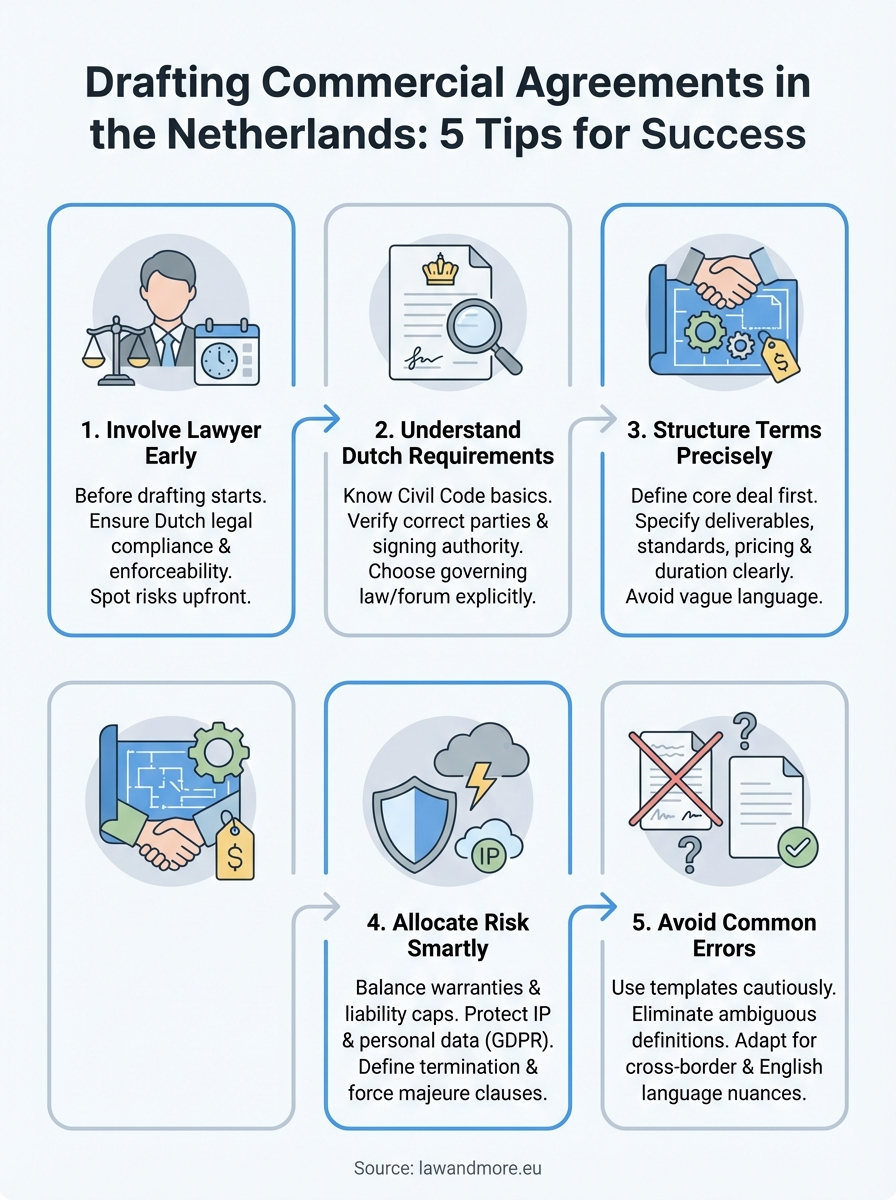
You gain the most value from legal advice when you involve a lawyer before you start drafting, not after problems emerge. A Dutch commercial contract lawyer helps you identify legal requirements specific to the Netherlands, spot risks you might miss, and structure terms that protect your interests while remaining enforceable under Dutch law. Waiting until negotiations stall or disputes arise costs more time and money than getting the contract right from the start.

Work with a Dutch commercial contract lawyer
Dutch contract law allows considerable freedom of contract, but certain mandatory rules apply depending on your contract type and parties involved. A lawyer ensures your agreement complies with Dutch Civil Code requirements, particularly around formation, performance, and termination. They also advise on sector-specific regulations that might govern your deal, from consumer protection rules to data privacy obligations under the GDPR.
Involving legal counsel early prevents you from agreeing to terms you cannot later enforce or defend.
How Law & More supports contract drafting
Law & More drafts and reviews commercial agreements for businesses operating in the Netherlands. Our lawyers work across multiple legal areas, so we spot issues that span corporate law, intellectual property, employment, and other fields. We explain contract terms in clear language, suggest practical alternatives when standard clauses don’t fit your deal, and negotiate on your behalf when needed. You reach us evenings and weekends, not just business hours.
When to seek legal advice during negotiations
Seek legal advice before you sign a letter of intent or agree to key commercial terms. Once you’ve shaken hands on price, scope, and timeline, changing those fundamentals becomes difficult. Involve your lawyer when the other party proposes their standard terms, when the contract involves significant value or risk, or when you’re entering an unfamiliar industry or cross-border arrangement.
2. Understand Dutch legal requirements and jurisdictional choices
Drafting commercial agreements under Dutch law requires you to get the legal foundation right before you negotiate specific business terms. You must identify who signs, confirm they have authority to bind the company, and decide which law governs the contract. These choices affect enforceability, dispute resolution, and how courts interpret your agreement if problems arise.
Know the essentials of Dutch contract law
Dutch contract law operates under the Dutch Civil Code (Burgerlijk Wetboek), which governs formation, validity, performance, and breach. Contracts form when you make an offer and the other party accepts it, with or without signatures depending on the circumstances. Dutch law recognizes both written and oral agreements, but written contracts prevent disputes over what you agreed. Certain contracts require specific formalities, such as notarial deeds for real estate transfers or employment agreements that meet statutory minimums.
Written contracts under Dutch law provide certainty and evidence that oral agreements cannot match.
Identify the right parties and signing authority
You must name the correct legal entities as parties to your contract. Use the full registered company name, including the legal form (B.V., N.V., or other designation), and verify the chamber of commerce registration number. Confirm that the person signing has authority to bind the company, either through board representation or a power of attorney. Contracts signed by unauthorized persons may not bind the company, leaving you without enforceable rights.

Decide on governing law, forum, and contract language
Choose which country’s law governs your contract and where disputes get resolved. Dutch parties often select Dutch law and Dutch courts, but international deals may require different choices. You can draft contracts in English even when Dutch law applies, though Dutch courts interpret ambiguous terms under Dutch legal principles. State your governing law choice explicitly in a dedicated clause to avoid uncertainty.
3. Structure the business terms with precision
The commercial terms form the core of your agreement. Before you add legal protections or boilerplate clauses, you capture what each party gives and receives. When drafting commercial agreements, you start with the business deal itself: what services or goods change hands, at what price, for how long, and under what conditions. Clear commercial terms prevent disputes and make the rest of your contract easier to negotiate.
Capture the commercial deal in clear terms first
You define the fundamental transaction before adding legal complexity. State who delivers what, when delivery happens, and what constitutes acceptable performance. Avoid reaching for a template and filling blanks before you understand the actual agreement between parties. Ground your contract in commercial reality by describing the transaction in plain terms that both business stakeholders and lawyers understand immediately.
Starting with clear business terms prevents misunderstandings that legal clauses cannot fix later.
Define services, deliverables, and performance standards
Spell out what services or deliverables you expect and what standards apply. Use specific, measurable terms rather than vague descriptions. If the contract involves software development, define each deliverable, acceptance criteria, and testing procedures. For service agreements, state response times, service levels, and quality metrics. Define technical terms and industry concepts in a definitions section so everyone interprets them the same way throughout the contract.

Set price, payment terms, and contract duration clearly
State the total price or rate structure and when payments fall due. Include currency, VAT treatment, and consequences for late payment. Specify whether the contract runs for a fixed term or renews automatically, and under what conditions either party can terminate early. Add renewal notice periods and any price adjustment mechanisms for multi-year contracts.
4. Allocate risk through warranties, liability limits, and protective clauses
Risk allocation determines who bears financial and operational consequences when things go wrong. When drafting commercial agreements in the Netherlands, you decide which party assumes liability for defects, breaches, delays, and unforeseen events. These clauses protect your business from excessive exposure while creating certainty about remedies available to each party.
Balance warranties, indemnities, and liability caps
You include warranties to guarantee specific facts or conditions, such as ownership of intellectual property or compliance with regulations. The other party relies on these promises when entering the contract. Pair warranties with indemnities that allocate who pays for third-party claims arising from breaches. Limit total liability through caps tied to contract value or specific amounts, excluding liability for fraud, willful misconduct, or violation of confidentiality obligations.
Effective risk allocation matches liability exposure to each party’s control over the underlying risk.
Protect intellectual property, data, and trade secrets
State who owns intellectual property created during the contract term and what rights each party receives. Specify whether you grant a license, transfer ownership, or keep all IP. Add confidentiality obligations that protect business information, trade secrets, and personal data exchanged during performance. Include GDPR compliance requirements when processing personal data, particularly data processing agreements for controller-processor relationships.

Regulate change control, termination, and force majeure
Establish a formal change control process for modifying scope, price, or timeline after signing. Require written approval from authorized representatives for material changes. Define termination rights for convenience, cause, or insolvency, stating notice periods and consequences for early exit. Include force majeure provisions that excuse performance during unforeseeable events beyond either party’s control, specifying which events qualify and what obligations remain.
5. Avoid common drafting mistakes that weaken contracts
Even experienced parties make errors when drafting commercial agreements. You might copy clauses from templates without checking whether they fit your deal, use inconsistent terminology that creates confusion, or fail to account for cross-border complications. These mistakes weaken enforceability and invite disputes. You eliminate these risks by recognizing where drafters commonly go wrong and correcting those problems before you finalize the contract.
Use templates and online samples with caution
Templates provide starting points, not complete solutions. You cannot simply fill blanks in a generic form and expect it to protect your interests under Dutch law. Standard templates often include clauses from other jurisdictions, miss sector-specific requirements, or allocate risks inappropriately for your situation. Review templates critically and adapt them to your actual transaction rather than forcing your deal into a template’s structure.
Templates save time only when you understand which clauses need modification for your specific contract.
Eliminate ambiguity and inconsistent definitions
You create ambiguity when you use different terms for the same concept or fail to define key terms consistently. Check that capitalized definitions appear in a definitions section and get used the same way throughout. Remove vague phrases like "reasonable efforts" or "as soon as possible" that courts must interpret. Replace them with specific standards, deadlines, and metrics that leave no room for competing interpretations.
Adapt drafting for cross border and English language deals
Contracts in English governed by Dutch law require extra attention. Dutch courts interpret English contracts under Dutch legal principles, which may differ from common law jurisdictions. Avoid legal terms that carry specific meanings in other systems but lack direct Dutch equivalents. When parties operate across borders, specify currency, tax responsibilities, and compliance obligations for each jurisdiction explicitly.
Moving forward
Drafting commercial agreements under Dutch law requires attention to legal requirements, clear commercial terms, balanced risk allocation, and careful review to eliminate ambiguity. You gain the strongest protection when you involve legal counsel early, structure the business deal precisely before adding legal complexity, and adapt standard clauses to fit your specific transaction. These five tips help you create contracts that serve your business needs while remaining enforceable in the Netherlands.
Getting contracts right from the start prevents costly disputes and renegotiations later. Whether you’re negotiating a supplier agreement, software license, or distribution contract, professional legal support makes the difference between a document that works and one that creates problems.
Contact Law & More for assistance with drafting, reviewing, or negotiating commercial agreements under Dutch law. Our lawyers provide practical advice in clear language and work across multiple legal areas to protect your interests. We’re available evenings and weekends when you need us.