



Divorce is always a difficult journey, but when your spouse is battling dementia or a serious mental illness, it enters a realm of profound legal and emotional complexity. You're not just ending a marriage; you're navigating the heart-wrenching task of ensuring the person you once built a life with is protected, even as you part ways.
Dutch law acknowledges that marriages can break down under these incredibly tough circumstances. However, the standard divorce process is rightly modified to place a strong emphasis on protecting the vulnerable spouse. This means key legal concepts like 'wilsbekwaamheid' (the capacity to make one's own decisions) and court-appointed representation become central to the entire process.

The Legal and Emotional Crossroads of Divorce and Mental Incapacity
Making the decision to divorce is one of life's most challenging moments. When your partner can no longer fully advocate for themselves, that decision is weighed down by a host of difficult questions.
Is a divorce even legally possible? How can the process be fair if my spouse cannot consent? Who will look out for their interests? These are immediate and pressing concerns, and this guide is designed to provide clear, practical answers within the context of Dutch law.
A Path Forward with Legal Safeguards
The Dutch legal system provides a path forward, but it is one lined with robust safeguards to prevent exploitation and ensure the wellbeing of the incapacitated spouse. It is a specialised legal journey, and we will walk through the essential components together.
Here’s what we will explore:
- Determining Legal Capacity: How Dutch courts assess if a spouse truly understands the implications of a divorce and can agree to it.
- Guardianship and Representation: The crucial roles of curators, administrators, and mentors who might be appointed to act on your spouse’s behalf.
- The Adapted Divorce Process: A step-by-step look at how proceedings change when a legal representative becomes involved.
- Fair Financial Outcomes: How assets and alimony are handled to secure the long-term needs of an ill spouse.
Mental health issues can be a significant factor in marital breakdowns. A major Dutch study found that 'personal problems of spouse'—often linked to mental illness—were cited as a reason for divorce by 43-50% of respondents. Dutch law addresses this reality by allowing for divorce while imposing strict protective measures. A spouse's cognitive decline does not leave them unprotected. You can learn more about the research on divorce motives in the Netherlands.
How Dutch Courts Determine Legal Capacity for Divorce
When a divorce involves a spouse with dementia or a serious mental illness, Dutch law focuses on one central question: capacity. The court must determine if the spouse has 'wilsbekwaamheid'—the mental ability to understand what a divorce is and what its consequences will be. This is not about the medical diagnosis itself, but about whether the individual can truly grasp the situation and make a reasoned decision about it.
It is one thing to know you are married; it is another thing entirely to comprehend what ending that marriage means for your finances, your home, and your personal life. That is the crucial distinction a Dutch court must make.
The Court's Evaluation Process
A court will not make this determination lightly or based on one person's word. There is a structured process to ensure the assessment is fair, objective, and above all, protective of the potentially vulnerable spouse.
A key step is often appointing an independent medical expert, such as a geriatrician or a psychiatrist, to evaluate the spouse. This expert's report provides the court with a crucial, impartial opinion on the person's cognitive state and their ability to appreciate what is happening in the divorce proceedings.
Key Factors in the Assessment
When a judge assesses wilsbekwaamheid for a divorce, they consider several specific factors:
- Understanding Information: Can the spouse process the facts? Do they understand they are married, that a divorce has been requested, and what it means to no longer be married?
- Appreciating Consequences: Can they connect the divorce to how it will change their day-to-day life, their living situation, and their finances?
- Reasoned Decision-Making: Is the person able to weigh the pros and cons of divorcing and express a consistent choice based on that logic?
- Communicating the Decision: Can they clearly communicate their decision, even if they require assistance to do so?
The court's assessment is dynamic. A person's capacity can fluctuate, especially with certain mental illnesses. The evaluation focuses on their ability to make this specific decision at the time it needs to be made, not on their general cognitive ability over the past months or years.
The context for these sensitive cases is shaped by wider trends. A major research on divorce motives involving 1,718 divorced people in the Netherlands found that a spouse's personal problems—which can include mental illness or dementia—were a major reason for divorce for 46% of women and 43% of men. When these issues progress to the point where someone cannot make their own decisions, Dutch family law (specifically the Dutch Civil Code) requires the court to intervene.
When a Spouse Is Deemed Incapacitated
If the court concludes that a spouse lacks the legal capacity to consent to the divorce, the case cannot proceed as normal. A finding of incapacity immediately triggers the need for a protective measure, meaning a legal representative must be appointed before anything else can happen. The concept of limited legal capacity is a cornerstone of Dutch law, ensuring vulnerable individuals are not left unprotected. You can learn more about the implications of an association with limited legal capacity in our related article.
This determination is the critical turning point. It shifts the entire legal dynamic from a negotiation between two spouses to a court-overseen process where a guardian or administrator acts as a legal proxy.
Understanding Curatorship, Administration and Mentorship
When a Dutch court finds that a spouse can no longer handle their own affairs during a divorce, the law intervenes to protect them. A formal protective measure is put in place, legally empowering someone else to make decisions on their behalf and ensure their interests are safeguarded throughout the entire process.
In the Netherlands, this protection comes in three main forms: curatele (curatorship), bewind (administration), and mentorschap (mentorship). You can think of them as different levels of support, each tailored to specific needs. Understanding which one applies is absolutely critical, as it determines who you will be dealing with legally on behalf of your spouse.
The Three Tiers of Legal Protection
Each of these measures covers different aspects of a person's life. While they are all established by a court order, their scope varies significantly. One is purely for finances, another for personal care, and the last, most comprehensive one, covers everything.
-
Bewind (Administration): This is the most frequently used measure, and it is focused on financial matters. An administrator (bewindvoerder) is appointed to manage the person's assets, pay their bills, handle taxes, and make all financial decisions. In a divorce context, this is the person who will negotiate the division of property and any alimony arrangements.
-
Mentorschap (Mentorship): This measure is focused on personal, non-financial decisions. A mentor (mentor) is appointed to make choices about medical care, nursing, and the person’s overall well-being. Their role in a divorce is to ensure that the personal needs and future care of the incapacitated spouse are properly addressed in any settlement.
-
Curatele (Curatorship): This is the most extensive and restrictive protective measure. It combines both financial and personal oversight, rendering the individual legally incapacitated (handelingsonbekwaam). A curator (curator) becomes the legal representative for all matters, both financial and personal. Because it has such a profound impact on personal freedom, it is reserved for situations where someone truly cannot manage any aspect of their life.
The court does not take these decisions lightly. There is a clear process of evaluation before a judge makes a final ruling on which, if any, of these measures is necessary.
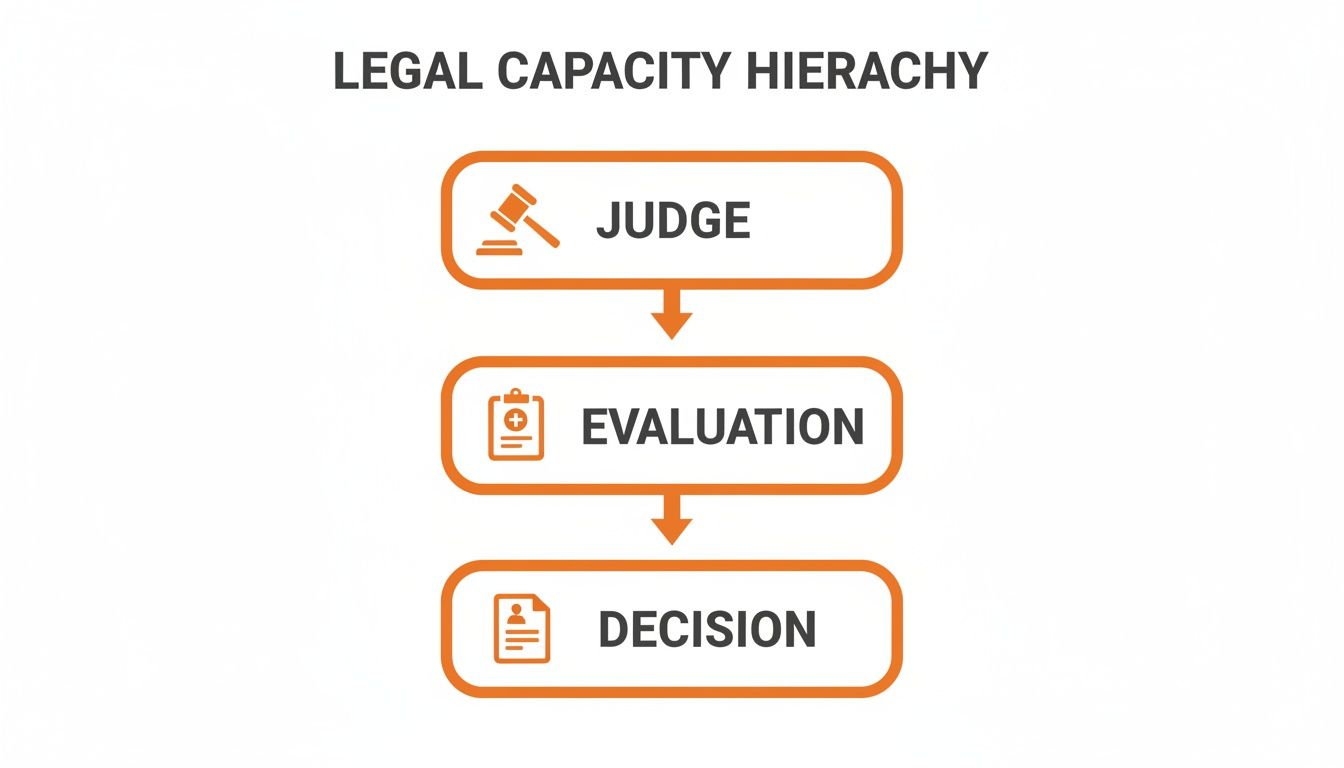
As this shows, the court's decision is the final step after a thorough evaluation, ensuring the protective measure chosen is the right fit for the individual's circumstances.
How a Representative is Appointed
A request for one of these measures must be submitted to the sub-district court (kantonrechter). This request can be made by the person themselves, their partner, or close relatives like parents or adult children.
The court then schedules a hearing to assess the situation properly. The judge will speak with the person in question (if possible), the person who filed the request, and other relevant parties. A medical certificate or an expert opinion is almost always required to support the claim of incapacity.
The court's primary goal is always to choose the least intrusive measure that provides the necessary protection. If only financial management is a problem, the court will likely order bewind rather than the more restrictive curatele.
The representative who is appointed could be a family member (like an adult child) or a professional guardian or administrator. Their duty, first and foremost, is to act in the best interests of the person they represent. A spouse initiating a divorce would have a clear conflict of interest and would almost certainly not be appointed as the representative.
To help clarify the differences between these legal safeguards, here is a quick comparison:
Comparing Protective Measures in the Netherlands
This table breaks down the three primary legal measures for adults unable to manage their own affairs, showing their scope and how they apply in divorce cases.
| Protective Measure | Scope of Authority | Primary Focus | When It Is Used in Divorce |
|---|---|---|---|
| Bewind (Administration) | Financial matters only | Managing assets, income, and debts | The administrator negotiates the division of property and alimony. |
| Mentorschap (Mentorship) | Personal care matters only | Decisions on medical treatment and well-being | The mentor ensures the settlement accounts for the spouse's future care needs. |
| Curatele (Curatorship) | All financial and personal matters | Complete legal representation of the individual | The curator handles all aspects of the divorce on the spouse's behalf. |
These court-appointed roles are designed to provide a legal safety net when someone can no longer advocate for themselves.
Finally, it is crucial to understand that the role of a legal representative is very different from someone holding a power of attorney. A court-appointed guardian’s authority is established by law after a judge has determined incapacity. For a deeper dive into these differences, you can read our detailed guide on the dutch power of attorney. In a divorce involving incapacity, any court-ordered measures will always take precedence.
The Step-by-Step Divorce Process with a Guardian
When a legal representative like a guardian or curator becomes involved, the entire dynamic of the divorce shifts. It is no longer a negotiation between two spouses; it becomes a formal, court-supervised procedure. The law intervenes to ensure every decision is transparent, fair, and above all, serves the best interests of the incapacitated spouse. This path is more structured than a standard divorce, demanding specific legal formalities at each stage.
The journey starts, as always, with filing a divorce petition. The key difference, however, is that you do not serve the papers directly to your spouse. Instead, they are officially served to their court-appointed guardian or administrator. This person is now the sole legal point of contact for everything related to the divorce.

From this point on, the guardian effectively takes on the role your spouse would normally play. But there is a critical distinction: they have a legal duty to act only in your spouse's best interests. This is not a personal negotiation; it is a formal legal process guided by strict rules.
Filing the Petition and Serving the Documents
The first practical step is for your lawyer to file a divorce petition with the court. This document formally requests the dissolution of the marriage and usually includes initial proposals for matters like assets, housing, and alimony.
Once filed, a bailiff officially delivers a copy of this petition to the legal representative. This formal act, known as serving, ensures the guardian is officially aware of the proceedings and has the opportunity to respond on your spouse's behalf. If you are just beginning to explore this area, a helpful resource explains how to get legal guardianship of a parent, a process with principles that also apply to spouses.
The Guardian's Role in Negotiation
Any talks over the divorce settlement, or echtscheidingsconvenant, will now happen between your lawyer and the guardian, who will almost certainly have their own legal counsel. The guardian’s primary mission is to protect the financial and personal future of the incapacitated spouse.
They will meticulously scrutinise any proposals concerning:
- Division of Assets: Making sure the spouse receives their fair and rightful share of all marital property.
- Partner Alimony: Calculating a just amount of support based on the spouse’s needs, especially given their inability to work and potential long-term care costs.
- Pension Rights: Securing the spouse's legal portion of any pension benefits built up during the marriage.
- Housing Arrangements: Ensuring the spouse’s future housing and care needs are financially accounted for.
This is not a negotiation based on emotional compromise. It is a factual, evidence-based assessment of what is legally fair and necessary for the vulnerable party.
Heightened Court Scrutiny and Final Approval
In these cases, the judge’s role becomes significantly more protective. While a judge always reviews a standard divorce settlement, the level of scrutiny is far higher when one party is legally incapacitated. The court must be absolutely convinced that the agreement is not just legally correct, but genuinely equitable and sustainable for the ill spouse.
A key part of this process is the reliance on evidence. The guardian will present financial statements, medical reports detailing future care needs, and expert opinions to support their position. The court leans heavily on this documentation to make its final decision.
The final divorce decree is granted only when the judge is fully satisfied that the guardian has performed their duties diligently and that the settlement adequately protects the incapacitated spouse's interests for the long haul. This judicial oversight acts as a crucial safety net, ensuring a just outcome even when one spouse cannot advocate for themselves.
Splitting Assets and Arranging Alimony Fairly
Financial settlements in any divorce require careful consideration, but when one spouse is facing a long-term illness, the stakes are much higher. The Dutch legal system strongly protects the vulnerable spouse, ensuring they are financially secure, both now and for the future. This protection focuses on two key areas: the division of marital property and partner alimony (partneralimentatie).
This is not just about dividing assets down the middle. It is about building a sustainable financial future for someone who may have significant ongoing care costs and little to no ability to earn an income. The court, along with the appointed legal representative, will meticulously examine the financial landscape to arrive at a fair and lasting solution.
Alimony for a Spouse Unable to Work
Partner alimony is designed to help the lower-earning spouse maintain a similar standard of living after the divorce. But when that spouse cannot work because of dementia or a severe mental illness, the entire approach to alimony shifts. The court recognises that their inability to be self-sufficient is not a temporary setback.
In these situations, the court may order a lifelong alimony obligation. The amount and duration are not based on the usual ideas of retraining or returning to the workforce. Instead, it is based on the realistic, long-term needs of the ill spouse. This means covering daily living expenses, housing, and the often high costs of medical care or specialised living facilities. For a detailed overview of spousal support, you can learn more from our complete guide to alimony in the Netherlands.
Several key factors will influence the court's decision on alimony:
- The needs of the recipient spouse: This is determined by looking at their standard of living during the marriage, plus any extra costs related to their illness.
- The paying spouse's capacity: The court carefully assesses the income and financial ability of the healthy spouse to provide that support.
- Duration of the marriage: As a general rule, longer marriages often lead to longer-term support obligations.
The legal representative's role here is crucial. They will present clear evidence of future care costs and financial needs to ensure the alimony award is truly adequate.
Protecting Assets for Future Care
Dividing marital property also requires a forward-thinking plan. The main goal is to structure the settlement in a way that protects the assets given to the incapacitated spouse, ensuring they are used exactly as intended: for their long-term care and well-being.
Simply handing over a lump sum of cash may not be the safest option. Instead, a court can order specific protective measures to guard these funds from mismanagement or exploitation.
For instance, a court might rule that the incapacitated spouse's share of the proceeds from selling the family home must be placed directly into a protected bank account. This account would be managed by their administrator (bewindvoerder), ensuring the money is preserved for future needs rather than being easily accessible and potentially wasted.
Another effective strategy is placing assets into a trust. This legal arrangement adds another layer of security. A trustee manages the funds according to strict rules, all focused on the beneficiary's long-term welfare. The objective is to create a financial safety net that can last a lifetime, providing peace of mind that the spouse will be cared for long after the divorce is finalised.
Unique Challenges for Expat Families and Children
When a divorce involves a spouse with dementia or mental illness, the situation becomes exponentially more complex for international families living in the Netherlands. You are suddenly navigating different legal systems and cultural norms, all while managing the profound impact on your children. This requires a careful legal strategy and a deep understanding of both Dutch and international law.

It is an emotionally charged situation for everyone, particularly when your children’s futures are on the line. The court's primary focus will always be the child's well-being. This means finding a balance between their right to a relationship with both parents and the absolute need for a stable, safe environment.
Child Custody and Visitation Rights
In Dutch law, the guiding principle in every decision involving children is their best interests. When one parent is dealing with a severe mental illness, the court must carefully assess their ability to provide a safe and nurturing home. This does not automatically mean that parent loses all contact.
Instead, the court looks for solutions tailored to the family's unique circumstances. The key considerations include:
- Parental Authority (Gezag): Will the parents continue to share joint authority, or should sole authority be granted to one parent? This often depends on the ill parent's capacity to make sound decisions for the child.
- Visitation Arrangements (Omgangsregeling): If the parent's condition could pose a risk, the court might order supervised visitation. This is a practical way to ensure the parent-child relationship can continue in a controlled and safe setting.
- Information Rights: Even if a parent does not have custody or only has supervised visits, they generally retain the right to be informed about their child's development and major life events.
Sometimes, a spouse's mental illness directly impacts co-parenting. For instance, if you are dealing with a narcissistic personality, you will need specific strategies. Resources on co-parenting with a narcissistic individual can offer vital guidance to protect your child’s emotional health.
Cross-Border Legal Hurdles for Expats
For international residents, divorcing a spouse with a mental illness here in the Netherlands adds another layer of legal complexity. The first and most critical question is about jurisdiction—which country’s laws will apply to the divorce, your assets, and child custody?
This is decided by factors like the spouses' nationalities and where you last lived together as a couple. An experienced family lawyer is essential to navigate these international legal frameworks and ensure the divorce is filed in the correct jurisdiction for your situation.
A major hurdle for expats is enforcing legal decisions across borders. A Dutch court order for alimony or a guardianship measure may need to be legally recognised in another country to be enforceable there. That recognition process can be complex and time-consuming.
Furthermore, if your spouse has a guardianship or protection order that was issued in another country, it must be validated under Dutch law to have any effect here. This step ensures that a legal representative appointed abroad has the authority to act on your spouse's behalf within the Dutch legal system. These cross-border details make specialised legal advice not just advisable, but a necessity for a fair outcome.
Frequently Asked Questions
Going through a divorce when dementia or mental illness is involved naturally brings up many specific, often difficult, questions. We have gathered some of the most common concerns we hear from clients to provide direct answers and clarity.
Can My Spouse's Guardian Refuse the Divorce?
A guardian cannot simply block a divorce. Their legal responsibility is to act in the best interests of the person they represent, not to stand in the way based on personal opinion. If you have valid grounds for the divorce—which in the Netherlands is the irretrievable breakdown of the marriage—the process itself will proceed.
However, the guardian has real power in the negotiations. They will scrutinise any proposed settlement and will challenge anything they see as unfair to their ward. If they refuse to agree to a particular financial arrangement, the issue will go before a judge, who then has the final say based on the evidence and Dutch legal standards of fairness.
What if My Spouse's Condition Worsens During the Divorce?
A sudden decline in your spouse's health can have a major impact on the proceedings. If their condition deteriorates, their legal representative is required to inform the court. This new reality may force a re-evaluation of the divorce settlement being discussed.
For instance, if your spouse suddenly needs more intensive and expensive long-term care, their guardian will likely argue for a larger portion of the marital assets or a higher spousal alimony amount to cover these new costs. The court’s priority is always to ensure the final agreement provides for the spouse's current and future needs, even if that means pausing the process to reassess the financial picture.
Is a Mental Illness Diagnosis Automatic Proof of Incapacity?
No. A medical diagnosis is one thing, but legal capacity is another. Dutch law is very clear on the distinction between a medical condition and the legal concept of wilsbekwaamheid (decisional capacity). Many people living with well-managed mental illnesses are perfectly capable of understanding the divorce process and making their own decisions.
The court's focus is on practical, functional ability. Can the person understand the information presented? Can they weigh the consequences of the divorce and communicate a reasoned decision? A judge will only find a spouse to be legally incapacitated after a thorough evaluation, which almost always includes a report from an independent medical expert confirming they do not meet this standard.
How Is Alimony Calculated if My Spouse Is in a State-Funded Care Home?
This is where matters can become more complex. When a spouse lives in a care facility that is partly funded by the government, the alimony calculation changes. The court still looks at your ability to pay and your spouse's needs, but the "need" is adjusted. It is often based on the personal contribution (eigen bijdrage) they are required to pay for their care.
Your alimony payment may be directed specifically towards covering this personal contribution, along with other expenses not covered by the state, to maintain their quality of life. The spouse's legal representative will provide the court with detailed evidence of all these costs to determine what a fair and appropriate alimony amount should be in these specific circumstances.
At Law & More, our family law specialists have guided many clients through the sensitive and legally complex process of divorcing a spouse with dementia or mental illness. We provide compassionate, clear, and strategic legal support to protect your interests while ensuring a fair outcome for everyone involved. For a consultation to discuss your situation, please contact us through our website.