


Decentralised Autonomous Organisations (DAOs) present a significant challenge for traditional Dutch corporate law. Currently, they operate in a legal grey area. Without a formal legal status, a DAO cannot own property, enter into contracts, or provide its members with the crucial protection of limited liability. This guide explains how to use established Dutch legal structures to bridge this gap, ensuring your DAO can operate safely and effectively within the Netherlands.
The Problem with a DAO’s Legal Status in the Netherlands
Imagine a promising startup with a team, a product, and waiting customers, but no formal company registration. While the idea is strong, every business action—from leasing an office to paying a developer—must be undertaken by the founders in their personal capacity.
This is the exact situation an unincorporated DAO faces under Dutch law. It is viewed merely as an association of individuals, not as a recognized legal entity.
This lack of legal personality creates immediate and practical problems:
- No Contractual Capacity: A DAO cannot sign service agreements, lease office space, or hire employees in its own name. Individual members must do so, making them personally responsible for all legal obligations.
- Inability to Own Assets: A DAO cannot hold a bank account, own intellectual property, or possess real estate. Any assets are technically held by the members collectively or by a designated individual, creating significant risks and complexity.
- Unlimited Personal Liability: This is the most critical risk. Without the protective shield of a corporate entity, members can be held personally liable for all the DAO’s debts and legal obligations. A single contract dispute could jeopardize the personal assets of every token holder involved in governance.
Facing the Legal Reality
The core issue is that Dutch corporate law, primarily outlined in Book 2 of the Dutch Civil Code, does not recognize an entity governed purely by smart contracts as a legal person. The law requires defined structures, such as a board of directors and articles of association, which a typical DAO lacks.
A DAO as such has no legal status in the Netherlands. This absence means DAOs cannot directly enter contracts, open bank accounts, or enjoy limited liability protections akin to Dutch BV or NV structures.
This was a key point highlighted in a 2023 working paper from the European Central Bank, which underscores the disconnect between decentralised technology and traditional legal frameworks. The paper makes it clear that until legislation evolves, DAOs must adapt to the current system to function properly. You can explore further insights into the future of DAOs in finance from this report.
Therefore, the solution is not to operate in this legal void but to use an established Dutch legal entity as a “wrapper.” This approach grants the DAO the legal personality it needs to interact with the traditional business world, building a vital bridge between its decentralised operations and the structured requirements of Dutch law.
Choosing the Right Dutch Legal Structure for Your DAO
Selecting the right legal “wrapper” for your DAO in the Netherlands is the most critical decision you will make. This choice is not merely administrative; it fundamentally shapes your governance, liability, and your DAO’s ability to engage with the off-chain world of contracts, banking, and investments. While Dutch corporate law offers several viable options, not all are a natural fit for a decentralised organisation.
The primary challenge is finding a legal structure that provides a liability shield and legal standing without undermining the community-driven ethos that defines a DAO. In the Netherlands, this choice typically narrows down to three main options: the foundation (Stichting), the cooperative (Coöperatie), and the private limited company (BV). Each has distinct advantages and disadvantages.
This flowchart illustrates the initial decision: operating without a legal entity versus choosing a formal legal wrapper.
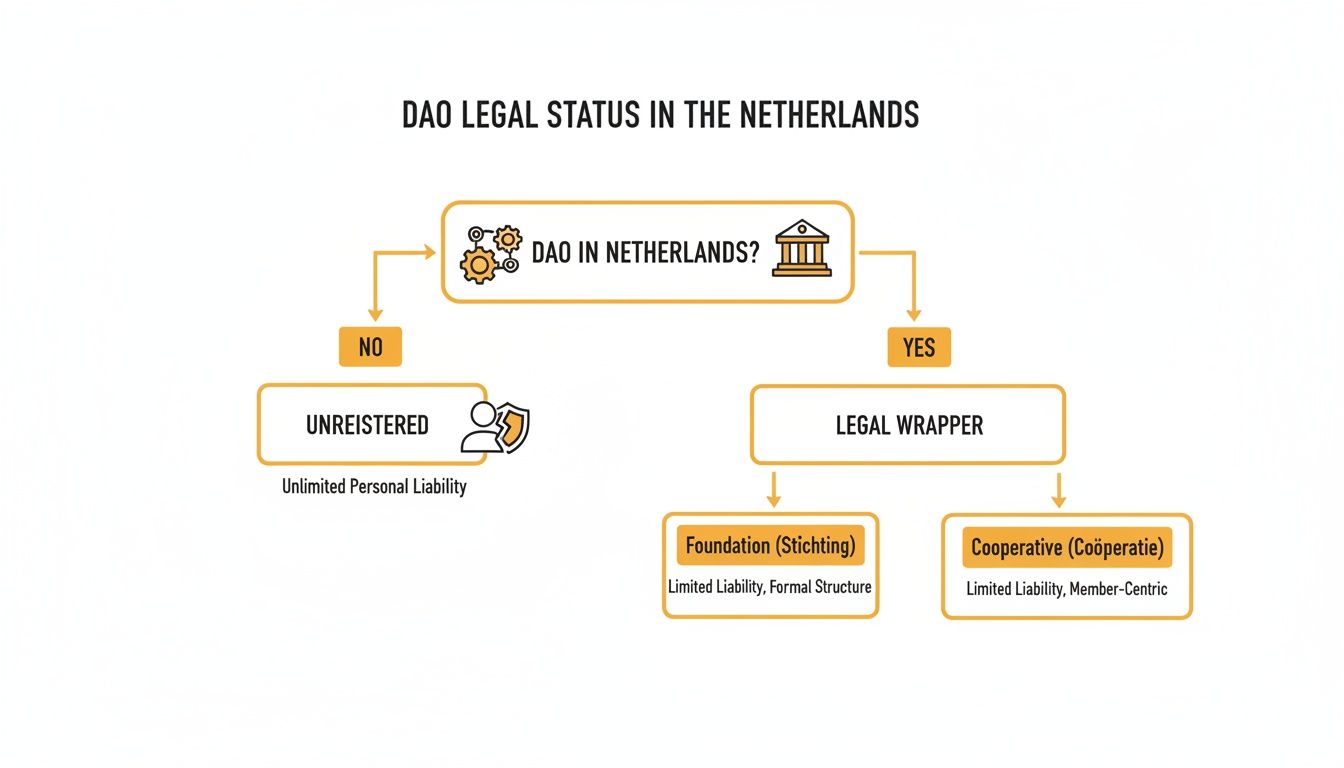
As the diagram shows, forgoing a legal wrapper may seem ideologically aligned with decentralisation, but it exposes members to significant personal liability.
The Foundation (Stichting)
A Dutch foundation, or Stichting, is often an excellent choice for DAOs focused on a clear, non-commercial purpose, such as protocol development treasuries, public goods funding, or managing a community grant program. The defining feature of a foundation is that it has no members or shareholders.
This structure is effective because it creates a clean separation between the legal ownership of assets and the community that benefits from them. A Stichting is managed by a board, but its articles of association can be drafted to legally require the board to execute the outcomes of the DAO’s on-chain votes, creating an effective hybrid governance model.
- Key Advantage: Ideal for safeguarding treasury assets and focusing on a specific mission without the pressure to distribute profits.
- Main Drawback: It is legally prohibited from distributing profits to its founders or board members, making it unsuitable for any for-profit DAO.
The Private Limited Company (BV)
The Besloten Vennootschap (BV) is the standard Dutch legal form for most for-profit businesses. It provides a robust liability shield for its shareholders and is a familiar and trusted entity for international investors and business partners.
However, a BV can be a cumbersome structure for a DAO. Its governance model is centered on shareholders, which does not always align with a large, token-holding community. Issuing shares to thousands of pseudonymous token holders is an administrative challenge and raises significant compliance issues. Nevertheless, for a DAO with a small, clearly defined group of core contributors seeking to raise capital and operate commercially, the BV can be a powerful tool.
The Cooperative (Coöperatie)
For many DAOs, the Coöperatie offers the most balanced and adaptable framework. At its core, a cooperative is designed to serve the economic interests of its members—a principle that aligns perfectly with the community-centric ethos of decentralised organisations.
The key advantage of the cooperative lies in its flexible membership structure. Members can join and leave with relative ease, avoiding the formal and costly notarial deeds required to transfer shares in a BV. Importantly, a cooperative can distribute profits to its members, making it ideal for for-profit ventures. The governance can be tailored to mirror the voting power of DAO members, creating a direct link between on-chain proposals and legally binding off-chain actions.
For a large number of DAOs, the cooperative provides the best of both worlds. It fuses the member-driven spirit of a decentralised community with the legal protection and operational capacity of a recognised corporate entity.
To help you evaluate these options, here is a side-by-side comparison.
Comparison of Dutch Legal Entities for DAO Implementation
| Feature | Foundation (Stichting) | Cooperative (Coöperatie) | Private Limited Company (BV) |
|---|---|---|---|
| Primary Purpose | Non-profit; serving a specific mission or cause. | Serving the economic or social interests of its members. | For-profit; generating returns for shareholders. |
| Profit Distribution | Not permitted to distribute profits to founders or board. | Permitted; profits can be distributed to members. | Permitted; dividends are distributed to shareholders. |
| Membership Structure | No members or shareholders. | Membership-based; flexible entry and exit. | Shareholder-based; formal transfer process. |
| Governance | Board-led; can be structured to follow on-chain votes. | Member-led; highly adaptable to DAO voting mechanisms. | Shareholder-led; can conflict with token-based governance. |
| Liability Protection | Strong limited liability for the board. | Strong limited liability for members (U.A. / B.A.). | Strong limited liability for shareholders. |
| Best Suited For | Grant programmes, protocol treasuries, public goods funding. | For-profit DAOs, service DAOs, investment DAOs. | DAOs with a small core team, seeking traditional venture capital. |
Each option has its trade-offs, but the cooperative often emerges as the most natural and versatile fit for the unique characteristics of a DAO.
When your DAO handles crypto-assets, especially stablecoins, your choice of legal entity must be made with regulatory compliance in mind. Understanding how your assets are classified under frameworks like the EU’s MiCA Stablecoin Categories is a critical first step. Your legal wrapper must be capable of handling the compliance requirements associated with the specific tokens it holds. Here again, the inherent adaptability of the cooperative often makes it a strong candidate for navigating this complex and evolving regulatory landscape.
Understanding Governance and Personal Liability Risks
Operating a DAO without a formal Dutch legal entity is like sailing in rough seas without a hull. While the decentralised structure is innovative, it offers no protection when problems arise. This situation places every member involved in governance at significant personal financial risk, transforming a collaborative project into a high-stakes gamble. The core of this risk lies in a legal concept known as joint and several liability.
In simple terms, this means that if the DAO incurs debts or is sued, creditors can pursue any single member for the full amount. It does not matter if you hold only a few tokens or if your vote was minor; your personal assets—your home, your savings—are potentially at risk. The burden then shifts to you to attempt to recover proportional shares from other members, which is often a difficult and expensive process.
Consider it an unregistered business partnership. If the partnership defaults on a loan, the bank will not pursue each partner for their small share. Instead, it can legally demand the entire sum from the one partner who appears most capable of paying, leaving them to resolve the internal financial dispute. Under Dutch law, this is precisely the precarious position DAO members are in when operating without a corporate shield.

The Gap Between Smart Contracts and Corporate Law
Another major issue arises in governance. While smart contracts are excellent for executing on-chain votes with transparency and efficiency, they do not satisfy the formal requirements of Dutch corporate law. The Dutch legal system is built on a foundation of written, legally recognized documents.
Certain key corporate actions require specific formalities that a smart contract alone cannot replicate. These include:
- Articles of Association: This is the foundational document, filed with the Chamber of Commerce, that outlines the company’s purpose, rules, and governance structure. Smart contract code is not a legally valid substitute.
- Board Resolutions: Major decisions, such as appointing a director or approving a significant transaction, must be formally documented in written resolutions signed by the board. An on-chain vote tally does not meet this standard.
- Shareholder Agreements: These are detailed contracts governing the relationships between shareholders, covering issues that extend far beyond what a simple token-based voting system can manage.
This disconnect creates a significant legal vulnerability. Without these formal documents, a DAO’s decisions could be deemed legally unenforceable, and its entire governance model could be challenged in court.
Bridging the Governance Divide
The most practical solution is to adopt a hybrid governance model. This approach uses a formal Dutch legal entity—such as a cooperative or a foundation—to act as the DAO’s legal representative. The entity’s board can then be legally bound by its articles of association to implement the decisions passed by the DAO’s on-chain voting process.
This setup creates a legally sound bridge:
- The DAO community proposes and votes on actions on-chain.
- The outcome of the vote becomes a binding instruction to the board of the Dutch legal entity.
- The board then executes that decision through legally compliant, off-chain actions, such as signing a contract or authorising a payment from a corporate bank account.
This hybrid structure provides the essential liability shield and ensures the DAO’s operations are legally robust and defensible. The risks of personal liability for directors are very real, but a well-structured entity helps manage them effectively. For a deeper understanding, you can read more about corporate liability in the Netherlands and when directors become personally liable in our detailed article. Furthermore, to protect assets and ensure smooth operations, DAOs should adopt the best practices for risk management in DeFi.
Meeting Dutch Data and Algorithm Regulations
Beyond corporate structures and liability, DAOs operating in the Netherlands must navigate another critical layer of oversight: data protection and algorithmic regulation. This is an area where international founders often encounter difficulties. Many assume a decentralised model exists beyond the reach of national regulators, but in the Netherlands, this assumption is a costly mistake.
At the center of this framework is the Dutch Data Protection Authority (Autoriteit Persoonsgegevens, or AP). The AP’s role extends beyond typical data privacy; it is also tasked with ensuring that algorithms used in the Netherlands are fair, transparent, and non-discriminatory, especially when they involve personal data.
The AP as the National Algorithm Watchdog
A DAO’s automated nature, driven entirely by smart contracts, places it directly under the AP’s scrutiny. A smart contract is, at its core, an algorithm—a set of rules that executes automatically. If that contract processes any information that can be linked to an identifiable person (such as wallet addresses tied to KYC data), it falls under the strict rules of the General Data Protection Regulation (GDPR).
Since January 2023, the AP’s authority was formally expanded, positioning it as the national algorithm regulator. This has direct consequences for any DAO with a connection to the Netherlands. The AP even established a new Coordination Algorithms Directorate specifically to oversee how algorithms are used across all sectors. With an initial budget increase of €1 million, the authority now has the power to proactively investigate and impose substantial fines for non-compliance. You can read more about the AP’s expanded role as the algorithm regulator and what it means for tech-driven organisations.
This oversight is not merely theoretical. The AP’s mission is to prevent automated systems from making arbitrary or unfair decisions that affect individuals. For a DAO, this could involve:
- Distributing rewards based on participation data.
- Granting or revoking membership rights automatically.
- Processing transaction data linked to user identities.
Why a Legal Entity Is Crucial for Compliance
This is where the need for a formal Dutch corporate entity becomes undeniably clear once again. An unincorporated DAO has no legal person to assume responsibility for GDPR compliance. Who is the data controller? Who responds to a data access request from a member? Who pays the fine if the AP discovers a violation? Without a legal wrapper, these duties could fall directly on individual members, increasing their liability risks.
Operating a DAO in the Netherlands requires a deep understanding not just of corporate law, but also of the evolving regulatory landscape for artificial intelligence and automated decision-making. The AP’s active role means compliance cannot be an afterthought.
A formally registered entity, such as a cooperative or foundation, can be designated as the data controller. This structure allows the DAO to create clear data processing agreements, appoint a data protection officer if necessary, and demonstrate a clear line of accountability to regulators like the AP. It provides a central point of contact and a legal shield that is essential for managing the significant financial risks associated with non-compliance. As automated systems become more complex, the regulatory environment will only become stricter. For more context, it is worthwhile to understand the legal side of artificial intelligence in the EU and the upcoming AI Act, which will further shape these obligations.
Preparing for New Tax Reporting Rules Under DAC8
While understanding current corporate and data regulations is essential, a major shift is on the horizon that will fundamentally change the compliance landscape for DAOs in the Netherlands. The forthcoming EU Directive on Administrative Cooperation, better known as DAC8, will introduce a new era of tax transparency for crypto-assets. When it is implemented, operating a DAO without a formal legal structure will become nearly impossible.
This is not a distant, theoretical change. The new rules are set to take effect in the Netherlands on 1 January 2026. From that date, a wide range of crypto-related entities will be subject to mandatory, stringent reporting obligations to the Dutch Tax Administration (Belastingdienst).
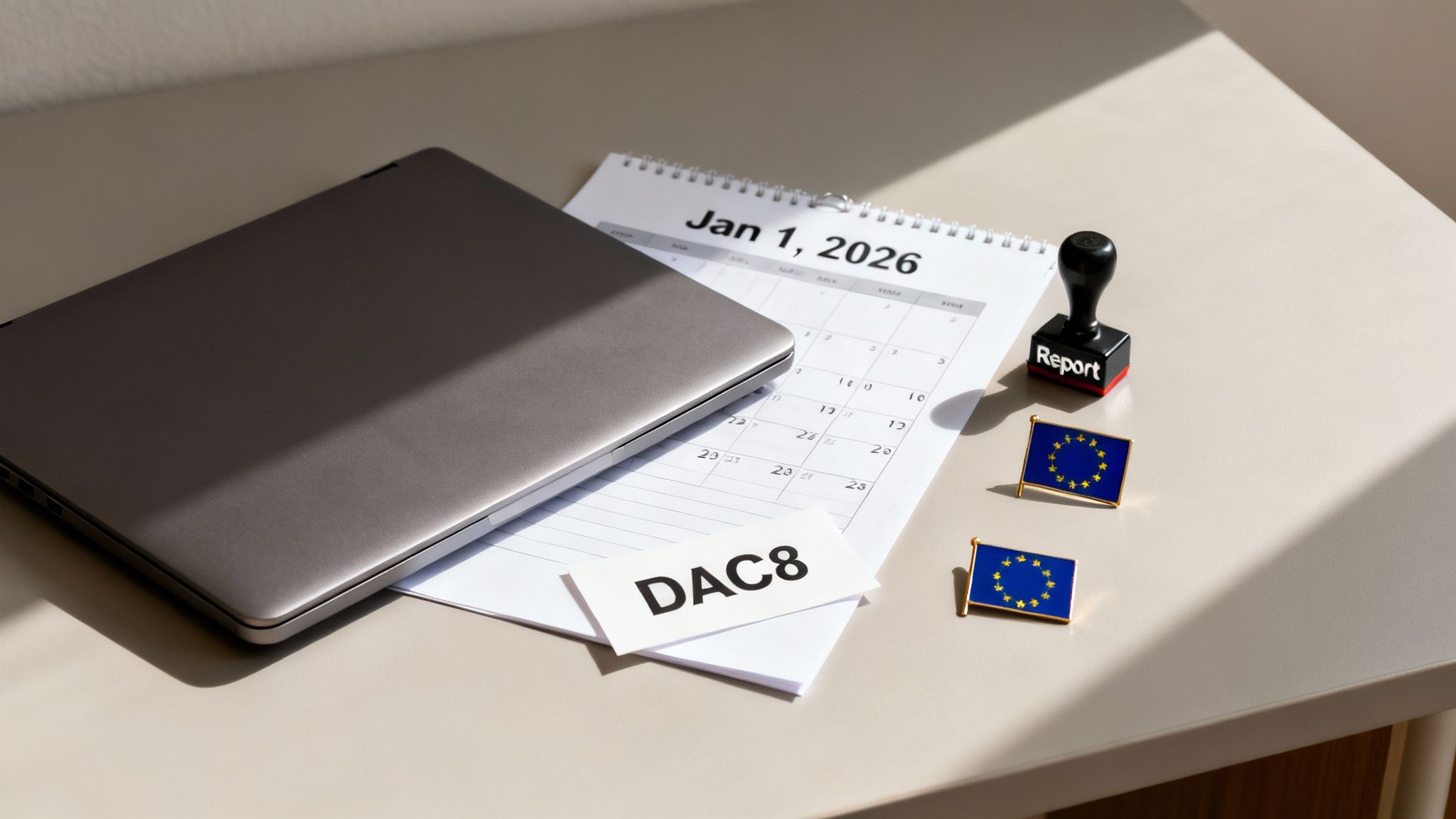
This looming regulation brings crypto-asset transactions out of the shadows and places them directly under the scrutiny of tax authorities, which has significant implications for how DAOs must be organized to remain compliant.
What Is a Crypto-Asset Service Provider (CASP)?
At the core of DAC8 is the concept of a Crypto-Asset Service Provider (CASP). The directive uses a very broad definition, defining a CASP as any person or entity whose business involves providing crypto-asset services to third parties. This definition is intentionally broad and will almost certainly encompass many DAOs and their associated platforms.
A DAO that engages in any of the following activities will likely be classified as a CASP:
- Exchanging crypto-assets for fiat currency or other crypto-assets.
- Providing custody and administration of crypto-assets.
- Managing a trading platform for crypto-assets.
- Facilitating the transfer of crypto-assets between users.
Many DAOs, especially those in the DeFi space or managing community treasuries with active trading, will find their core functions fall under this definition. The decentralised nature of a DAO provides no exemption; if its operations offer these services to users, it will be subject to the new rules.
The Scope of New Reporting Obligations
Under the Dutch implementation of DAC8, CASPs will be legally required to conduct extensive due diligence and reporting. They must collect, verify, and automatically report detailed information about their users and their transactions to the Dutch Tax Administration. This data will then be shared with tax authorities across the entire EU.
The Dutch implementation of the EU DAC8 Directive, effective January 1, 2026, imposes strict reporting obligations on crypto-asset service providers. This aligns with Dutch corporate law’s emphasis on transparency and tax compliance, making formal legal structures essential for DAOs.
The draft Act to Implement the EU Directive on the Exchange of Information on Crypto-Assets leaves no room for doubt: any CASP with a ‘relevant connection’ to the Netherlands must comply. This means collecting and reporting both user and transaction data. The penalties for non-compliance are severe, with potential administrative fines reaching as high as €1,030,000. You can discover more insights about these upcoming data-sharing requirements for crypto providers from PwC.
Why a Formal Structure Is Non-Negotiable Post-DAC8
These new rules create a powerful and urgent case for establishing a formal Dutch legal entity. An unincorporated DAO is simply not equipped to handle such complex compliance tasks.
Consider the practical questions:
- Who is the legal person responsible for collecting and verifying user data?
- Who signs the reports submitted to the Belastingdienst?
- Who is legally liable for the massive fines if something goes wrong?
Without a formal structure like a cooperative or a foundation, these responsibilities—and liabilities—would fall directly onto individual members or core developers. This exposes them to an enormous level of personal risk, far beyond what any reasonable participant would accept.
A proper legal entity provides the framework needed to manage these obligations professionally, appoint responsible officers, and interact with tax authorities in a structured, compliant manner. From 2026 onwards, tax compliance will not just be a good practice for DAOs; it will be a legal necessity.
Your Questions About DAOs and Dutch Law, Answered
As the innovative world of DAOs intersects with the traditional structures of Dutch corporate law, many practical questions arise for founders, investors, and token holders. This section provides clear, actionable answers to the most common legal questions we encounter, moving beyond theory to address real-world issues.
Are Smart Contracts Legally Binding in the Netherlands?
Yes, a smart contract can be a legally binding agreement under Dutch law, but this is not automatic. The Dutch legal system is flexible regarding the form a contract can take; what truly matters is its substance.
For a smart contract to be upheld in court, it must meet the same basic criteria as a traditional paper contract: there must be a clear offer and acceptance, and both parties must have intended to create a legal relationship. The terms, as written in the code, must be clear enough for a court to understand.
The main challenge, however, arises with interpretation and enforcement. If a dispute occurs, a Dutch court will need to determine what the code was intended to do. This often requires expert witnesses to translate the code into plain language, which can add complexity and cost to any legal dispute. A well-drafted legal wrapper is invaluable here; it can include clauses that explicitly state the smart contract’s outcomes are legally binding, helping to bridge the gap between code and the courtroom.
Can DAO Token Holders Be Considered De Facto Directors?
This is a significant and often overlooked risk. Under Dutch corporate law, an individual who is not an official director but acts as one can be held liable as a de facto director. This could easily apply to highly active and influential DAO members whose votes consistently guide the organization’s decisions.
The key question a court would ask is whether a token holder’s influence is so significant that they are, in effect, managing the organization. This is not a simple yes-or-no question; it is based entirely on the specific facts of the situation.
Imagine a scenario where a small group of “whale” token holders consistently coordinate their votes to approve major financial decisions. If those decisions result in insolvency or other legal issues, a court could look past the decentralised label and assign director-level liability to those individuals. This risk alone makes the liability shield offered by a formal legal entity extremely important.
Does a Foreign Entity Like a Wyoming LLC Protect Me in the Netherlands?
Using a foreign entity, such as a Wyoming LLC, can give a DAO a legal personality, but it is not a complete solution for operating in the Netherlands. While the LLC structure is recognized, it does not grant the DAO immunity from its obligations under Dutch law.
If the DAO has significant operations, employees, or management functions based in the Netherlands, it will still be required to comply with local regulations. This includes:
- Dutch Tax Law: The entity could be considered a Dutch tax resident, meaning it would have to comply with corporate income tax rules and DAC8 reporting.
- Employment Law: If it hires individuals in the Netherlands, it must adhere to all Dutch employment regulations.
- Regulatory Compliance: It must comply with rules from Dutch authorities like the AP (Data Protection Authority) and DNB (De Nederlandsche Bank), especially if it qualifies as a CASP.
Simply registering a DAO in another country does not create a legal shield against Dutch regulations. If your DAO’s center of effective management is in the Netherlands, local laws will apply.
Therefore, while a foreign entity is a valid option, it requires careful cross-border legal and tax planning to remain compliant in the Netherlands. For many, structuring through a Dutch entity like a cooperative offers a more direct and less complicated path.
How Can a DAO Open a Dutch Bank Account?
Opening a bank account is one of the biggest practical hurdles for an unincorporated DAO. Dutch banks are bound by strict Anti-Money Laundering (AML) and Know Your Customer (KYC) regulations, making it impossible for an entity without a legal personality to open an account.
A bank needs to identify the ultimate beneficial owners (UBOs) and understand the organization’s governance structure. An unincorporated DAO, often with anonymous or pseudonymous members, cannot provide this information.
The only viable solution is to establish a formal Dutch legal entity. A foundation or cooperative registered with the Dutch Chamber of Commerce (KvK) has the legal status required to apply for a bank account. The board members of this entity will undergo the bank’s KYC process, providing the transparency and accountability the bank needs to meet its regulatory obligations. This is the key that enables a DAO to manage its finances, pay for services, and operate within the traditional financial system.
Navigating the intersection of DAOs and Dutch law requires expert guidance to ensure your innovative structure is built on a solid legal foundation. If you are planning to launch or operate a DAO with a connection to the Netherlands, contact our team of corporate law specialists at Law and More to structure your organisation for success and compliance. Visit us at https://lawandmore.eu to schedule a consultation.