



1. Introduction: What is the CMR Convention and Why is it Crucial for International Transport
The CMR Convention is the foundation for international road transport and regulates the rights and obligations of all parties involved. In this guide, you will learn everything about the CMR Convention, its practical application and how you, as a transport operator, can benefit optimally from this international regulation.

The CMR Convention (Convention relative au Contrat de Transport International de Marchandises par Route), the convention on the contract for the international carriage of goods by road, forms the legal basis for cross-border road transport between more than 56 countries worldwide. This international convention establishes uniform rules for liability, documentation and dispute resolution, protecting both carriers and shippers in international transport. The convention was drawn up by the United Nations Economic Commission for Europe (UNECE). Almost all European countries have ratified the CMR Convention, underlining its widespread application in the region.
In this comprehensive guide, we cover:
- Definition and key concepts of the CMR Convention
- Practical application and documentation requirements
- Liability rules and compensation
- Step-by-step implementation for your company
- Common mistakes and how to avoid them
- Practical examples and frequently asked questions
This information is essential for transport operators, shippers, logistics service providers and anyone involved in the international carriage of goods by road.
2. Understanding the CMR Convention: Key Concepts and Definitions
2.1 Basic Definitions
The CMR Convention was signed in Geneva on 19 May 1956 and has been in force since 14 July 1960. The CMR applies to any contract for the carriage of goods by road between persons in different countries. In addition, the sender has the right to dispose of the goods before they are delivered.
The abbreviation CMR stands for the French name of this fundamental transport convention. It specifically regulates the cross-border transport of goods by road between Member States, whereby at least one of the countries where the transport begins or ends must be a party to the convention. A growing number of Asian countries have now also acceded to the CMR Convention, further expanding its scope.
Scope of application of the CMR Convention:
- International road transport of goods for hire or reward
- Transport between different countries that are parties to the convention
- Applies automatically to cross-border transport, regardless of contractual agreements
- Limited exceptions for postal, funeral and removal transport
2.2 Key concepts and coherence
The CMR Convention creates a direct link between four crucial elements: the CMR consignment note as a document, the carrier’s liability, limitation of compensation and uniform rules for dispute resolution. The CMR imposes uniform liability rules for damage in the event of loss or damage to the cargo. The carrier is liable for damage, loss or delay, unless he can prove that the damage was caused by force majeure, an error on the part of the sender, or by specific circumstances such as defective packaging.
Important connections:
- Mandatory nature: Article 41 CMR prohibits contractual deviation from the provisions of the convention
- Relationship to multimodal transport: Article 2 CMR regulates the application in combined transport (combination of road/rail/water)
- SDR Protocol of 1978: Determines the limits of compensation in Special Drawing Rights
- National legislation: CMR takes precedence over national transport laws in international transport
The convention stipulates that parties cannot deviate from the protective provisions, which gives both carriers and consignors legal certainty in international transport activities.
3. Why the CMR Convention is essential for international road transport
The CMR Convention provides uniform regulations in more than 56 countries, ensuring legal certainty and predictability in cross-border road transport. This standardisation protects all parties and significantly reduces legal complexity.
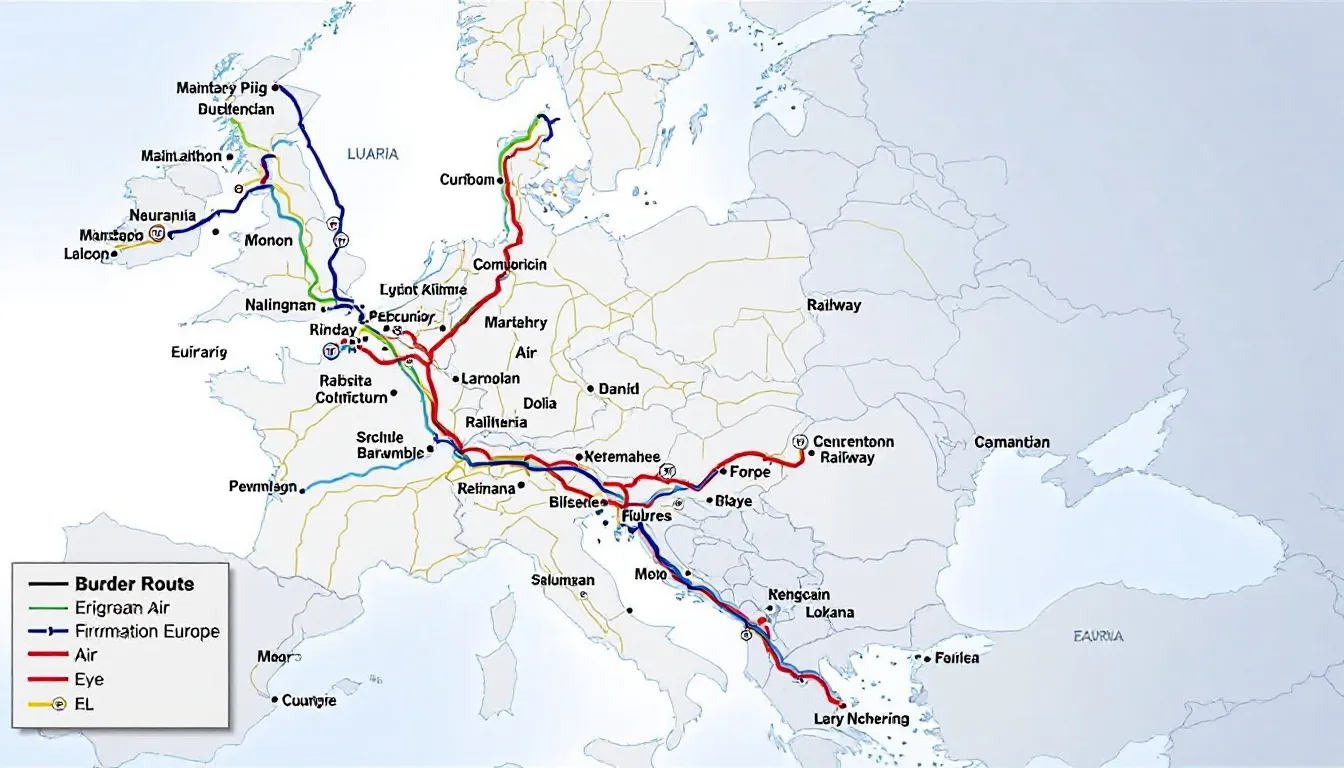
Concrete benefits for the transport sector:
Legal certainty and predictability
- Standardised liability rules protect both carriers and shippers
- Dutch courts apply the same rules as courts in other countries that are party to the convention
- Predictable outcomes in disputes due to uniform application
Economic benefits
- Increased trade flows due to reduced legal barriers
- Lower transaction costs due to standardised procedures
- Simplification of international trade transactions
- More efficient dispute resolution through uniform regulations
Practical operational benefits
- Unambiguous documentation via CMR consignment note in all treaty countries
- Standardised procedures for damage reporting and settlement
- Clear deadlines and claims in the event of problems during transport
- Automatic application without complex contract negotiations
According to industry organisations, the CMR Convention facilitates millions of cross-border transports every year, with the uniform regulations drastically reducing disputes and uncertainty.
4. CMR Liability and Compensation: Comparison Table
| Type of damage | CMR limit | Calculation | Example (1000 kg) | Exception |
|---|---|---|---|---|
| Loss of goods | 8.33 SDR per kg | Gross weight x 8.33 SDR | € 10,400 | Intentional misconduct/gross negligence on the part of the carrier |
| Damage | 8.33 SDR per kg | Depreciation x rate | Max € 10,400* | Article 29 CMR |
| Delay | Max freight price | Delay > delivery date | Maximum transport costs | Proven damage required |
| Full load | 8.33 SDR per kg | Total weight x rate | According to weight | In case of total loss |
*Amounts are indicative based on an SDR exchange rate of approximately €1.25 per SDR
Important points to note:
- The limitation of liability does not apply in the event of intent or gross negligence on the part of the carrier (Article 29 CMR)
- Damage is calculated in proportion to the reduction in value
- In the event of delay, the freight price is the maximum compensation
- SDR rates fluctuate, which means that euro amounts may vary
- All claims against the carrier expire after one year, unless there is intent, in which case a period of three years applies
Comparison with national regulations: The CMR Convention often offers more favourable protection than national transport laws, particularly due to the guaranteed minimum compensation per kilogram. Dutch transport laws without CMR application may apply lower limits.
5. Step-by-Step Guide to CMR-Compliant International Transport
Step 1: Preparation and Documentation
Check CMR applicability Verify whether your transport falls under the CMR Convention in accordance with Article 1. The Convention applies to the international carriage of goods by road for remuneration, where at least one of the countries of departure or destination is a party to the Convention.
Prepare CMR consignment note
- Obtain a correct CMR consignment note in accordance with Articles 5-6
- Fill in all mandatory fields: sender, addressee, place of loading/unloading
- Accurately state the nature and weight of the goods
- Note any special instructions or reservations
Checklist of mandatory information:
- Date and place of issue of the consignment note
- Name and address of sender and recipient
- Place of receipt and delivery
- Usual description of the goods
- Weight and number of packages
- Freight price and additional costs
- Instructions for customs formalities
- Number of packages and their special marks and numbers
The sender is liable for costs and damage caused by inaccuracies in the consignment note. However, the absence, irregularity or loss of the consignment note does not affect the existence of the transport agreement.
Step 2: Execution of the transport
Careful handling during transport Article 17 of the CMR obliges the carrier to handle the goods with care. Document all relevant circumstances that may affect the condition of the cargo.
Important procedures during transport:
- Carry out regular checks on the condition of the cargo and vehicle
- Document special circumstances (weather conditions, delays, incidents)
- Keep the CMR consignment note in a safe place throughout the entire transport
- Report any damage, loss or delay en route immediately
The carrier must check the accuracy of the consignment note upon receipt.
Use of CMR documentation:
- Carry all three copies (sender/pink, recipient/blue, carrier/green)
- Present the CMR consignment note during checks by the authorities
- Do not make any changes without the consent of all parties
Step 3: Delivery and settlement
Correct delivery according to CMR Deliver the goods to the consignee or their authorised representative in accordance with Articles 13-16 CMR. Check the identity and authority of the recipient.
Procedures for different scenarios:
- Visible damage: Immediate protest and note on consignment note
- Hidden damage: The addressee has 7 days after delivery to lodge a complaint
- Delay: Written protest to the carrier within 21 days
- Loss: Immediate notification upon discovery
Administrative settlement:
- Keep all CMR documentation for the limitation period (1 year)
- Carefully record protests and damage reports
- Prepare evidence for any claims
- Inform the insurer in good time in the event of damage
- A written claim suspends the limitation period until the day on which the carrier rejects the claim in writing.
6. Common mistakes in CMR transport to avoid
Mistake 1: Incomplete or incorrect waybill completion Incomplete CMR documentation significantly weakens your legal position. Missing information about weight, nature of goods or special instructions can lead to problems with evidence and liability.
Mistake 2: Missing protest deadlines
The CMR Convention applies strict deadlines: immediate notification in the case of visible damage, 7 days in the case of hidden damage. Exceeding these deadlines may invalidate your right to compensation.
Mistake 3: Underestimating liability limitations Many carriers do not realise that the CMR limit of 8.33 SDR per kilogram may be insufficient for high-value goods. Additional insurance coverage is often necessary.
Mistake 4: Confusion about applicability in multimodal transport Complex rules apply to transport involving multiple modes of transport (road/rail/water). The CMR convention only applies to the road section, unless damage occurs during that segment.
Pro Tip: Implement standardised procedures for CMR documentation and train your staff regularly. Use checklists for each transport phase and keep track of case law and regulations through trade associations.
7. Practical example: CMR damage claim from A to Z
Case Study: Water damage during transport of electronic equipment
A Dutch carrier transports electronic equipment worth €50,000 (gross weight 2,000 kg) from Rotterdam to Warsaw. Due to a defective cover, water damage occurs during heavy rain in Germany.

Initial situation:
- Cargo: Electronic equipment, value €50,000
- Weight: 2,000 kg gross
- Route: Netherlands to Poland (CMR applicable)
- Damage: 40% of the goods unusable due to water damage
Steps taken:
- Immediate notification: Carrier reports damage immediately upon discovery
- CMR analysis: Consignment note correctly completed, no grounds for exclusion
- Damage assessment: Expert determines 40% total loss (€20,000)
- Calculation of compensation: 2,000 kg × 8.33 SDR = 16,660 SDR ≈ £17,775
Final result: The carrier was liable for water damage (no force majeure). Compensation was limited to €20,825 in accordance with Article 23 of the CMR, even though the actual damage amounted to €20,000.
| Aspect | For CMR | With CMR |
|---|---|---|
| Liability | Uncertain | Clearly regulated |
| Compensation | Negotiable | € 20,825 (SDR limit) |
| Procedure | Complex | Standardised |
| Terms | Variable | 7 days protest |
| Dispute | Long-term | Rapid settlement |
Lessons learned:
- CMR provides clarity on liability and procedures
- Compensation limit may be lower than actual damage
- Correct documentation is crucial for a successful claim
- Additional insurance advisable for high-value goods
8. Frequently asked questions about the CMR Convention
Q1: Does the CMR Convention also apply to domestic transport in the Netherlands? A1: No, the CMR Convention only applies to international transport. Domestic transport is only covered if it is part of an international route or if the parties explicitly agree to CMR conditions.
Q4: When does the liability limitation of 8.33 SDR per kilogram lapse? A4: The limitation lapses in the event of intent or gross negligence on the part of the carrier in accordance with Article 29 of the CMR. In that case, full compensation can be claimed without limit. In the event of partial acceptance of the claim, the limitation period resumes its course only for the disputed part.
Q3: Within what period must I report damage according to the CMR Convention? A3: Visible damage must be reported immediately upon delivery. For hidden damage, the consignee has 7 days after delivery. In case of delay, a period of 21 days applies.
Q4: When does the liability limitation of 8.33 SDR per kilogram expire? A4: The limitation expires in the event of intent or gross negligence on the part of the carrier in accordance with Article 29 of the CMR. In that case, full compensation can be claimed without limit.
Q5: How long is the limitation period for CMR claims? A5: Article 32 CMR sets a limitation period of one year after delivery of the goods. In the event of total loss, the period runs from 30 days after the agreed delivery date. In the absence of a stipulated period, claims for damages expire 60 days after receipt by the carrier.
Q6: What happens if one of the countries is not a party to the CMR Convention? A6: The CMR Convention only applies if both the country of departure and the country of destination are parties to it. In non-signatory countries, national transport laws or contractual agreements apply.
9. Conclusion: Successful International Transport with the CMR Convention
The CMR Convention forms the indispensable legal basis for international road transport of goods. By applying uniform rules for liability, documentation and dispute resolution, the convention protects all parties involved and promotes international trade.
The 5 most important points for transport operators:
- Applicability: The CMR Convention automatically applies to cross-border road transport between contracting countries
- Consignment note: Correct CMR documentation is mandatory and crucial for evidence
- Liability: Limited liability of 8.33 SDR per kg, except in cases of intent or gross negligence
- Time limits: Strict protest periods (immediate/7 days) and limitation period (1 year)
- Mandatory law: No contractual deviation from protective provisions is possible
Recommended next steps:
- Implement standardised CMR procedures in your company
- Train staff on correct waybill completion and damage reporting procedures
- Evaluate insurance coverage in relation to CMR liability limits
- Stay up to date with case law and developments in transport law
Professional advice: For complex international transport operations or disputes, always consult a specialist in transport law. The CMR Convention provides a solid basis, but specific situations may require additional legal analysis.
By correctly applying the CMR Convention, you create legal certainty for your company and build trust with international trading partners. This international regulation remains the cornerstone of reliable cross-border road transport.