



Child custody laws in the Netherlands are often more complex than many anticipate. While most parents believe obtaining joint parental authority is straightforward, the reality is different. Over 80 percent of Dutch custody cases now favor mediation over court battles. This shift is transforming family life for expats and international families alike. The key question isn’t just who gets custody, but how to navigate a system that requires cooperation, flexibility, and a child-centered approach at every step. For parents married, in a civil partnership, or in a registered partnership, different legal relationships can impact parental authority and recognition of rights.
|
Takeaway |
Explanation |
|---|---|
|
Understanding Parental Responsibility |
In the Netherlands, parental responsibility goes beyond custody, encompassing the duty to care for and nurture children until they reach adulthood, always prioritizing their best interests. For example, in cases involving international families or parents in a registered partnership, determining who holds parental authority can be complex and may require legal clarification. |
|
Importance of Legal Expertise |
Selecting a legal professional well-versed in Dutch family law is essential for expats to effectively navigate complex cultural and legal nuances. |
|
Documentation Essentials |
Families should prepare thorough documentation, including proof of residency and parenting plans, to support legal processes in custody matters, especially in international cases. |
|
Encouragement of Mediation |
The Dutch legal system favors mediation over adversarial proceedings, urging parents to collaboratively develop solutions that support their children’s emotional and psychological well-being. |
Understanding Dutch Child Custody Laws and Terminology
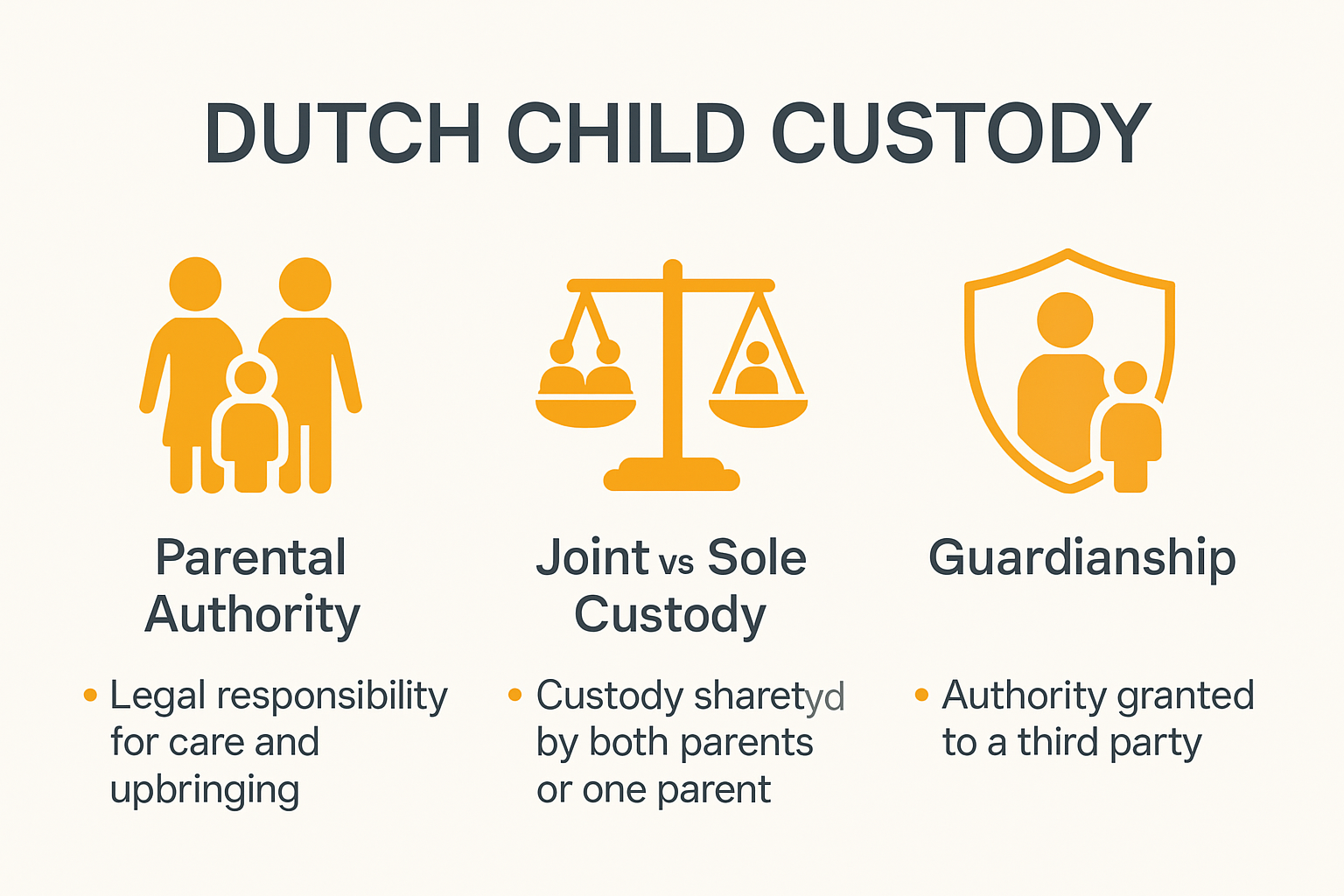
Navigating child custody laws in the Netherlands requires a solid understanding of the unique legal framework and terminology that governs parental responsibilities and children’s rights. In the Netherlands, the concept of custody does not exist as understood in some other countries; instead, parental authority covers both legal and physical aspects. All minor children in the Netherlands are under parental authority or guardianship. The birth mother automatically gains parental authority at birth. In cases of same-sex partnerships or registered partnerships, the co-mother may also obtain parental authority, but specific legal procedures may apply to establish her rights and responsibilities. Parental authority and custody are not the same; parental authority relates to care and upbringing, whereas custody refers to legal terms often misused. For international families, foreign law may determine parental authority in some situations, and parental authority or guardianship must be established by a foreign court to be recognized in the Netherlands. This knowledge is particularly important for expats and international families addressing family dynamics and legal obligations.
Core Concepts of Dutch Parental Responsibility
In Dutch law, parental responsibility (ouderlijk gezag) is a fundamental concept that extends well beyond physical custody. It includes the comprehensive duty of parents to care for, protect, and nurture their children until they reach legal adulthood. Unlike some jurisdictions, Dutch law focuses on the child’s overall development and welfare as the primary consideration in any custody arrangement, emphasizing the child’s legal rights and the importance of considering the child’s interests in all decisions.
Parental responsibility involves key aspects such as making decisions about the child’s education, healthcare, religious upbringing, school, and personal development. Parents are expected to consult each other on important matters affecting the child, such as education, contact, and relocation. The legal system ensures the child’s best interests are paramount, encouraging both parents to maintain meaningful connections and responsibilities regardless of their relationship status. After divorce, both parents retain legal custody of their children in principle unless granted single custody due to the child’s best interests. Visitation rights under Dutch law include not only visits but also communication methods like emails and phone calls. Children over 12 years of age can provide their child’s opinion on visitation arrangements, and while it is not binding, the court will consider the child’s opinion in its decision-making process. Learn more about parental authority complexities with our expert legal guidance.
Legal Terminology and Custody Arrangements
Familiarity with specific legal terms is crucial when dealing with child custody matters in the Netherlands. Important terms include:
-
Joint Parental Authority: The standard arrangement where both parents share legal responsibilities, even if separated or divorced. Parents married or in a civil partnership automatically have joint custody of all children born of the marriage or civil partnership. Dutch law strongly promotes cooperative parenting and shared decision-making. Parents have an obligation to promote contact between the child and both parents.
-
Sole Parental Authority: Granted in specific situations such as proven neglect or inability to co-parent effectively, where a court awards parental authority exclusively to one parent after careful consideration. If parents cannot agree, the judge will decide on the custody arrangement.
-
Guardianship: Different from parental authority, guardianship (voogdij) may be assigned to a third party if parents cannot fulfill their responsibilities, such as in cases of prolonged illness or incarceration.
If parents are not married, only the mother has immediate custody of any children born during the relationship. Unmarried fathers can apply for joint parental authority in court if they recognized the child, otherwise, they do not automatically have parental authority. The mother automatically has parental authority over her child, while the father obtains this right if married to the mother or through recognition. In these cases, specific forms must be completed and submitted to the court.
The Dutch approach to child custody values flexibility and practical solutions. Courts recognize the complexity and evolving nature of family structures, especially in international contexts. When parents separate or divorce, they are required to create a parenting plan addressing care and upbringing arrangements for their children. Parents are obliged to submit this parenting plan to the court. Expats and migrants should understand that the law prioritizes maintaining meaningful relationships between children and both parents whenever possible. There is an obligation for parents to promote contact and facilitate the child’s relationships with both parents and family members. Parents must consult the other parent on important matters such as relocation, holiday plans, and major decisions affecting the child. If a parent wishes to relocate abroad with the child, permission must be requested from the other parent or, if refused, from the court. The Dutch court decides on relocation requests based on the best interests of the child, and the judge is responsible for making these decisions if parents cannot agree.
International families may face additional challenges due to cross-border issues. The Netherlands adheres to international conventions protecting children’s rights and facilitating cooperative custody dispute resolutions, including recognition and enforcement of custody arrangements across jurisdictions. If a visitation arrangement is not working, parents can agree on a new arrangement or apply to the courts for a revision. Initial visitation arrangements are often common, such as alternating weekends and holidays after separation.
Factors such as residency status, cultural background, and family dynamics significantly influence custody decisions. The child’s habitual residence is an important factor in determining jurisdiction in international custody cases. Legal professionals specializing in family law can offer tailored advice to address each family’s unique situation.
Ultimately, Dutch child custody laws embody a progressive, child-focused approach, balancing parental duties, safeguarding children’s welfare, and fostering stable environments for healthy emotional and psychological growth.

Key Procedures for International and Migrant Families
International and migrant families encounter distinct challenges when navigating child custody procedures in the Netherlands. The Dutch legal framework aims to protect children’s interests while accommodating the complexities of multicultural families. Legal procedures may differ depending on where the children live, especially in cross-border cases, as the place of residence is an important factor in determining jurisdiction and applicable law.
When discussing jurisdiction, it is important to note that the Dutch nationality of the child can influence which court has authority and which legal rules apply. Whether or not children have Dutch nationality may affect the necessity and application of court rulings, parenting plans, and parental authority issues within Dutch law.
Jurisdiction and Legal Considerations
Determining jurisdiction is a vital initial step for international families. Dutch courts consider the child’s habitual residence as the primary factor in deciding which legal system applies. If a child has lived in the Netherlands for a significant time, Dutch custody laws generally govern the case. Once a child has left the Netherlands, the Dutch courts lose jurisdiction quickly.
For expats and migrants, this can be complicated. The legal system takes into account the child’s nationality, parents’ residency status, and length of stay in the Netherlands. Parental agreements are important, with courts encouraging comprehensive parenting plans that address international issues. Explore our guide on family legal navigation for international families.
Documentation and Legal Requirements
International families must prepare extensive documentation for custody matters, including:
-
Proof of Residency: Documents verifying the child’s habitual residence and family’s legal status in the Netherlands.
-
Comprehensive Parenting Plan: Detailed agreements covering custody, visitation, and communication. The parenting plan must address contact arrangements, financial measures, and where the children will live in the future.
-
International Documentation: Certified translations of birth certificates, marriage records, and prior custody agreements from the country of origin.
This process can be challenging, requiring careful verification and official certification. Courts scrutinize the authenticity and completeness of documents, making expert legal assistance crucial.
Cross-border custody cases add complexity. The Netherlands follows international conventions like the Hague Convention on the Civil Aspects of International Child Abduction, which prevents unauthorized international relocation and ensures both parents can maintain meaningful contact. The court will evaluate the promoting of contact between the child and both parents when considering a parent’s request to relocate. Children can be abducted if a parent moves with them without the consent of the other parent.
Cultural differences, language barriers, and varying parental responsibility interpretations can complicate matters. The Dutch system emphasizes mediation and collaborative solutions prioritizing children’s emotional and psychological health.
Migrant families need to understand these procedures, which may involve mediation, court assessments, and evaluations of family circumstances. Professional legal guidance is vital to protect children’s interests while complying with Dutch law.
The Dutch approach to international child custody emphasizes flexibility, cultural sensitivity, and child-centeredness, recognizing the challenges multicultural families face and striving to support children’s stable development.
Co-Parenting and Navigating Relationships with Ex-Partners
Practical Co-Parenting Arrangements
Co-parenting after a divorce or separation can be challenging, but Dutch law is designed to support both parents in maintaining a meaningful role in their child’s life. In most cases, joint parental authority remains the standard, meaning both parents are responsible for making important decisions about their child’s upbringing, education, and welfare. This shared responsibility continues even if the parents no longer live together, ensuring that the child benefits from the involvement of both parents in their daily life.
A well-structured parenting plan is essential for successful co-parenting. This plan should clearly outline the care arrangement, including where the child will live, how contact with the other parent will be maintained, and how decisions about schooling, healthcare, and extracurricular activities will be made. The Dutch court expects parents to submit a comprehensive parenting plan during divorce proceedings, and will only intervene in very extreme cases where parents are unable to reach an agreement or where the child’s best interests are at risk.
When parents live abroad or one parent wishes to move abroad with the child, additional complexities arise. Dutch courts will carefully consider the best interests of the child, taking into account the criteria developed in case law and European regulation. Factors such as the child’s age, the strength of their relationship with each parent, and the practicalities of maintaining contact across borders are all important. Parents should be aware that moving abroad may involve additional costs and logistical challenges, and any significant change to the care arrangement typically requires the consent of the other parent or, if necessary, a court decision.
Dispute resolution is a key part of co-parenting in the Netherlands. The legal system encourages parents to resolve disagreements through communication and mediation, rather than resorting to court intervention. However, in extreme cases—such as when cooperation is impossible or the child’s welfare is at stake—the court may award sole custody to just one parent. This is a last resort, used only when it is clearly in the best interest of the child.
Navigating the relationship with an ex-partner requires ongoing communication, flexibility, and a focus on the child’s needs. Parents are encouraged to seek advice from a lawyer experienced in Dutch family law to fully understand their rights, obligations, and the legal processes involved. By prioritizing the child’s best interests and working collaboratively, parents can create a stable, supportive environment that allows their child to thrive, even after a separation or divorce.
Working with Legal Professionals in the Netherlands
Handling child custody issues in the Netherlands requires working closely with legal professionals who have deep expertise in Dutch family law. The complex mix of parental rights, international rules, and legal nuances demands specialized knowledge beyond standard legal services.
Choosing the Right Legal Expertise
Selecting the right lawyer is essential. The ideal expert understands both Dutch domestic law and international family law principles. Expats and international families benefit from lawyers who can navigate cultural and legal complexities and provide guidance beyond traditional legal advice.
Specialized knowledge is critical. Lawyers must be familiar with Dutch custody laws, recent legislative changes, international conventions, and provisions affecting multicultural families. Explore our comprehensive guide to legal consultation for non-Dutch nationals dealing with family law.
Comprehensive Legal Support Services
Legal support in child custody cases covers several key areas:
-
Initial Consultation: Assessing family dynamics, legal status, and custody options.
-
Documentation Preparation: Gathering and translating necessary legal documents.
-
Mediation Assistance: Guiding negotiations and conflict resolution.
-
Court Representation: Advocating for clients in Dutch family court.
Dutch legal professionals adopt a holistic approach, focusing on children’s emotional well-being and long-term development, distinguishing Dutch practice from more adversarial systems.
International families face unique challenges requiring nuanced legal interpretation. Family law specialists handle cross-border residency, international marriage contracts, and jurisdictional conflicts, creating strategies that protect parental rights and prioritize children’s interests.
Consultations involve detailed interviews, document reviews, and tailored strategies addressing emotional and practical aspects of custody cases.
Technological advances have improved legal consultations in the Netherlands, with digital platforms enabling smooth communication, document sharing, and multilingual support, making expert advice more accessible.
Successful legal partnerships are built on trust, understanding, and commitment to positive outcomes for children and families. Choosing experienced, empathetic, and strategic legal experts helps families turn legal challenges into opportunities for constructive resolution and healthy family dynamics.
What is parental responsibility in the Netherlands?
Parental responsibility (ouderlijk gezag) involves parents’ duties to care for, protect, and support their children until adulthood, always considering the child’s best interests.
Joint parental authority is the default in the Netherlands, allowing both parents to share legal responsibilities and make important decisions about their child’s upbringing, even if separated or divorced.
What documentation is required for child custody cases involving international families?
International families need proof of residency, a detailed parenting plan, and certified documents from their country of origin, such as birth certificates and prior custody agreements.
Why is mediation encouraged in Dutch child custody disputes?
The Dutch legal system prefers mediation over adversarial court proceedings to encourage parents to collaboratively find solutions that prioritize their children’s emotional and psychological well-being.
Ready to Take Control of Your Child Custody Situation?
Understanding Dutch child custody law can be daunting, especially when dealing with joint parental authority, complex international documents, or cross-border family challenges. If you are an expat, business leader, or legal professional facing uncertainty about mediation or legal requirements, you don’t have to face it alone. At , you will find expert support fluent in your language and understanding your needs.
Our team specializes in guiding international families, expats, and professionals through every step—from preparing necessary documents to achieving child-focused outcomes required by Dutch law. Expect prompt, clear communication and advice tailored to your situation.
Remove the stress from your child custody case—visit Law & More’s main site and connect with specialists ready to help you secure your family’s future. Don’t wait until your options are limited. Schedule a personalized consultation today for the guidance your family deserves.