



Netherlands business immigration is drawing in ambitious entrepreneurs from every corner of the globe. With over 3,500 international startups launching in the Netherlands every year, you might expect the real barrier to entry lies in the fierce competition. Surprisingly, the bigger challenge is understanding the subtle legal pathways and compliance rules that trip up even the savviest applicants. The real advantage goes to those who master the unspoken rules of Dutch bureaucracy long before they set foot in the country.
Table of Contents
Quick Summary
| Takeaway | Explanation |
| Choose the right visa for business. | Entrepreneurs can benefit from Startup visas or Self-Employed permits designed for innovative ventures and established professionals. |
| Meet all eligibility criteria. | Applicants must demonstrate financial sustainability, business viability, relevant expertise, and valid health insurance coverage to qualify for immigration. |
| Prepare thorough documentation. | Compiling a comprehensive portfolio including a business plan, professional credentials, and proof of financial stability is crucial. |
| Understand compliance requirements. | Maintaining residency requires regular reporting to tax authorities and compliance with Dutch business regulations. |
| Embrace cultural integration. | Engaging with local business culture and networking enhances opportunities for successful business transitions in the Netherlands. |
Understanding Netherlands Business Immigration Rules
Netherlands business immigration represents a sophisticated and strategic pathway for international entrepreneurs and companies seeking to establish or expand their operations within the Dutch market. The country’s robust legal framework and business-friendly environment create unique opportunities for global professionals looking to navigate the complex landscape of corporate relocation and business establishment.
Key Immigration Pathways for Business Professionals
The Netherlands offers multiple immigration routes tailored to different professional scenarios. Entrepreneurs and highly skilled migrants can access specialised permits designed to facilitate seamless business integration. Startup visas and self-employed permits are particularly attractive options for innovative professionals seeking to leverage the Netherlands’ dynamic economic ecosystem.
These immigration channels are carefully structured to attract talent and entrepreneurial expertise. The Dutch government recognises the significant economic contributions made by international business professionals and has developed a strategic approach to welcoming skilled individuals who can drive innovation and economic growth. Learn more about our comprehensive immigration strategies for detailed insights into the legal frameworks governing business migration.
Eligibility and Documentation Requirements
Successful business immigration in the Netherlands hinges on meeting specific eligibility criteria and presenting comprehensive documentation. Entrepreneurs must demonstrate:
-
Financial Sustainability: Proof of sufficient financial resources to support business operations
-
Business Viability: A comprehensive business plan outlining economic potential
-
Professional Qualifications: Evidence of relevant skills and professional background
-
Health Insurance: Valid medical coverage for the duration of residency
The Dutch immigration system emphasises quality and potential. Applicants are evaluated based on their capacity to contribute meaningfully to the Netherlands’ economic landscape. This approach ensures that business immigrants are not merely relocating but are positioned to create tangible value within the national economic framework.
Regulatory Compliance and Strategic Considerations
Navigating Netherlands business immigration requires meticulous attention to regulatory nuances. The process involves multiple governmental departments and demands precision in documentation and procedural adherence. Entrepreneurs must be prepared to engage with the Immigration and Naturalisation Service (IND), tax authorities, and local municipal registration systems.
Understanding the intricate legal requirements is crucial. Each business immigration route carries unique obligations and potential pathways to long-term residency. Factors such as investment scale, business sector, and individual professional background significantly influence the immigration strategy. Professional legal guidance becomes instrumental in interpreting these complex regulations and developing a robust immigration approach that aligns with both personal and business objectives.
The Netherlands continues to position itself as a global hub for international business talent, offering a transparent, efficient, and welcoming immigration system that balances rigorous standards with genuine opportunities for skilled professionals and innovative entrepreneurs.
Key Visa Options for Entrepreneurs and Businesses
The Netherlands offers a comprehensive range of visa options designed to support international entrepreneurs and businesses seeking to establish or expand their operations within the Dutch market. These specialised immigration routes provide strategic pathways for professionals looking to leverage the country’s dynamic business ecosystem.
Startup Visa Programme
The Dutch Startup Visa represents a pioneering approach to attracting innovative entrepreneurs. This unique programme provides a dedicated residence permit for non-European Union entrepreneurs with groundbreaking business concepts. To qualify, applicants must partner with a recognised Dutch startup facilitator who validates the innovative potential of their business model. Learn more about establishing your business venture in the Netherlands.
Key characteristics of the Startup Visa include:
-
Maximum Validity: One-year residency permit
-
Innovation Requirement: Demonstrable innovative business concept
-
Facilitator Support: Mandatory guidance from an experienced startup mentor
-
Potential Extension: Opportunity to transition to long-term residency based on business performance
The programme specifically targets entrepreneurs developing cutting-edge solutions in technology, sustainability, healthcare, and other high-potential sectors. Applicants undergo a rigorous assessment process that evaluates both the individual’s professional capabilities and the innovative merit of their proposed business.
Self-Employed Professionals Permit
The Self-Employed Professionals (Zelfstandigen) permit offers an alternative route for entrepreneurs who can demonstrate substantial professional expertise and economic added value. This visa category requires applicants to prove their ability to generate sufficient income and contribute meaningfully to the Dutch economy.
Eligibility criteria for this permit are comprehensive and include:
-
Minimum Income Threshold: Demonstrating a sustainable income level
-
Professional Credentials: Extensive professional experience and relevant qualifications
-
Economic Added Value: Clear evidence of contribution to the Dutch business landscape
-
Financial Independence: Proof of financial stability and business sustainability
Specific Bilateral Immigration Arrangements
The Netherlands has developed specific bilateral immigration arrangements with select countries to facilitate business migration. The Dutch-American Friendship Treaty (DAFT) represents a prime example, offering streamlined immigration processes for U.S. entrepreneurs interested in establishing businesses in the Netherlands.
These bilateral arrangements typically provide simplified entry requirements, reduced bureaucratic barriers, and additional support for international entrepreneurs. They reflect the Netherlands’ commitment to creating an open, accessible environment for global business talent.
Entrepreneurs considering business immigration to the Netherlands must navigate a complex regulatory landscape. Each visa option carries unique requirements, documentation standards, and potential pathways to long-term residency. Professional legal guidance becomes crucial in interpreting these nuanced regulations and developing a strategic immigration approach that aligns with individual business objectives.
To help entrepreneurs select the most suitable business immigration route, the following table compares the key features and requirements of the main Dutch visas discussed in this guide.
| Visa Option | Validity | Main Requirements | Suitable For | Extension/Next Steps |
| Startup Visa | 1 year | Innovative concept, facilitator support | Innovative entrepreneurs | Can lead to long-term permit |
| Self-Employed Permit | Variable | Income threshold, professional credentials | Experienced business owners | Pathway to residency |
| Bilateral Arrangement (DAFT) | Variable | Bilateral country citizenship, business plan | US entrepreneurs (example) | Streamlined, may renew |
The Netherlands continues to position itself as a global hub for international entrepreneurship, offering transparent, efficient, and innovative immigration solutions that balance rigorous standards with genuine opportunities for skilled professionals and forward-thinking business leaders.
Step-by-Step Application and Legal Process
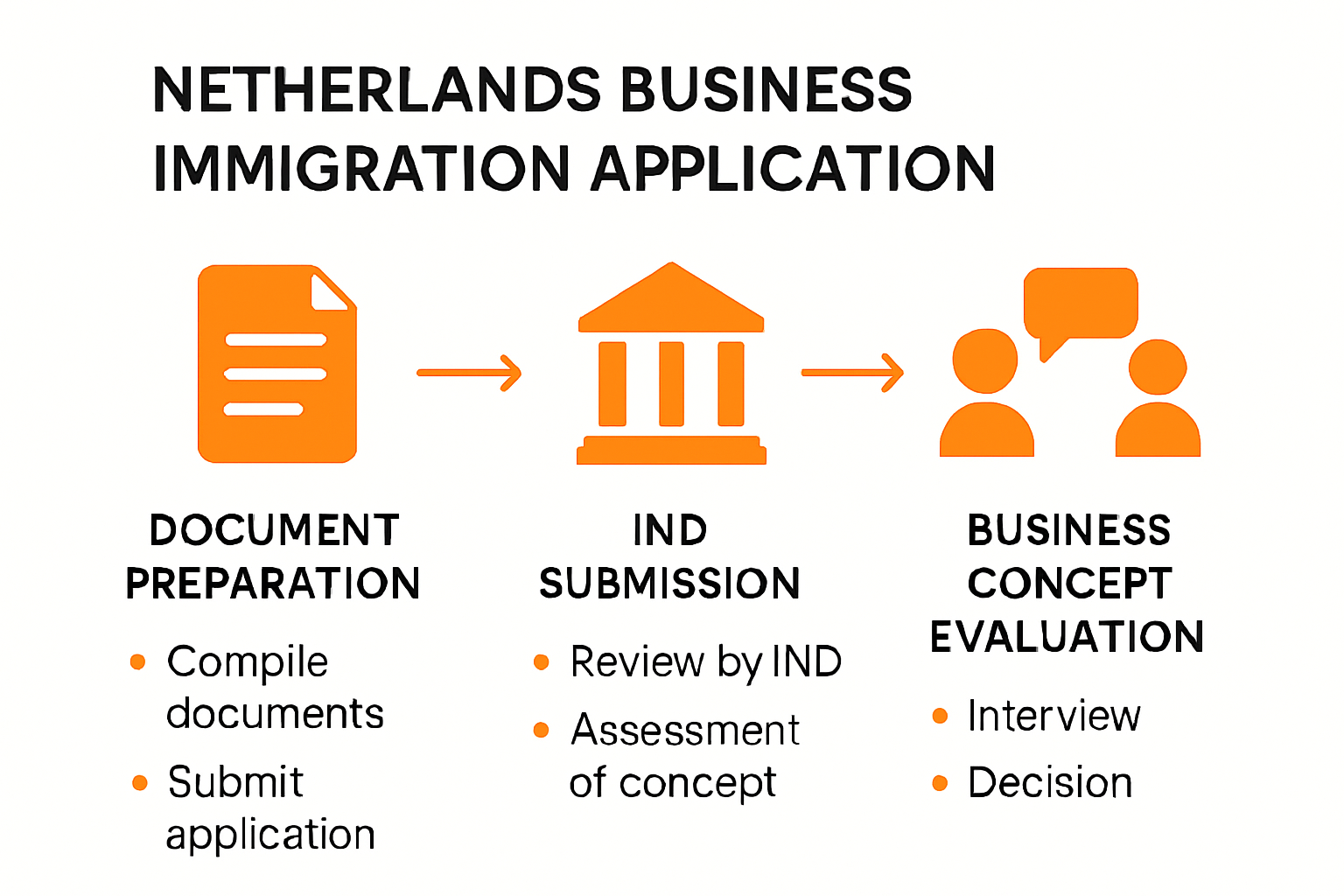
Navigating the Netherlands business immigration process requires a systematic and thorough approach. International entrepreneurs must carefully follow a comprehensive legal framework that ensures compliance with Dutch immigration and business establishment regulations. The application journey demands precision, strategic planning, and meticulous documentation.
Initial Preparation and Documentation
Successful business immigration begins with extensive preparation. Entrepreneurs must compile a comprehensive portfolio of documents that demonstrate their professional capabilities, business concept, and economic potential. Learn more about preparing your business documentation to ensure a smooth application process.
Key documentation requirements include:
-
Detailed Business Plan: A comprehensive document outlining business strategy, financial projections, and innovation potential
-
Professional Credentials: Verified academic and professional qualifications
-
Financial Proof: Bank statements, investment evidence, and financial sustainability documentation
-
Passport and Personal Identification: Authenticated international travel documents
-
Health Insurance: Comprehensive medical coverage valid in the Netherlands
Entrepreneurs must ensure all documents are officially translated into English or Dutch and meet the stringent standards of the Immigration and Naturalisation Service (IND). Each document undergoes careful scrutiny to verify the applicant’s professional credibility and business viability.
Application Submission and Review Process
The formal application process involves multiple stages of assessment by Dutch governmental authorities. Entrepreneurs must submit their application through the designated immigration channels, typically the IND, with precise attention to procedural requirements.
The review process encompasses several critical evaluation stages:
-
Initial Document Screening: Comprehensive review of submitted documentation
-
Business Concept Evaluation: Assessment of innovative potential and economic contribution
-
Personal Interview: Direct assessment of the entrepreneur’s professional background
-
Background Verification: Comprehensive check of professional and personal history
Applicants should anticipate a detailed and potentially lengthy review process. The Dutch immigration system prioritises quality over speed, ensuring that only genuinely innovative and economically valuable business proposals receive approval.
Legal Compliance and Post-Approval Requirements
Successful visa approval marks the beginning of a continued compliance journey. Entrepreneurs must adhere to specific legal obligations to maintain their residency and business operation status.
Post-approval requirements include:
-
Regular Reporting: Periodic updates on business progress and financial performance
-
Tax Registration: Comprehensive engagement with Dutch tax authorities
-
Business Registration: Official registration with the Netherlands Chamber of Commerce
-
Ongoing Compliance: Continuous adherence to immigration and business regulations
Entrepreneurs must maintain active communication with immigration authorities and demonstrate ongoing commitment to their proposed business objectives. The Netherlands offers a supportive yet rigorous environment that demands continuous professional development and economic contribution.
For clarity on the process of obtaining business immigration status in the Netherlands, the following table summarises the main steps involved, along with the key actions required at each stage.
| Step | Key Actions/Requirements |
| Initial Preparation | Compile business plan, qualifications, financial proof, identification, insurance |
| Documentation Translation | Ensure all documents are officially translated into English or Dutch |
| Application Submission | File application with IND and attach required supporting documents |
| Document & Business Evaluation | IND reviews documents and assesses business concept and innovation |
| Personal Interview | Attend interview to verify professional background |
| Background Verification | Complete personal and professional background checks |
| Post-Approval Compliance | Register with Chamber of Commerce, tax authority, provide regular business updates |
The business immigration process reflects the Netherlands’ commitment to attracting global talent while maintaining high standards of professional excellence. Successful applicants become part of a dynamic ecosystem that values innovation, economic potential, and international entrepreneurial spirit.
Essential Tips for Successful Business Relocation
Relocating a business to the Netherlands requires strategic planning, cultural adaptation, and comprehensive understanding of the local business ecosystem. Successful entrepreneurs approach this transition with meticulous preparation, recognising that business relocation involves far more than logistical arrangements. Learn more about legal considerations for business transitions to ensure a smooth migration process.
Financial and Operational Preparation
Financial readiness forms the cornerstone of successful business relocation. Entrepreneurs must develop a robust financial strategy that accounts for Dutch taxation systems, banking regulations, and operational costs. This preparation involves comprehensive financial planning that extends beyond basic budgeting.
Key financial considerations include:
-
Tax Structure Evaluation: Understanding Dutch corporate tax frameworks
-
Banking Setup: Establishing local bank accounts with appropriate international transaction capabilities
-
Capital Investment: Ensuring sufficient financial reserves for initial establishment period
-
Currency Exchange Management: Developing strategies for managing international financial transactions
Beyond financial planning, businesses must conduct extensive market research to understand the nuanced Dutch business landscape. This involves analyzing local market dynamics, competitive environments, and sector-specific regulations that might impact business operations.
Cultural and Professional Integration
Successful business relocation transcends mere administrative processes. Cultural adaptation plays a critical role in establishing meaningful business relationships and understanding local professional norms. The Netherlands boasts a distinct business culture characterized by directness, collaborative approaches, and consensus-driven decision-making.
Entrepreneurs should focus on:
-
Language Proficiency: Developing basic Dutch language skills
-
Networking Strategies: Engaging with local business associations and professional networks
-
Cultural Competence: Understanding Dutch business etiquette and communication styles
-
Professional Development: Participating in local entrepreneurial ecosystems and industry events
Building genuine relationships becomes paramount. Dutch business culture values transparency, long-term partnerships, and mutual respect. Entrepreneurs who invest time in understanding these cultural nuances significantly enhance their potential for successful integration.
Legal and Regulatory Compliance
Navigating the complex landscape of Dutch business regulations requires comprehensive legal understanding and proactive compliance strategies. International entrepreneurs must develop a systematic approach to meeting regulatory requirements across multiple governmental domains.
Critical compliance areas include:
-
Corporate Registration: Precise documentation with the Netherlands Chamber of Commerce
-
Employment Regulations: Understanding Dutch labour laws and worker protection standards
-
Intellectual Property Protection: Securing appropriate legal safeguards for business innovations
-
Ongoing Regulatory Monitoring: Maintaining awareness of evolving legal frameworks
Professional legal consultation becomes essential in this context. Experienced legal professionals can provide targeted guidance, helping entrepreneurs anticipate potential challenges and develop strategic compliance approaches.
Relocation represents more than a geographical transition. It is a holistic transformation that demands intellectual flexibility, strategic thinking, and genuine commitment to understanding a new business environment. Successful entrepreneurs approach this journey with curiosity, preparation, and a willingness to adapt.
The Netherlands offers a dynamic, innovative business ecosystem that rewards thoughtful, well-prepared international entrepreneurs. By combining strategic planning, cultural intelligence, and rigorous compliance, businesses can transform relocation challenges into significant competitive advantages.

Frequently Asked Questions
What are the key immigration pathways for business professionals in the Netherlands?
The Netherlands offers multiple immigration routes, including the Startup Visa for innovative entrepreneurs and the Self-Employed Professionals Permit for established individuals. These pathways are designed to facilitate business integration and attract skilled professionals.
What eligibility criteria must be met for business immigration to the Netherlands?
Applicants must demonstrate financial sustainability, business viability, relevant professional qualifications, and valid health insurance to qualify for business immigration in the Netherlands.
How can I prepare for the Netherlands business immigration application process?
Entrepreneurs should compile a detailed business plan, provide professional credentials, and submit proof of financial stability. Key documentation must be translated into English or Dutch and meet the standards set by the Immigration and Naturalisation Service (IND).
What are the post-approval requirements for maintaining residency in the Netherlands?
After obtaining a visa, entrepreneurs must comply with legal obligations, including regular reporting on business progress, tax registration with Dutch authorities, and ongoing adherence to immigration regulations.
Overcome Business Immigration Barriers With Personalised Legal Support
Mastering the complexities of Netherlands business immigration—such as choosing the right visa, preparing impeccable documentation, and staying compliant—can be overwhelming. The article highlights how missing a single requirement or misunderstanding Dutch regulations can delay your entrepreneurial plans. Many ambitious professionals face uncertainty when dealing with eligibility, documentation standards, and strict compliance demands.
Do not let bureaucracy and uncertainty hold your venture back. Law & More specialises in tailored business immigration solutions, guiding you through Dutch procedures with clarity and confidence. Our multilingual team is experienced in corporate and immigration law, ensuring your documentation and compliance are always in order. Discover how we can help you secure your Netherlands business future—visit our main site now, or see how we approach complex immigration law cases. Let us take the legal burden off your shoulders, so you can focus on building your success.