


When another country seeks to prosecute an individual located in the Netherlands, the Dutch legal system engages one of two distinct procedures. This is not a mere technicality; the path taken profoundly impacts the individual’s rights, the speed of the process, and the available grounds to contest the transfer. Understanding this fundamental distinction is the first step in navigating these complex international legal challenges.
The Dual Systems of International Cooperation
The pivotal question is straightforward: does the request originate from a European Union member state or a non-EU country? The answer dictates the entire legal framework that follows.
This process is fundamentally about jurisdiction—which state holds the legal authority to prosecute a crime. Before examining Dutch procedures, it is useful to understand the basics of what is jurisdiction in law, as this concept underpins every international request.
European Arrest Warrant vs. Traditional Extradition
For requests originating within the European Union, the process is not ‘extradition’ but ‘surrender,’ governed by the European Arrest Warrant (EAW). This is an expedited system built on mutual trust among EU nations. It bypasses slower, traditional diplomatic channels in favour of a streamlined, court-to-court mechanism designed for efficiency. The primary goal is to ensure individuals cannot evade justice simply by crossing an internal EU border.
Conversely, requests from non-EU countries initiate a more formal, classic extradition procedure. This process is governed by the Dutch Extradition Act (Uitleveringswet) and is shaped by specific bilateral or multilateral treaties the Netherlands holds with the requesting nation. These cases involve a far more detailed review by Dutch courts, which meticulously verify that the request complies with all treaty obligations and fundamental legal principles, such as dual criminality.
To provide a clearer overview, let’s compare the key differences between these two systems.
Extradition vs. European Arrest Warrant at a Glance
The table below summarises the essential distinctions between the traditional, treaty-based extradition process for non-EU countries and the modern, streamlined EAW system operating within the EU.
| Feature | Traditional Extradition (Non-EU) | European Arrest Warrant (EU) |
|---|---|---|
| Legal Basis | Dutch Extradition Act & specific treaties | EU Framework Decision & Dutch Surrender Act |
| Key Principle | Cooperation based on treaty obligations | Mutual recognition of judicial decisions |
| Political Role | Minister of Justice has the final say | Purely a judicial process; no political veto |
| Dual Criminality | Required (conduct must be a crime in both countries) | Abolished for 32 listed categories of offences |
| Timeline | Lengthy (months, sometimes years) | Fast-tracked (strict deadlines, often weeks) |
| Grounds for Refusal | Broader (political offence, nationality, etc.) | Very limited and strictly defined |
As illustrated, the EAW represents a significant paradigm shift, prioritizing speed and trust over the cautious, state-by-state verifications inherent in traditional extradition.
The impact of the EAW system, implemented in the Netherlands through the Surrender Act (Overleveringswet), has been substantial. In 2022, for instance, Dutch authorities issued 1,247 EAWs and processed 892 incoming requests from other EU states.

The efficiency gains are undeniable. The average time to complete a surrender under an EAW has decreased significantly, dropping to just 28 days in 2023 from an average of 79 days prior to the system’s introduction.
Facing either of these procedures requires an immediate understanding of your rights. For those detained, our firm provides a comprehensive guide on your rights during arrest and police custody in the Netherlands.
How the European Arrest Warrant Works in Practice

The European Arrest Warrant (EAW) is the EU’s solution for cross-border criminal justice, tailored for a continent with open borders. It operates on the powerful principle of mutual recognition.
In practice, this means Dutch courts must fundamentally trust the legal systems of other EU member states. A warrant issued by a judicial authority in Spain or Poland is afforded nearly the same legal weight as one issued in the Netherlands.
This system removes politics and diplomatic negotiations from the process entirely. It is a purely judicial matter, streamlined for speed and efficiency. The entire procedure is governed by strict, non-negotiable deadlines, making immediate legal counsel essential from the moment an EAW is executed.
The Abolition of Dual Criminality for Serious Offences
A cornerstone of the EAW system is its treatment of dual criminality—the traditional requirement that an act must be a crime in both the requesting and the executing country. For a specific list of 32 serious offences, the EAW dispenses with this requirement.
If an individual is sought for a crime on this list that carries a maximum penalty of at least three years in the issuing country, the Netherlands is obligated to surrender them. There is no assessment of whether the act also constitutes a crime under Dutch law.
This list covers a range of offences that frequently have a cross-border dimension. Key examples where dual criminality is no longer a factor include:
- Cybercrime
- Terrorism
- Corruption and fraud
- Trafficking in human beings
- Money laundering
- Participation in a criminal organisation
Due to this streamlined approach, when an EU country issues an EAW for one of these offences, the Dutch court’s role is not to second-guess the case. Its function is to ensure the surrender process is conducted correctly according to the established rules. For any crimes not on this list, the dual criminality check still applies.
By removing the dual criminality test for these 32 offences, the EAW system prioritises the collective security of the European Union, ensuring that serious criminals cannot find a safe haven by exploiting differences in national laws. It reflects a deep level of trust and integration among member states’ justice systems.
The Practical Steps of an EAW Procedure
When an EU state issues an EAW for someone believed to be in the Netherlands, a clear, time-sensitive process is initiated. Understanding these steps is critical, as the timeframe for legal action is extremely limited.
- Issuing and Execution: A judicial authority in another EU country issues the EAW and transmits it directly to the Dutch Public Prosecutor (Officier van Justitie), who is responsible for its execution. This almost invariably leads to the arrest of the requested person.
- Court Hearing: The case is fast-tracked to the International Legal Assistance Chamber (Internationale Rechtshulpkamer) of the District Court of Amsterdam. This is the sole court in the Netherlands designated to handle EAW cases, a deliberate centralisation to ensure specialised expertise and consistent application of the law.
- The Court’s Decision: During the hearing, the court’s review is highly focused. It verifies the person’s identity, confirms the warrant’s formal validity, and assesses whether any of the strictly defined grounds for refusal apply. The court must render its final decision within 60 days of the arrest.
- Surrender: If the court approves the surrender, the physical transfer must occur within 10 days of the final decision. These tight deadlines underscore the urgency of these cases and the necessity of establishing a robust defence strategy from the outset.
Given the complexities of these cross-border cases, it is vital to have support from lawyers who understand both Dutch law and the international legal frameworks that govern it. You can learn more about how our firm handles these challenges in our article on cross-border criminal defence in the Netherlands. The EAW process leaves very little room for delay or error, making expert legal guidance indispensable.
Navigating Traditional Extradition with Non-EU Countries
When an extradition request originates from a country outside the European Union, the accelerated process of the European Arrest Warrant is replaced by a far more formal and deliberate procedure. This is the domain of traditional extradition, a complex area governed by the Dutch Extradition Act (Uitleveringswet) and an intricate network of international treaties.
Unlike the EU’s system, which is founded on mutual trust, each request from a non-EU country is treated as a unique case. It is scrutinised on its own merits, based on the specific agreements between the Netherlands and the requesting nation. This cautious approach provides crucial safeguards but also results in a significantly slower and more complex process.
The Foundation of Extradition Treaties
The entire framework for non-EU extradition is built upon treaties. These agreements serve as the rulebook, defining the obligations between countries. They specify which offences are extraditable, list the required documentation, and establish the precise legal standards that Dutch courts must apply. In the absence of a treaty, extradition is generally not possible, with only very limited exceptions.
The Netherlands actively maintains and expands its network of judicial cooperation. This network currently includes 75 bilateral extradition treaties, supplemented by multilateral agreements such as the 1957 European Convention on Extradition. Recent pacts with Morocco (December 18, 2023) and the UAE (August 29, 2021) demonstrate an ongoing commitment to closing international legal gaps.
To provide a sense of scale, between 2018 and 2023, Dutch authorities processed 312 extradition requests based on these non-EU treaties, with an approval rate of 68%. The Dutch government’s extensive treaty database offers further details on these international agreements.
Dual Criminality: The Cornerstone of the Process
At the core of nearly every traditional extradition case is the principle of dual criminality. This serves as a fundamental safeguard: the conduct in question must be considered a criminal offence in both the requesting country and the Netherlands.
A Dutch court does not simply accept the requesting state’s classification of the crime. It conducts a careful analysis to answer two key questions:
- Does the behaviour described in the request constitute a crime under Dutch law?
- Does this Dutch crime carry a penalty that meets the minimum threshold specified in the treaty (often at least one year of imprisonment)?
If the act is legal in the Netherlands, extradition will be refused. This principle prevents individuals from being sent abroad to face charges for conduct that is not considered criminal domestically, acting as a critical protection of individual rights. Handling these complex international legal matters requires specialised knowledge, which you can read more about by consulting an experienced international lawyer.
The Speciality Rule: A Vital Protection
Another key protection embedded in extradition law is the speciality rule. This principle functions as an essential shield for the extradited person.
The speciality rule ensures that once a person is extradited, the requesting country can only prosecute them for the specific crime for which the Netherlands granted the extradition. Any attempt to add new charges or prosecute for different past offences is prohibited without obtaining fresh consent from the Dutch authorities.
This rule is crucial. It prevents a country from using a minor, extraditable offence as a pretext to secure an individual’s transfer, only to then pursue them for more serious or politically sensitive charges that might not have met the original extradition criteria. It guarantees that the scope of the prosecution remains strictly within the boundaries approved by the Dutch court, ensuring fairness and upholding the integrity of the extradition agreement.
Legal Grounds for Refusing an Extradition Request
The fact that an extradition or surrender request meets all technical requirements does not guarantee its approval. Dutch law, deeply integrated with European human rights principles, contains several powerful safeguards. These act as a critical braking system, allowing judges to halt the process if there is a real risk that an individual’s fundamental rights will be violated.
These grounds for refusal are not legal loopholes; they are essential protections that prevent the Netherlands from becoming complicit in human rights abuses abroad. For anyone facing extradition or a European Arrest Warrant (EAW), understanding these safeguards is absolutely vital.
The Absolute Ban on Inhumane Treatment
The most robust and frequently invoked protection is found in Article 3 of the European Convention on Human Rights (ECHR). This article establishes an absolute, non-negotiable prohibition of torture and any inhuman or degrading treatment or punishment. Dutch courts take this obligation with utmost seriousness in every case, whether it involves an EU member state or a non-EU country.
If a real and demonstrable risk exists that a person will face treatment violating Article 3 in the requesting country, extradition must be refused. A Dutch judge will not simply accept assurances from the requesting state at face value. Instead, the court will conduct a thorough, evidence-based inquiry into the conditions on the ground.
This investigation involves examining:
- Detention Conditions: Courts scrutinise credible reports from organisations like the Council of Europe’s Committee for the Prevention of Torture (CPT). They look for evidence of prison overcrowding, violence, poor sanitation, and inadequate medical care in the requesting country.
- Rule of Law Concerns: The judge also evaluates the independence of the judiciary and the broader human rights climate. A justice system where a fair trial is not guaranteed can, in certain circumstances, contribute to the risk of an Article 3 violation.
- Individual Circumstances: The person’s specific situation is also critical. Their age, health, or psychological state are all considered to assess whether the potential detention conditions would be uniquely harmful to them.
Double Jeopardy or ‘Ne Bis In Idem’
A foundational principle of criminal justice is ne bis in idem, which means a person cannot be tried or punished for the same crime twice. This protection is enshrined in both Dutch and international law and constitutes a mandatory ground for a court to refuse a request.
If it can be demonstrated that the person has already been finally convicted or acquitted in the Netherlands (or another EU member state) for the exact same conduct described in the extradition request, the request must be denied. This prevents individuals from being relentlessly pursued for the same actions across different jurisdictions and provides crucial legal finality.
The principle of ne bis in idem is a fundamental guarantee of legal certainty. It ensures that once a judicial decision is final, the matter is closed, protecting individuals from the endless threat of prosecution for an act they have already answered for.
Other Important Grounds for Refusal
Beyond the absolute shields of Article 3 and double jeopardy, Dutch courts consider several other significant factors that can halt an extradition or surrender.
A request can be challenged based on a number of well-established legal principles. The table below provides a concise overview of the most common grounds a Dutch court will consider.
Key Grounds for Refusing Extradition or Surrender
| Ground for Refusal | Applies to Extradition (Non-EU) | Applies to EAW (EU) | Brief Explanation |
|---|---|---|---|
| Human Rights (Article 3 ECHR) | Yes | Yes | A real risk of torture or inhuman/degrading treatment in the requesting state. An absolute bar. |
| Double Jeopardy (Ne Bis In Idem) | Yes | Yes | The person has already been finally judged for the same offence in the Netherlands or another state. |
| Political Offence | Yes | No | The offence is considered purely political in nature (e.g., dissent). This generally does not cover terrorism. |
| Risk of Death Penalty | Yes | N/A | The request will be denied unless there’s a binding guarantee the death penalty won’t be carried out. |
| Statute of Limitations | Yes | Yes | The time limit for prosecuting the offence has expired under Dutch law. |
| In Absentia Judgments | N/A | Yes | The person was convicted without being present at trial and has not been guaranteed the right to a retrial. |
| Dutch Nationality | Yes | Limited | The Netherlands can refuse to extradite its own nationals but may offer to prosecute them locally instead. |
It is clear that each ground requires a meticulous, fact-specific legal argument. A successful defence in these complex cases often depends on demonstrating effectively how one or more of these crucial protections apply to the individual’s unique circumstances.
A Step-by-Step Walkthrough of the Dutch Extradition Process
To effectively manage an extradition or surrender request, it is essential to understand its journey through the Dutch legal system. It is a structured, time-sensitive process that begins the moment a request is received and the individual is located. From the initial arrest to the final court ruling, knowing these stages can make an overwhelming experience more manageable.
Dutch law, deeply rooted in international legal commitments, meticulously outlines each step. The Netherlands has a robust framework for extradition, exemplified by its long-standing bilateral treaty with the United States, signed on June 24, 1980. This treaty is a perfect illustration of how international criminal law binds Dutch courts, with the national Extradition Act (Uitleveringswet) governing the proceedings.
To provide a sense of scale, between 2015 and 2023, Dutch courts processed approximately 150 non-EU extradition requests annually, approving roughly 65%. This reflects both an efficient system and a judiciary that takes its review function seriously. Further details on this key treaty can be found on the U.S. Congress website.
Arrest and Initial Appearance
In nearly all cases, the process begins with an arrest. The Dutch police take the person named in the request into custody. Shortly thereafter, they are brought before an investigating judge, known as the rechter-commissaris. This is not the main hearing but a preliminary review.
The purpose of this first appearance is to:
- Confirm the person’s identity.
- Formally inform them of the request that has been made.
- Decide whether they must be held in pre-trial detention to prevent flight.
This initial step is absolutely critical, and it is where the right to a lawyer is activated. Securing legal representation from this moment is essential to ensure all rights are protected.
The Role of The Public Prosecutor
The Public Prosecutor (Officier van Justitie) acts as the central coordinator for the entire procedure. They formally receive the extradition request or European Arrest Warrant (EAW) and present the case to the court. Their role is to argue in favour of granting the request, but only if it satisfies all legal requirements under both Dutch and international law.
The prosecutor is also responsible for ensuring that all documentation from the requesting country is complete and correct. Crucially, the defence team has the right to access the full case file compiled by the prosecutor—a fundamental principle for building a robust defence.
This diagram provides a simple overview of key grounds upon which a Dutch court might refuse an extradition request.
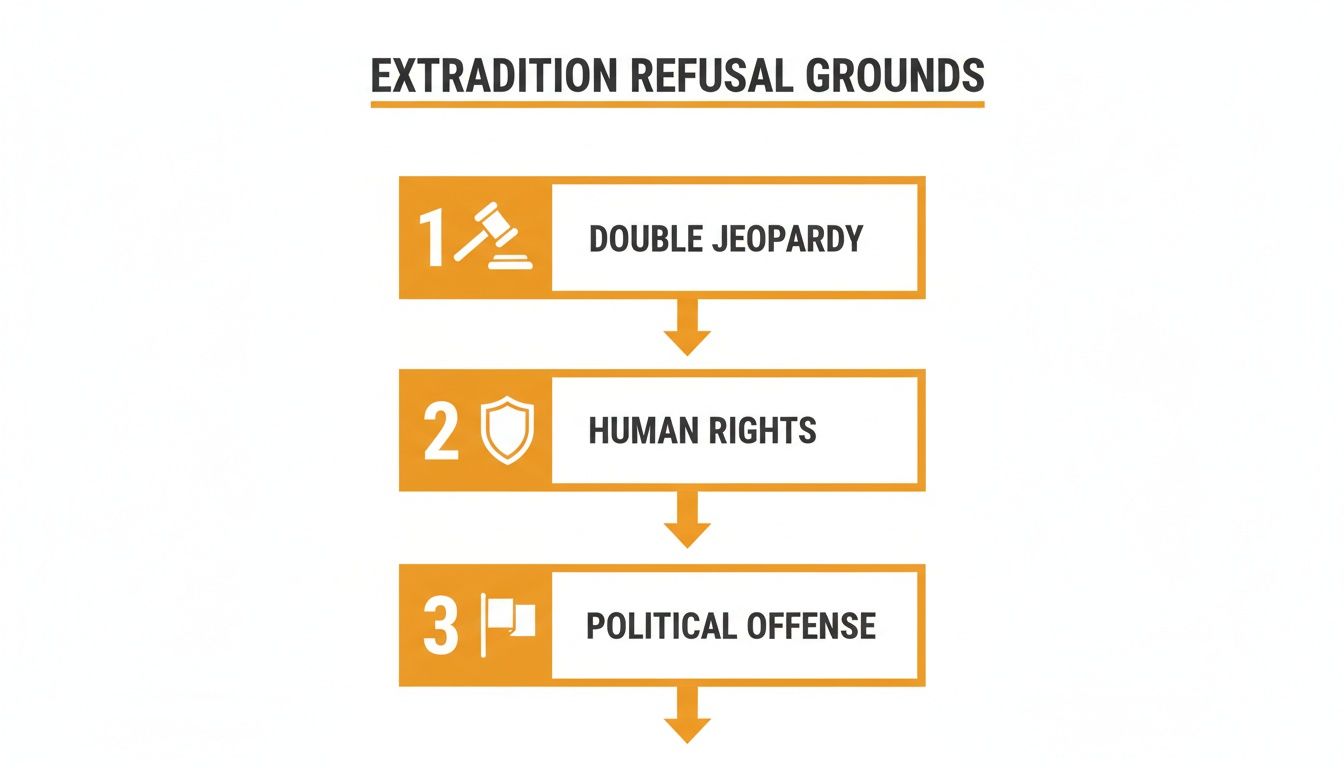
As shown, protections such as the prohibition of double jeopardy and the safeguarding of fundamental human rights are central pillars of the court’s decision-making process.
The Main Court Hearing
In the Netherlands, all extradition and surrender cases are channelled to a single, specialised court: the International Legal Assistance Chamber (Internationale Rechtshulpkamer or IRS) of the District Court of Amsterdam. Centralising these cases ensures they are handled by experienced judges with deep expertise in international criminal law.
During the hearing, the court’s task is not to determine guilt or innocence regarding the underlying crime. Its focus is exclusively on whether the request is legally sound. They examine procedural correctness and look for any grounds for refusal, such as potential human rights violations or issues with dual criminality. This is the stage where the defence presents all its arguments against the transfer.
The Appeals Process
If the District Court approves the extradition or surrender, an appeal is still possible. The case can be brought before the Supreme Court of the Netherlands (Hoge Raad). It is important to note, however, that the Supreme Court’s review is limited. It only examines whether the lower court applied the law correctly; it will not re-evaluate the facts of the case.
In truly exceptional circumstances, after all domestic legal remedies have been exhausted, a complaint can be filed with the European Court of Human Rights (ECHR). This is only possible if there is a strong argument that the extradition itself would violate the European Convention on Human Rights.
Frequently Asked Questions About Extradition Cases
When caught in the complexities of an extradition or surrender request, specific questions invariably arise. Below, we address some of the most common—and often misunderstood—issues to provide practical, clear answers.
I’m a Dutch Citizen. Can I Be Extradited from The Netherlands?
Yes, you can be, and this is often a source of confusion. While many countries have a blanket prohibition on extraditing their own citizens, the Netherlands’ approach is more nuanced and depends on who is making the request.
In the case of a European Arrest Warrant (EAW) from another EU country, the surrender of Dutch nationals is generally standard procedure. The EAW system is built on mutual trust, and nationality is rarely an obstacle.
For extradition requests from non-EU countries, the situation is more complex. The law permits the extradition of a Dutch citizen, but with a critical condition. The Netherlands can insist on a guarantee that if the person is convicted and sentenced to imprisonment, they will be permitted to serve that sentence back in the Netherlands. This policy prevents the Netherlands from becoming a safe haven while ensuring its citizens are not indefinitely held in foreign prison systems.
What Is the Speciality Rule and How Does It Protect Me?
The speciality rule is a cornerstone principle of international extradition law. It acts as a crucial promise made by the requesting country, strictly limiting what they can do after your transfer.
In simple terms, it means the requesting country can only prosecute you for the exact crime for which the Netherlands approved your extradition. They cannot add new charges, substitute a more serious offence, or try you for other past conduct without first obtaining new consent from the Dutch authorities.
This rule is a powerful safeguard against legal abuse. It prevents a country from using a minor, legitimate charge to secure your presence, only to pursue you for unrelated or more severe allegations once you are on their soil. It ensures the entire process remains transparent and fair.
What Happens if Two Countries Request My Extradition at The Same Time?
It is not uncommon for an individual to be sought by multiple jurisdictions simultaneously, leading to competing requests. When this occurs, the Dutch courts do not make the final decision. Instead, the authority rests with the Minister of Justice and Security.
The Minister must perform a careful balancing act, considering several key factors:
- The seriousness of the offences in each request.
- The location where the most serious crime was allegedly committed.
- The dates on which the requests were formally received.
- Your nationality and other personal circumstances.
If one request is an EAW from an EU member and the other is a traditional extradition request from a non-EU country, the EAW is typically given priority due to EU obligations. However, this is not an absolute rule; the Minister will always assess the complete context before making a final determination.
How Is My Personal Data Protected During an EAW Procedure?
In the digital age, data protection is a major concern, particularly in EAW cases that involve the rapid cross-border exchange of sensitive personal information. This data often circulates through large-scale databases like the Schengen Information System (SIS II).
The processing of your data is governed by strict EU laws, most notably the General Data Protection Regulation (GDPR). This grants you fundamental rights, including the right to access the data held about you, to request corrections to inaccurate information, and to have it deleted if it was unlawfully processed.
Importantly, Dutch courts have demonstrated a willingness to refuse surrender if there is a real risk that an individual’s fundamental data protection rights will be violated in the issuing country. This provides an essential check, ensuring that the efficiency of the EAW system does not override the right to privacy.
Navigating the complexities of international criminal law requires expert guidance. At Law & More, our experienced team is equipped to handle the intricacies of extradition and surrender cases, ensuring your rights are protected at every stage. Contact us to discuss your situation.