
Many business deals begin with a casual conversation, a brief email, or a verbal 'yes.' Under Dutch law, these informal moments can often be sufficient to form a legally binding contract. While this may seem convenient, relying on such loose understandings is a significant risk. It exposes your business to ambiguity and potential disputes, making the journey from informal agreements to enforceable rights an essential process to understand.
When Does a Handshake Become a Binding Contract?
In the Netherlands, a formal, signed document is not always required for a contract to be legally valid. The law primarily looks for three core elements: a clear offer, a definite acceptance of that offer, and a genuine intention from both parties to be legally bound by their promises. When these conditions are met, a contract exists, regardless of its format.
This means that an email exchange detailing a service for a specific price, or a verbal agreement made during a meeting, can carry substantial legal weight. However, this is precisely where the danger lies. Informal agreements are often vague, leaving critical details undefined.
The Inherent Risks of Ambiguity
Operating your business based on handshake deals or brief email chains can lead to serious complications. Without a formal document, you leave key questions unanswered:
- What are the exact deadlines? Vague timelines can derail a project without providing any clear recourse.
- What is the precise scope of work? A term like "website redesign" can mean vastly different things to you and your client, paving the way for scope creep and payment disputes.
- What happens if one party fails to deliver? Without defined consequences for a breach, resolving the issue becomes a messy argument over "he said, she said," rather than a straightforward contractual process.
- How are payments structured? Unclear payment terms are one of the most common catalysts for commercial conflicts.
The flowchart below illustrates the recommended progression from a casual understanding to a more secure, formal agreement.
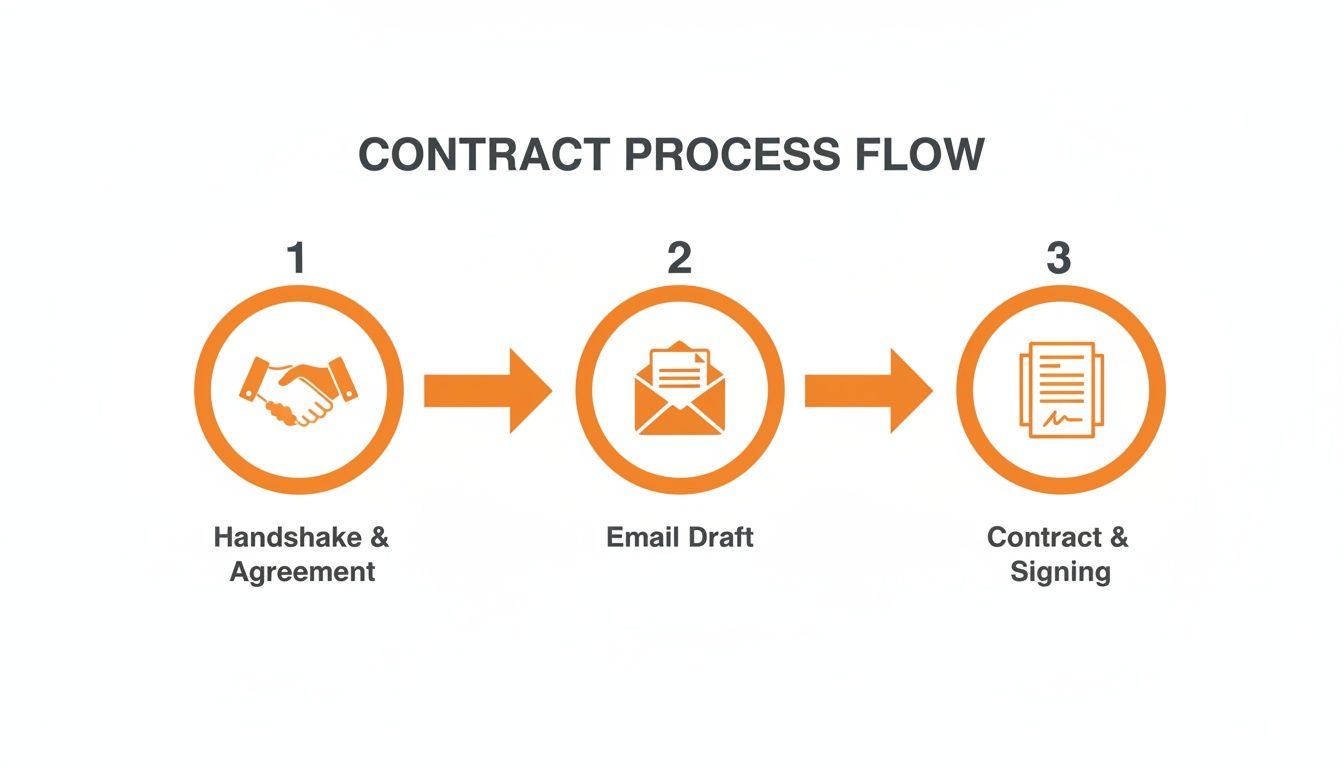
As shown, while a deal may start informally, the path to legal security involves deliberately formalising it to prevent disputes before they arise.
Why Formalisation is a Critical Risk-Management Tool
Transforming a casual understanding into a proper written contract is more than just administrative paperwork; it is a fundamental risk management strategy. A formal contract compels both parties to consider the specific details, discuss potential issues, and agree on a clear path forward.
A well-drafted contract serves as a roadmap for your business relationship. It not only protects you when things go wrong but also helps prevent them from going wrong in the first place by ensuring everyone is aligned from the outset.
Consider a software developer who agrees via email to build an "e-commerce feature" for a client. The client expects a fully integrated payment gateway, inventory management, and a shipping calculator. The developer, however, only budgeted for a simple product display and a basic 'buy now' button. This discrepancy, which would have been easily identified during formal contract drafting, can lead to a complete breakdown of the professional relationship and potential legal action.
Understanding the legal standing of these initial conversations is crucial. Taking the step to clarify and document all terms is the most important action you can take to secure your rights.
Building a Case with Everyday Evidence
When a dispute arises from an informal agreement, the party who can best prove the agreed-upon terms is more likely to prevail. The journey from informal agreements to enforceable rights often depends on your ability to present a clear, credible narrative supported by solid evidence. Fortunately, this proof is often found within your daily business communications.
This process is not about preparing for a dramatic legal battle; it is about methodical organisation. Your primary objective is to construct a timeline that clearly demonstrates a mutual understanding and a genuine intention to be bound by the agreement. This involves gathering and arranging every piece of communication related to the deal.
Uncovering Evidence in Your Digital Footprint
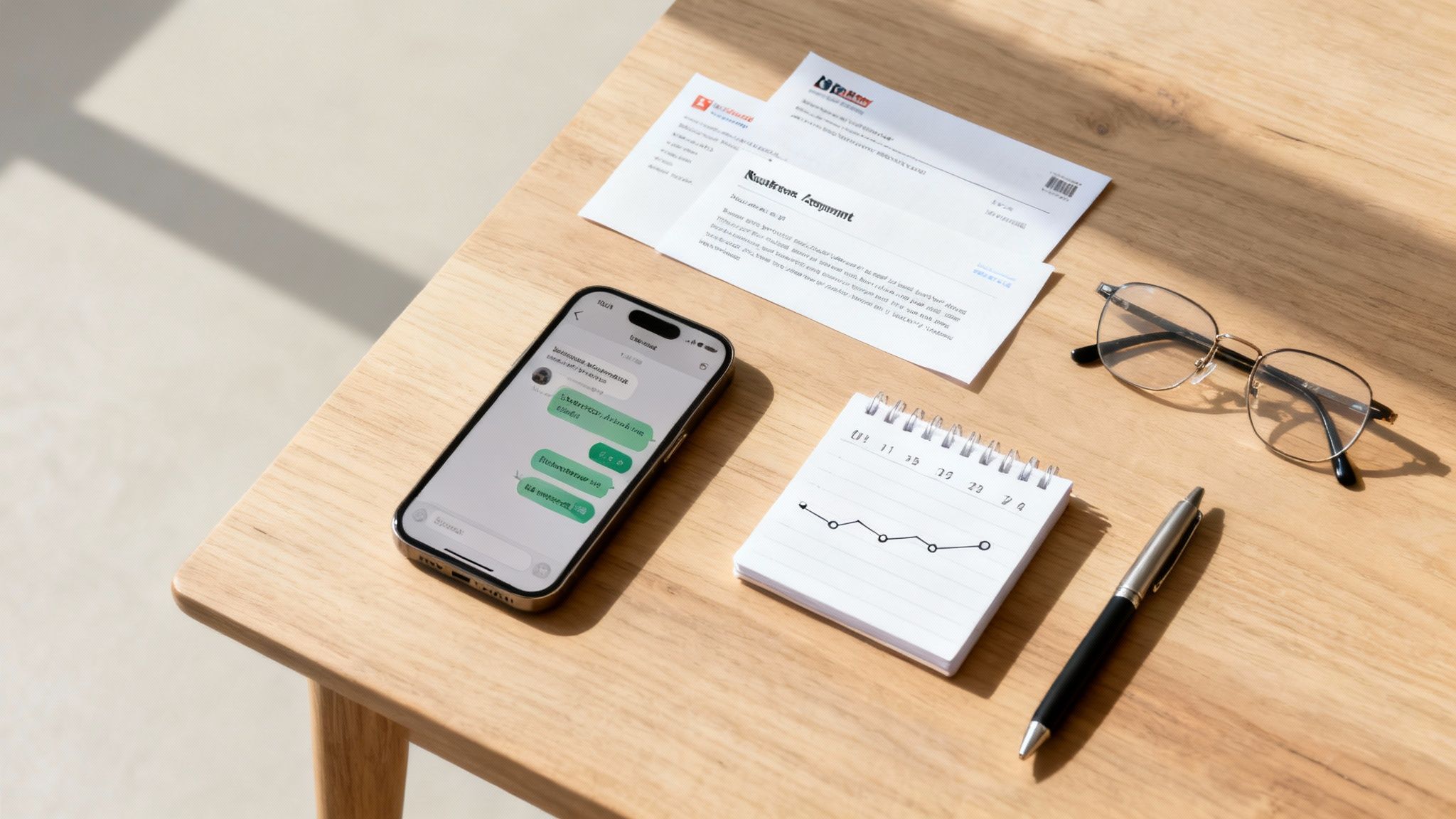
Nearly every business conversation today leaves a digital trail. Under Dutch law, evidence such as emails, text messages, and even conversations in applications like WhatsApp can be powerful. While a single message may not outline the entire agreement, a series of communications, when read together, can establish the core terms.
For example, an initial email might outline the project scope. A follow-up message on WhatsApp could confirm the price, and a final text might set the start date. When these fragments are pieced together, they can form a surprisingly robust picture of a binding contract.
It is essential to collect all communications, no matter how insignificant they may seem at the time. A simple message like, "Okay, that sounds good," could be the acceptance that makes the entire agreement legally binding.
Organising Communications for Clarity
Once you have gathered all relevant messages and documents, the next step is to arrange them in chronological order. This timeline becomes the backbone of your case, illustrating how an initial idea evolved into a concrete, agreed-upon plan.
Create a master document or a dedicated folder and organise every piece of evidence by date and time. This simple action can illuminate the logical progression of your negotiations and pinpoint the critical moments of offer and acceptance.
Your objective is to present a narrative that is easy for a third party—such as a judge or mediator—to follow. A clear, well-organised timeline transforms a confusing jumble of conversations into compelling proof of a concluded deal.
As you review your evidence, pay close attention to the specific language used. Look for phrases that signal commitment, such as "I agree to those terms," "Let's proceed," or "Consider it confirmed." These are the building blocks that will solidify your claim.
To make sense of your collection, it helps to understand how different types of evidence are regarded in a legal context.
Evidence Types for Informal Agreements
Here is a comparison of common evidence types, their general legal weight, and best practices for preservation under Dutch law.
| Evidence Type | Legal Admissibility | Key Preservation Tip |
|---|---|---|
| Emails | High | Preserve entire email chains with headers. Avoid forwarding, which can alter metadata. |
| WhatsApp/SMS Messages | High | Take clear screenshots that include dates, times, and contact information. Export chat histories where possible. |
| Recorded Phone Calls | Conditional | Admissibility depends on consent laws; legal consultation is advised. Preserve the original, unedited audio file. |
| Meeting Notes/Minutes | Moderate to High | Most effective if circulated and acknowledged (even implicitly) by the other party after the meeting. |
| Witness Testimony | High | Corroborate testimony with other forms of evidence. Witness statements should be drafted and signed promptly. |
| Invoices & Payments | High | Demonstrates performance under the agreement. Maintain detailed records of all transactions. |
This table illustrates that while digital messages are strong evidence, combining them with other forms of proof, such as witness accounts or financial records, creates the most robust case.
The Power of Witness Testimony
Do not overlook the human element. If key discussions occurred in meetings or on phone calls with others present, those individuals can serve as crucial witnesses. Their testimony can support your version of events and fill in gaps that written communications may not cover.
- Meeting Notes: Any summaries or notes circulated after a meeting are invaluable, acting as a real-time record of what was discussed and agreed upon.
- Third-Party Corroboration: If you mentioned the deal to a colleague or business partner, their recollection can add significant weight to your position.
- Formal Witness Statements: In more serious disputes, obtaining formal, signed witness statements can be decisive. For more complex evidence-gathering needs, a preliminary witness examination can be a powerful tool.
Ultimately, building a strong case involves becoming a diligent archivist of your own business dealings. By systematically collecting, organising, and understanding the everyday evidence you already possess, you create a powerful foundation to enforce your rights should a disagreement arise.
Drafting a Clear Confirmation of Your Agreement

With a solid file of evidence in hand, you have the raw materials to move from informal agreements to enforceable rights. The next task is to consolidate that collection of emails, messages, and meeting notes into a single, unambiguous document. This confirmation document serves one vital purpose: to eliminate uncertainty and capture the exact terms both parties believe they agreed to.
This is not about adding complex legal jargon. The most effective confirmation documents are often the clearest and simplest. The goal is to create a written record that both you and the other party can review and confirm as an accurate reflection of your agreement.
Laying the Foundation with Essential Clauses
Every solid agreement, regardless of its simplicity, must cover a few fundamental points. These are the structural pillars of your contract. Omitting one creates a weak spot that could easily lead to future disputes.
Your confirmation document must clearly state:
- The Parties Involved: List the full, official legal names and registered addresses for all individuals or companies. Avoid using nicknames or trading names; precision is essential for enforceability.
- The Core Obligations: What, exactly, is each party required to do? Be specific. "Build a website" is too vague. Instead, write something like, "Design, develop, and launch a five-page e-commerce website with payment gateway integration, as detailed in the email dated [Date]."
- Payment Terms: Specify the amount to be paid, the due dates for payments, and the payment methods. Detail everything, including whether VAT (BTW) is included and any specific invoicing procedures.
- Timelines and Deadlines: Clearly state key dates for deliverables, milestones, and final completion. Ambiguous timelines are a common source of conflict in contractual relationships.
These elements form the non-negotiable core of your agreement, transforming a vague understanding into a concrete plan.
Translating Casual Language into Legal Certainty
One of the biggest challenges is converting the casual language from texts and emails into precise, legally sound terms. A message stating, "Sure, I can get that done next month," is a good starting point, but it is not a legally binding deadline. Your task is to translate this informal intent into something concrete.
For instance, "next month" should become "by no later than 5:00 PM CET on [Specific Date]." The term "standard quality" should be defined with specific metrics or by referencing accepted industry standards. The goal is to remove any room for interpretation.
The act of drafting this confirmation forces you to confront and resolve ambiguities. If you find it difficult to define a term, it is a significant red flag that you and the other party were never truly aligned. It is far better to address this now than to dispute it later.
Imagine a freelance consultant who agreed via email to provide "ongoing support." A proper confirmation should define this as "a maximum of five hours of email support per calendar month, with a response time of 24 hours during business days (Monday-Friday, 9:00-17:00 CET)." This level of detail protects both parties and sets clear expectations.
Adding Clauses That Prevent Future Disputes
Beyond the basics, a well-thought-out confirmation anticipates potential problems and addresses them proactively. Including a few key clauses can save an incredible amount of time, money, and stress if the relationship deteriorates.
Consider adding clauses that cover:
- Dispute Resolution: How will disagreements be handled? Specify a process, such as requiring mediation before either party can initiate legal proceedings. This is often a much faster and more cost-effective route than litigation.
- Termination: Under what conditions can either party end the agreement? Outline the required notice period and any consequences of early termination, such as a termination fee.
- Confidentiality: If sensitive information is being shared, a confidentiality clause (or a separate Non-Disclosure Agreement) is essential to protect your business interests.
These proactive measures demonstrate foresight and can de-escalate potential conflicts before they begin.
The Final Step of Formalisation
Once you have drafted the document, send it to the other party for review and signature. This is the moment of truth. Their willingness to sign a document that accurately reflects your shared conversations is the ultimate confirmation of your deal.
If they contest a key term that is clearly documented in your evidence, take it as a serious warning. However, if they sign, you have successfully transformed a precarious informal deal into a solid, written contract. You have closed the door on ambiguity and established a clear, enforceable set of rights for all involved parties.
Meeting Mandatory Dutch Legal Formalities
Simply documenting your agreement in writing and signing it is a significant step forward, but it is not always the final one. Under Dutch law, certain agreements are only considered valid if they meet specific, mandatory formal requirements. Failure to comply can render your entire contract void, returning you to your starting point. This is a critical part of the transition from informal agreements to enforceable rights.
While most day-to-day business deals, such as service contracts or simple sales agreements, are perfectly valid with a straightforward written document, larger, high-stakes transactions often require a more formal approach. In these cases, Dutch law intervenes to ensure clarity, prevent fraud, and protect all involved parties.
When a Notarial Deed Is Non-Negotiable
For some agreements, engaging a civil-law notary (notaris) is mandatory. A notarial deed is an official document drawn up and executed before a notary, who is responsible for verifying the identities of the signatories and ensuring they fully understand the legal implications of the agreement. It represents the highest standard of legal certainty.
A notarial deed is required for the following situations:
- Real Estate Transactions: The transfer of ownership of property, such as a house or commercial building, must be recorded in a notarial deed, which is then registered with the Land Registry (Kadaster).
- Establishing a Private Limited Company (BV): The articles of association for a new BV must be laid down in a notarial deed.
- Last Wills and Testaments: For a will to be legally valid in the Netherlands, it must be formalised by a notary.
- Prenuptial Agreements: Agreements made before or during a marriage that alter the standard community of property rules must be notarised.
Attempting to handle these matters with a simple written contract will result in a legally unenforceable agreement.
The Role of Public Registers and Signatures
Beyond the notary's office, some agreements must also be filed in public registers to be effective against third parties. This is common for actions such as pledging assets as security for a loan. Registration creates a public record that helps prevent disputes over who has a prior claim.
The method of signing also matters. A traditional "wet ink" signature remains the norm, but electronic signatures are increasingly common. However, not all digital signatures carry the same legal weight. You can explore the legal value of different digital signatures in our detailed guide to ensure that any contract you sign electronically will be upheld in court.
A Historical Perspective on Formalisation
The need for official formalities has deep historical roots. In 1890, as Dutch industry expanded, workers often had only verbal agreements with employers, leading to unsafe working conditions. The creation of the Netherlands Labour Authority marked a pivotal shift from risky handshake deals to solid, enforceable rights.
Over the 135-year journey from 1890 to 2025, this authority has overseen significant improvements in working conditions, driven by laws that formalised rights to health, safety, and fair working hours. This serves as a powerful example of how state enforcement can transform vague promises into concrete protections.
The modern iteration of this authority, the Inspectorate SZW, continues to enforce these crucial labour laws today.
The very existence of this agency is a direct result of the historical push to formalise and enforce agreements that protect workers.
Choosing the Governing Law for International Deals
For international businesses, a choice of law clause is a crucial formality. This section of your contract specifies which country's laws will be used to interpret the agreement and resolve any disputes.
If your contract involves parties from different countries but the primary activities occur in the Netherlands, adding a simple yet powerful sentence is a game-changer: "This agreement shall be governed by and construed in accordance with the laws of the Netherlands." This removes ambiguity and provides a predictable legal framework if a dispute arises.
Neglecting to specify a governing law can lead to a costly and complex legal battle simply to determine which court has jurisdiction. By addressing these mandatory formalities, you complete the process of transforming your initial agreement into a robust, legally sound, and fully enforceable contract under Dutch law.
Enforcing Your Rights When an Agreement is Breached
A formal, signed contract is more than just a document—it is your toolkit for when things do not go as planned. Its true power is revealed when one party fails to uphold their side of the bargain. While having a clear contract is the first step, knowing how to enforce it is what truly matters. This is where you turn your contractual rights into real-world outcomes.
Under Dutch law, you cannot immediately resort to court action. The process begins with a mandatory, formal step designed to give the other party a fair opportunity to remedy the situation. This initial move dictates all subsequent actions.
The Crucial First Step: The Notice of Default
Before you can claim damages or dissolve an agreement, you must formally declare the other party to be in default. This is done by sending a written notice known as an ingebrekestelling. This is not a friendly reminder, but a non-negotiable legal requirement.
To be valid, this notice of default must meet several criteria:
- It Must Be in Writing: A formal letter or email is required. A phone call or verbal warning is insufficient.
- State the Failure Clearly: You must be specific. Do not simply state they are late; explain exactly what they failed to do. For example, "You have failed to deliver the agreed-upon software module by the deadline of [Date]."
- Set a Reasonable Final Deadline: You must provide them with one last chance to fulfill their obligation within a reasonable timeframe. The definition of "reasonable" depends on the context; it could be a few days for a missed payment or a couple of weeks for a more complex task.
Only when this new deadline passes without resolution is the other party officially in legal default (verzuim). At this point, a new set of enforcement options becomes available to you.
Your Options After a Default
Once the other party is legally in default, you are in a stronger position. The path you choose will depend on your desired outcome, your ongoing business relationship, and the terms of your contract.
- Demand Specific Performance: You can request a court order compelling the other party to do exactly what they promised. This is the preferred remedy when the product or service is unique and monetary compensation would not be an adequate substitute.
- Claim Compensation: If the breach has resulted in financial loss, you can sue for damages. This can cover anything from lost profits to the costs of hiring a replacement to complete the job.
- Suspend Your Own Obligations: The law generally permits you to pause your side of the agreement. For instance, you can rightfully withhold a milestone payment until a key deliverable is completed as agreed.
- Terminate the Agreement: For a serious breach, you may have the right to dissolve (ontbinden) the contract entirely. This effectively ends the agreement, and both parties must, as much as possible, reverse what has already been done.
A key takeaway from my experience is that enforcement is not always a dramatic courtroom battle. Often, a professionally drafted notice of default is sufficient. It sends a clear signal that you are serious and can be incredibly effective at bringing a reluctant party back to the negotiating table.
Practical Alternatives: Negotiation and Mediation
Before initiating legal action, it is always wise to consider structured negotiation or mediation. These alternative dispute resolution (ADR) methods are almost always faster, cheaper, and less confrontational than litigation. A neutral third-party mediator can help facilitate communication and guide both sides toward a mutually acceptable solution, potentially preserving the business relationship.
This structured approach reflects a broader societal shift toward formalised, enforceable rights that create stable economic relationships. For example, in the Dutch labour market of the 1970s, women's employment was often informal and precarious. Policy reforms introduced enforceable rights through collective agreements, which helped increase female earnings by an estimated 92% between 1977 and 2021 by guaranteeing protections such as equal pay. You can read more about these labour market and income inequality findings in the Netherlands.
When Legal Action is Unavoidable
If dialogue fails and all other avenues are exhausted, court action may be your only remaining option. When an agreement has completely broken down, understanding specific enforcement tools, such as a trustee's sale and foreclosure auctions, can become vital. This final step involves filing a claim with the appropriate Dutch court, where the evidence you have gathered and the solid contract you created will form the foundation of your case.
Frequently Asked Questions About Formalising Agreements
Turning an informal conversation or email into a legally sound agreement often raises practical questions. For SMEs and international professionals operating in the Netherlands, understanding the specific rules can be the difference between a secure deal and a costly dispute. Here are straightforward answers to the questions we encounter most frequently.
Is a WhatsApp Message a Legally Binding Contract in the Netherlands?
Yes, it can be. Under Dutch law, a WhatsApp message or a series of messages can form a legally binding contract. The legal system is flexible regarding the form of a contract; what matters is the substance. Was there a clear offer? Was there a definite acceptance? And, crucially, did both parties intend to be legally bound by their exchange?
For example, if a freelance designer sends a proposal via email and the client replies on WhatsApp stating, "Perfect, let's go ahead with that price and timeline," a valid contract has likely been formed. The challenge, as is often the case, lies in proving the terms. Piecing together a coherent agreement from conversations scattered across multiple platforms can be complex. This is precisely why a single, formal confirmation document is always the recommended approach—it eliminates ambiguity.
How Long Do I Have to Formalise a Verbal Agreement?
There is no statutory deadline for putting a verbal agreement in writing. However, the best time to do so is immediately. The more time that passes, the greater the risk that memories will fade, details will become unclear, and the original intent of the agreement will be lost.
Delay is the enemy of clarity. Acting quickly to document your verbal understanding is not just good practice; it is a defensive strategy that locks in the terms while they are fresh in everyone's mind and prevents minor misunderstandings from escalating into major disputes.
If you wait months, the other party may genuinely forget a key point or attempt to reinterpret the agreement to their advantage. Formalise it promptly.
What Happens if the Other Party Refuses to Sign the Confirmation Document?
This is a significant red flag and a moment for extreme caution. If you have sent a written document that you believe is a fair and accurate summary of your prior verbal or email agreement, and the other party refuses to sign, you must determine the reason.
Several scenarios could be at play:
- A genuine misunderstanding: They may feel the document does not accurately capture the agreed-upon terms. This provides an opportunity to discuss and clarify the specific points of disagreement.
- A change of mind: They may be reconsidering the deal. Their refusal to sign is a clear signal, even if the original informal agreement is technically still binding.
- Intentional avoidance: They might be trying to keep the terms deliberately vague to create flexibility or exploit loopholes later.
Legally, their refusal to sign does not automatically invalidate the original informal agreement. In a dispute, their refusal to sign a fair confirmation could even be used as evidence of bad faith. If you find yourself in this situation, it is strongly recommended that you seek legal advice to understand your position and how best to enforce your rights.
Do I Need a Lawyer to Draft a Simple Contract?
While you are not legally required to have a lawyer draft every simple contract, it is one of the most prudent investments a business can make. Online templates may seem like a convenient starting point, but they are generic by nature. They cannot account for the specific risks and nuances of your situation, industry, or particular deal.
A skilled lawyer does more than fill in blanks on a template. They will:
- Identify potential risks that you may not have considered.
- Ensure compliance with specific Dutch legal requirements.
- Draft precise language that protects your interests and closes loopholes.
- Advise on practical clauses covering areas such as dispute resolution and termination rights.
For a broader perspective on managing documents once they are drafted, you can explore various legal document processing use cases. However, for the strategic thinking and drafting that truly protects your business, the expertise of a legal professional is indispensable. A small investment in legal review upfront can prevent catastrophic costs and complications later.
At Law & More, our team specialises in transforming ambiguous understandings into ironclad contracts. If you require assistance in formalising an agreement or navigating a dispute, we provide clear, practical guidance tailored to your needs. Contact us today to ensure your rights are protected. https://lawandmore.eu