


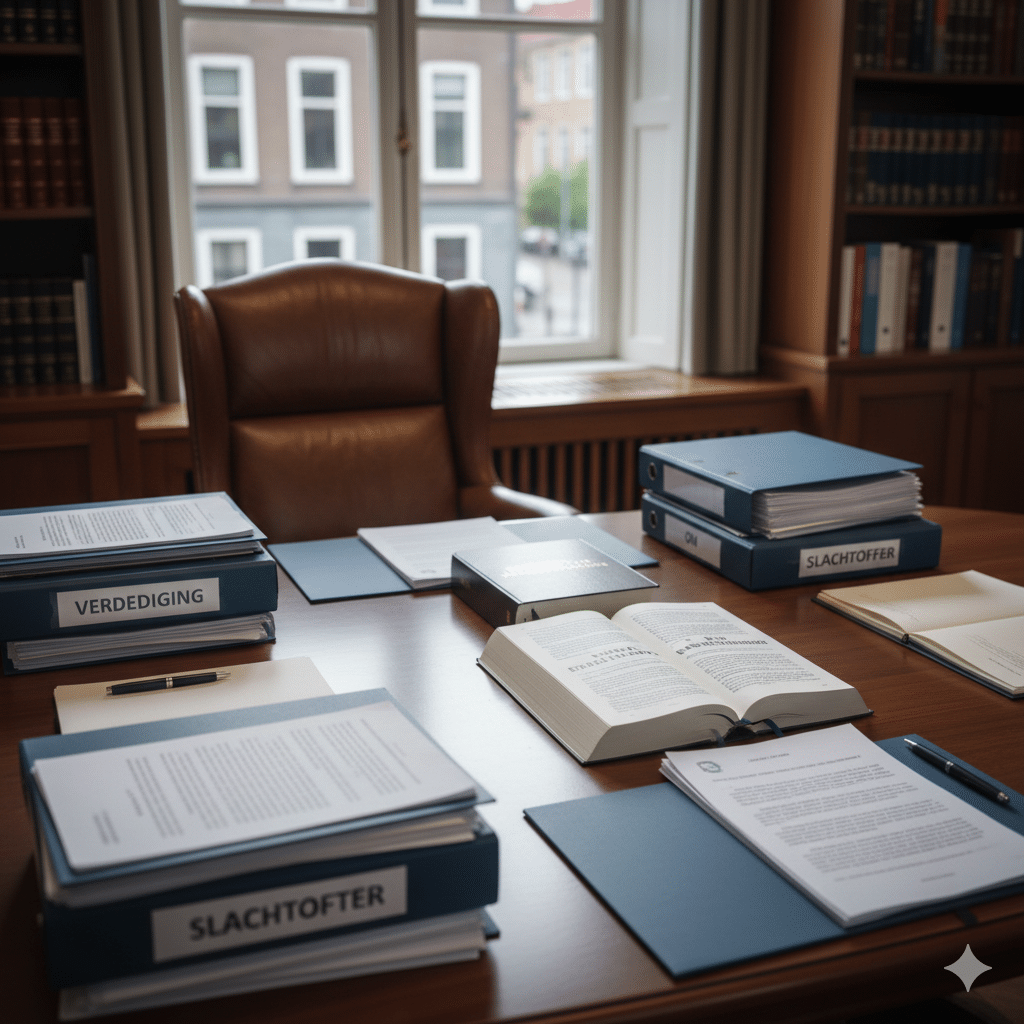
The outcome of a criminal trial is rarely decided solely in the courtroom. Often, the verdict is shaped months earlier, in the silence of an interrogation room, the technical analysis of a forensic lab, or the meticulous drafting of investigative requests by a defense lawyer. At the heart of this process lies a specific legal framework: the “onderzoeksvragen” (investigative questions).
These questions form the engine of the Dutch criminal justice system. They dictate not only what the judge must decide but also the order in which they must decide it. Understanding this framework is crucial not just for legal professionals, but for anyone navigating a criminal charge. Whether you are a defendant seeking acquittal, a prosecutor building a case, or a victim seeking justice, the answers to these questions determine the future.
This guide provides a comprehensive analysis of the investigative questions under Articles 348 and 350 of the Code of Criminal Procedure (Wetboek van Strafvordering or Sv), and explains how the defense, the Public Prosecution Service (Openbaar Ministerie or OM), and the victim can influence the answers through strategic investigative requests (onderzoekswensen).
The Legal Framework: Structure as a Safeguard
In Dutch criminal law, a judge cannot simply jump to a conclusion. They must follow a strict, sequential path defined by law. This structure serves as a fundamental safeguard for a fair trial, ensuring that no procedural step is skipped and no substantive issue is overlooked.
The court must answer two distinct sets of questions: the preliminary questions (formal validity) and the substantive questions (content of the case).
1. Preliminary Questions (Article 348 Sv)
Before looking at the evidence, the court must establish that the proceedings are technically valid. If the answer to any of these questions is negative, the substantive case stops there.
- Is the summons valid? Does it clearly state the charge and the time/place of the alleged offense?
- Is the court competent? Does this specific court have jurisdiction over this type of offense?
- Is the Public Prosecutor admissible? Has the statute of limitations expired? Was the decision to prosecute made in violation of principles of due process?
- Are there grounds for suspension? Is the defendant mentally fit to stand trial?
2. Substantive Questions (Article 350 Sv)
Only if all formal hurdles are cleared does the judge proceed to the core of the case—the four key questions regarding guilt and punishment:
- Is the offense proven? Can the facts be established based on legal evidence (Articles 338 and 339 Sv)?
- Is the fact punishable? Does the proven conduct actually constitute a criminal offense under the law?
- Is the defendant punishable? Are there grounds for excuse (e.g., psychological force majeure) or justification (e.g., self-defense)?
- What sanction should follow? What sentence or measure is appropriate given the severity of the act and the person of the defendant?
Recent case law, such as ECLI:NL:HR:2025:1711, confirms that the Supreme Court (Hoge Raad) strictly enforces this framework. The court must motivate its decisions on these questions transparently. If a judge fails to address a properly submitted defense argument regarding these questions, the verdict risks being overturned.
The Role of the Defense: Steering the Investigation
A common misconception is that the defense lawyer sits back and waits for the trial to challenge the prosecutor’s story. In reality, effective defense work is proactive. The defense has the right—and often the duty—to submit investigative requests (onderzoekswensen) to influence the answers to the investigative questions.
The Right to Request Investigation
Under the Code of Criminal Procedure, the defense is not dependent solely on the police file. Defense attorneys have statutory rights to request specific investigative acts:
- Article 183 Sv: Requesting the Examining Magistrate (Rechter-Commissaris) to conduct investigations.
- Articles 150a & 150b Sv: Requesting expert examinations or counter-examinations.
- Article 263 Sv: Summoning witnesses and experts to the hearing.
Types of Strategic Requests
Investigative requests are most effective when they target specific weak points in the prosecutor’s “onderzoeksvragen.”
- Expert Investigations: In complex fraud or cybercrime cases, the defense may request a specialized forensic accountant or IT expert to interpret data differently than the police.
- Traffic Reconstruction: In serious traffic accidents, causality is often the battleground. If the OM claims a driver was speeding, the defense might request a technical reconstruction to prove that road conditions, not speed, caused the collision.
- Alternative Scenarios: The defense may request witnesses to substantiate an alibi or an alternative chain of events. For instance, in ECLI:NL:RBAMS:2019:997, the introduction of evidence supporting an alternative scenario led to an acquittal because the court could no longer be convinced of the primary charge.
Timing and Formalities
Timing is critical. Requests should ideally be made during the preliminary investigation. While Article 414 Sv allows for new requests during appeal proceedings, the earlier an investigation is steered, the better. A request must be “properly motivated,” meaning the defense must explain why the witness or expert is relevant to one of the Article 350 Sv questions.
The Role of the Public Prosecutor: The Gatekeeper
The Public Prosecution Service holds the “primacy” of the investigation. They direct the police and decide which leads to pursue.
Authority and Obligations
Under Article 181 Sv, the OM has the authority to order investigations via the Examining Magistrate. They also have the power to refuse defense requests, but this refusal is not absolute. It must be motivated.
Handling Conflicting Requests
When the defense submits a request—for example, to interview a reluctant witness—the Prosecutor may refuse if they believe it is irrelevant or meant solely to delay proceedings. However, this gatekeeping role is subject to judicial review. If the Prosecutor refuses, the defense can appeal to the Examining Magistrate (Article 183 Sv) or renew the request before the trial court.
The relationship is adversarial but balanced. While the OM builds the case for conviction, they are also magistrates required to seek the truth, which includes investigating exculpatory evidence.
The Role of the Victim: A Voice, Not a Party
Historically, victims were observers in Dutch criminal law. Today, their role has expanded significantly, though they remain “participants” rather than full parties like the defense and OM.
Influencing the File
Victims have specific rights to ensure the truth is told. Under Article 51b Sv, a victim can request the Public Prosecutor to add relevant documents to the case file. If the OM refuses, the victim can appeal directly to the Examining Magistrate under Article 177b Sv.
The Examining Magistrate as Arbiter
If a victim wants specific research done—for example, a medical expert to prove the long-term impact of an assault—and the prosecutor declines, the Examining Magistrate acts as the neutral arbiter. They apply a balance test (see ECLI:NL:HR:2024:1387): they weigh the relevance of the victim’s request against the interests of the investigation and the privacy of the defendant.
Indirect Influence via the Victim Statement
While the “spreekrecht” (right to speak) is primarily for victim impact statements, it can indirectly trigger further investigation. If a victim reveals new facts during their statement that contradict the police file, the court or OM may be compelled to investigate these discrepancies to answer the question: “Is the offense proven?”
Conclusion
The “onderzoeksvragen” are not merely a checklist for judges; they are the battlefield where criminal cases are won or lost. For the defense, they represent opportunities to inject doubt or alternative facts into the narrative. For the Public Prosecutor, they are the burden of proof that must be met meticulously. For the victim, they offer specific, albeit limited, avenues to ensure their reality becomes part of the judicial truth.
Navigating this procedural landscape requires expertise. Whether you are formulating an investigative request or challenging a refusal, the difference between a conviction and an acquittal often lies in asking the right questions at the right time.
Frequently Asked Questions
1. What are the five substantive investigative questions the judge must answer in every criminal case?
Based on Article 350 Sv, the judge must answer the following questions in strict order:
- Is it proven that the defendant committed the act as charged?
- Does the proven act constitute a criminal offense (punishability of the fact)?
- Is the defendant criminally liable for the act (punishability of the offender)?
- What sentence or measure should be imposed?
Note: Before these, the judge answers the formal questions of Article 348 Sv (validity of summons, competence of court, admissibility of OM, suspension grounds).
2. Which investigative requests (onderzoekswensen) can the defense submit and when?
The defense can request the hearing of witnesses, the appointment of experts, or the addition of documents to the file. These requests can be made:
- During the preliminary investigation to the Examining Magistrate (Article 183 Sv).
- Prior to the court hearing by notifying the Public Prosecutor (Article 263 Sv).
- During the court hearing itself (Article 328 Sv).
- During appeal proceedings (Article 414 Sv).
Requests must be submitted within the legal timeframes (usually 10 days before the hearing for witnesses) and must be properly motivated.
3. Can the defense force an expert investigation, or can the OM refuse?
The defense cannot strictly “force” an investigation, but they have strong rights. The OM can refuse a request if they deem it irrelevant, unnecessary, or harmful to the investigation (Article 264 Sv). However, the defense can challenge this refusal before the court or request the Examining Magistrate to appoint an expert (Article 150a/150b Sv). If the judge deems the expert necessary for the defense’s right to a fair trial, the request must be granted.
4. How can a victim add evidence to the criminal file if the OM refuses?
If the Public Prosecutor refuses to add documents relevant to the victim, the victim can use Article 51b Sv. If the refusal persists, the victim can file a written complaint/request to the Examining Magistrate under Article 177b Sv. The Examining Magistrate will then decide whether the documents should be added.
5. What role does the victim’s right to speak (spreekrecht) play in investigative requests?
The right to speak (Article 51e Sv) is primarily meant for the victim to express the impact of the crime. However, if the victim reveals new facts or contradictions during their statement, this can prompt the court or OM to order further investigation ex officio to clarify the truth. It serves as an indirect method of influencing the scope of the investigation.
6. In what cases do defense investigative requests lead to acquittal or sentence reduction?
Requests often lead to acquittal when they successfully challenge the reliability of key evidence (e.g., questioning a breathalyzer’s calibration) or substantiate an alternative scenario (e.g., witness testimony confirming an alibi). Sentence reduction often occurs when reports (like a psychological evaluation requested by the defense) prove diminished responsibility or personal circumstances that mitigate guilt (see ECLI:NL:RBROT:2025:14743).
7. How does the Examining Magistrate test a victim’s request for additional investigation?
The Examining Magistrate applies a balance test. They assess whether the requested investigation is relevant to the case and whether it serves the truth-finding process. This is weighed against opposing interests, such as the privacy of the defendant, the efficiency of the investigation, or state security (see ECLI:NL:HR:2024:1387).
8. What are successful investigative requests in traffic accidents involving injury or death?
Successful requests often focus on causality. Examples include: requesting a traffic accident analysis (VOA) reconstruction to verify speeds; requesting medical experts to determine if the injury was caused by the collision or a pre-existing condition; or requesting data on traffic light cycles to dispute a “running a red light” allegation (ECLI:NL:RBROT:2019:7166).
9. Can the Public Prosecutor formulate investigative requests, and how does this relate to the defense?
Yes, the OM leads the investigation and can independently order investigative acts (Article 181 Sv) or summon experts (Article 260 Sv). The OM essentially builds the initial file. The defense’s requests usually function as a check or balance against the OM’s selection of evidence, ensuring that exculpatory evidence is not overlooked.
10. What happens if the investigative wishes of the OM and the defense conflict?
If the OM wants to proceed to trial but the defense demands further investigation (e.g., interviewing a witness abroad), a conflict arises. The OM may initially refuse the request. Ultimately, the trial judge (or the Examining Magistrate during the preliminary phase) decides. The judge must ensure the defendant has a fair trial. If the judge believes the defense’s request is essential for answering the investigative questions of Article 350 Sv, the judge will overrule the OM and order the investigation.