



Adoption reshapes families and gives children permanent homes with the full backing of the law. More than 2,000 children are adopted in England every year but what truly matters goes far beyond the paperwork. While most imagine adoption as mainly a legal formality the true impact lies in how these new family bonds become every bit as significant as birth relationships. This legal switch does not just grant a new surname it offers children a future filled with real belonging and life-changing stability.
Table of Contents
- What Is Adoption And Its Relevance In Family Law?
- The Significance Of The Family Law Adoption Process
- Key Concepts And Terminology In Adoption Law
- How The Adoption Process Works In Theory
- Real-World Context And Implications Of Family Law Adoption
Quick Summary
| Takeaway | Explanation |
|---|---|
| Adoption permanently transfers parental rights | Adoption results in a complete legal transfer of parental rights from biological to adoptive parents, ensuring stability for the child. |
| Rigorous evaluations protect children’s welfare | The adoption process includes thorough background checks and assessments to verify the suitability of prospective adoptive parents. |
| Adoption creates equal legal relationships | Adopted children gain the same legal status and rights as biological children, including inheritance and legal recognition. |
| Emotional support is essential in adoption | Professional services are necessary to help families navigate the emotional complexities associated with adoption and foster integration. |
| Awareness of cultural and social dynamics is crucial | Understanding societal perceptions and cultural sensitivities greatly impacts the adoption process, especially in cross-cultural adoptions. |
What is Adoption and Its Relevance in Family Law?
Adoption represents a profound legal mechanism through which families are formed, children find permanent homes, and complex familial relationships are legally established. Within the realm of family law, adoption transcends mere procedural requirements, embodying a transformative process that legally transfers parental rights and responsibilities from biological parents to adoptive parents.
Understanding Adoption as a Legal Construct
At its core, adoption is a legally binding procedure where an individual or couple assumes full parental rights and responsibilities for a child who is not their biological offspring. This process fundamentally alters the child’s legal status, creating a permanent familial relationship that carries the same legal weight as a biological parent child relationship.
Key characteristics of legal adoption include:
- Complete transfer of parental rights and obligations
- Permanent legal recognition of the new familial relationship
- Termination of biological parents’ legal rights
- Creation of inheritance and succession rights for the adopted child
The Social and Legal Significance of Adoption
Beyond its legal framework, adoption represents a critical social mechanism for child welfare. It provides children without stable family environments an opportunity to experience nurturing, permanent family relationships. Family law plays a crucial role in establishing rigorous standards to ensure these adoptions prioritise the child’s best interests.
The adoption process involves comprehensive assessments designed to evaluate prospective parents’ capability to provide emotional, financial, and developmental support. These evaluations include background checks, home studies, psychological assessments, and detailed interviews to determine the suitability of potential adoptive parents.
Whether through domestic or international channels, adoption remains a complex yet profoundly meaningful pathway for creating families. Family law provides the essential legal scaffolding that transforms the emotional journey of adoption into a secure, recognised familial relationship with robust legal protections for all parties involved.
The Significance of the Family Law Adoption Process
The family law adoption process represents a comprehensive legal framework designed to protect the rights, welfare, and long-term interests of children seeking permanent familial placements. This intricate process goes far beyond simple administrative procedures, serving as a critical mechanism for ensuring child protection, establishing legal familial relationships, and safeguarding the fundamental rights of all parties involved.
Legal Safeguards and Protective Mechanisms
Family law adoption processes are meticulously structured to create robust protective barriers that shield vulnerable children from potential exploitation or inappropriate placements. These legal mechanisms incorporate multiple layers of evaluation and verification to guarantee that adoption serves the child’s best interests.
Critical protective elements include:
- Comprehensive background investigations of prospective adoptive parents
- Psychological assessments to evaluate parental capabilities
- Mandatory home study evaluations
- Verification of financial stability and emotional readiness
Emotional and Developmental Considerations
Beyond legal technicalities, the adoption process recognises the profound emotional dimensions of creating new family structures. Professional interventions are designed to support not just legal transitions but also psychological and emotional adjustments for children and adoptive parents.
The process acknowledges the complex emotional landscape of adoption, understanding that successful integration requires more than legal documentation. Counselling services, support groups, and ongoing assessments help families navigate the intricate emotional terrain of building new familial bonds.
By establishing rigorous standards and comprehensive evaluation protocols, the family law adoption process transforms what could be a potentially traumatic experience into a structured, supportive pathway towards creating permanent, loving family units.
This table summarises the critical protective and evaluative features built into the family law adoption process, highlighting how each aspect supports child welfare and legal integrity.
| Feature | Purpose |
|---|---|
| Background investigations | To confirm adoptive parents have no disqualifying criminal or child protection history |
| Psychological assessments | To determine prospective parents’ emotional readiness and parental capability |
| Mandatory home study evaluations | To assess the suitability and safety of the home environment |
| Financial stability verification | To ensure prospective parents can adequately provide for the child |
| Ongoing counselling and support | To help families address emotional adjustment and integration post-adoption |
| Court oversight and finalisation | To legally validate and formalise the adoption, ensuring due process |
 It represents a sophisticated legal instrument that balances children’s welfare, prospective parents’ aspirations, and societal responsibilities towards vulnerable individuals seeking stable, nurturing environments.
Key Concepts and Terminology in Adoption Law
Adoption law encompasses a sophisticated legal landscape with specialised terminology that precisely defines the intricate relationships, rights, and responsibilities within the adoption process. Understanding these key concepts is fundamental to comprehending the legal framework that governs familial transformations through adoption.
Fundamental Legal Definitions
Within adoption law, specific terms carry profound legal significance. Adoption represents a comprehensive legal procedure that permanently transfers parental rights and responsibilities from biological parents to adoptive parents, creating a legally recognised familial relationship equivalent to biological parenthood.
Critical legal terminology includes:
- Adoptability: The legal determination that a child is eligible for adoption
- Termination of Parental Rights: Legal process ending biological parents’ legal relationship with the child
- Home Study: Comprehensive assessment evaluating prospective adoptive parents’ suitability
- Consent: Legal permission required from biological parents or relevant authorities
Jurisdictional and Procedural Concepts
Adoption law operates within complex jurisdictional frameworks that vary between domestic and international contexts. Intercountry adoption introduces additional legal complexities, requiring compliance with multiple national and international legal standards. These procedures ensure that adoptions are conducted ethically, prioritising the child’s welfare and protecting against potential exploitation.
The legal terminology surrounding adoption reflects the nuanced nature of creating permanent familial bonds. Legal guardianship, permanent placement, and child welfare considerations represent intricate legal concepts that transform emotional connections into legally recognised relationships. These terms encapsulate the profound responsibility of creating stable, nurturing environments for children who require permanent family placements.
The following table presents key legal terms and concepts in adoption law to help readers quickly reference their definitions and core significance.
| Term | Definition |
|---|---|
| Adoption | Legal process permanently transferring parental rights and obligations to adoptive parents |
| Adoptability | Status confirming a child meets legal requirements for adoption |
| Termination of Parental Rights | Legal end of the birth parents’ relationship and rights to the child |
| Home Study | In-depth assessment of prospective adoptive parents’ suitability and home environment |
| Consent | Legal approval required from birth parents or authorities before adoption can proceed |
| Legal Guardianship | Court-granted legal responsibility for a child, distinct from full adoption |
| Permanent Placement | Arrangement providing a child with a stable, long-term family environment |
By establishing precise legal language, adoption law creates a structured approach that balances emotional connections with rigorous legal protections, ensuring that the process of creating families remains transparent, ethical, and centred on the child’s fundamental rights and well-being.
How the Adoption Process Works in Theory
The theoretical framework of the adoption process represents a complex interconnected system designed to ensure child welfare, legal protection, and ethical considerations. This intricate mechanism transforms the abstract concept of family formation into a structured, carefully evaluated legal pathway that prioritises the child’s best interests.
Theoretical Foundations of Adoption Eligibility
At the core of the adoption process lies a comprehensive evaluation system that determines the potential for successful family integration. Adoptability is not merely a legal status but a holistic assessment that examines multiple dimensions of a child’s potential placement and a prospective family’s capacity to provide nurturing support.
Key theoretical criteria for adoption eligibility include:
- Comprehensive assessment of the child’s developmental needs
- Evaluation of prospective parents’ emotional and financial readiness
- Psychological compatibility between the child and potential adoptive family
- Consideration of cultural and familial integration potential
Systemic Considerations in Adoption Placement
The theoretical model of adoption placement operates as a sophisticated ecosystem that balances legal, psychological, and social considerations. Matching processes go beyond simple administrative procedures, representing a nuanced approach to creating sustainable familial relationships.
This theoretical framework recognises that successful adoption transcends legal documentation. It involves a delicate interplay of emotional, psychological, and social factors that determine the potential for long-term family stability. Professional interventions are designed to create comprehensive support systems that facilitate smooth transitions and address potential challenges in family integration.
By conceptualising adoption as a dynamic, multifaceted process, the theoretical approach ensures that legal mechanisms serve broader humanitarian objectives. The ultimate goal extends beyond formal placement, focusing on creating supportive environments where children can thrive, develop meaningful familial connections, and experience the fundamental human need for belonging and stability.
Real-World Context and Implications of Family Law Adoption
Family law adoption represents a profound intersection between legal frameworks and human experiences, transforming abstract legal principles into tangible life outcomes. The real-world implications extend far beyond courtroom proceedings, directly impacting the lives of children, biological parents, and adoptive families across diverse social contexts.
Societal and Psychological Dynamics
Adoption processes reflect complex societal dynamics, addressing critical challenges related to child welfare, family structures, and social support systems. Psychological integration emerges as a crucial consideration, recognising that successful adoption involves more than legal documentation.
Significant real-world considerations include:
- Long-term emotional and psychological impact on adopted children
- Social perception and stigma surrounding non-traditional family structures
- Cultural challenges in cross-cultural and intercountry adoptions
- Economic implications of supporting adopted children’s developmental needs
Legal and Ethical Frameworks
Practical implementation of adoption laws requires navigating intricate ethical landscapes. The legal system must balance protecting children’s fundamental rights with providing compassionate pathways for family formation. Ethical adoption practices demand rigorous screening, transparent processes, and ongoing support mechanisms that prioritise the child’s holistic well-being.
The real-world application of family law adoption recognises that each adoption journey represents a unique narrative of human connection. Professional interventions extend beyond initial placement, incorporating support systems that help families navigate complex emotional terrains. These comprehensive approaches acknowledge the multifaceted nature of creating familial bonds, ensuring that legal mechanisms serve broader humanitarian objectives of providing stable, nurturing environments for children seeking permanent homes.

Ready to Navigate the Adoption Journey with Confidence?
Understanding the family law adoption process is just the first step. If you are feeling overwhelmed by complex legal terminology such as adoptability, termination of parental rights, and home study, you are not alone. Many who wish to offer a child a loving home find the legal safeguards and procedural requirements confusing or stressful. You may be worried about protecting your rights, fulfilling rigorous legal standards, and ensuring that the child’s best interests remain at the heart of every decision.
Let the dedicated team at Law & More help guide you through each stage of your adoption journey. We have offices in both Eindhoven and Amsterdam, and our multilingual team provides clear, practical advice designed for families in the Netherlands and abroad. If you want to secure your family’s future and guarantee a smooth, ethical adoption process, contact us today through our accessible appointment request page. Your path to a secure and recognised family begins here. Do not let uncertainty stand in your way—take action now with Law & More and build the future you dream of.
Frequently Asked Questions
What is adoption in family law?
Adoption in family law is a legal process through which an individual or couple assumes full parental rights and responsibilities for a child who is not their biological offspring. It creates a permanent familial relationship that has the same legal recognition as one between biological parents and their children.
How does the adoption process ensure the child’s best interests?
The adoption process incorporates comprehensive assessments, including background checks, home studies, and psychological evaluations, to ensure that prospective adoptive parents are capable of providing a nurturing environment. This structured approach prioritises the child’s welfare and establishes rigorous standards for the adoption process.
What steps are involved in the family law adoption process?
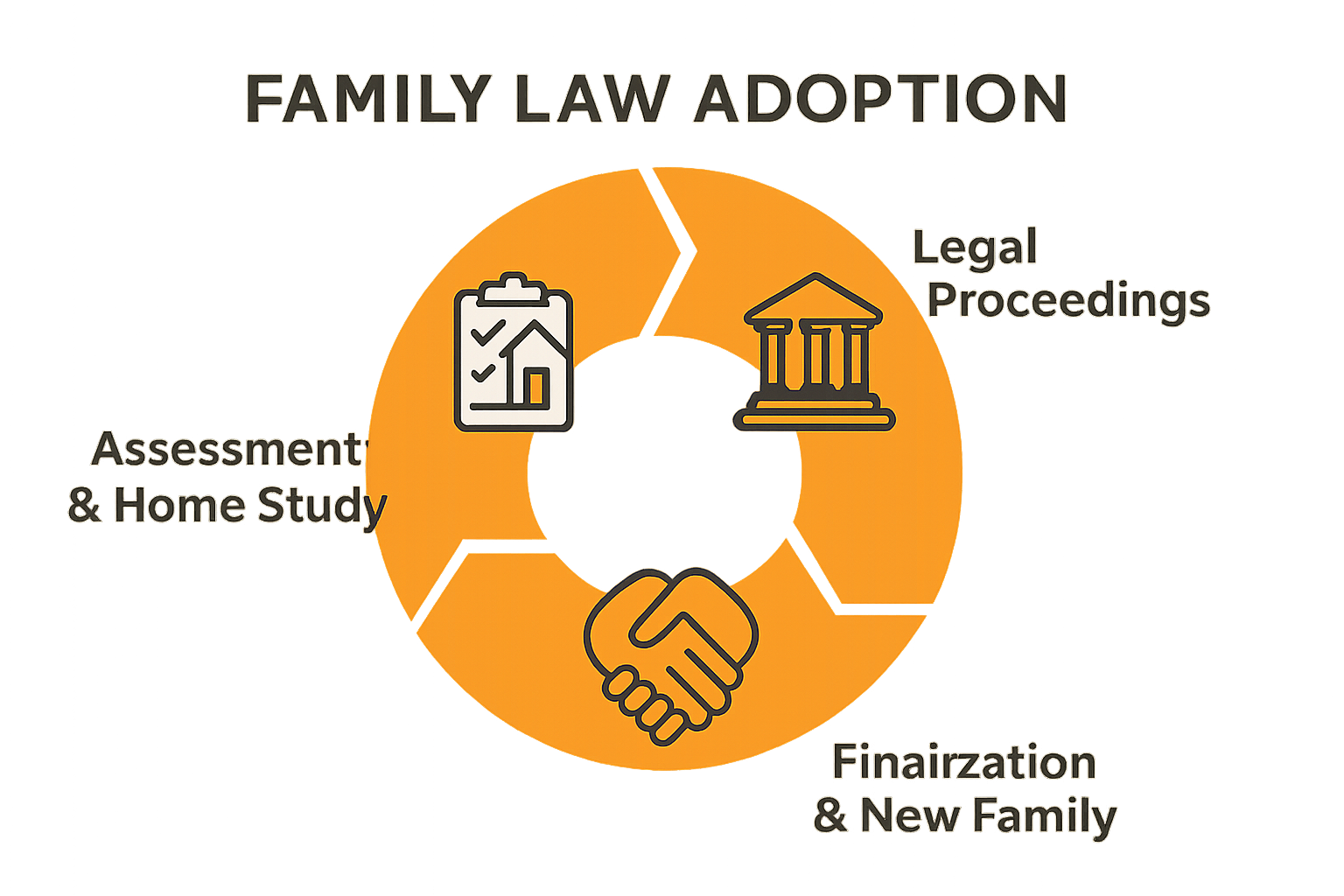
The family law adoption process typically involves several key steps: determining the adoptability of the child, terminating parental rights of the biological parents, conducting home studies of prospective adoptive parents, obtaining consent from relevant parties, and finalising the adoption in court.
What are the legal implications of adoption?
The legal implications of adoption include the complete transfer of parental rights and obligations from biological parents to adoptive parents, termination of the biological parents’ legal rights, and the establishment of inheritance and succession rights for the adopted child.