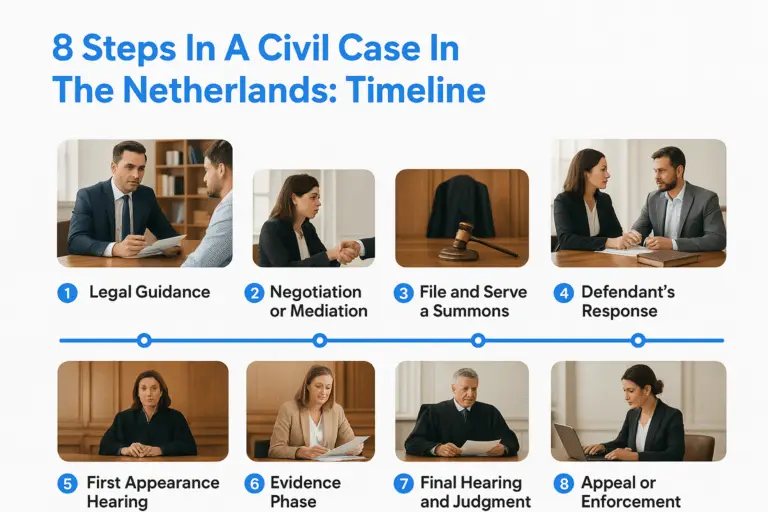
In the Netherlands you appeal a court decision by lodging an appeal (hoger beroep), and the deadline depends on the type of case: three months in ordinary civil cases, four weeks against a judgment in preliminary relief proceedings (kort geding), fourteen days in criminal cases and six weeks in administrative cases. The main exception: civil claims of €1,750 or less cannot be appealed at all.
The civil and criminal periods run from the date of the decision, not from the day you read it, and they cannot be extended. Missing the deadline ends the matter, however strong your arguments are.
Table of contents
What does an appeal mean in Dutch law?
A civil appeal is a full new hearing of the case, within the limits of the complaints you raise. The court of appeal (gerechtshof) assesses the facts and the law again and may reach a different conclusion on the evidence.
This second-chance function (herkansingsfunctie) means an appeal can succeed even if the first judgment contains no obvious error. It also means the appeal is your last opportunity to argue about the facts, because the Supreme Court (Hoge Raad) does not re-examine them.
Three other remedies are often confused with appeal. Opposition (verzet) is the remedy against a default judgment and goes back to the same court (Article 143 of the Dutch Code of Civil Procedure, Rv). Objection (bezwaar) is the mandatory first step against an administrative decision, filed with the authority itself. Cassation (cassatie) at the Supreme Court only reviews whether the law was applied correctly and the judgment is sufficiently reasoned.
Which deadline applies to your case?
Check the deadline before anything else. Courts apply appeal periods of their own motion, and an appeal lodged one day late is declared inadmissible without any look at the merits.
| Decision | Remedy | Period |
|---|---|---|
| Civil judgment of the district court or subdistrict court | Appeal to the court of appeal | Three months from the judgment (Article 339(1) Rv) |
| Judgment in preliminary relief proceedings | Appeal | Four weeks (Article 339(2) Rv) |
| Default judgment | Opposition before the same court | Four weeks after service or another qualifying event (Article 143(2) Rv) |
| Criminal judgment of the district court | Appeal to the court of appeal | Fourteen days in most cases (Article 408 Sv) |
| Administrative decision or court ruling | Objection, appeal, further appeal | Six weeks at each stage (Article 6:7 Awb) |
| Civil judgment of the court of appeal | Cassation | Three months; eight weeks in preliminary relief cases (Article 402 Rv) |
| Criminal judgment of the court of appeal | Cassation | Fourteen days in most cases (Article 432 Sv) |
In civil cases the period starts on the day the judgment is given, whether or not you have received it (Article 339(1) Rv). In criminal cases the fourteen days run from the judgment if you were summoned in person, attended, or otherwise knew the hearing date (Article 408(1) Sv); otherwise a later start applies.
In administrative cases a notice sent by post is in time if posted before the period ends and received within a week after it (Article 6:9 Awb). A late objection or appeal is still admissible if the delay is excusable (Article 6:11 Awb). Civil and criminal law have no such escape: settlement talks, illness or a change of lawyer do not stop the clock. If in doubt, lodge a protective appeal.
Can you appeal at all?
Not always. A civil judgment cannot be appealed if the claim did not exceed €1,750 (Article 332(1) Rv), so small claims are decided once by the subdistrict court (kantonrechter).
Interim judgments can only be appealed together with the final judgment, unless the court allows an earlier appeal; judgments granting or refusing a provisional measure can be appealed straight away (Article 337 Rv). Ask for leave in time if an interim ruling shapes the rest of the case.
In criminal cases, appeal is excluded for some of the lightest offences. In administrative law, some statutes provide for a single court instance. And you lose the right to appeal by acquiescence (berusting): if you unconditionally comply with or accept a judgment, you cannot challenge it later. Pay under written protest instead.
What must your grounds of appeal contain?
In a civil appeal, your complaints (grieven) against the judgment are set out in the statement of grounds of appeal (memorie van grieven). Each complaint must say which part of the judgment is wrong and why.
What you do not challenge stands. Under the strict rule developed in case law, all complaints, new evidence offers and amendments of the claim must in principle be in that first written submission; later additions are allowed only in narrow cases, such as consent of the other party or facts that arose later.
Within the scope of your complaints, defences the other party raised at first instance but the court never reached come back into play (devolutive effect). If only you appeal, the court of appeal cannot leave you worse off than the first judgment. Criminal appeals are different: even if only you appeal, the court of appeal may impose a heavier sentence.

In administrative appeals, the court reviews the lower judgment on the grounds you raise. Under Article 8:69a of the General Administrative Law Act (Awb), the court does not annul a decision for breach of a rule that clearly does not protect your interests. Arguments that could have been raised earlier may be left out of account.
Whatever the area of law, order the first-instance file: the writ or contested decision, the submissions, the numbered exhibits, hearing records and the judgment. If you dispute a factual finding, show exactly which evidence supports your version and where it is in the file.
Do you need a lawyer, and what does an appeal cost?
In a civil appeal you must be represented by a Dutch lawyer (advocaat) under Article 79(2) Rv, even if you acted in person before the subdistrict court. In cassation only a lawyer admitted to practise before the Supreme Court can act.
A criminal appeal does not require a lawyer; the appeal is lodged by a declaration at the registry of the court that gave the judgment. In administrative appeals you may act yourself or through an authorised representative.
Court fees (griffierecht) apply in civil and administrative cases. The amounts depend on the type and value of the claim and are adjusted periodically; check the current table on rechtspraak.nl. People with a low income may qualify for subsidised legal aid from the Legal Aid Board (Raad voor Rechtsbijstand). The losing party usually pays a fixed-scale contribution to the other side’s costs, which rarely covers the real cost of an appeal.
Does an appeal stop enforcement of the judgment?
In civil cases, only if the judgment was not declared provisionally enforceable (uitvoerbaar bij voorraad). Most judgments are, so the other party may enforce while the appeal runs.
You can ask the court of appeal to suspend enforcement of a provisionally enforceable judgment (Article 351 Rv), but the threshold is high, so apply promptly. In administrative law, an objection or appeal does not suspend the decision; you can ask the preliminary relief judge for an interim measure (voorlopige voorziening) under Article 8:81 Awb.
In criminal cases, a sentence is in principle not executed while an appeal is pending. Pre-trial detention is governed by separate rules.
How does the appeal procedure run?
A civil appeal starts with a writ of appeal served on the other party within the appeal period. The statement of grounds follows, the respondent answers and may lodge a cross-appeal in that answer, even after the appeal period has passed (Article 339(3) Rv).
The court then holds an oral hearing or decides on the documents. Hearings increasingly involve questions from the court about the file, so prepare for those.
A criminal appeal starts with a declaration at the registry within the period, followed by a written statement of grounds (appelschriftuur) that should also name the witnesses you want heard. A late request to hear witnesses is assessed more strictly. See appeal in criminal cases.
An administrative appeal goes to the Administrative Jurisdiction Division of the Council of State (Raad van State), the Central Appeals Tribunal (Centrale Raad van Beroep) for social security and civil service cases, the Trade and Industry Appeals Tribunal (College van Beroep voor het bedrijfsleven) for economic regulation, or the court of appeal in tax cases. A brief notice of appeal can be completed with grounds later.
A civil or administrative appeal often takes more than a year. If speed matters more than a final ruling, preliminary relief proceedings may be a better instrument.
What should you check if you want to appeal?
Most appeals are lost on procedure, not on substance. Check:
- The exact last day of the appeal period, counted from the date of the judgment.
- Whether the claim exceeded €1,750, so that appeal is possible (Article 332 Rv).
- Whether the judgment is provisionally enforceable and whether to request suspension.
- That you have not unconditionally complied with or accepted the judgment.
- Which parts of the judgment you will attack, with specific complaints.
- What a better outcome is worth compared with the cost and risk of the appeal.
What should you check if the other party appeals?
Winning at first instance does not end your work. Check:
- Whether the appeal was lodged in time and the claim exceeded €1,750.
- Whether you want to lodge a cross-appeal in your statement of answer (Article 339(3) Rv).
- Which of your first-instance defences the court never decided, since they revive on appeal.
- Whether you can enforce the judgment now if it is provisionally enforceable.
- That all your arguments and evidence offers are in your statement of answer.
- Whether settlement is better than a second round of costs.
What can we do for you with an appeal?
Our civil lawyers act in appeals before the courts of appeal and the administrative appeal courts:
- We calculate the appeal deadline and lodge a protective appeal if time is short.
- We assess the judgment and the prospects of an appeal.
- We draft the statement of grounds or the statement of answer, including any cross-appeal.
- We request suspension of enforcement or an interim measure.
- We represent you at the hearing before the court of appeal.
More on what legal representation in the Netherlands involves is on our separate page.
Summary
- Civil appeal: three months, or four weeks in preliminary relief cases (Article 339 Rv); no appeal for claims up to €1,750.
- Criminal appeal: fourteen days in most cases (Article 408 Sv); a heavier sentence is possible on appeal.
- Administrative objection and appeal: six weeks (Article 6:7 Awb).
- Put all complaints and evidence in your first written submission on appeal.
- A provisionally enforceable civil judgment can be enforced during the appeal unless suspended (Article 351 Rv).
Frequently asked questions
How long do I have to appeal a civil judgment in the Netherlands?
Three months from the date of the judgment, or four weeks for a judgment in preliminary relief proceedings (Article 339 Rv). The period runs from the judgment date, not from when you received it.
Can I appeal a judgment of the subdistrict court on a small claim?
Not if the claim was €1,750 or less (Article 332(1) Rv). Above that amount, appeal to the court of appeal is possible, with a lawyer.
Does an appeal stop the other party from enforcing the judgment?
Not if the judgment was declared provisionally enforceable, which is usual. You can ask the court of appeal to suspend enforcement (Article 351 Rv), but the threshold is high.
Can I bring new evidence on appeal?
In a civil appeal, yes, but in principle only in your first written submission on appeal. In administrative appeals, the room for new material is more limited.