If you sign a contract with a salesperson at your door in the Netherlands, you can cancel it within fourteen days. You do not have to give a reason and you pay no penalty. The main exception works in your favour: if the trader did not tell you about this right in the prescribed way, the period is extended by up to twelve months. Dutch law calls this a contract concluded away from the business premises (overeenkomst buiten de verkoopruimte). The rules are in articles 6:230g to 6:230z of the Dutch Civil Code (Burgerlijk Wetboek), which implement the European Consumer Rights Directive.
This protection covers energy contracts, insulation and solar panel deals, and subscriptions signed at a market stall or festival stand. Below we explain when the rules apply, when the period starts and ends, what the trader must give you in writing, what happens if work has already begun, the exceptions, and what you can do when a trader refuses to cooperate.
Table of contents
Which contracts count as door-to-door sales?
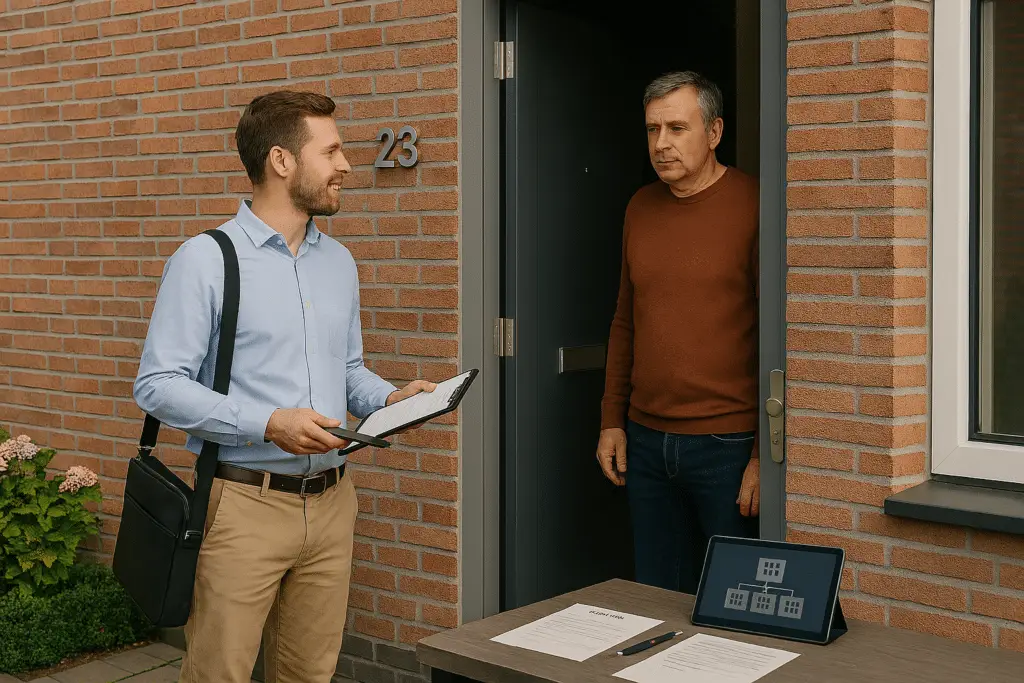
More than just the doorstep. The legal category covers four situations. First, an agreement made while you and the trader are physically together in a place that is not the trader’s shop or showroom. Second, an offer made in such a place and accepted shortly afterwards in the shop. Third, an agreement concluded during an excursion organised by the trader. Fourth, an agreement concluded after you were personally approached in a place that is not the business premises. In practice, this captures the salesperson at your door, the stand in a shopping centre gangway, the market stall, the festival stand and the sales visit at your workplace.
The extra protection is about the situation, not the product: you did not come to buy, you cannot compare prices on the spot and the seller sets the course of the conversation. The law therefore gives you fourteen days to reverse your decision and requires the information on paper or another durable medium.
The separate Door-to-Door Sales Act (Colportagewet), with its eight-day period, was repealed on 13 June 2014 when the Consumer Rights Directive was implemented. The current rules in Book 6 BW are mandatory, and courts apply them of their own motion: if you are sued for payment, you keep the protection even if you do not raise it yourself.
The rules apply to consumers: natural persons acting outside their trade or profession. A sole trader who signs a contract for the business does not have the statutory right of cancellation. A contract used for both private and business purposes can still count as a consumer contract if the business purpose is only marginal. Our overview of consumer protection in Dutch contracts sets out the wider framework.
How long is the cooling-off period, and when does it start?
You have fourteen days to cancel without giving reasons. Dutch law calls this cancellation ontbinding; the European term is withdrawal. Here they mean the same thing. The trader may not charge a penalty or ask for a reason, and a contract clause that says otherwise is void.
The starting point depends on what you bought. For a service, the period runs from the day after the contract was concluded. For goods, it runs from the day after you, or someone you designated, received the goods. If one order covers several items delivered separately, the period starts after the last item arrives. For regular deliveries over a period of time, it starts after the first delivery. The period ends at the close of the fourteenth day.
Sending your notice on the last day is enough; it does not have to arrive by then. Even so, we advise against waiting until the final day. You must be able to show that you sent the notice in time, and a message you cannot prove is worth little. Send it early and keep the evidence.
What must the trader give you, and in what form?
Before you sign, the trader must give you a defined set of information on paper or, if you agree, on another durable medium, in plain and intelligible language. The trader must also give you a copy of the signed contract or a confirmation of it. A verbal explanation, however clear, is not enough.
The information you must receive includes the following. The law itself is written as a list here, so a list is the clearest way to present it:
- the identity of the trader: name, trading name, geographic address, telephone number and, where applicable, the Chamber of Commerce (KvK) registration number;
- the main characteristics of the goods or services;
- the total price including taxes and all additional charges, or the way the price is calculated;
- the arrangements for payment, delivery and performance, and the date by which the trader will perform;
- the existence of the right of cancellation, its conditions, the period and the procedure for using it, together with the model cancellation form;
- who pays the cost of returning goods and, where work may start during the cooling-off period, the fact that you will owe a proportionate amount for what has been performed;
- the duration of the contract and the conditions for ending it, including any minimum term.
This information is not decoration. It forms part of the contract, and the trader cannot change it on its own afterwards. You do not owe charges you were not told about before signing. And if the trader disputes that the information was given, the trader must prove it did so, not you.
What happens if the trader does not follow the rules?
The most important sanction applies automatically. If the trader did not inform you about the right of cancellation in the prescribed way, the fourteen-day period is extended by twelve months. If the trader supplies the missing information within that year, a new fourteen-day period starts from that moment. This is not a favour the court may or may not grant; it follows directly from the law. It is also the reason why a contract signed at the door months ago can sometimes still be cancelled.
A second route applies if the sales method itself was the problem. A practice is misleading if it gives false information or leaves out essential information, and aggressive if harassment, coercion or undue influence significantly limits your freedom of choice, such as refusing to leave or insisting the price is only available today. A contract concluded through an unfair commercial practice can be annulled (Article 6:193j BW). Our article on unfair commercial practices under Dutch law explains the test.
Where a consumer is sued, courts apply these rules on their own initiative, and the sanction must be effective, proportionate and dissuasive. Depending on which duties were breached, the claim can be rejected, the amount you owe reduced, or the cancellation upheld long after the original fourteen days.
How do you cancel, and what happens next?
You do not need a special form. A clear statement that you are cancelling the contract is enough. You can send it by e-mail, by letter, through the trader’s online form or on the model cancellation form the trader should have given you. State which contract it is, the date it was concluded and what it was for. Add your contact details and the bank account for the refund. Keep a copy of the message and proof that you sent it. Registered post is not required, but for a large contract it removes one point of argument.
After you cancel, the trader must refund all payments received, including any delivery costs, within fourteen days of receiving your notice. The refund uses the same payment method you used, unless you agreed otherwise. For goods, the trader may hold back the refund until the goods are back or until you have shown that you sent them. You must return the goods within fourteen days. You pay the direct cost of returning them, unless the trader agreed to pay or did not tell you that these costs were yours.
You may inspect and test the goods as you would in a shop. If you handle them beyond what is needed to establish their nature, characteristics and functioning, you can be liable for the loss in value. That liability only exists if the trader informed you about the right of cancellation in the first place. In other words, a trader who kept quiet about the cooling-off period cannot then charge you for depreciation.
Cancellation also ends the arrangements linked to the contract. Ancillary agreements concluded in connection with it end automatically when the main contract is cancelled, at no cost to you. Examples are a finance agreement taken out to pay for an installation, or a service subscription sold with the product. If a lender keeps collecting instalments, write to both the lender and the trader and refer to your cancellation.
On evidence, you only need to show that you sent the cancellation notice in time, so keep the message and its timestamp. Everything else is for the trader to prove: that it gave the mandatory information, that you expressly asked for early performance, and that a statutory exception applies.
Can you still cancel when the work has already started?
Yes, but what you owe depends on what the trader did beforehand. Say you expressly asked for the work to begin during the cooling-off period, and the trader informed you about the right of cancellation and about the fact that you would owe a proportionate amount. In that case, you pay a proportionate part of the agreed price for the work actually performed when you cancel.
If one of those conditions is missing, the position changes completely: you owe nothing for the work already done. This is a deliberate sanction, not a windfall. It is why the order of events matters so much in insulation, solar panel and energy contracts, where installation or supply often starts immediately. The same logic applies to digital content delivered during the period. You only lose the right of cancellation if you expressly agreed to immediate delivery, acknowledged that you would lose the right, and the trader confirmed that consent in writing.
When is there no right of cancellation?
Only in a limited number of cases set out in the law. These exceptions are interpreted strictly, and a trader who relies on one must prove that it applies. The main categories are goods made to your specifications or clearly personalised, such as a kitchen designed and built for your home; perishable goods; sealed goods that are unsuitable for return for health or hygiene reasons once unsealed; goods that are inseparably mixed with other items after delivery; and services that have been fully performed, where performance began with your express prior consent and your acknowledgement that you would lose the right once the service was completed.
Urgent repairs and maintenance you requested yourself are treated separately. If you specifically asked the trader to come and carry out an urgent repair, you cannot cancel that repair. You can still cancel any extra services or goods supplied during the same visit that you did not ask for. An illustrative example: a boiler engineer you called out on a winter night may charge for the emergency repair, but a maintenance subscription sold during the same visit remains cancellable.
Financial services concluded at a distance and certain other categories have their own regimes, with similar but not identical rules. Contracts about immovable property fall outside this framework entirely. If you are unsure which regime applies, the safest course is to send the cancellation notice within fourteen days anyway and discuss the category afterwards.
What extra rules apply to energy, insulation and solar panels?
Energy contracts are often sold at the door and carry extra rules. Since 1 January 2026 the Energy Act (Energiewet) has replaced the Electricity Act 1998 and the Gas Act, and sets requirements for consumer supply contracts. The Netherlands Authority for Consumers and Markets (ACM) supervises the market and can act against suppliers and their sales agents. The fourteen-day right of cancellation applies alongside those rules. Our glossary entries on the Energy Act and the consumer energy contract explain the terminology.
With insulation and solar panels, the installer may not start during the cooling-off period unless you expressly asked for it; if you did not, or the information duties were not met, you owe nothing for the work done when you cancel. These contracts often run to five figures and are frequently linked to a loan or subsidy. Compare the price with quotations from local installers, and check that any subsidy the salesperson mentions actually applies to you: a false promise about a grant can be misleading information.
Subscriptions and memberships signed on the street follow the same fourteen-day rule. A donation to a charity is not a purchase from a trader, so that rule may not apply; a SEPA direct debit can, however, be reversed through your bank within eight weeks. The ordinary rules on contract duration and renewal apply on top of that. If you sign up for a subscription that renews automatically, read our article on automatic renewal of subscriptions under Dutch law. The rules for ending such a subscription are more favourable than most people assume.
What can you do if the trader refuses to cooperate?
Start with a written demand. State the date on which you cancelled, that the refund was due within fourteen days of that notice, and set a short final deadline. Do not accept a partial refund, or a claim that cancellation is impossible, unless the trader points to the statutory exception it relies on.
If that does not work, you have several options. Many sectors have a disputes committee (geschillencommissie) that issues a binding decision at low cost. For medium-sized amounts, that is often the fastest route. ConsuWijzer, the ACM’s consumer information service, gives guidance and collects reports that feed into enforcement. The Legal Services Counter (Juridisch Loket) gives initial advice at no cost, and subsidised legal aid may be available depending on your income. Consumer claims are heard by the subdistrict court (kantonrechter), where you may act without a lawyer. What decides the case is a well-documented file: the contract, the information you did or did not receive, and your cancellation notice.
If the trader passes the claim to a debt collector, collection costs may only be charged after a reminder giving you fourteen days to pay (Article 6:96(6) BW), and only up to the statutory maximum. Dispute the claim in writing and refer to your cancellation; staying silent is what can turn a disputed claim into a default judgment.
What should you check as a consumer?
The simplest rule is not to sign during the visit: ask for the offer by e-mail and take a night to think. If you did sign, check these points the same day:
- Did you receive the information on paper or another durable medium, a copy of the signed contract and the model cancellation form?
- Does the company on the contract match the one the salesperson named, and does its Chamber of Commerce (KVK) number check out?
- When does your fourteen-day period end: the day after signing for a service, the day after delivery for goods?
- Did you expressly ask for work or supply to start during the cooling-off period? If not, you owe nothing for work done before you cancel.
- Were you pressed with a price “only valid today” or claims that the neighbours had signed? Note it down; it may support an argument about an aggressive commercial practice.
- Is a loan or subsidy linked to the contract? Cancellation ends linked finance agreements as well.
Many municipalities also regulate door-to-door selling in their general local by-law (Algemene Plaatselijke Verordening, APV), for example permitted hours or a permit requirement. Report persistent breaches to the municipality and to the ACM through ConsuWijzer.
What should you check as a trader?
As a trader you carry the burden of proof on almost every point, so your paperwork decides the outcome. Check these points:
- Do your sales staff hand over all mandatory information and the model cancellation form before the consumer is bound?
- Does the consumer receive a copy or confirmation of the signed contract on a durable medium?
- If work or energy supply starts within fourteen days, do you have the consumer’s express written request and an acknowledgement of the proportionate amount owed?
- Do you refund within fourteen days of a cancellation notice, using the same payment method?
- Do your scripts avoid misleading or aggressive practices, such as a deadline “only today” or unsupported subsidy promises, that the ACM can fine?
What can we do for you with a doorstep contract?
Our civil lawyers advise consumers and traders on contracts concluded away from business premises. In practice we:
- check whether the contract falls under Articles 6:230g to 6:230z BW and when your cancellation period ends;
- draft the cancellation notice and the written demand for a refund within fourteen days;
- assess whether the trader met its information duties and what you owe for work already performed;
- respond to collection letters and dispute costs that do not meet the statutory rules;
- review sales scripts, information forms and contract templates for traders;
- represent you before a disputes committee (geschillencommissie) or the subdistrict court (kantonrechter).
Summary
- A contract signed with a salesperson at your door can be cancelled within fourteen days, without a reason and without a penalty (articles 6:230g to 6:230z of the Dutch Civil Code).
- If the trader did not inform you properly about this right, the period is extended by up to twelve months.
- The trader must refund your payments within fourteen days of your notice; you must return any goods within fourteen days.
- If work started early without your express request or without the required information, you owe nothing for what was done.
- Keep proof that you sent your cancellation in time; most other points are for the trader to prove.
Frequently asked questions
Can you cancel if you have already paid?
Yes. Payment does not affect the right of cancellation. The trader must refund everything it received, including standard delivery costs, within fourteen days of your notice.
Does the right also apply to a contract concluded by telephone?
Yes, under a different heading. A contract concluded entirely at a distance has its own fourteen-day right of cancellation. If the call was followed by a visit at which you signed, it is a contract concluded away from the business premises and the rules in this article apply.
What if you signed on behalf of your business?
Then the statutory consumer protection of Articles 6:230g to 6:230z BW does not apply, because you acted in the course of a trade or profession. General contract law can still help, for example if the trader misled you, but the automatic fourteen-day right does not exist.
Do you have to give the goods back before you get your money?
You must return them within fourteen days of your notice. The trader may hold back the refund until the goods are back or until you have proved that you sent them.
What if the trader never told you about the cooling-off period?
Then the fourteen-day period is extended by twelve months. If the trader provides the missing information within that year, a new fourteen-day period starts from the day you receive it.