Under EU Regulation 261/2004 you are entitled to a fixed compensation of EUR 250, 400 or 600 if your flight is cancelled at short notice, if you are denied boarding, or if you reach your final destination three hours or more late. The airline does not have to pay if it proves that the disruption was caused by extraordinary circumstances that it could not have avoided even with all reasonable measures.
The Regulation applies to every flight departing from an airport in the European Union and to flights arriving in the EU that are operated by an EU airline. The compensation is owed by the operating airline, does not depend on the ticket price, and comes on top of any refund and the meals, calls and hotel accommodation the airline must provide during the disruption.
Table of contents
Does Regulation 261/2004 apply to your flight?
That depends on where the flight departs and which airline operates it, not on your nationality or where you bought the ticket. Every departure from an EU airport is covered; an arrival in the EU from outside is covered only if an EU airline operates the flight.
A flight from New York to Amsterdam therefore falls under the Regulation if KLM operates it, but not if a US airline does. A flight from Amsterdam to New York is covered either way.
The Regulation also applies in Iceland, Norway and Liechtenstein through the Agreement on the European Economic Area, and in Switzerland under the air transport agreement between the EU and Switzerland. It applies in the EU’s outermost regions, such as the Canary Islands, Madeira, the Azores and the French overseas departments. It does not apply in the United Kingdom, which has kept its own version of the rules since Brexit. A flight from London to Amsterdam on a British airline is governed by the UK rules, not by Regulation 261/2004.

Which conditions must you meet yourself?
You must have a confirmed reservation and check in on time, and your ticket must have been available to the public. Staff tickets and other non-public fares are excluded.
On time means at the time the airline indicated or, if it gave no time, at the latest 45 minutes before the published departure time. This condition does not apply if the flight is cancelled, because there is then nothing to check in for. Tickets issued under a frequent flyer programme do count.
Two further limits are easily missed. If you are flying into the EU from a non-EU country and have already received compensation and assistance there, the Regulation does not apply again to the same disruption. And if the flight is part of a package holiday, the Regulation applies alongside the package travel rules. You may have rights against both the airline and the tour operator, but you cannot recover the same loss twice.
What about connecting flights?
Connecting flights booked on one reservation count as one journey. The Court of Justice of the European Union has held that if you miss a connection because the first flight was delayed and you reach your final destination three hours or more late, you are entitled to compensation, even if the delay of the first flight itself was shorter. If the whole journey was booked with an EU airline on one reservation, this also applies to a leg operated outside the EU by a partner airline.
What can you claim?
The Regulation gives you four separate rights: care, a refund or re-routing, compensation and, if you are downgraded, a partial refund. Airlines sometimes present one of these as if it settled the others, but a hotel room does not replace compensation, and a refund does not replace care.
Care during the wait
Care means meals and refreshments in reasonable relation to the waiting time, two telephone calls or messages and, if you have to stay overnight, a hotel room and transport between the airport and the hotel. You are entitled to care once the waiting time reaches two hours for flights of 1,500 km or less, three hours for longer flights within the EU and other flights of 1,500 to 3,500 km, and four hours for all other flights.
If the airline provides nothing, buy what is reasonable, keep the receipts and claim the costs back. That is a separate claim from the compensation.
Refund or re-routing
You choose between a refund and re-routing, not the airline. You can ask for a full refund of the unused part of the ticket within seven days, together with a return flight to your first point of departure if the journey no longer serves any purpose. Alternatively, you can choose re-routing to your final destination at the earliest opportunity, or at a later date that suits you. An airline that simply rebooks you without asking has not complied with the Regulation.
Compensation and downgrading
Compensation is the fixed amount explained below. It is due unless the airline proves extraordinary circumstances, and you do not have to show that you suffered any financial loss.
If you are placed in a lower class than the one you paid for, the airline must refund a percentage of the ticket price, rising with the distance of the flight: 30%, 50% or 75%. An upgrade, on the other hand, may not be charged to you.
How much compensation can you claim?
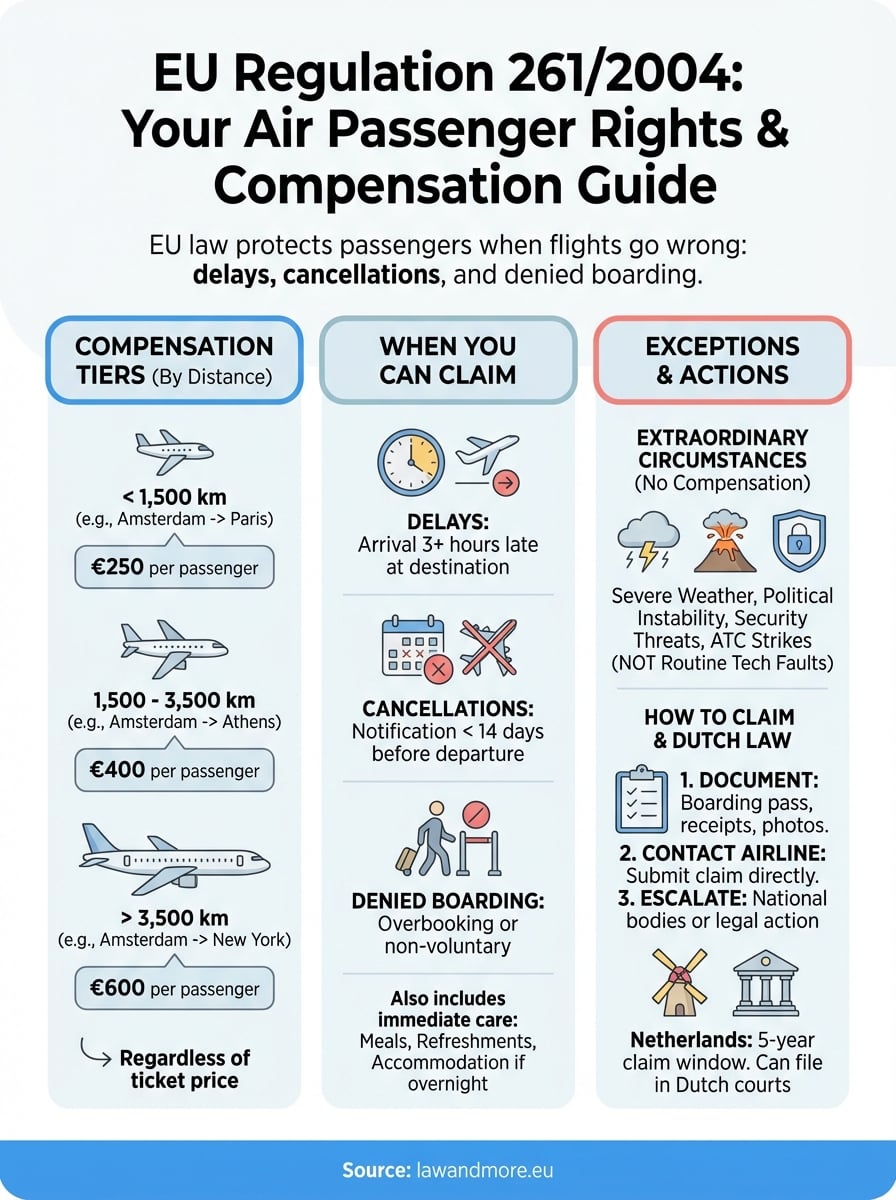
The amount depends only on the flight distance: EUR 250, 400 or 600 per passenger. The ticket price plays no role.
Under Article 7 of the Regulation, compensation is EUR 250 for flights of 1,500 km or less, EUR 400 for flights within the EU of more than 1,500 km and for other flights of 1,500 to 3,500 km, and EUR 600 for all other flights. The distance is measured by the great circle method between the departure airport and the final destination. A passenger who paid EUR 49 for a seat and a passenger who paid EUR 1,900 for the seat next to it receive the same amount.

Because the calculation runs to the final destination, a journey on one reservation is measured from start to finish. A trip from Amsterdam to Bangkok with a change in Dubai is one journey of more than 3,500 km, not two shorter flights. An airline that splits the route in its own calculation understates what it owes.
When may the airline pay half?
The airline may reduce the compensation by 50% in one situation only. It must have offered you re-routing to your final destination, and that alternative flight must have arrived no more than two hours (short band), three hours (middle band) or four hours (long band) after the original scheduled arrival time. If you declined re-routing and took a refund, the reduction does not apply. The airline must prove that it offered suitable re-routing and that you arrived within that window.
Delay, cancellation or denied boarding: which applies to you?
The Regulation distinguishes three events, and each gives different rights. Airlines have an interest in calling a cancellation a delay, so it helps to know the difference.
Long delay
The text of the Regulation gives delayed passengers care, and a refund once the delay reaches five hours, but no compensation. The right to compensation for delay comes from the Court of Justice. In Sturgeon (2009), confirmed in Nelson (2012), the Court held that passengers who reach their final destination three hours or more late lose the same amount of time as passengers whose flight is cancelled, and must be treated the same way.
Arrival time is the moment at least one aircraft door opens and passengers may leave the aircraft. It is not the moment of landing, nor the moment the aircraft reaches the gate. In a borderline case this decides the claim, so a photo with a timestamp of the door opening is worth more than an argument afterwards.

Cancellation
A cancellation gives you care, the choice between refund and re-routing, and compensation, but compensation depends on how much notice you received. No compensation is due if the airline informed you at least two weeks before the scheduled departure.
If you were told between two weeks and seven days before departure, compensation lapses only if you were offered re-routing that departed no more than two hours before the original departure time and arrived less than four hours after the original arrival time. With less than seven days’ notice, those windows narrow to one hour earlier and two hours later. Outside those windows, you are entitled to full compensation.
The operating airline must prove that it informed you and when. An entry in the airline’s own system does not by itself prove that the message reached you. If you booked through a travel agent, the airline remains responsible for informing you.
Denied boarding
Denied boarding covers more than overbooking. It is any refusal to carry a passenger who presented on time with a confirmed reservation, unless there are reasonable grounds such as missing travel documents or reasons of health, safety or security.
Before refusing passengers against their will, the airline must ask for volunteers who give up their seat in exchange for benefits agreed with the airline. Volunteers keep their right to a refund or re-routing. If there are not enough volunteers and you are refused boarding, compensation is due immediately, at the same amounts, together with care and the choice between refund and re-routing. There is no waiting period and no need to show a delay on arrival.
Under Article 15 of the Regulation, your rights cannot be limited or waived in advance. A clause in the airline’s conditions of carriage that tries to exclude them has no effect.
When can the airline rely on extraordinary circumstances?
Only if it proves two things: an extraordinary event, and that it took all reasonable measures to avoid the cancellation or delay. The burden of proof lies entirely with the airline.
The Court of Justice has held that an event is extraordinary only if it is not inherent in the normal exercise of the airline’s activity and is beyond its actual control. The case law gives a fairly clear picture.
- Technical problems are normally not extraordinary. A defect discovered during maintenance, or caused by wear and tear, is part of running an airline, even if it appears without warning. The exceptions are narrow: a hidden manufacturing defect disclosed by the manufacturer or an authority, sabotage or terrorism, and damage from an external event such as a bird strike or a foreign object on the runway.
- Strikes depend on who is striking. A strike by air traffic controllers or airport staff is external to the airline and can be extraordinary. A strike by the airline’s own pilots or cabin crew, including one called by a trade union during ordinary collective bargaining, is not. The same applies to a sudden mass sick leave of staff after a company announcement.
- Weather counts only if it actually prevented the flight. Conditions that make take-off or landing unsafe, or the closure of an airport or airspace, can qualify. It is not enough for an airline to point to bad weather earlier in the day or at another airport without showing why this flight could not operate despite reasonable rescheduling.
- An extraordinary cause is only half of the defence. The airline must also show that it took all reasonable measures, such as using a reserve aircraft or crew, or re-routing you on another airline’s flight. An airline that had a way to get you there and did not use it cannot rely on the extraordinary circumstance.
A one-line refusal citing operational or technical reasons is therefore not a valid defence. Ask the airline which event it relies on, on what date and at what time, and what measures it took. Airlines that cannot answer these questions usually pay.
How do you make a claim, and how long do you have?
Collect evidence on the day itself and then claim in writing from the operating airline. Do not wait: Dutch courts apply a two-year period, so start proceedings within two years of the flight.
At the airport, ask the ground staff for the reason in writing, photograph the departure board and the time when the doors open on arrival, and keep your boarding pass and booking confirmation. If the airline provides no meals or hotel, buy what is reasonable and keep the receipts. Evidence gathered at the airport is worth far more than a reconstruction months later.
Then write to the operating airline, not to the travel agent or ticket seller, because the Regulation places the obligations on the airline that operated or was to operate the flight. State the flight number and date, the booking reference, what happened, the distance band and the exact amount you claim, and attach your evidence. Set a reasonable deadline for payment and keep proof that you sent the letter.

If the airline refuses or does not reply, you can complain to the national enforcement body. In the Netherlands that is the Human Environment and Transport Inspectorate (Inspectie Leefomgeving en Transport, ILT), for flights departing from Dutch airports and for flights to the Netherlands operated by EU airlines. The ILT supervises compliance and can act against airlines that structurally fail to meet their obligations, but it does not order payment to an individual passenger. For the money, you need the airline’s agreement or a court judgment.
Which limitation period applies?
The Regulation itself contains no limitation period. In Cuadrench Moré (22 November 2012, C-139/11), the Court of Justice held that the two-year period of the Montreal Convention does not apply to these claims and that national law decides. The periods therefore differ widely across the EU.
In the Netherlands the position is not fully settled. Dutch courts apply the two-year period for claims under a contract of carriage by air in Article 8:1835 of the Dutch Civil Code (BW) (for example ECLI:NL:RBNHO:2024:10724). It is an expiry period: a letter to the airline does not stop it. Because a letter does not stop this period, start court proceedings well before the second anniversary of your flight.
How do you enforce a claim in the Netherlands?
You can usually bring the claim before a Dutch subdistrict court (kantonrechter) if your flight departed from or arrived in the Netherlands. You do not need a lawyer there, and the procedure is relatively quick and inexpensive.
For flights within the EU, the Court of Justice allows you to sue at the place of departure or the place of arrival, as you choose, and you can also sue the airline where it is established. If your flight departed from Amsterdam, Eindhoven, Rotterdam or Maastricht, you can therefore bring your claim in the Netherlands even if the airline is based elsewhere in the EU.
Compensation claims are almost always well below EUR 25,000, the limit for the subdistrict court. Court fees are payable in advance on a statutory scale that is indexed each year, and the losing party is normally ordered to pay a fixed contribution towards the winner’s costs. Our overview of small claims procedures in the Netherlands explains how these cases run, and our page on civil law sets out the wider procedural framework.
If the airline is established in another EU country and you prefer to sue there, the European Small Claims Procedure is often the cheapest route. A Dutch judgment can in any case be enforced elsewhere in the EU without a separate declaration of enforceability. Our European law team regularly handles claims against airlines established outside the Netherlands.
Which claims fall outside the Regulation?
Regulation 261/2004 compensates lost time in a standard way, and nothing else. Lost or damaged baggage, assistance for passengers with reduced mobility and further financial loss are governed by other rules.
Lost, damaged or delayed baggage falls under the Montreal Convention, which applies in the EU through Regulation (EC) 2027/97. Liability is capped at an amount expressed in special drawing rights, which is reviewed periodically. You must report the damage to the airline within short deadlines: for damaged baggage within seven days of receipt, for delayed baggage within 21 days. You must prove your actual loss, as there is no fixed amount. Declaring a higher value at check-in for a supplement raises the cap.
Passengers with a disability or reduced mobility are protected by Regulation (EC) 1107/2006. Airports and airlines must provide assistance free of charge and may refuse carriage on grounds of disability only for safety reasons or where the size of the aircraft makes it impossible. Notifying your needs in advance, at least 48 hours before departure, secures the best service.
Further damage, such as a missed connection on a separate booking, a wasted hotel night or a lost business day, can be claimed under ordinary contract law and the Montreal Convention. Article 12 of the Regulation preserves that right, although the fixed compensation may be deducted. These claims require proof of your loss.
Should you use a claim agency?
You can, but it costs you a share of your compensation, often a third or more, even if the airline pays without resistance. The arrangement is lawful: under Article 3:94 BW a money claim can be assigned by deed and notice to the debtor. Claiming yourself costs no more than a letter, and compensation is per passenger, so a family of four on a long-haul flight can claim up to EUR 2,400.
What should you check as an airline or travel business?
Under Article 14 of the Regulation, the operating airline must display a notice at check-in and give every passenger affected by denied boarding, cancellation or a delay of at least two hours a written notice of their rights. The ILT can act against airlines operating from Dutch airports. Check these points:
- Do disrupted passengers receive the written Article 14 notice, with the ILT’s contact details?
- Can you prove when and how each passenger was informed of a cancellation (Article 5)?
- Is every refusal based on extraordinary circumstances backed by records of the event and the measures taken?
- Do your terms avoid clauses that limit passenger rights, which are void under Article 15?
- As a tour operator or ticket seller, do your contracts allocate the duty to pass on schedule changes, given your own liability under the package travel rules?
What changes with the 2026 revision?
The revision was adopted as Regulation (EU) 2026/2202 of 16 September 2026, but its new rules do not yet apply to current flights. Until the amending regulation enters into application, the current Regulation, as interpreted by the Court of Justice, governs every claim.
In June 2026 the European Parliament and the Council reached agreement on a text amending Regulation 261/2004 and Regulation 2027/97, after negotiations since 2013. The text must still be formally adopted and published in the Official Journal. The agreed text keeps the three-hour arrival delay threshold and the amounts of EUR 250, 400 and 600. The EU’s Your Europe page sets out the current rights.
What should you check as a passenger?
Your claim depends on the evidence you collect on the day and on claiming in time. Check these points:
- Do you know whether it was a delay, a cancellation or denied boarding, and have you recorded the time the doors opened on arrival?
- Did you ask for the reason in writing and keep receipts for meals or a hotel the airline did not provide?
- Have you chosen deliberately between a refund and re-routing, and refused a voucher if you want money?
- Have you claimed in writing from the operating airline, within two years of the flight?
- If the airline invokes extraordinary circumstances, has it named the event and the measures it took?
What can we do for you with a flight compensation claim?
Our civil lawyers assist passengers and travel businesses with claims under Regulation 261/2004:
- We check which event occurred and calculate the compensation per passenger and distance band.
- We send a demand letter to the operating airline and interrupt the limitation period.
- We test the airline’s reliance on extraordinary circumstances against the case law of the Court of Justice.
- We bring the claim before the kantonrechter or through the European Small Claims Procedure.
- We review the passenger information and contract terms of airlines and tour operators.
Summary
- Regulation 261/2004 covers all flights departing from the EU and flights into the EU operated by an EU airline.
- Compensation is EUR 250, 400 or 600 per passenger, depending on distance, for a delay of three hours or more on arrival, a late cancellation or denied boarding.
- The airline must also provide care and let you choose between a refund and re-routing.
- The airline escapes compensation only if it proves extraordinary circumstances and that it took all reasonable measures; technical defects rarely qualify.
- Claim in writing from the operating airline, and act within two years of the flight.
Frequently asked questions
When does EU Regulation 261/2004 apply?
It applies to all flights departing from an EU airport, and to flights into the EU operated by an EU airline. You must have a confirmed reservation and have checked in on time, unless the flight was cancelled.
What are extraordinary circumstances?
They are events that are not part of the airline’s normal operations and are beyond its control, such as an air traffic control strike or weather that makes a flight unsafe. The airline must prove the event and that it took all reasonable measures. Technical defects rarely qualify.
What can I do if an airline refuses to pay compensation?
Ask the airline which event it relies on and what measures it took, and complain to the Human Environment and Transport Inspectorate (ILT). If the airline still refuses, you can bring your claim before the Dutch subdistrict court without a lawyer, or ask us to do so.