
Legal representation means that an admitted lawyer (advocaat) acts in your name and on your instructions: the lawyer conducts the proceedings, signs the procedural documents, addresses the court and negotiates with the other side. In civil cases above the subdistrict court it is compulsory; in criminal cases it is a right you can choose to use; in administrative cases it is optional.
Under Dutch law, representation is a formal capacity, not a general term for legal help. It decides whether you may conduct a case yourself, who may sign a writ of summons, whether your correspondence is covered by professional privilege and who is accountable to the Netherlands Bar (Nederlandse orde van advocaten) if something goes wrong.
Table of contents
When is a lawyer compulsory in Dutch proceedings?
In civil cases, you need a lawyer unless your case is heard by the subdistrict court (kantonrechter). That rule is in Article 79 of the Dutch Code of Civil Procedure (Wetboek van Burgerlijke Rechtsvordering, Rv); criminal and administrative cases follow their own rules.

Civil proceedings
The subdistrict court is a section of the district court. Under Article 93 Rv, it hears claims up to 25,000 euros and, whatever the amount, employment cases, tenancy cases, consumer credit and consumer purchase disputes, and agency agreements. In those cases you may conduct the case yourself, or be assisted by an authorised representative who does not have to be a lawyer.
In all other civil cases, representation by an advocaat is compulsory. That applies to ordinary proceedings before the district court, to an appeal to the court of appeal (gerechtshof) and to cassation before the Supreme Court (Hoge Raad). In cassation, only a lawyer registered as a cassation lawyer (cassatieadvocaat) may act. There is one important exception in summary proceedings (kort geding) before the district court: the claimant needs a lawyer, but the defendant may appear in person under Article 255 Rv, unless the defendant files a counterclaim.
Where representation is compulsory, the consequences of acting without a lawyer are procedural, not a matter of the merits. A claimant cannot validly start the case, and a defendant who does not appear through a lawyer risks a default judgment (verstek). More on how civil cases run can be found in our article on litigation in Dutch courts and on our civil procedure page.
Criminal proceedings
Nobody is obliged to have a lawyer in a Dutch criminal case, but the right to one is protected at every stage. Article 28 of the Code of Criminal Procedure (Wetboek van Strafvordering, Sv) gives every suspect the right to be assisted by a lawyer.
Under Article 28a Sv, a suspect can waive that right, but only voluntarily and after being informed of the consequences. Under Article 28c Sv, an arrested suspect may consult a lawyer before the first police interview, in principle for up to half an hour. Under Article 28d Sv, the lawyer may attend the interview itself, both for an arrested suspect and for a suspect invited to attend for questioning. When a suspect is arrested, Article 28b Sv requires the assistant public prosecutor, in the cases it describes, to notify the Legal Aid Board (Raad voor Rechtsbijstand), so that a duty lawyer can be assigned.
Statements made in a first interview without advice are hard to correct later, and under Article 29 Sv you have the right to remain silent. Our criminal lawyers page explains how we assist at police interviews.
Administrative proceedings
In administrative law, a lawyer is never compulsory. In objection proceedings before a public authority and in appeals to the administrative courts under the General Administrative Law Act (Algemene wet bestuursrecht, Awb), you may act yourself or appoint any authorised representative.
That also applies to appeals to the Administrative Jurisdiction Division of the Council of State (Afdeling bestuursrechtspraak van de Raad van State). The absence of a requirement says nothing about whether a lawyer is advisable. Administrative deadlines are short, generally six weeks, and courts apply them strictly. In immigration cases the period is often four weeks.
What does legal representation include?
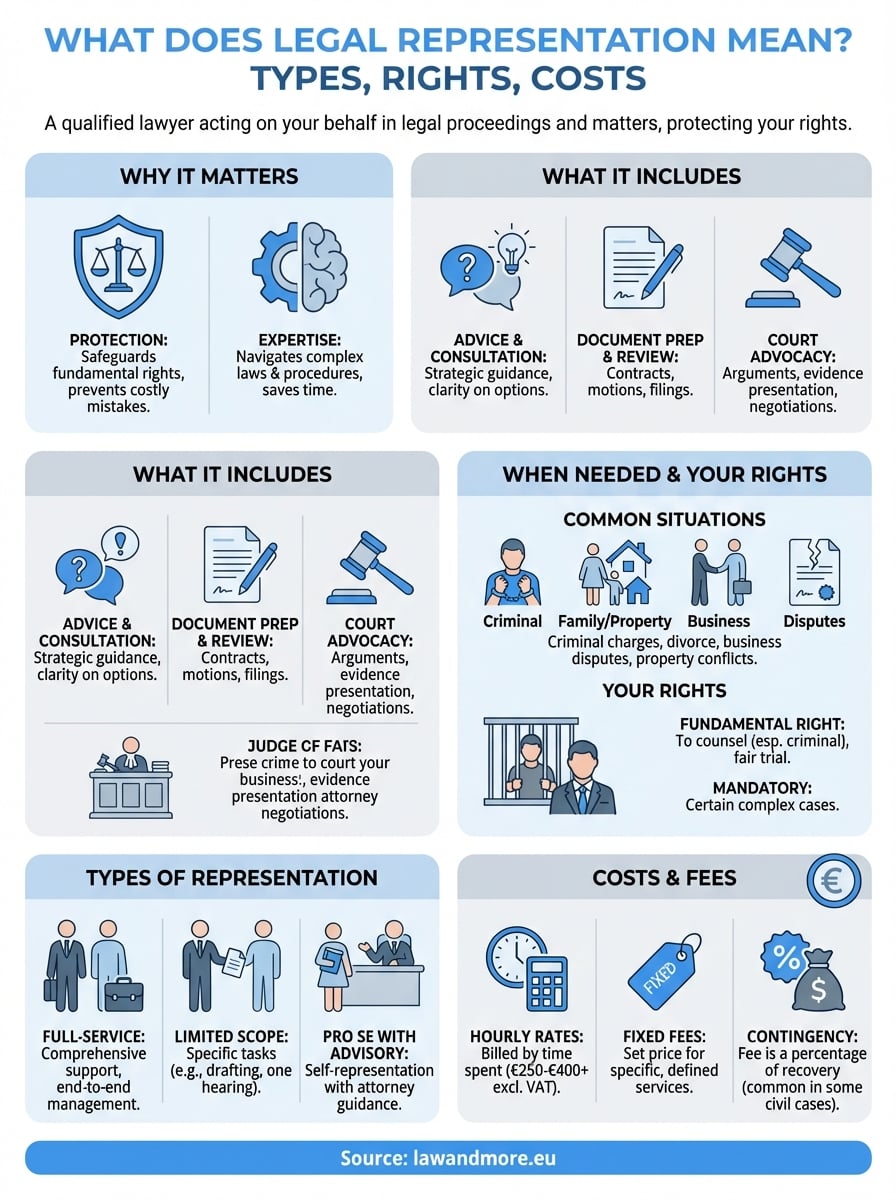
Representation covers far more than the hearing: advice, documents, negotiation and the procedural deadlines. Most of the work happens before anyone enters a courtroom, and much of it aims to make a hearing unnecessary.
Your lawyer first establishes the facts, the applicable rules and whether a limitation period has expired, including where your evidence is weak. Advice from an advocaat is covered by professional privilege (verschoningsrecht), so correspondence about a dispute, an internal investigation or a regulatory issue is protected in a way that correspondence with an unadmitted adviser is not.

Your lawyer then drafts the documents on which a case stands or falls: the writ of summons or petition, the statement of defence and the exhibits. In transactional matters, that includes the contracts and settlement agreements that prevent litigation. A liability cap, a forum clause or a final discharge in a settlement can decide the entire outcome.
In court, your lawyer presents the case and answers the judge’s questions; Dutch civil procedure gives the judge an active role. Outside court, the same authority allows your lawyer to negotiate a settlement, a payment plan or the withdrawal of proceedings on terms.
Representation also means someone is responsible for the procedural steps. The appeal period is three months in ordinary civil cases (Article 339 Rv), four weeks after a summary judgment, generally six weeks in administrative matters and fourteen days in criminal cases. Our appeal lawyers can check whether a period is still open.
Is representation the same as a power of attorney?
No. A power of attorney allows someone to perform specific legal acts for you; legal representation is the procedural right to act for you before a court.
A power of attorney (volmacht) is a private instrument. It authorises someone to sign a deed, sell a property or operate an account on your behalf. It proves a mandate, but it gives no right to appear in court. You can give a family member a power of attorney to sell your house in the Netherlands, but that family member cannot conduct the court case that follows from the sale where a lawyer is compulsory.
It also works the other way round. When you instruct an advocaat for litigation, procedural law itself gives the lawyer the authority to act, so no separate power of attorney is needed. A separate power is only needed if the lawyer also has to manage assets or perform legal acts outside the proceedings. The same distinction applies to a lasting power of attorney (levenstestament) and to a court-appointed administrator under a protective administration (bewind). These arrange who may act for you in daily and financial matters, not who may litigate.
Who may act as a legal representative?
Only an advocaat can represent you where representation is compulsory. Other advisers can help and draft, but cannot appear in those proceedings.
An advocaat is admitted to the bar and subject to its supervision, disciplinary law and professional privilege. A civil-law notary (notaris) has authority in a defined set of matters, such as property transfers, incorporations, marital property agreements and wills. In-house lawyers advise their own organisation; their position differs from that of an external lawyer in ways that matter for privilege. Legal advisers without bar admission, including many debt collection agencies and consultancy firms, may assist and draft, but cannot appear where representation by a lawyer is compulsory.
International clients sometimes ask whether their own lawyer from abroad can act. A lawyer from another EU member state may provide services in the Netherlands, but where representation is compulsory, that lawyer must act together with a Dutch advocaat. A lawyer from outside the EU cannot represent you in those proceedings at all, although they can of course continue to advise you in the background.
The practical test is simple: ask whether the person you instruct may appear in the court that will decide your case. If not, you may need a second adviser at the worst possible moment. The register of the Netherlands Bar is public on advocatenorde.nl, and it takes seconds to check before you sign an engagement letter.
Can you choose your own lawyer?
Yes. Outside duty-lawyer situations, you choose who represents you, including when you receive subsidised legal aid or have legal expenses insurance.
With subsidised legal aid, you may instruct any lawyer who participates in the legal aid system and is willing to take the case. If trust breaks down or communication fails, you can ask the Legal Aid Board for a different lawyer. In criminal cases, the court can only replace a lawyer who obstructs the proceedings after hearing both sides.
A company instructs a lawyer through its directors. Once engaged, the lawyer’s duties run to the company, not to individual shareholders. That distinction often surfaces painfully in shareholder disputes, where a director and the company may need separate lawyers.

Subsidised legal aid is governed by the Legal Aid Act (Wet op de rechtsbijstand) and administered by the Legal Aid Board. If your income and assets are below the statutory limits, the Board grants a legal aid certificate (toevoeging) and the state pays most of the lawyer’s fee; you pay a personal contribution. The limits and the contribution are adjusted every year, so take the current figures from the Board itself. Het Juridisch Loket gives first-line advice at no cost and can refer you to a lawyer.
What does legal representation cost, and who pays?
There is no statutory tariff for lawyers in the Netherlands. You agree the fee with your lawyer in advance; at the end of a civil case, the losing party usually pays only a fixed contribution to the winner’s costs.
Fees are set out in an engagement letter before the work starts. Most work is charged by the hour; fixed fees are common for defined tasks such as a contract review or a demand letter. Dutch professional rules generally do not allow an arrangement in which the entire fee depends on the result. Ask in writing what is included: whether travel time is charged, how costs such as bailiffs, court fees, translations and experts are handled, and whether the rate includes VAT. A clear estimate for the first phase, with a review point, is more useful than an estimate for the whole case, which no honest lawyer can give at the start.
Court fees and the costs of the other side
Starting or defending civil proceedings usually means paying a court fee (griffierecht) under the Civil Cases Court Fees Act (Wet griffierechten burgerlijke zaken). The amount depends on the court, the value of the claim and whether you are an individual or an organisation. The rates are adjusted every year and published on rechtspraak.nl. Lower rates apply to people with limited means.
At the end of a civil case, the court normally orders the losing party to pay the winner’s costs under Article 237 Rv. That contribution is calculated on a fixed points-based scale (liquidatietarief) and is usually a fraction of the real costs. Intellectual property cases are the main exception: under Article 1019h Rv, the court can award the reasonable and proportionate costs actually incurred. Do not budget on the assumption that winning pays for itself.
Legal expenses insurance
Many households and businesses have legal expenses insurance (rechtsbijstandverzekering) without remembering it. Check the policy before you instruct anyone. Cover is usually limited by subject, by a minimum claim value and by a waiting period after the start of the policy. Under EU insurance law and the case law of the Court of Justice, you may choose your own lawyer once legal or administrative proceedings are started, although the insurer may limit the amount it reimburses.

How do you instruct a lawyer?
Start by identifying the area of law rather than the firm, and bring the key documents and your deadline to the first meeting.
Dutch practice is specialised: a corporate lawyer for a shareholder dispute, a family lawyer for divorce and children, an employment lawyer for dismissal and a business lawyer for commercial contracts. Bring a short timeline, the contract or decision at the centre of the matter, the correspondence and any deadline you have received. If a deadline is running, for example the six-week objection period under Article 6:7 Awb, say so at the start.
What must your lawyer do, and what if it goes wrong?
Your lawyer must act independently, in your interest, with integrity, confidentially and competently. If you are not satisfied, you can use the firm’s complaints procedure and then complain to the local dean of the bar.
The Counsel Act (Advocatenwet) binds every advocaat to five core values: independence, partiality, expertise, integrity and confidentiality. Confidentiality is backed by the right to refuse to give evidence, so what you tell your lawyer in that capacity cannot be extracted in proceedings. Partiality means your lawyer serves your interest, not a neutral view of the dispute. That duty stops at the truth: no lawyer may knowingly present false information to a court.
A lawyer owes you a duty of care in handling the case, not a guaranteed result. Refusing an unlawful instruction, advising against a hopeless appeal and telling you plainly that a claim is not worth pursuing are part of that duty.
If you are dissatisfied, start with the firm’s own complaints procedure, which every Dutch law firm must have and describe in its terms of engagement; ours is set out in our office complaints procedure. If that does not resolve the matter, you can complain to the dean (deken) of the local bar. The dean investigates and tries to mediate. The complaint can then go to the disciplinary tribunal (raad van discipline), with appeal to the disciplinary appeals tribunal (hof van discipline). Disputes about fees and the quality of the work can be submitted to the Disputes Committee for the Legal Profession (Geschillencommissie Advocatuur) if the terms of engagement provide for it. Claims for damages for professional negligence follow the ordinary civil route; every Dutch lawyer must have professional indemnity insurance.
What can we do for you with legal representation?
As explained on our civil lawyer page, we act for individuals and businesses in and out of court, in Dutch and in English.
- We assess whether a lawyer is compulsory in your case and which deadline applies.
- We set out our fee and the expected court fee (griffierecht) in a written engagement letter before we start.
- We draft the writ of summons, statement of defence, objection or appeal and file it in time.
- We negotiate with the other side and record any settlement in a binding agreement.
- We represent you before the subdistrict court, the district court, the court of appeal or the administrative courts.
Summary
- In civil cases, you need an advocaat unless the subdistrict court hears the case (Article 79 Rv); in summary proceedings, the defendant may appear in person.
- In criminal cases, a lawyer is not compulsory, but you have the right to consult a lawyer before and during the first police interview (Articles 28 to 28d Sv).
- In administrative cases, you may act yourself or appoint any representative, but deadlines are short.
- A power of attorney gives authority to perform legal acts, not the right to litigate.
- Fees are agreed in advance; the losing party usually pays only a fixed contribution to the winner’s costs.
Frequently asked questions
Can I go to court in the Netherlands without a lawyer?
Yes, before the subdistrict court, for example in employment, tenancy and consumer cases and for claims up to 25,000 euros (Article 93 Rv), and in administrative cases. Before the district court in other cases, the court of appeal and the Supreme Court, you need an advocaat.
Does a family member with a power of attorney count as a representative?
Only where representation is not compulsory. Before the subdistrict court and in administrative cases, anyone you authorise can represent you. Where a lawyer is compulsory under Article 79 Rv, a power of attorney is not enough.
Will the other side pay my lawyer if I win?
Usually only in part. Under Article 237 Rv the court awards a contribution based on a fixed scale (liquidatietarief), which is often much lower than your actual costs. In intellectual property cases, the full reasonable costs can be awarded (Article 1019h Rv).