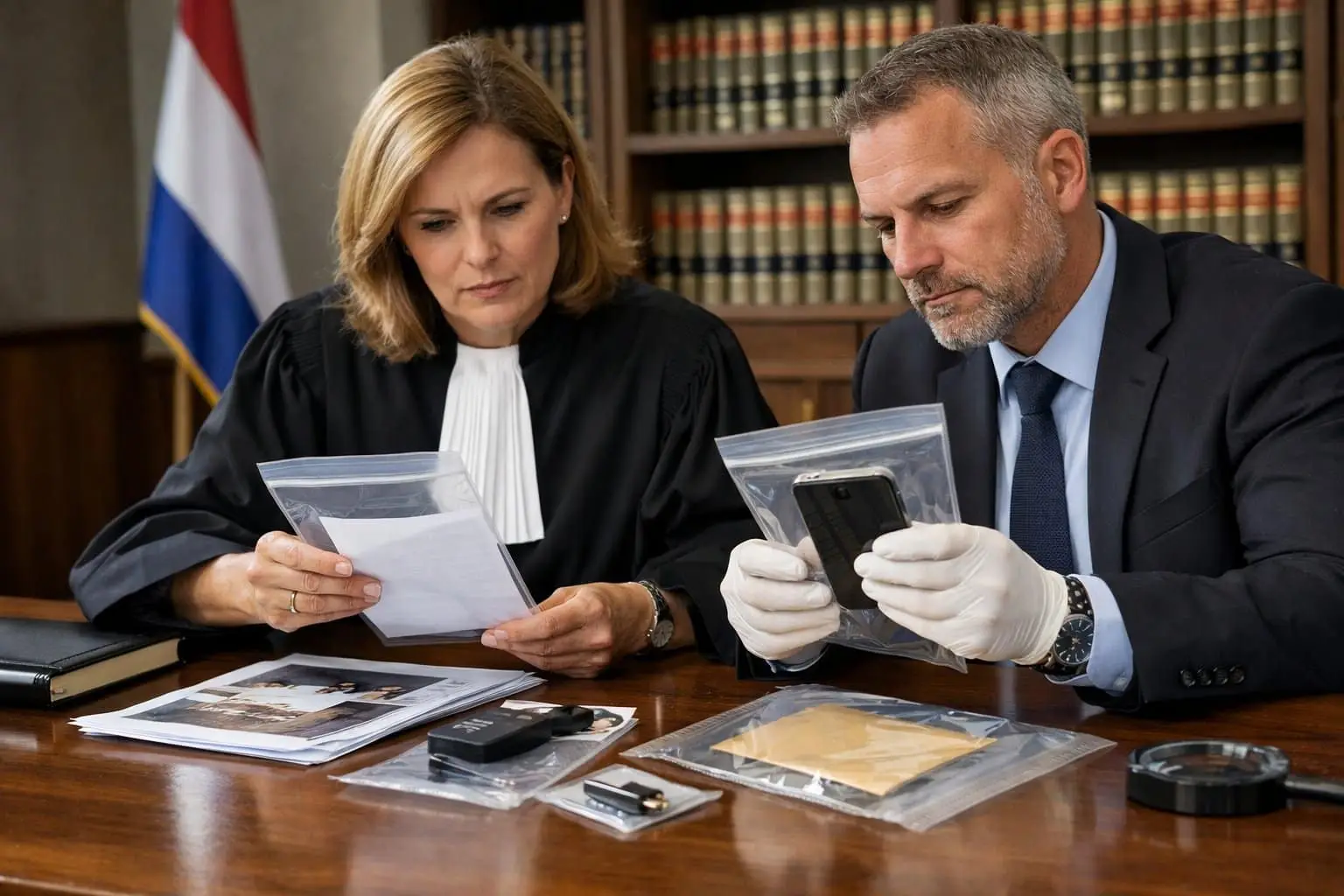
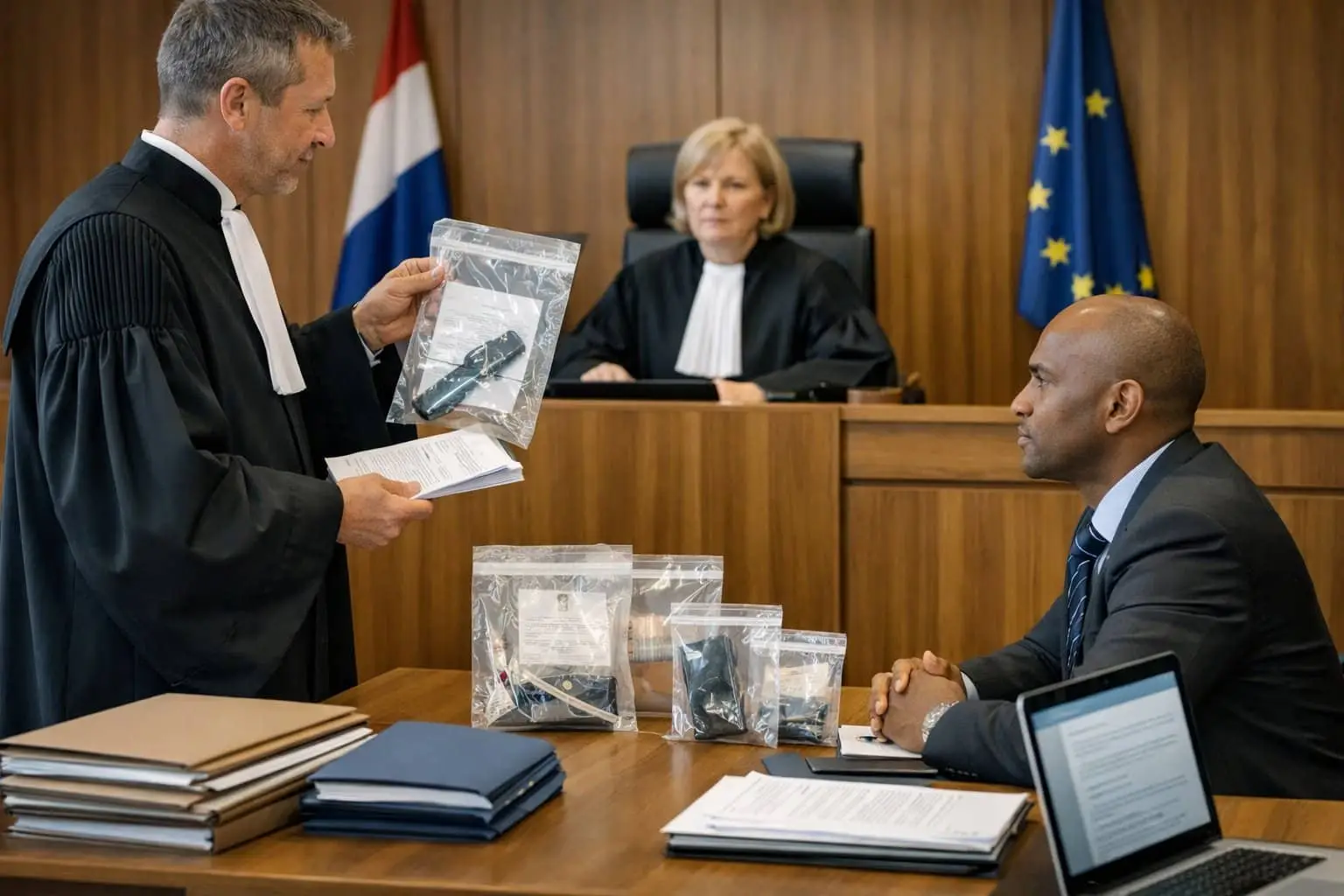
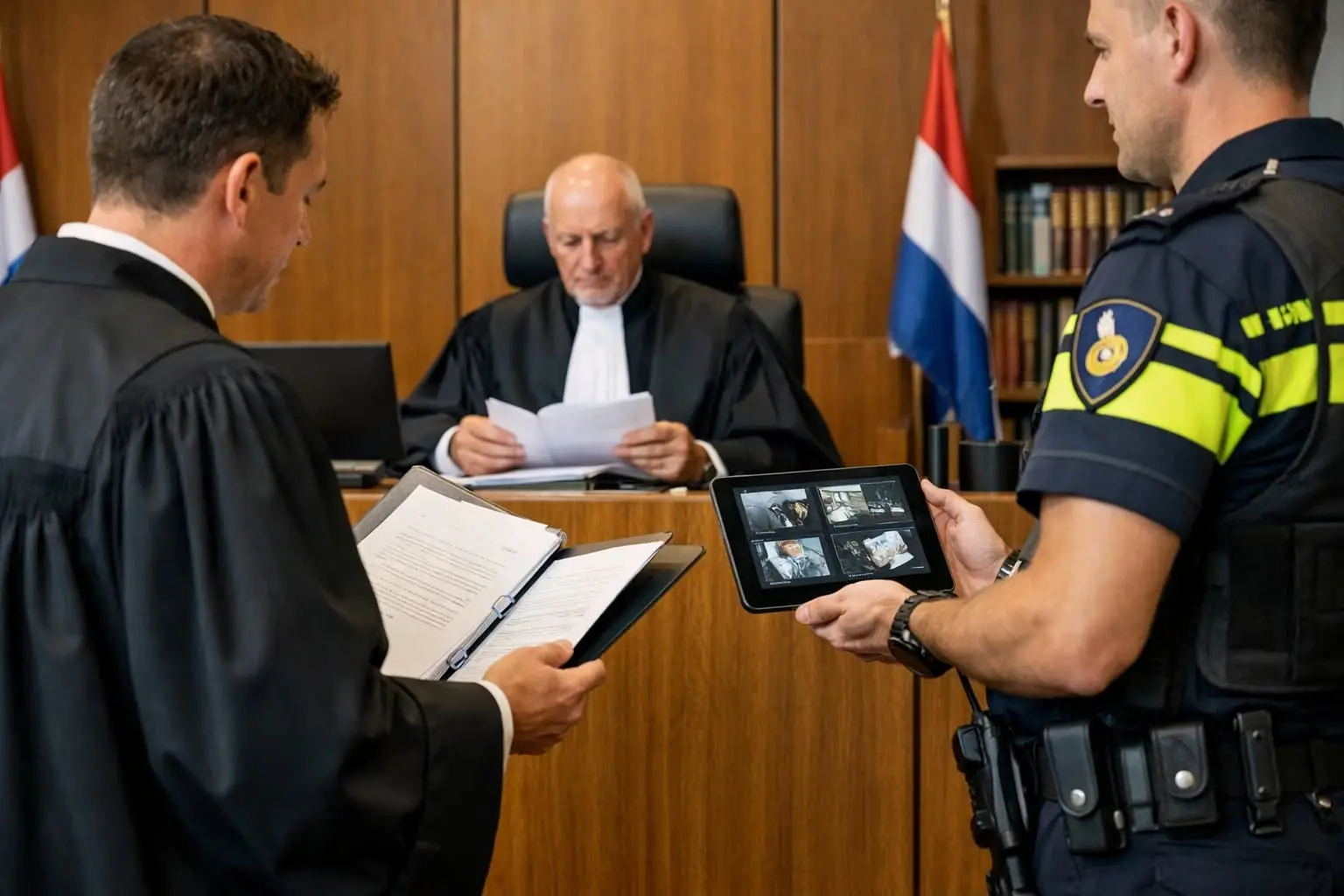
Evidence rules shape every criminal case in the Netherlands, determining which information judges can consider when deciding guilt or innocence.
In Dutch criminal proceedings, most forms of evidence are admissible as long as they meet basic requirements of relevance and reliability, though illegally gathered evidence may be excluded depending on how serious the violation was.
Understanding what counts as valid evidence can make the difference between a conviction and an acquittal.

The Dutch system takes a practical approach to evidence.
Written statements often carry as much weight as live testimony, and judges actively evaluate all materials presented rather than following strict hierarchies about which types of evidence matter most.
This flexibility means you need to understand both what can be used against you and how to challenge questionable evidence effectively.
Digital evidence now plays a central role in Dutch criminal cases, from mobile phone data to facial recognition systems.
As technology advances, the rules governing how police collect and present this information continue to evolve.
Overview of Evidence in Dutch Criminal Proceedings

Dutch criminal proceedings rely on a flexible approach to evidence that gives judges considerable authority in determining what information can be considered.
The system balances thorough fact-finding with protections for defendants through rules set out in the Code of Criminal Procedure.
Key Principles of the Dutch Evidentiary System
The Dutch evidentiary system operates under the principle of free evaluation of evidence.
This means judges have substantial freedom to assess and weigh evidence based on their professional judgement rather than strict predetermined rules.
You won’t find rigid hierarchies that automatically favour one type of evidence over another.
Dutch criminal law requires proof beyond reasonable doubt for conviction.
However, the Code of Criminal Procedure gives judges discretion in how they reach this standard.
They must base their decisions on evidence that is legally obtained and properly presented in court.
The immediacy principle plays a central role in Dutch criminal procedure.
This principle requires that evidence be presented in court in its most original form whenever possible.
Judges should directly examine evidence rather than rely solely on secondhand accounts.
Despite this requirement, Dutch courts do accept certain written statements and hearsay evidence in practice.
Role of Criminal Procedure Law
The Dutch Code of Criminal Procedure governs how evidence must be collected, presented, and evaluated in criminal courts.
This framework establishes both the powers of investigators and the limits on those powers to protect your rights as a suspect or defendant.
Criminal procedure law requires that investigators document their evidence-gathering activities thoroughly.
Police and prosecutors must follow specific protocols when conducting searches, seizures, and interrogations.
Any deviation from these requirements can affect whether evidence is admissible.
Your right to challenge evidence stems directly from procedural law.
The Code allows you to question the methods used to gather evidence and to present alternative interpretations.
Dutch criminal courts must consider these challenges when evaluating the reliability and validity of evidence.
Types of Evidence Used in Court
Dutch criminal courts accept various forms of evidence for fact-finding purposes.
Physical evidence includes items like weapons, documents, or forensic materials collected from crime scenes.
Witness testimony comes from individuals who observed relevant events or have pertinent knowledge about the case.
Expert testimony and forensic reports help judges understand technical or scientific aspects of cases.
These might include DNA analysis, financial records, or psychological assessments.
Digital evidence has become increasingly important, with Dutch courts now regularly considering data from phones, computers, and electronic systems.
Statements from suspects and defendants can be used as evidence, though you have the right to remain silent.
Judges evaluate all these evidence types together rather than applying fixed rules about which types carry more weight.
Admissibility Criteria in Dutch Criminal Law

Dutch criminal procedure establishes specific legal standards that determine whether evidence can be used in court, with judges holding significant discretion in evaluating materials.
The system balances the presumption of innocence with practical enforcement needs whilst maintaining fair trial protections.
Legal Standards for Admissibility
Dutch criminal procedure law does not impose a strict numerus clausus system for evidence types.
This means judges have broad discretion to consider various forms of evidence.
The Code of Criminal Procedure allows prosecutors and judicial authorities to present tangible evidence, witness statements, expert reports, and documentary materials during criminal trials.
The legal framework emphasises flexibility rather than rigid exclusionary rules.
You will find that most evidence is admissible unless specific legal provisions prohibit its use.
Written hearsay evidence is generally accepted in Dutch courts, contrasting with systems that require strict adherence to the immediacy principle.
The Supreme Court has confirmed that prosecutors can rely on written statements without calling witnesses to testify directly.
Criminal procedure law does impose limitations when evidence is obtained through serious violations of procedural rules.
Courts apply a balancing test that weighs the severity of the violation against the public interest in prosecution and the defendant’s right to a fair trial.
Minimum Evidence Rules
The Dutch evidentiary system requires at least two separate pieces of evidence to support a conviction.
This principle, known as the minimum evidence rule, protects the presumption of innocence by preventing convictions based solely on a single statement or document.
Your confession alone cannot lead to conviction without corroborating evidence.
Similarly, a single witness statement must be supported by additional proof.
This rule applies across all criminal trials, regardless of offence severity.
Judges must base their decisions on evidence presented during proceedings and documented in the official case file.
The public prosecutor bears the burden of providing sufficient admissible evidence to meet this standard whilst respecting the defendant’s rights under the rule of law.
Role of Judges in Evaluating Evidence
Judges in the Dutch criminal justice system actively assess evidence rather than passively receiving submissions from parties.
This inquisitorial approach means judicial authority extends to questioning witnesses, requesting additional investigation, and independently evaluating the reliability of presented materials.
Judges do not apply predetermined hierarchies when weighing evidence.
Written statements, forensic reports, and physical evidence are assessed holistically based on their reliability and relevance to the case.
The judge’s evaluation considers whether evidence was lawfully obtained and whether any procedural violations warrant exclusion of evidence.
The emphasis lies on judicial discretion guided by the principle of free evaluation.
Judges must provide reasoned decisions that explain which evidence they found credible and why certain materials were accepted or rejected in reaching their verdict.
Collection and Use of Digital Evidence
Digital traces left by individuals in criminal investigations form a significant portion of evidence in Dutch courts, appearing in over half of all cases.
Dutch law permits broad use of digital evidence whilst balancing this against data protection requirements under European regulations.
Regulation of Digital Traces
Digital evidence in Dutch criminal proceedings falls under both national criminal procedure law and European data protection frameworks.
The Law Enforcement Directive (Directive 2016/680) governs how law enforcement processes personal data during criminal investigations.
This directive works alongside the General Data Protection Regulation to protect digital privacy.
Dutch courts accept most forms of digital evidence without strict admissibility rules.
Judges evaluate written materials rather than requiring witnesses to testify about digital traces in court.
This approach allows prosecutors to present data from smartphones, computers, and online services directly.
The eEvidence regulation, effective from March 2026, will strengthen cross-border exchange of digital evidence within the EU.
This regulation applies to data stored with internet service providers, including domain providers, mobile phone services, and online gaming platforms.
Digital Forensics and Investigation Methods
Dutch investigators use several techniques to collect digital evidence from devices and networks.
Network searches allow police to access data from connected devices, whilst smartphone searches extract messages, location data, and application information.
Investigators must follow proper collection procedures to ensure digital evidence remains admissible.
This includes documenting the chain of custody and preserving original data.
Privacy impact assessments help balance investigative needs against individual privacy rights protected under privacy law.
Digital forensics specialists analyse seized devices to recover deleted files, trace communications, and establish timelines.
These methods produce evidence that Dutch courts regularly accept, provided investigators followed lawful procedures during collection.
AI and Automated Data Analysis
Dutch law enforcement employs AI-based systems for processing large volumes of digital evidence.
Hansken extracts relevant data from massive data sets, allowing investigators to search through seized computers and storage devices efficiently.
CATCH provides facial recognition capabilities to identify suspects in images and videos.
These automated data analysis tools speed up digital investigations that would otherwise require months of manual review.
However, Dutch law does not yet provide specific regulations for AI systems used in evidence production.
The draft Code of Criminal Procedure lacks provisions addressing how courts should evaluate evidence generated by automated systems.
Privacy concerns arise when AI analyses personal data during investigations.
Data protection law requires that automated processing serves legitimate law enforcement purposes and includes appropriate safeguards.
Courts must consider whether AI-generated evidence meets reliability standards despite limited regulatory frameworks.
Procedures for Gathering and Challenging Evidence
Police and prosecutors use specific investigative measures to collect evidence, whilst the defence has legal tools to challenge this process.
Witness testimony and expert reports follow strict protocols, and the Public Prosecution Service oversees the entire evidence-gathering framework.
Investigative Measures by Police and Prosecutors
The police conduct the initial criminal investigation under supervision from the public prosecutor.
They can use various investigative measures including searches, seizures, forensic analysis, and digital evidence collection.
Each measure requires proper legal authorisation.
Your case file is built through documented evidence that meets legal standards.
The police must follow strict protocols when gathering physical evidence, conducting interviews, or performing technical investigations.
All actions are recorded in official reports.
The public prosecutor’s office directs the investigation and determines which measures are necessary.
They decide when to involve forensic experts or request additional investigative powers.
For serious cases, an investigatory judge may authorise special measures like wiretaps or surveillance.
Evidence gathering must respect your fundamental rights.
Investigators cannot use arbitrary methods, and they must maintain proper documentation of how evidence was obtained.
This creates a clear trail that can be examined later during the trial process.
Role of the Defence and Legal Assistance
You have the right to legal assistance from the moment you become a suspect.
Your lawyer can challenge investigative measures, question the reliability of evidence, and request additional investigations.
This ensures the police investigation remains balanced.
The defence can introduce its own evidence, including alternative expert reports or witness statements that contradict the prosecution’s case.
Your lawyer reviews all collected evidence and identifies procedural errors or violations of your rights.
During the trial process, your legal representative can cross-examine prosecution witnesses and challenge the admissibility of evidence.
They can argue that certain evidence should be excluded because it was gathered illegally or is unreliable.
Witness Testimony and Expert Evidence
Witness statements form a key part of criminal cases in the Netherlands.
Witnesses provide their accounts to police during the investigation, and these written statements can be used at trial.
The court evaluates the reliability of each witness based on consistency and credibility.
Expert witnesses offer specialised knowledge in areas like forensics, medicine, or digital technology.
The public prosecution service often commissions expert reports to support their case.
You can request your own experts to provide alternative analyses.
The court carefully weighs expert evidence based on the expert’s qualifications, methodology, and independence.
Written expert reports are commonly used, though experts may be called to testify in person for complex cases.
Public Prosecution Service Responsibilities
The Public Prosecution Service holds ultimate responsibility for the criminal investigation’s integrity.
They ensure that police follow proper procedures and that evidence meets legal standards for admissibility.
The public prosecutor decides which evidence to present at trial.
Your case file must contain all relevant evidence, including information that might support your defence.
The public prosecutor cannot withhold exculpatory evidence.
They balance the pursuit of justice with protecting your procedural rights throughout the investigation.
Exclusion and Challenges of Illegally Gathered Evidence
Dutch courts weigh multiple factors when deciding whether illegally gathered evidence should be excluded, distinguishing between violations of procedural rules and questions of reliability.
The approach balances the suspect’s rights with the pursuit of truth, creating a flexible system that considers the severity of each breach.
Standards for Exclusion of Evidence
Section 359a of the Dutch Code of Criminal Procedure sets out when illegally gathered evidence may be excluded. The court examines three key factors: the interest the violated rule serves, the gravity of the breach, and the harm it causes.
The breach must be irremediable to trigger exclusion. If you were not informed of DNA test results, the court checks whether you can still request a second opinion.
Exclusion only occurs when no remedy exists. Professional judges handle both the exclusion decision and the trial itself.
This means the same judge who sees excluded evidence must ignore it when deciding guilt. The system trusts professional judges to compartmentalise this knowledge, though critics worry unconscious bias may occur.
Possible sanctions under Section 359a include:
- Reduction of sentence proportionate to the breach
- Exclusion of evidence obtained through the breach
- Dismissal of the case if a fair trial becomes impossible
Privacy infringement and violations of the right to privacy fall under this framework. The court considers whether the breached rule protects your interests specifically or serves broader purposes.
Illegally Gathered vs. Unreliable Evidence
Dutch law treats illegally gathered evidence differently from unreliable evidence. Unreliable evidence gets excluded because it undermines the search for truth.
Illegally gathered evidence may be reliable but obtained through procedural violations. When evidence is unreliable because of illegal gathering methods, courts exclude it based on unreliability alone.
The procedural legality principle becomes secondary. For example, a coerced confession violates both the nemo tenetur principle (the right against self-incrimination) and produces unreliable statements.
Evidence that is illegally gathered but still reliable presents the harder question. A search without proper authorisation may uncover genuine physical evidence.
Courts then apply Section 359a to weigh the breach’s severity. The distinction matters because different legal bases apply.
Unreliable evidence never contributes to conviction under truth-seeking principles. Illegally gathered but reliable evidence requires specific balancing under exclusionary rules.
Case Law and Practical Examples
The Supreme Court’s 30 March 2004 judgment established current standards for Section 359a application. Courts must verify two preconditions before considering exclusion: the breach occurred during investigation of the specific offence charged, and the breach cannot be remedied.
If police tap Person A’s phone illegally and discover evidence against Person B, that evidence remains admissible in Person B’s trial. The breach occurred during a different investigation, not the one targeting Person B.
Court practices show flexibility in actual practices. Minor procedural errors rarely lead to exclusion.
A missing signature on a warrant differs from conducting warrantless searches of your home. The latter represents a serious privacy infringement warranting stronger sanctions.
Dutch law therefore allows illegally gathered evidence unless specific circumstances justify exclusion. This differs from stricter exclusionary rules in some jurisdictions that automatically exclude such evidence.
International and European Considerations
Dutch criminal evidence law operates within broader European frameworks that shape how evidence is collected, shared, and admitted across borders. The European Convention on Human Rights sets fundamental standards, whilst EU mechanisms facilitate cross-border cooperation amongst member states.
Judicial Cooperation and Mutual Recognition
The European Union relies on mutual recognition to handle evidence gathered in cross-border criminal investigations. When Dutch authorities request evidence from another member state, the principle assumes that evidence lawfully obtained abroad should generally be admissible in Dutch courts.
The European Investigation Order provides the primary legal framework for this cooperation. Dutch law enforcement agencies use this mechanism to request investigative measures from other member states.
Eurojust supports coordination in complex cross-border cases involving multiple jurisdictions. Dutch courts face challenges when evidence arrives from countries with different procedural standards.
If Hungarian authorities conduct a search without judicial approval, which would require court authorisation in the Netherlands, Dutch judges must decide whether to admit that evidence. The lex loci principle typically governs, meaning evidence collected lawfully according to the laws where it was gathered is presumed admissible.
Compliance with the European Convention on Human Rights
The ECHR establishes minimum standards that Dutch criminal procedure must respect when collecting and using evidence. Article 6 guarantees the right to a fair trial, which directly affects evidence admissibility.
The Council of Europe’s monitoring ensures member states, including the Netherlands, comply with these standards. Dutch courts examine whether evidence obtained through methods that violate ECHR rights should be excluded.
Evidence gained through torture or inhuman treatment is automatically inadmissible. Other violations require judicial balancing to determine if admitting the evidence would render the trial unfair overall.
The European Court of Human Rights reviews Dutch decisions when applicants claim their Article 6 rights were breached. This case law influences how Dutch courts interpret their own exclusionary rules in practice.
Comparative and Cross-Border Evidence Issues
Common law systems typically impose stricter exclusionary rules than the Dutch approach. Evidence that would be automatically excluded in England or Ireland might be admitted in Dutch proceedings after judicial assessment.
This creates practical challenges in cross-border cases. Dutch law does not distinguish between domestically gathered evidence and evidence obtained through international cooperation.
The same admissibility standards apply regardless of where you collected the evidence. This differs from some member states that maintain separate rules for foreign evidence.
The lack of harmonised EU rules on evidence admissibility means Dutch courts apply their own standards when assessing evidence from abroad. Procedural justice requirements under Dutch law focus on whether the evidence-gathering method violated fundamental rights, not merely whether it breached foreign procedural rules.
Frequently Asked Questions
Dutch criminal evidence law operates under principles that prioritise substantive truth whilst maintaining procedural safeguards. Courts evaluate a broad range of evidence types, though specific rules govern admissibility and assessment.
What types of evidence are considered legally valid in Dutch criminal law?
Dutch courts accept multiple forms of evidence in criminal proceedings. Physical evidence, witness statements, expert reports, and documentary materials all qualify as valid evidence.
The system follows a free evaluation principle, which means judges have considerable freedom in assessing what evidence to accept and how much weight to give it. Hearsay evidence receives acceptance in Dutch criminal law.
This differs from some other legal systems that strictly limit or exclude hearsay. Written materials often form the basis of evidence evaluation, and many cases proceed without calling witnesses to testify in court.
How does the process of forensic investigation operate in the Netherlands?
Police investigators collect evidence after receiving a report or discovering a criminal offence. The investigation phase focuses on gathering all materials relevant to establishing the facts of the case.
Officers may request your cooperation during this process. Physical evidence, statements, and observations all contribute to the investigation.
Dutch criminal procedure follows a moderately inquisitorial approach, meaning investigators actively seek truth rather than simply responding to claims presented by opposing sides. The police work under supervision of the Public Prosecution Service during the investigation phase.
Can digital or electronic evidence be used in Dutch courtrooms, and under what conditions?
Digital evidence plays an increasingly important role in Dutch criminal proceedings. Courts accept electronic data as evidence when it meets general admissibility standards.
AI-based systems like Hansken help gather data from large datasets, whilst tools like CATCH assist with facial recognition. The use of digital evidence must comply with both criminal procedure law and data protection regulations.
Current Dutch law does not contain comprehensive specific provisions for AI-generated evidence. Judges assess the reliability and validity of digital evidence using the same free evaluation principles applied to traditional evidence types.
What are the rules regarding the admissibility of witness testimonies in Dutch criminal trials?
Witness statements qualify as admissible evidence when they relate to facts within the witness’s personal knowledge. You cannot testify about matters you did not directly observe or experience yourself.
Parties may request to present witness evidence when disputed facts could help resolve the case. The immediacy principle requires evidence to be produced and examined during the trial phase.
However, Dutch courts frequently rely on written witness statements rather than live testimony. This practice stems from the broader acceptance of hearsay and written materials in Dutch criminal procedure.
What role does chain of custody play in the integrity of evidence in the Netherlands?
Chain of custody refers to the documented process of evidence handling from collection through presentation in court. Proper documentation ensures evidence remains uncontaminated and authentic.
Dutch law requires investigators to maintain clear records of who handled evidence and when. Breaks in the chain of custody can affect evidence reliability.
Judges evaluate whether procedural irregularities in evidence handling undermine its trustworthiness. Your defence lawyer may challenge evidence that lacks proper documentation or shows signs of tampering.
How is illegally obtained evidence treated by Dutch courts?
Dutch criminal procedure includes exclusionary rules that address unlawfully obtained evidence. Courts balance several factors when deciding whether to exclude evidence.
The seriousness of the rights violation weighs against the interests of justice and truth-finding. Evidence obtained through violations of privacy rights or privilege against self-incrimination may face exclusion.
However, Dutch law does not automatically exclude all illegally obtained evidence. Judges have discretion to decide based on the specific circumstances.