Looking for the right guide to a Dutch civil law dispute? This page groups our English guides by subject, so you can go straight to the one that fits your situation. Most civil disputes come down to three questions: what was agreed, who is liable, and what can still be enforced.
The rules sit mainly in the Dutch Civil Code (Burgerlijk Wetboek, BW) and the Dutch Code of Civil Procedure (Wetboek van Burgerlijke Rechtsvordering, Rv). You can consult both on wetten.overheid.nl, the official government database of Dutch legislation. The guides below explain how these rules work in practice.
Who is liable for damage?
Under Dutch law, you can claim compensation if someone breaches a contract (Article 6:74 BW) or commits an unlawful act against you (Article 6:162 BW). The guides below apply these rules to specific situations, from foundation damage to delayed flights.
- Foundation damage: how liability is assessed
- Liability within companies and groups
- Industrial power outages: who pays for the damage?
- Delayed or cancelled flights: your rights under EU Regulation 261/2004
How do you recover a debt and enforce a claim?
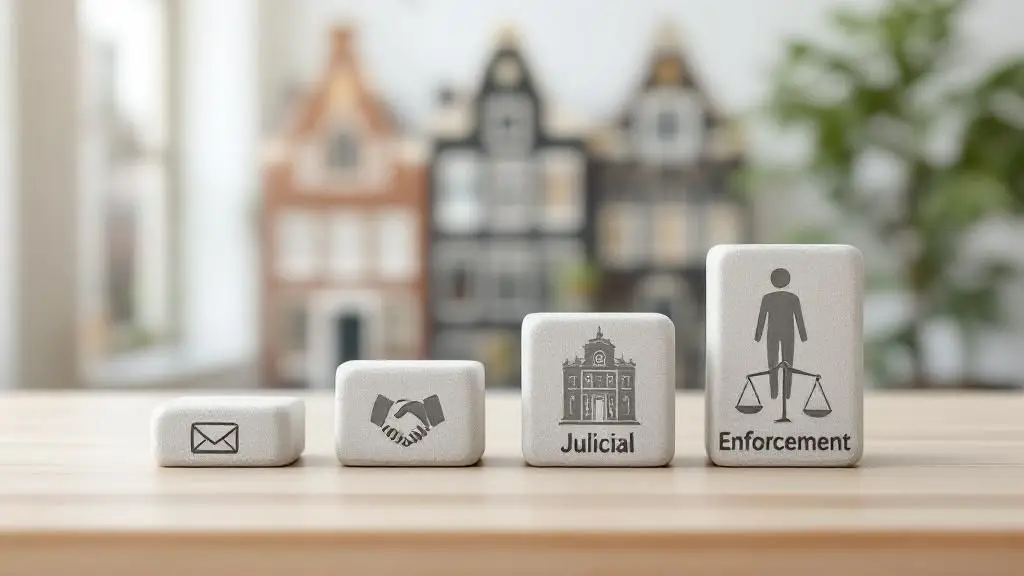
A creditor who is not paid needs an enforceable title, usually a court judgment, before a bailiff (gerechtsdeurwaarder) can seize assets. Insolvency and debt restructuring procedures limit what you can still recover.
- Large amounts of cash seized: what are your rights?
- What can a creditor still recover after a WSNP debt restructuring?
Can you challenge an attachment or a judgment?
An attachment or a judgment is not always the end of the matter. You can ask the court to lift a prejudgment attachment (conservatoir beslag), and you can oppose a default judgment (verstekvonnis) within the statutory period.
- Lifting a prejudgment attachment: when is it possible?
- Setting aside a default judgment (verzet against a verstekvonnis)
Other questions in this field
The guides below cover consumer rights, contract law, the role of a lawyer, and the time limits within which you must bring a claim.
- A salesperson at your door: what are your rights as a consumer?
- What does legal representation mean?
- What does a lawyer do?
- Dutch contract law: where freedom of contract meets mandatory rules
- Online purchases and subscriptions: when does automatic renewal bind you?
- Limitation periods in Dutch law
- How To Claim Lost Money From Casinos Without License
Guides in our other practice areas
- Employment law in the Netherlands
- Family law in the Netherlands
- Corporate law in the Netherlands
- Dutch criminal law
- IT and privacy law in the Netherlands
- Dutch immigration law
- Dutch real estate law
- Dutch energy law
In summary
- Liability usually arises from a breach of contract (Article 6:74 BW) or an unlawful act (Article 6:162 BW).
- A creditor needs an enforceable title before a bailiff can seize assets.
- You can ask the court to lift a prejudgment attachment, and you can oppose a default judgment within the statutory period.
- Claims become time-barred, so check the limitation period that applies to your situation.
Law & More assists individuals and companies with contract disputes, liability claims and debt recovery.
Unsure where you stand? Tell us about your situation. We will let you know your options within one working day.
How Law & More can help you with this is explained on our civil lawyer page.