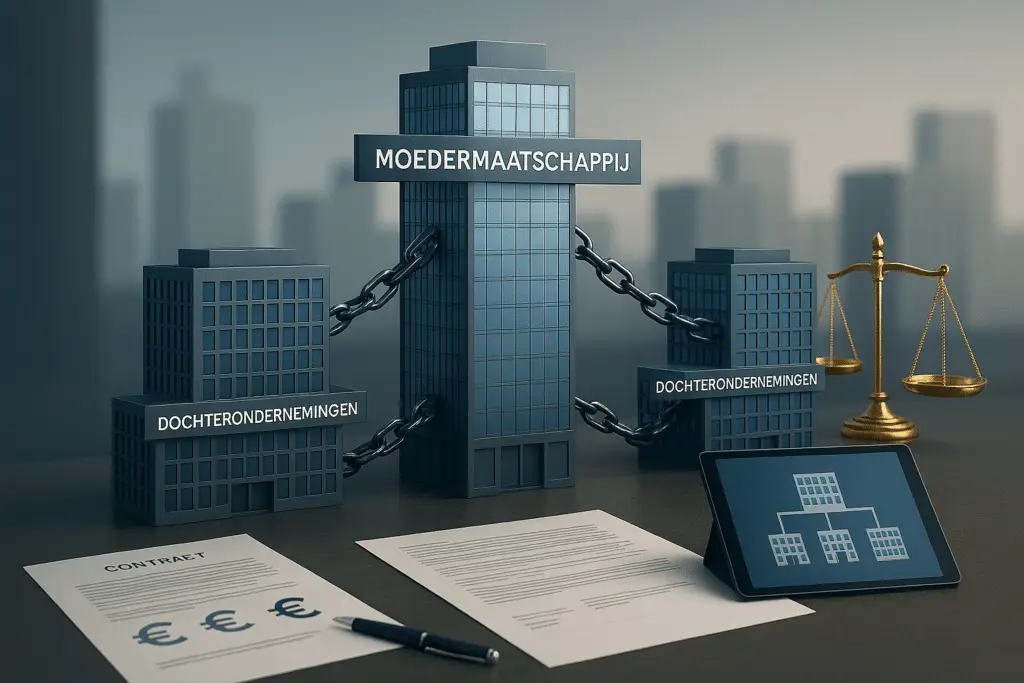
A parent or sister company in the Netherlands is not liable for another group company’s debts merely because it owns the shares. It becomes liable through a 403 declaration under Article 2:403 of the Dutch Civil Code (BW), through group liability for joint unlawful conduct under Article 6:166 BW, or through its own breach of a duty of care towards the subsidiary’s creditors under Article 6:162 BW.
The 403 declaration is a voluntary written statement in which a parent accepts joint and several liability (hoofdelijke aansprakelijkheid) for debts arising from a subsidiary’s legal acts. Group liability under Article 6:166 BW makes every company that made a relevant contribution to unlawful conduct within a group liable for the whole of the resulting damage.
That distinction decides most disputes. A creditor of a collapsed subsidiary has to point to a declaration filed with the trade register, to unlawful conduct in which the parent took part, or to a breach of a duty of care the parent owed to the creditors. Below we set out the three routes, the case law that limits them, the defences of a group company, the withdrawal of a 403 declaration and the limitation periods.
Table of contents
What do corporate and group liability mean in Dutch law?
Dutch company law starts from the separateness of each legal entity, and group liability is the set of exceptions to it. Each company owes its own debts; a shareholder is in principle only liable for what it undertook to pay on its shares.
A private limited company (besloten vennootschap, BV) owes its own debts; that is the point of the legal form, as explained in our guide to the BV and limited liability. Group liability is the set of exceptions that stops this separateness from becoming a shield for conduct that harms creditors.
Two definitions matter before the exceptions do. Article 2:24a BW defines a subsidiary (dochtermaatschappij), essentially by reference to voting control or the power to appoint and dismiss the majority of the board. Article 2:24b BW defines a group (groep) as an economic unit in which legal entities and companies are organisationally connected. Whether a company belongs to a group is therefore a question of actual organisation, not of a label in an annual report.
Against that background, there are three bases of liability.
- Liability a parent takes on voluntarily through a 403 declaration.
- Group liability under Article 6:166 BW, imposed by law on companies that acted together unlawfully.
- The parent’s own wrongful act (onrechtmatige daad) under Article 6:162 BW, which is where the duty of care towards a subsidiary’s creditors comes in.
All three can be relied on in the same proceedings, and in practice they usually are.
When is a parent liable through a 403 declaration?
A parent is liable through a 403 declaration when it has filed a written statement at the trade register accepting joint and several liability for the debts arising from the legal acts of a named group company. For the creditor, this is the easiest route: it only has to show the declaration and the debt.
The 403 declaration is filed at the trade register of the Chamber of Commerce (KVK). It is not a favour to creditors; it is the price of an exemption. A group company covered by a valid declaration does not have to prepare and publish its own annual accounts under Title 9 of Book 2 BW, provided the other conditions of Article 2:403 BW are met.
Those conditions include that the group company’s figures are consolidated in the group accounts of another legal entity, that the shareholders have given written consent to the exemption for the financial year, and that the consent and the declaration are filed at the trade register.
For a creditor, there is nothing to prove about influence, involvement or fault. The creditor shows the debt, shows the declaration, and sues the parent for the full amount. Under Article 6:7 BW, joint and several liability means that the creditor may claim the whole sum from either debtor, and that payment by one discharges the other towards the creditor.
Two limits are worth knowing.
- The declaration covers debts arising from legal acts of the group company, so in essence contractual debts and their consequences. It is not a general guarantee for every liability the subsidiary might incur, and claims based on a wrongful act are in principle outside its scope.
- It only covers the entities named in it. In a group of fifteen companies, a declaration may exist for three. You check this by consulting the trade register file and the subsidiary’s published accounts, where the exemption and the declaration are normally disclosed.
Can the parent withdraw the declaration?
Yes, but withdrawal only works for the future, and ending the remaining liability for older debts requires a separate procedure. Creditors can oppose that procedure within two months.
A parent may withdraw a 403 declaration at any time by filing a statement to that effect at the trade register, under Article 2:404(1) BW. Under Article 2:404(2) BW, the parent remains liable for debts arising from legal acts performed before the withdrawal could be invoked against the creditor. That remaining liability (overblijvende aansprakelijkheid) is what a supplier with a long-running contract actually cares about.
Ending the remaining liability is a separate and much heavier exercise. Article 2:404(3) BW allows it only if all of the following conditions are met.
- The group company no longer belongs to the group.
- A notice of the intention to end the remaining liability has been available for inspection at the trade register for at least two months.
- At least two months have passed since that intention was announced in a nationally distributed daily newspaper.
- The creditor did not object in time, withdrew its objection, or its objection was finally dismissed.
The creditor’s tool here is opposition (verzet). Under Article 2:404(5) BW, a creditor whose claim is still covered can file a petition with the court within two months of the announcement. Under Article 2:404(4) BW, the creditor can demand security or another safeguard for its claim, unless the entity’s financial position already gives sufficient assurance of payment.
The practical consequence is simple. A creditor that spots a newspaper announcement or a trade register filing and does nothing for two months may lose its recourse against the parent. A creditor that reacts usually ends up with security.
When are group companies liable under Article 6:166 BW?
Group companies are liable under Article 6:166 BW when they took part in unlawful conduct as a group, the risk of damage should have held them back, and the conduct can be attributed to each of them. Each participant is then liable for the whole of the damage.
Article 6:166 BW makes each member of a group that acts unlawfully jointly and severally liable for the whole of the damage, if the chance of causing damage should have restrained them from that conduct and the conduct can be attributed to them. The provision was not written for company groups; it applies to any group of persons acting together. Courts apply it to company groups only where the companies genuinely acted together; its value is that the individual causal contribution of each participant does not have to be established.
The claimant therefore does not need to show which company performed the decisive act. An example to illustrate: take a hypothetical group in which one company decides to dispose of waste unlawfully, a second arranges the transport and a third supplies the drums. Under the ordinary rules each of them would argue about its own share in causing the damage. Under Article 6:166 BW they are liable for the entire damage together, and the argument about shares moves to the internal settlement between them.
What the claimant does have to establish is threefold.
- There was conduct in group formation, rather than a series of unconnected acts.
- The risk of damage was such that it ought to have deterred the participants.
- The conduct can be attributed to the defendant in question.
The third element keeps the provision within bounds. Membership of a group, a shareholding, a shared brand or a consolidated balance sheet are not conduct. The claimant has to point to something the company itself did, or knowingly allowed.
A group-wide incident, such as a security failure that affects the customers of several group companies, can raise the same questions of attribution. Our article on liability after a data breach discusses who is responsible in that situation.
Which defences does an individual group company have?
The main defences are that the company made no relevant contribution to the harmful conduct, and that the risk of damage was not visible to it. Both are won or lost on documents.
The central defence is the absence of a relevant contribution to the conduct that caused the damage. A company that neither decided, nor carried out, nor knowingly facilitated the conduct is outside the reach of Article 6:166 BW, however closely it is tied to the group in corporate terms. Receiving an ordinary dividend, sharing an accountant, sitting in the same building or benefiting indirectly from a profitable but unlawful activity is not in itself participation.
The second defence concerns foreseeability. Liability requires that the prospect of damage should have restrained the participants. A company that supplied goods to a sister company on ordinary commercial terms, without knowing or having reason to suspect what they would be used for, can argue that the risk could not have deterred it, because it could not see it.
Both defences depend on evidence. The claimant must first put forward facts from which participation in group conduct can be inferred. A defendant that limits itself to a denial will rarely be believed once those facts are on the table.
What works is documentary evidence: board minutes showing the defendant was not consulted, correspondence showing it was not informed, an organisational chart showing where the decision-making authority lay, and management agreements that placed the activity elsewhere. Documents from the time are worth far more than a witness statement drafted after the claim arrived.
When is a parent liable without a 403 declaration?
A parent can be liable to its subsidiary’s creditors for its own wrongful act under Article 6:162 BW, if it was closely involved in the subsidiary’s policy and knowingly let creditors bear the risk. The Supreme Court accepted this in the Comsys judgment.
In Comsys (Hoge Raad 11 September 2009, ECLI:NL:HR:2009:BH4033), the holding was sole shareholder and director of two subsidiaries: one employed the staff and bore the costs, the other contracted with and invoiced the clients. The cost-bearing subsidiary made losses from 1999, which were covered through current-account financing without its costs being fully recharged. When the bank ended the credit in 2003, it went bankrupt and its creditors were left unpaid.
The Supreme Court upheld the finding that the holding, as director, knew the structure would harm the subsidiary’s creditors once the financing stopped, and had done nothing to protect them. The claim was brought by the trustee in bankruptcy. The sister company was not liable: cooperating in the group’s division of tasks is not unlawful in itself.
The recurring elements in this line of case law are close administrative and financial integration, a subsidiary that depends financially on the parent, and knowledge on the parent’s side that the group’s financial policy leaves creditors unpaid. Intensive involvement in the subsidiary’s policy, letting risks run while knowing that creditors will bear them, and creating a misleading impression of the subsidiary’s solvency are the situations in which the duty bites.
What the case law does not do is impose a general duty to rescue. A parent is not obliged to fund a subsidiary in difficulty, nor to warn every counterparty that the subsidiary is making losses. The duty arises from the parent’s own involvement. Where the parent kept its distance, did not interfere in the subsidiary’s commercial decisions and gave no assurances, the ordinary rule applies and the creditor’s recourse ends with the subsidiary’s assets.
When the individual board members can be held personally liable is a related question, dealt with in our article on director’s liability of a Dutch BV director.
Does EU competition law work differently?
Yes. European competition law follows its own logic and should not be confused with the civil rules above. For the purpose of fining a cartel, the Court of Justice of the European Union treats a parent and a wholly owned subsidiary as one undertaking. It applies a rebuttable presumption that the parent exercised decisive influence over the subsidiary’s conduct, as confirmed in Akzo Nobel (Case C-97/08 P, 10 September 2009).
The parent may rebut that presumption, but only with concrete evidence that the subsidiary acted autonomously on the market. Outside competition law, the presumption does not exist, and a claimant cannot borrow it to make a civil claim easier.
Which route should a creditor take?
A creditor does not have to choose: the routes rest on different legal bases and can be relied on together. The sensible order follows the burden of proof, starting with a 403 declaration if there is one.
The routes can be pleaded together or in the alternative. The creditor cannot recover more than its actual loss: once one jointly and severally liable debtor has paid, Article 6:7 BW discharges the others towards the creditor.
In practice the burden of proof dictates the order. If a valid 403 declaration exists, that is the primary claim, because it requires nothing beyond the declaration and the debt. Group liability under Article 6:166 BW comes next: it reaches a wider circle of defendants, but requires evidence of joint conduct and foreseeability. A claim against the parent for breach of its duty of care, or against the individual directors, is the third layer. Including all three in one writ of summons costs little extra and keeps every option open if the first fails.
| Aspect | 403 declaration (Article 2:403 BW) | Group liability (Article 6:166 BW) |
|---|---|---|
| What must exist | A declaration filed at the trade register whose remaining liability has not been effectively ended | Unlawful conduct in group formation that caused damage |
| What the creditor must prove | The declaration and the debt | Joint conduct, a foreseeable risk of damage and attribution to each defendant |
| Who can be addressed | The company that issued the declaration, alongside the group company named in it | Every group company that made a relevant contribution |
| Available defences | Limited: scope of the declaration, effective termination, limitation | No relevant contribution, no foreseeable risk, no attribution |
| Limitation | Follows the underlying debt, for a contractual payment claim in principle Article 3:307 BW | Article 3:310 BW: five years from knowledge, twenty years at the latest |
Before anything is filed, map the group. Order the trade register files of the subsidiary and of every entity above it, retrieve the last published accounts, and establish for each company whether it decided, carried out, financed or merely received. That mapping determines who is named in the summons and what has to be argued against each of them.
Where the subsidiary is already insolvent, the trustee’s position and the creditor’s own position must be distinguished carefully. Our article on an insolvent counterparty in court proceedings explains that interaction.
What if the group company is already bankrupt?
Bankruptcy of the group company changes who may sue for what. The trustee brings the claims that harm all creditors together; an individual creditor keeps its own claim only for damage that is its own. A claim under a 403 declaration is not affected by the bankruptcy.
The trustee (curator) administers the estate and brings the claims that belong to the company itself, including the claim against its own directors for improper management. The Dutch Supreme Court has also long accepted that a trustee may bring a claim on behalf of the joint creditors against a third party whose wrongful conduct harmed them collectively, known after the Peeters/Gatzen judgment. The Comsys case was an example of a claim brought by the trustee. Where the trustee pursues that route, the proceeds fall into the estate and are distributed according to the statutory ranking.
An individual creditor keeps its own claim where the damage it suffered is its own and not merely a reflection of the loss suffered by all creditors together. A supplier that was induced to keep delivering after the parent knew the subsidiary could no longer pay has a personal claim. A creditor complaining only that the estate is empty does not. Distinguishing the two at the outset prevents a claim from being dismissed for lack of standing, and it also shows whether it is worth approaching the trustee to coordinate rather than litigate in parallel.
A 403 claim is not affected by the subsidiary’s bankruptcy. The parent’s liability is its own and exists alongside the subsidiary’s debt. The creditor may sue the parent while filing its claim in the bankruptcy. What it may not do is collect twice: whatever it receives from the estate reduces what it can still recover from the parent.
How does a creditor combine the routes in practice?
An example to illustrate: a Dutch supplier delivers packaging for years to a distribution BV that belongs to an international group. The distribution BV goes bankrupt with an unpaid balance.
The supplier first checks the trade register and finds that the Dutch holding filed a 403 declaration for the distribution BV. It files its claim with the trustee and at the same time claims the full amount from the holding under the declaration. It also sends letters interrupting limitation to the holding and to the sister company that ran the group’s purchasing, reserving its rights under Article 6:166 BW and Article 6:162 BW in case the declaration turns out to have been withdrawn in time.
How long do you have to bring a claim?
A claim for damages under Article 6:166 BW lapses five years after you became aware of the damage and the liable party, and a 403 claim follows the limitation period of the underlying debt. The clocks run separately per debtor and per legal basis, and more group liability claims fail on limitation than on the merits.
A claim for damages under Article 6:166 or 6:162 BW lapses five years after the day following the day you became aware of both the damage and the liable party, and in any event twenty years after the event (Article 3:310 BW). A claim under a 403 declaration follows the underlying debt; for a contractual payment claim that is five years from the day after it became due (Article 3:307 BW).
The clocks run separately for each debtor and each legal basis. Interrupting limitation against the parent does nothing for the claim against a sister company, so keep a matrix: one row per debtor, one column per legal basis.
Under Article 3:317 BW, limitation is interrupted by a written demand, or a written communication in which you unequivocally reserve your right to performance. Identify the debtor, describe the claim and its basis, state the amount or say it is not yet quantified, and reserve all rights expressly.
Send it separately to every entity, keep proof of dispatch and receipt, and repeat it within each new limitation period until proceedings are issued. Issuing a writ of summons also interrupts limitation, provided the proceedings are pursued.
Forfeiture of rights (rechtsverwerking) is a separate and narrow risk. The passage of time alone is not enough: the debtor must have gained a justified expectation that you will not enforce, or its position must have been unreasonably harmed by the delay. Negotiating while reserving rights in writing does not lead to forfeiture.
Who ultimately pays within the group?
Joint and several liability decides whom the creditor may sue, not who bears the loss in the end. Under Article 6:166(2) BW, participants contribute in equal shares, unless fairness requires a different split; a parent that pays under a 403 declaration has recourse against the subsidiary.
For group liability, Article 6:166(2) BW provides that the participants contribute to the damages in equal shares among themselves, unless the circumstances of the case require a different apportionment for reasons of fairness. That default of equal shares is easily displaced. Courts look at who took the decision, who carried it out, who had the means to prevent it and who profited, and they redistribute accordingly. A company that only carried out instructions and gained nothing will usually end up bearing a small share; the company that designed the operation bears most of it.
Where liability rests on a 403 declaration, the internal position is different again. A parent that pays a subsidiary’s debt under the declaration has a claim against that subsidiary for what it paid. In the usual case, where the subsidiary is insolvent, that claim is worth very little. That is the risk the parent accepted in exchange for the reporting exemption, and it is why the exemption should be a deliberate decision rather than a routine one taken by the accountant.
Groups can and should regulate the internal allocation in advance. A written intra-group agreement on indemnities, insurance and the allocation of liabilities per activity is enforceable between the parties, provided it is clear and does not lead to a result that is unacceptable under reasonableness and fairness. What such an agreement cannot do is bind the creditor: towards the outside world, each liable company still answers for the whole. Our overview of financial security within corporate law deals with the instruments available.
What should you check as a parent company or group company?
Your exposure is manageable if it is deliberate and documented. Check these points:
- Has every 403 declaration been a conscious financing decision, and do you review each year whether the reporting exemption under Article 2:403 BW is still worth the joint and several liability?
- Is each subsidiary’s decision-making demonstrably its own, with board minutes showing what the parent did and did not decide?
- Have you avoided assurances about a subsidiary’s solvency to its counterparties? Such statements are the classic route into a duty of care under Article 6:162 BW.
- Do intra-group agreements on indemnities, insurance and allocation of liabilities reflect what actually happens?
- As a sister company, have you recorded objections to risky group activities in writing at the time?
- If a subsidiary is in difficulty, have you taken advice and recorded why you chose to intervene or to abstain?
What should you check as a creditor?
Speed matters more than anything else. Check these points:
- Is there a 403 declaration for your counterparty in the trade register of the Chamber of Commerce (KVK)? Check before the relationship goes wrong.
- Have you mapped the group: which entity decided, carried out, financed or merely received?
- Have you sent a separate letter interrupting limitation (Article 3:317 BW) to every possible defendant, on every legal basis?
- Are you watching the trade register and national newspapers for a notice ending a remaining liability? The two-month opposition period of Article 2:404(5) BW does not reopen.
- If the counterparty is bankrupt, is your damage your own, or only a reflection of the loss of all creditors that the trustee pursues?
Where the counterparty is heading for insolvency, the practical options are set out in our article on the consequences of your contract partner’s bankruptcy.
What can we do for you with corporate and group liability?
Our corporate lawyers advise parent companies, group companies and creditors on liability within group structures; further background is in our corporate law guides. In practice we:
- check the trade register for 403 declarations and their withdrawal, and map who decided what within the group;
- assess whether a 403 declaration still makes sense for your group, and draft its withdrawal and the procedure ending the remaining liability under Article 2:404 BW;
- draft letters interrupting limitation against every possible defendant and on every legal basis;
- file opposition to the end of a remaining liability within the two-month period;
- defend group companies against claims under Article 6:166 or 6:162 BW, and bring recourse claims within the group;
- conduct proceedings before the civil courts and the Enterprise Chamber (Ondernemingskamer).
Summary
- Owning shares does not make a parent liable for a subsidiary’s debts. Liability arises from a 403 declaration, joint unlawful conduct (Article 6:166 BW) or the parent’s own breach of a duty of care (Article 6:162 BW).
- A 403 declaration makes the parent jointly and severally liable for debts from the subsidiary’s legal acts; withdrawal only works for the future, and creditors can oppose the end of the remaining liability within two months.
- Under Article 6:166 BW, every group company that made a relevant contribution to unlawful group conduct is liable for the whole damage; mere group membership is not enough.
- Under the Comsys case law, a parent that is closely involved and knowingly lets creditors bear the risk can breach a duty of care towards them.
- Limitation runs separately per debtor and per legal basis: interrupt it in writing against every possible defendant.
Frequently asked questions
Can a parent company be liable without a 403 declaration?
Yes. A parent that is closely involved in its subsidiary’s policy and knowingly lets creditors bear the risk can breach a duty of care towards them, which is a wrongful act under Article 6:162 BW (Hoge Raad, Comsys, 2009). It can also be liable for unlawful conduct in group formation under Article 6:166 BW. Owning the shares alone is not enough.
Can I as a creditor claim from both the parent and the subsidiary?
Yes, if both are liable. With joint and several liability you may claim the full amount from each liable party, but under Article 6:7 BW you cannot collect more than your total claim.
What happens if the 403 declaration is withdrawn?
Under Article 2:404 BW the parent remains liable for debts arising from legal acts performed before the withdrawal could be invoked against you. That remaining liability only ends after a separate procedure, which you can oppose within two months of the newspaper announcement.
How long do I have to claim?
A claim for damages based on group liability lapses five years after you became aware of the damage and the liable party, and at the latest twenty years after the event (Article 3:310 BW). A claim under a 403 declaration follows the limitation period of the underlying debt, usually five years from the due date for a contractual payment claim. You can interrupt limitation in writing under Article 3:317 BW.
Can I claim from all group companies?
Only from those that are liable on a specific legal basis: the company that issued a 403 declaration, a parent that breached its own duty of care, or group companies that made a relevant contribution to the unlawful group conduct. Belonging to the same group is not enough.