You just learned your business partner has filed for bankruptcy. The news hits hard. Outstanding invoices are now in limbo. Your goods might be sitting in their warehouse. Contracts you relied on are suddenly uncertain. This is not just a financial setback. It threatens your cash flow and your ability to serve your own customers.
The good news is that Dutch law gives you specific rights and tools to protect yourself. You can reclaim goods you supplied. You can offset mutual debts. You can file claims with the bankruptcy trustee. The key is acting fast and knowing exactly which steps to take in what order.
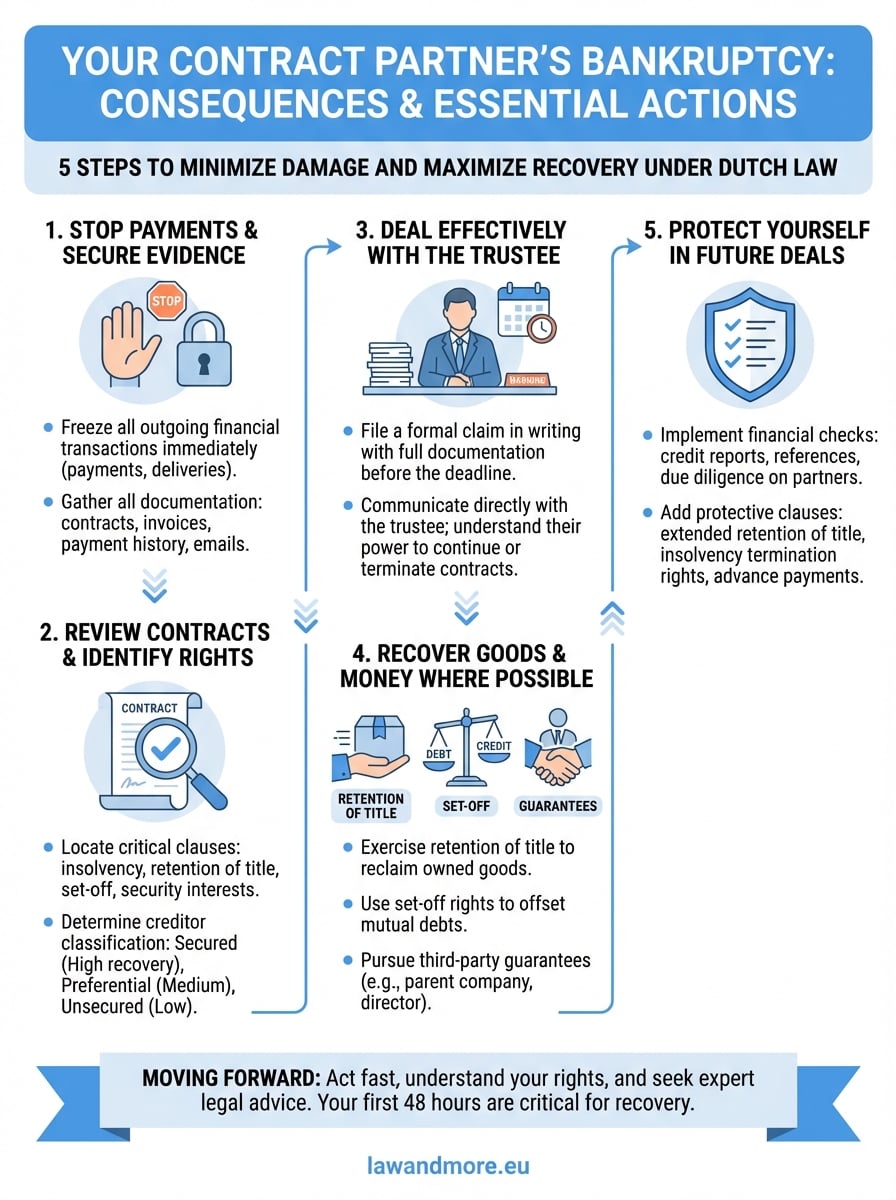
This guide walks you through the five essential actions you need to take when your contract partner goes bankrupt. You’ll learn what bankruptcy means for your contracts, how to stop further losses immediately, which legal rights you can exercise, how to navigate the trustee relationship, and how to protect your business from similar situations in the future. Each section gives you concrete steps you can take today to minimize damage and maximize your recovery.
What your partner’s bankruptcy means under Dutch law
When a Dutch court declares your business partner bankrupt, a fundamental legal shift happens instantly. The company’s management loses all authority to act on the company’s behalf. A court-appointed bankruptcy trustee (called a curator in Dutch) takes complete control of the company’s assets, contracts, and operations. Your former contact persons at the company can no longer make binding decisions, negotiate terms, or authorize payments. Every action you take from this moment forward must go through the trustee.
The automatic stay and loss of control
Dutch bankruptcy law triggers an automatic stay the moment bankruptcy is declared. This legal freeze stops all individual lawsuits and collection efforts against the bankrupt company. You cannot sue them in regular court anymore. You cannot seize their assets directly. You cannot force payment through normal legal channels.
The trustee’s job is to liquidate the company’s assets and distribute the proceeds to creditors according to strict legal rankings. Secured creditors with collateral get paid first. Next come preferential creditors like tax authorities. Unsecured creditors (which is where most suppliers and service providers end up) share whatever remains. In practice, unsecured creditors often recover only 10-15% of what they are owed, and sometimes nothing at all.
What happens to existing contracts
Your contracts do not automatically end when your partner files for bankruptcy. The trustee has the legal right to decide whether to continue or terminate each active contract. This decision rests entirely on whether continuing the contract benefits the bankrupt estate financially.
If the trustee chooses to continue your contract, they must provide security guarantees and pay you for all work performed or goods delivered after the bankruptcy date.
If the contract is terminated, you lose the right to future performance and payments. You can file a claim for damages, but this claim joins the pool of unsecured debts. The consequences of your contract partner’s bankruptcy: what can you do? Understanding the trustee’s power over your contracts is your first step toward protecting your interests and recovering as much as possible from this difficult situation.
Your immediate priority is recognizing that the rules have changed completely. The business relationship you had yesterday no longer exists in the same form. You need to adapt your strategy, secure your position, and take specific legal steps to protect your financial interests.
Step 1. Stop payments and secure your evidence
Your first action when you hear about your partner’s bankruptcy must be to freeze all financial transactions with them immediately. Every payment you make and every product you deliver after the bankruptcy date flows into the bankrupt estate, where you will likely never see any return. You need to stop the bleeding before you can start recovery. The consequences of your contract partner’s bankruptcy: what can you do? Your answer starts with this critical first step taken within the first 48 hours.
Freeze all outgoing transactions
You must halt all payments to the bankrupt company immediately. This includes outstanding invoices you owe them, automatic bank transfers, and any pending payment authorizations. This is not about breaking your word. This is about protecting cash that may become essential for exercising your set-off rights later. Dutch law allows you to offset mutual debts, but only if you still have money that you owe them when you file your claim.
Stop all deliveries and service performance at once. Do not ship another product or provide another hour of work, regardless of existing orders or agreements. Fulfilling orders now means sending your assets away with virtually no chance of payment. Terminate any ongoing projects or service contracts immediately by notifying the trustee in writing.
Your instinct to honor commitments is admirable in normal business, but in bankruptcy, continuing performance directly harms your recovery prospects.
Gather and organize your documentation
Start building your case file immediately. You need to collect and secure every document related to your business relationship. Your contract documents are now your most valuable asset because they prove what you are owed and what rights you can claim. Make copies of everything and store them securely in both physical and digital formats.
Create an organized file that includes:
- All signed contracts and amendments
- General terms and conditions
- Purchase orders and confirmations
- Outstanding invoices (both what they owe you and what you owe them)
- Delivery notes and proof of service completion
- Email correspondence confirming orders, terms, or changes
- Payment history and account statements
The trustee will demand detailed proof for every claim you file. A well-organized documentation package strengthens your credibility and speeds up the claims process. Missing or incomplete records weaken your position and may result in rejected claims.
Step 2. Review contracts and identify your rights
Once you have secured your documentation and stopped all outgoing transactions, you need to conduct a strategic contract review to identify exactly what rights you hold. Your contract is no longer just a commercial agreement. It is now the legal foundation that determines whether you recover your losses or join the long line of unsecured creditors. Every clause matters because certain contractual provisions give you direct recovery rights that bypass the general creditor queue entirely.
Locate critical clauses that trigger on bankruptcy
Start by searching your contract for any clause that specifically addresses insolvency or bankruptcy. Many well-drafted commercial agreements include provisions that activate automatically when one party becomes insolvent. You need to identify whether your contract grants you immediate termination rights, security interests, or retention of title protections.
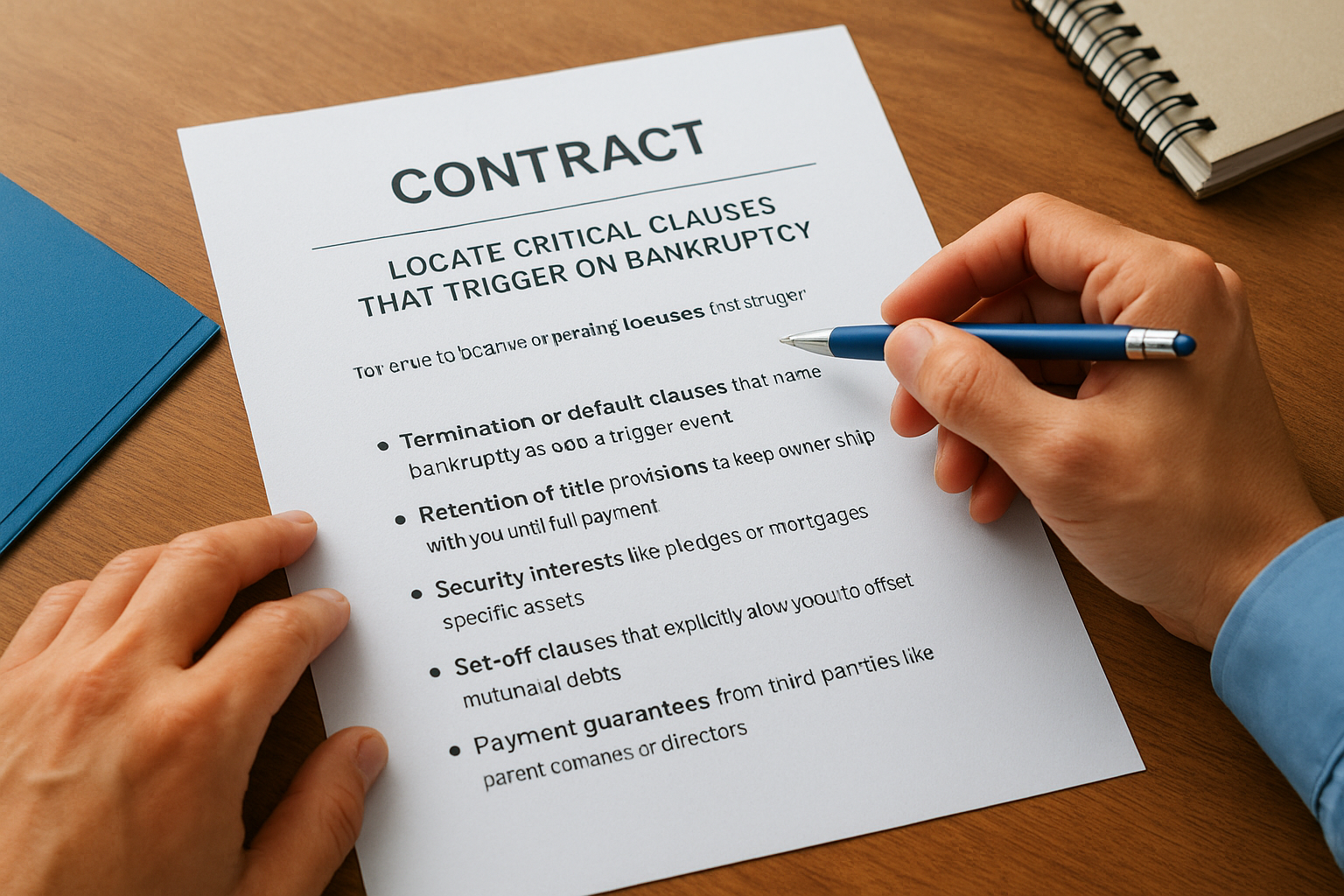
Look for these specific clause types:
- Termination or default clauses that name bankruptcy as a trigger event
- Retention of title provisions (eigendomsvoorbehoud) that keep ownership with you until full payment
- Security interests like pledges (pandrecht) or mortgages (hypotheek) over specific assets
- Set-off clauses that explicitly allow you to offset mutual debts
- Payment guarantees from third parties like parent companies or directors
Finding these clauses transforms your position from passive creditor to active rights holder. Document every relevant provision you find and note the exact contract section numbers for reference when dealing with the trustee.
Understand your creditor classification
Dutch bankruptcy law ranks creditors in a strict hierarchy that directly impacts your recovery chances. You must determine where you fall in this ranking because it determines both your priority level and the legal tools available to you.
| Creditor Type | Your Rights | Recovery Likelihood |
|---|---|---|
| Secured Creditor | Direct claim on specific assets through pledge or mortgage | High (often 80-100%) |
| Preferential Creditor | Legal priority (mainly tax authorities and employees) | Medium (50-70%) |
| Unsecured Creditor | Share in remaining estate after others are paid | Low (10-15% average) |
If your contract review reveals you only have a standard payment claim without special provisions, you face the harsh reality of unsecured creditor status with minimal recovery prospects.
Understanding the consequences of your contract partner’s bankruptcy: what can you do? depends entirely on which creditor category you fall into and which contractual rights you can enforce. Take the time now to classify your position accurately because this determines your entire recovery strategy moving forward.
Step 3. Deal effectively with the trustee
Your relationship with the bankruptcy trustee determines how much of your money you recover. The trustee holds complete legal authority over the bankrupt company’s assets and contracts. You cannot negotiate with your former contact person anymore. You cannot appeal to the company’s board. Every communication, claim, and request must go directly to the trustee in writing. Understanding how to work with this person professionally and strategically separates creditors who recover significant amounts from those who get nothing.
File your claim correctly and on time
The trustee will set a hard deadline for filing claims, typically announced in a verification meeting notice. Missing this deadline can result in your claim being completely rejected. You need to submit your claim in writing with full documentation attached before this date. The consequences of your contract partner’s bankruptcy: what can you do? starts with filing a proper claim that the trustee cannot ignore or dismiss.
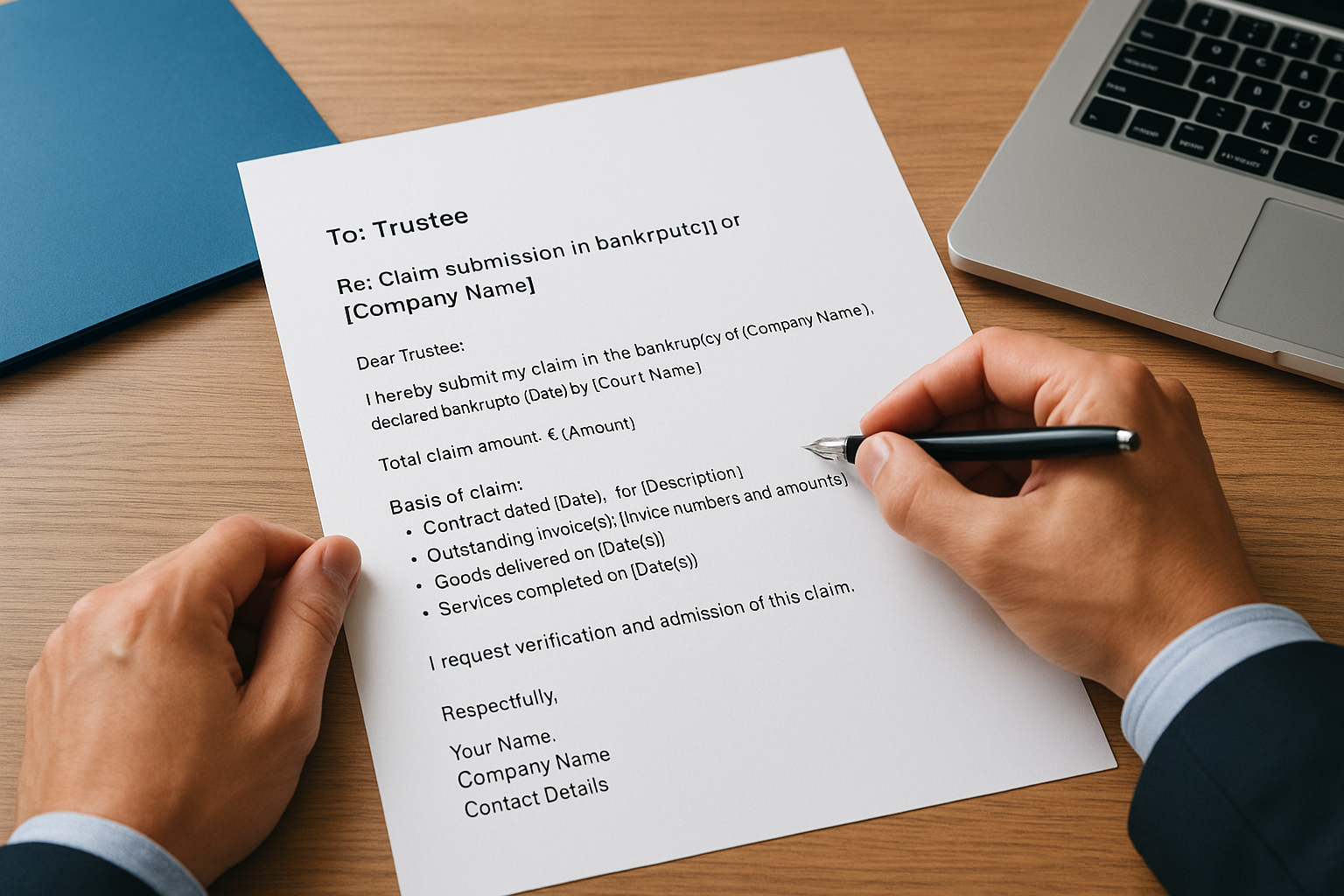
Your claim submission must include these essential elements:
Formal Claim Letter Template:
To: [Trustee Name]
Re: Claim submission in bankruptcy of [Company Name]

Dear [Trustee],

I hereby submit my claim in the bankruptcy of [Company Name], declared
bankrupt on [Date] by the [Court Name].

Total claim amount: €[Amount]

Basis of claim:
- Contract dated [Date] for [Description]
- Outstanding invoice(s): [Invoice numbers and amounts]
- Goods delivered on [Date(s)]
- Services completed on [Date(s)]

Attached documentation:
1. Copy of signed contract
2. Copies of all outstanding invoices
3. Proof of delivery/completion
4. Relevant correspondence

I request verification and admission of this claim.

Respectfully,
[Your Name]
[Company Name]
[Contact Details]
Attach clear copies (not originals) of every supporting document. Number your attachments to match the list in your letter. Use professional language without emotion or accusation. The trustee processes dozens of claims and responds better to organized, factual submissions.
Understand the trustee’s decision on your contract
The trustee will decide whether to continue or terminate each active contract based purely on whether continuation benefits the bankrupt estate financially. You need to know which decision helps or hurts your position. If the trustee continues your contract, they must pay you for all post-bankruptcy performance. This gives you guaranteed payment for new work.
If your contract provides essential services or valuable assets to the estate, contact the trustee immediately to explain why continuation serves everyone’s interests.
However, termination leaves you with only an unsecured damage claim. Push for written confirmation of the trustee’s decision as soon as possible so you can plan your next moves accordingly.
Step 4. Recover goods and money where possible
Filing a claim with the trustee puts you in line with all other creditors, but active recovery mechanisms let you bypass that queue entirely. Dutch law provides three powerful tools that can help you reclaim specific goods or secure payment before the general distribution happens. You must act quickly and assert these rights formally with the trustee to maximize your recovery. The consequences of your contract partner’s bankruptcy: what can you do? depends largely on how effectively you exercise these direct recovery options in the critical weeks following the bankruptcy declaration.
Exercise retention of title over supplied goods
A retention of title clause (eigendomsvoorbehoud) in your contract means you still own the goods you delivered until you receive full payment. This transforms you from a creditor asking for money into an owner demanding your property back. You can reclaim these goods directly from the bankrupt estate without waiting in line with other creditors.
To exercise this right, send a formal written notice to the trustee immediately:
Retention of Title Notice Template:
To: [Trustee Name]
Re: Retention of Title Claim in [Company Name] Bankruptcy

Dear [Trustee],

I hereby invoke my retention of title rights under Article [X] of our
contract dated [Date].

The following goods remain my property as full payment has not been received:

- [Product description], Invoice [Number], delivered [Date], value €[Amount]
- [Product description], Invoice [Number], delivered [Date], value €[Amount]

Total value of goods claimed: €[Amount]

Attached: Contract with retention clause, delivery notes, unpaid invoices

I request immediate coordination to recover these goods.

Respectfully,
[Your Name]
Attach proof of delivery and clear photos or serial numbers that identify your specific goods on their premises. The trustee will verify your claim and schedule recovery if everything checks out.
Use set-off rights to reduce your loss
Dutch law allows you to offset mutual debts when you both owe each other money. Instead of paying them €10,000 while hoping to recover €25,000 later, you cancel both debts and file a claim for only the €15,000 difference. This self-help mechanism keeps cash in your business and dramatically reduces your exposure to the bankrupt estate.
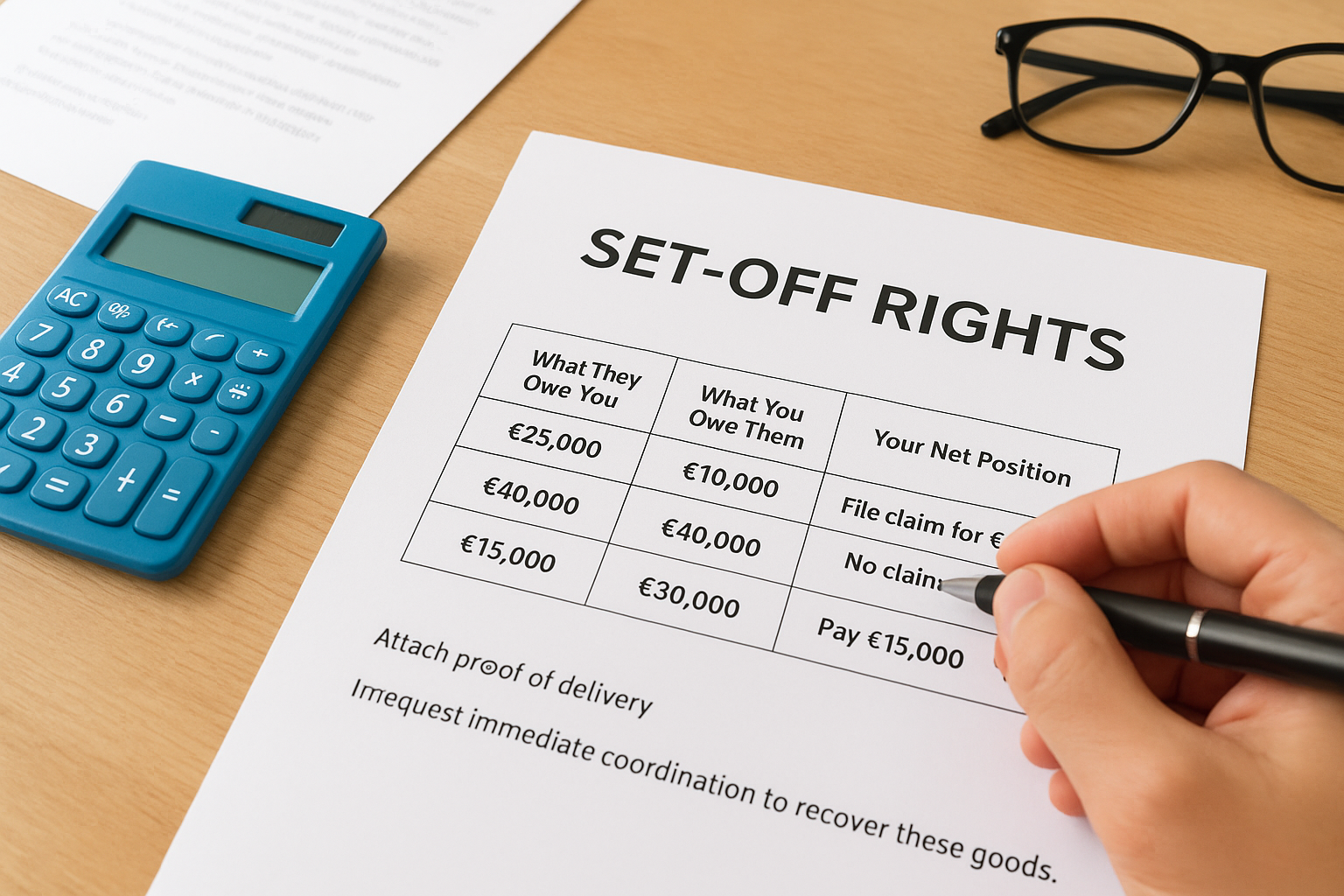
Calculate your set-off position immediately using this formula:
| What They Owe You | What You Owe Them | Your Net Position |
|---|---|---|
| €25,000 | €10,000 | File claim for €15,000 |
| €40,000 | €40,000 | No claim needed (debts cancel) |
| €15,000 | €30,000 | Pay €15,000 to trustee |
Set-off works automatically under Dutch law, but you must declare it formally to the trustee and refuse any payment demands for debts you can offset.
Pursue third-party guarantees
Bank guarantees, parent company guarantees, or personal director guarantees create separate payment obligations that survive the bankruptcy. These guarantors remain fully liable even though the company cannot pay. You can demand immediate payment from them without involving the trustee or waiting for estate distributions.
Contact guarantors directly with a formal payment demand citing the guarantee document and the triggering bankruptcy event. Many guarantors will negotiate quick settlements to avoid legal proceedings. This recovery path often succeeds when all other options fail because you are pursuing solvent parties with real assets.
Step 5. Protect yourself in future deals
Going through your partner’s bankruptcy teaches you an expensive lesson about commercial risk management. You cannot prevent others from going bankrupt, but you can absolutely build defenses that protect your business when it happens. The consequences of your contract partner’s bankruptcy: what can you do? becomes a much smaller problem when you have preventive measures built into your standard business practices from the start. Smart prevention now saves you from painful recovery efforts later.
Build financial checks into your approval process
You need to screen potential partners before signing significant contracts, not after problems appear. Create a standard due diligence checklist that you complete for every new relationship above a certain threshold value. This screening catches warning signs early and lets you walk away from risky deals.
Run these checks on every potential partner:
Pre-Contract Due Diligence Checklist:
- Request most recent annual financial statements
- Order a credit report from a commercial credit bureau
- Check Dutch Business Register (Kamer van Koophandel) for legal structure and history
- Search court records for judgments, liens, or ongoing litigation
- Contact three trade references and ask direct questions about payment behavior
- Review payment terms they request (very long terms signal cash flow problems)
- Set internal credit limits based on their financial health
Companies with nothing to hide provide this information quickly and transparently, while reluctance or delays often signal underlying problems you need to avoid.
Add protective clauses to standard contracts
Your standard contract templates need automatic protections that activate the moment a partner becomes insolvent. Work with a lawyer to draft clauses that give you immediate rights without requiring court action or complex negotiations.
Include these essential protective provisions in every contract:
| Clause Type | What It Does |
|---|---|
| Extended Retention of Title | Maintains your ownership even if goods are processed or mixed with other materials |
| Insolvency Termination Right | Lets you terminate immediately upon bankruptcy filing without liability |
| Third-Party Guarantee Requirement | Requires parent company or director guarantee for high-value deals |
| Advance Payment Milestones | Structures payments so you receive funds before or immediately after completing work |
| Security Interest Registration | Gives you registered security rights over specific assets or receivables |
Build these protections directly into your terms so every new contract automatically includes them. This transforms contract negotiations from reactive damage control into proactive risk management.
Moving forward with confidence
You now have a complete action plan for handling the consequences of your contract partner’s bankruptcy: what can you do? The five steps in this guide give you concrete tools to protect your business, recover what you can, and prevent similar losses in the future. Act fast when you hear about a bankruptcy declaration. Your first 48 hours determine whether you recover significant amounts or lose everything to the general creditor pool.
The legal landscape around bankruptcy is complex and unforgiving. Small mistakes in documentation, missed trustee deadlines, or incorrect claim filings cost you real money. You need expert legal support to navigate trustee negotiations, assert your contractual rights correctly, and maximize your recovery potential. Contact Law & More today for experienced guidance through Dutch bankruptcy proceedings. Our specialists help businesses protect their interests and recover assets when partners become insolvent.