
Rent arrears in the Netherlands give a landlord a claim for payment and, once they persist, a ground to have the lease dissolved. What they never give is a right to act alone. For built immovable property, article 7:231 of the Dutch Civil Code (Burgerlijk Wetboek, BW) reserves dissolution of the lease to the court, and a tenant can only be removed on the basis of a judgment enforced by a bailiff. In practice, arrears of around three months of rent are the point at which the subdistrict court (kantonrechter) is willing to dissolve the lease and order eviction.
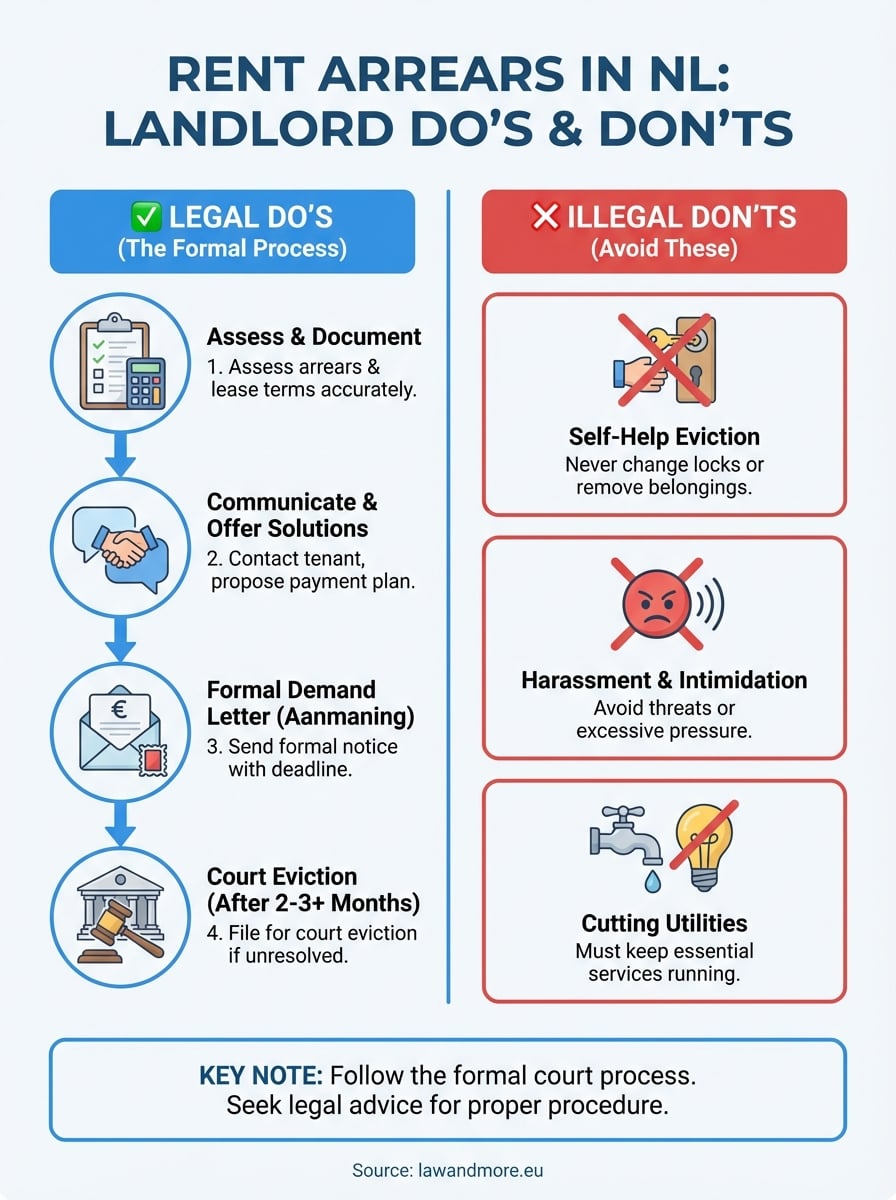
That leaves a landlord with a narrow but effective route: establish the default properly, send a demand letter that meets the statutory requirements, comply with the reporting duty that applies to residential lettings, and then bring a claim for payment, dissolution and eviction before the subdistrict court. Everything outside that route, from changing the locks to cutting off the heating, turns a landlord with a valid claim into a defendant.
This article sets out when a tenant is legally in default, what a demand letter must contain, how the subdistrict court applies the exception in article 6:265 BW, how long the procedure takes, and how the money is recovered afterwards. It also covers the defences a tenant can raise and the actions that are prohibited whatever the size of the arrears.
When a tenant is in default
The tenant is obliged to pay the rent at the agreed time under article 7:212 BW. Where the lease sets a fixed payment date, and virtually every Dutch lease does, the expiry of that date puts the tenant in default by operation of law under article 6:83 BW, without any reminder being necessary. Default is the moment from which statutory interest starts to run and from which the tenant is liable for the damage caused by the delay.

Establishing the arrears accurately comes first, because the amount claimed is what the court will test. Set out per month what was due, what was received and on what date, and reconcile that with the bank statements. Distinguish the basic rent from the advance payments for service charges and utilities, because an unsettled annual service charge statement is a frequent source of dispute and is not the same thing as unpaid rent. Where the parties agreed a payment arrangement or a temporary reduction, record it in writing and signed; an undocumented concession is regularly relied on by tenants as evidence that the arrears were accepted. The same applies to arrangements around temporary rentals, where the end date and the rent due for the final period are often disputed.
A fixed payment date in the lease means the tenant is in default the day after it passes, without a reminder.
The lease itself cannot enlarge these rights. Dutch tenancy law in Book 7, Title 4 BW is largely mandatory for residential lettings, so a clause allowing the landlord to end the lease or re-enter the property without a court order is void. That principle is set out in more detail in our overview of tenancy law provisions.
The demand letter and the statutory fourteen-day notice
Although default may arise automatically, a written demand remains necessary in practice and is legally required before extrajudicial collection costs can be charged. Where the tenant is a consumer, article 6:96 BW prescribes the form: the landlord must first send a written notice giving the tenant at least fourteen days, counted from the day after receipt, to pay without any additional costs, and that notice must state the amount of the collection costs that will be charged if payment is not made. A notice that miscalculates the period or omits the amount does not entitle the landlord to those costs, and courts check this point of their own motion.

A properly drafted demand letter names the tenant and the property, breaks the arrears down by month, states the total including interest, gives the payment period and the account to be used, sets out the collection costs that follow if payment is not made, and announces that court proceedings will follow. Send it by post and by email, and keep proof of dispatch: the burden of proving that the notice reached the tenant lies with the landlord.
The reporting duty for residential lettings
Landlords of residential accommodation have a separate statutory obligation that is regularly overlooked. Under the rules on early identification of debt introduced with the Municipal Debt Assistance Act (Wet gemeentelijke schuldhulpverlening), a landlord who is faced with rent arrears must, after making an effort to reach the tenant and to offer debt assistance, report those arrears to the municipality so that it can offer help. The report does not suspend the landlord claim, but failing to make it can be held against a landlord who later asks the court to dissolve the lease, precisely because the court weighs the efforts made before proceedings were started.
Dissolution and eviction go through the subdistrict court
A landlord cannot dissolve a lease of built immovable property out of court. Article 7:231 BW allows dissolution on the ground of a shortcoming by the tenant only by judicial decision, with a narrow exception for premises closed down by the mayor under the Opium Act. All lease disputes, whatever the amount at stake, are heard by the subdistrict court under article 93 of the Code of Civil Procedure (Rv). The case is started by a writ of summons (dagvaarding) served by a bailiff, not by a petition, and the claim normally combines three heads: payment of the arrears with interest and costs, dissolution of the lease, and eviction of the property.

The exception in article 6:265 BW
The legal test is set by article 6:265 BW: every failure to perform gives the other party the right to dissolve, unless the failure, given its particular nature or minor significance, does not justify dissolution and its consequences. The burden of invoking and substantiating that exception rests on the tenant. The Supreme Court has confirmed that there is no separate threshold of a sufficiently serious breach; the court weighs all the circumstances of the case within the framework of that exception.
For rent arrears this produces a reasonably predictable practice. Arrears equal to three months of rent or more are generally treated as a failure that justifies dissolution. Below that level the outcome depends on the circumstances: the payment history, whether the tenant reacted to the demand, whether the arrears were cleared before or during the hearing, the presence of debt assistance, and the personal consequences of losing the home. A tenant who pays everything before judgment often escapes dissolution but is still ordered to pay the costs; a tenant who has been in arrears repeatedly over a longer period may lose the home on a smaller sum.
Three months of arrears is the practical benchmark for dissolution, not a statutory rule; the court weighs all circumstances under the exception in article 6:265 BW.
How the procedure runs
After service of the writ the tenant is given an opportunity to respond, usually followed by an oral hearing at which the court explores a settlement before ruling. A first-instance judgment on unpaid rent and eviction is normally given within a few months, and the court almost always declares it provisionally enforceable, so an appeal does not by itself stop enforcement. The judgment sets a period after which the tenant must have left, and eviction is carried out by the bailiff, who first serves the judgment and issues an order to vacate. The practical sequence, including the role of the bailiff and the costs of the operation, is described in our article on the legal eviction process.
Interim relief proceedings (kort geding) are available where the situation cannot wait, but they are not a shortcut for ordinary arrears. The interim relief judge cannot dissolve a lease and will only order eviction where it is highly likely that the court in the main proceedings will do so and where the landlord has a genuine urgent interest, for example because the arrears are combined with nuisance or with subletting. In a straightforward arrears case, proceedings on the merits before the subdistrict court are both faster in the end and safer.
Recovering the money
Dissolution ends the tenancy but does not pay the arrears. Statutory interest under article 6:119 BW runs from the moment of default; between businesses the higher commercial rate of article 6:119a BW applies. Extrajudicial collection costs follow a statutory scale, laid down in a government decree, calculated on the principal sum and subject to the fourteen-day notice described above for consumers. The court also awards a contribution to the legal costs, set according to fixed rates.
Once judgment has been given, the bailiff can attach wages, benefits, bank balances and movable property, subject to the protected minimum income that must be left to the debtor. Where there is a real risk that assets will disappear before judgment, a landlord can apply to the interim relief judge for leave to levy a protective attachment beforehand. A deposit may be set off against arrears, but the rules of the Good Landlordship Act (Wet goed verhuurderschap) apply: the deposit may not exceed two months of rent and must be returned or accounted for within the short periods that act prescribes. If the tenant is admitted to statutory debt restructuring, the arrears from before admission fall within that scheme and can no longer be collected individually, while rent accruing afterwards remains payable in full.
What a landlord may not do
No amount of arrears authorises self-help. Changing the locks, removing a door, blocking access, putting the tenant belongings outside or disconnecting water, electricity or heating are unlawful acts under article 6:162 BW, and entering a rented home without permission can also amount to unlawful entry (huisvredebreuk) under article 138 of the Criminal Code (Wetboek van Strafrecht). A tenant confronted with such measures can obtain restoration of access in interim relief proceedings within days, together with damages and a penalty payment, and the landlord will be ordered to pay the costs. A landlord who has taken the law into his own hands also arrives at the later hearing on dissolution in a markedly weaker position.

Pressure that goes beyond ordinary collection is separately regulated. The Good Landlordship Act obliges landlords to refrain from intimidation and requires every municipality to maintain a reporting point where tenants can raise complaints; municipalities can enforce with administrative measures and fines. Repeated visits, threats or messages designed to make a tenant leave therefore create a risk that runs alongside the civil claim rather than helping it. The landlord maintenance obligations also continue unchanged: rent arrears do not suspend the duty to remedy defects, as our overview of tenant rights explains.
Only a bailiff acting on a court judgment may clear a rented property; every other route is an unlawful act.
Defences a tenant can raise
Anticipating the defence is part of preparing the claim. The most common one is a defect in the property. A tenant who has reported a defect and does not see it remedied can ask the Rent Assessment Committee (Huurcommissie) for a temporary reduction of the rent, and article 7:207 BW allows a claim for reduction from the moment the defect was reported. A tenant may not simply stop paying, and a reduction is not the same as a right to withhold, but a well-documented defect regularly reduces the arrears the court accepts.
Disputes about the level of the rent or about the service charge statement operate in the same way: the Huurcommissie has jurisdiction over the rent level in the regulated and mid-market segments and over annual service charge statements, and its decision binds both parties unless one of them goes to the subdistrict court in time. Where the arrears arose during works to the property, the position is governed by the rules on renovation rather than by the ordinary payment obligation; the balance between a landlord renovation proposal and a tenant right to a reduction is set out in our article on renovation with continued tenancy.
Leases of business premises follow the same procedural route to the subdistrict court, but the substantive weighing differs: there is no housing interest to protect, and the court looks primarily at the commercial relationship and at the history of payment. Contractual penalty clauses are common in these leases and can be moderated by the court under article 6:94 BW where the penalty is disproportionate. The distinction between the different categories of commercial space, and what follows from it, is explained in our comparison of real property and commercial tenancy law.
What to do first
Act early and in writing. Establish the arrears month by month, send a demand letter that meets the requirements of article 6:96 BW, make the report to the municipality where the letting is residential, and record any payment arrangement in a signed document that states the ordinary rent plus the amount towards the arrears and what happens if an instalment is missed. If the arrears reach around three months of rent without a workable arrangement, prepare the claim for payment, dissolution and eviction and have the writ served. Waiting longer rarely improves the recovery position, because the arrears the tenant can realistically repay shrink as they grow.
Law & More advises landlords and tenants on rent arrears, demand letters and collection, dissolution and eviction proceedings before the subdistrict court, service charge and rent level disputes, and proceedings before the Huurcommissie. We assess the file, indicate what the court is likely to accept as a ground for dissolution and conduct the proceedings and the enforcement that follows. If you are faced with rent arrears, contact Law & More to discuss the position before steps are taken that cannot be undone.
How Law & More can help you with this is explained on our tenancy lawyer page.