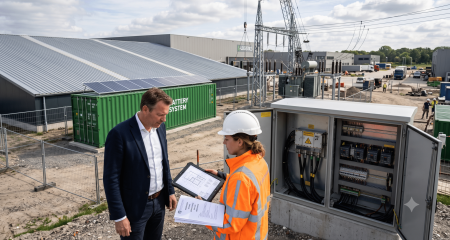
A company that establishes itself on an industrial park with its own energy grid does not become a customer of Liander, Enexis or Stedin, but rather a connected party on a closed system (in Dutch: gesloten systeem). For its energy supply, the company is then dependent on the operator of that system, often the site owner, a party affiliated with the owner, or a specialized operator working under contract for the park. On 1 January 2026, the Energiewet (Dutch Energy Act) entered into force; this Act replaced the Elektriciteitswet 1998 (Electricity Act 1998) and the Gaswet (Gas Act) and has since formed the applicable framework for closed distribution systems. In this article, we set out the position of the connected party as it must be assessed under the Energiewet, with attention to the distinction between connection, transport, supply, supervision and transitional law. The general framework of the GDS regime is discussed in our overview article on private networks and closed distribution systems.
What has changed with the Energiewet?
Since 1 January 2026, the Energiewet has replaced the Elektriciteitswet 1998 and the Gaswet and has brought the rules on, among other things, supply, connection, transport, supervision and closed distribution systems together under a single statutory framework. For the connected party on a GDS, this did not represent a break with the past, but it did create a new statutory basis against which its position must now be assessed. A number of concepts and powers have been reformulated, and for practical purposes it is important always to refer to the correct provision of the Energiewet rather than to the now-repealed Elektriciteitswet 1998 and Gaswet.
A rigorous analysis also distinguishes between the various legal relationships governed by the Energiewet: the relationship between the connected party and the supplier, the relationship between the connected party and the system operator, access to connection and transport, the contractual protection of certain categories of end users, supervision and enforcement by the Authority for Consumers and Markets (ACM), and the continuity of the system and the energy supply. For closed distribution systems, the second and third relationships are of particular relevance, although the supply relationship can also have consequences for the connected party.
First establish this: is the system a recognised closed system?
Under the Energiewet, the ACM may, on application, recognise a system as a closed system, provided that conditions are met relating to, among other things, the geographical delineation, the technical or functional interconnection of the site, the number of connected parties, the absence of household end users, and the safety and reliability of the system. Following recognition, the ACM designates an operator on application. The qualification of a network as a closed system is therefore not automatic, nor is it purely a factual or technical question: it is a public-law status that must be applied for and granted.
For the connected party, this is more than a formality. The recognition and the designation of the operator determine, among other things, which party is responsible for the statutory obligations towards connected parties, which tariff and transparency rules apply, and which dispute resolution route is available. Where there is doubt about the status of the system to which a company is connected, it is advisable to request the recognition and the designation of the operator from the ACM or from the operator itself.
Existing exemptions and transitional law
For closed distribution systems that already existed before 1 January 2026, the Energiewet provides for transitional law. An old exemption granted under the Elektriciteitswet 1998 is, for its remaining term, treated as a recognition and as a designation of the operator under the Energiewet. This means that an existing GDS has not been left without a legal basis from one day to the next, but it does not mean that existing business operations may simply continue unchanged.
Existing tariff structures and conditions may also continue to have effect: structures and conditions that were in force immediately before the entry into force of the relevant Energiewet provision may, within the transitional arrangement, be regarded as approved methods or conditions. It is therefore important for both the operator and the connected party to consult the precise transitional provision before assuming that old arrangements have simply lapsed, or conversely that they simply continue to apply unchanged. The available material does not support the conclusion that there is a single general rule that applies exactly the same transitional regime to every exemption, tariff structure or contractual condition; this must be assessed on a case-by-case basis.
Connection, transport and supply: three distinct questions
A careful analysis of the position of the connected party requires a clear distinction between three questions that are often conflated in practice: the question of connection to the system, the question of the transport of energy over that system, and the question of the supply of energy by a supplier. The Energiewet regulates these subjects separately, and the consequences of a dispute can differ significantly depending on whether it concerns connection, transport or supply.
The operator of a closed system is required, on request, to make an offer for the provision, management and maintenance of a connection, and for the provision of transport of electricity or gas over its system. Refusal is possible where there is, on reasonable grounds, insufficient transport capacity available; such a refusal must then be properly substantiated. For the connected party, this means that a mere reference to a lack of capacity is not sufficient: the operator may be required to provide insight into the concrete technical limitation, the available and required capacity, and the way in which the remaining capacity is allocated.
As regards supply, the starting point is that an end user is in principle free to conclude an agreement with a supplier of its choice. For GDS operators that also supply energy themselves or are otherwise commercially involved with the site, this means that system management on the one hand and supply or other commercial services on the other may not simply be combined. Access to the system may not, in practice, be made conditional on taking energy or other non-network-related services from the operator or a party affiliated with it.
Record the contracted capacity separately
A point that regularly gives rise to disputes in practice is the assumption that the technical connection capacity is equal to the contractually available transport capacity. That is not necessarily the case. Case law concerning public networks shows that it is for the applicant itself to determine the desired contracted transport capacity and to verify whether the network operator’s offer corresponds to it. This case law concerns the public network and therefore does not constitute a direct GDS rule, but the practical point of attention is equally relevant for a GDS: a high technical connection capacity offers no guarantee of an equally high contracted transport capacity.
For companies electrifying their production processes, wishing to install charging infrastructure, or otherwise seeing their energy needs grow, this distinction is essential. In the connection and transport agreement, it is advisable to record separately: the technical connection capacity, the contracted transport capacity for offtake and for any feed-in, the procedure for increasing that capacity, the consequences of exceeding it, and the criteria that apply in the event of capacity scarcity.
Capacity scarcity, congestion and investment issues
With increasing congestion on the Dutch electricity grid, the question of capacity allocation and investment in grid reinforcement has also become more important within closed distribution systems. The available material does not support the conclusion that exactly the same congestion management regime applies to every closed system as applies to the public network; such a categorical statement would oversimplify the statutory reality. It is, however, plausible that an operator relying on capacity scarcity must substantiate this concretely, and that the remaining capacity may not be allocated arbitrarily or solely in favour of affiliated parties.
Restraint with absolute statements is also warranted on the question of who must finance a necessary grid reinforcement. There is no general rule providing that the costs of a system reinforcement may never be placed on a single connected party; it is, however, plausible that an investment benefiting the entire system, and therefore all connected parties, cannot simply be allocated in full to a single party without further justification. Connected parties confronted with a substantial investment proposal would do well to ask for the technical justification, the expected useful life of the investment, and the extent to which other connected parties also benefit from it.
Tariffs, general terms and conditions, and transparency
An important difference from the public network is that the operator of a closed system does not have its tariffs approved in advance by the ACM in the same way as a regular network operator. This does not mean, however, that it may freely charge any tariff. The Energiewet requires that the tariff be based on a calculation method drawn up and published by the operator in advance, which results in tariffs that reflect the costs of performing its tasks and obligations and that are transparent and non-discriminatory.
For the connected party, this means that a high tariff is not, in itself, decisive. The relevant question is whether the tariff results from a calculation method that was knowable in advance, and whether the underlying costs can be verifiably attributed to the performance of a statutory task. A connected party that doubts the reasonableness of a tariff can ask the ACM to assess whether the calculation method or the tariff meets these requirements; it is not the case, however, that the ACM automatically claws back or adjusts every tariff in every case. The ACM can determine that the operator must adjust its calculation method or tariff where it finds that the statutory requirements have not been met; whether, and to what extent, amounts already paid can be reclaimed is generally a separate, additional civil-law question.
The general terms and conditions of the operator of a closed system must also be reasonable, transparent and non-discriminatory. For connected parties with a small connection acting in the course of a profession or business, provisions of the Dutch Civil Code on general terms and conditions may also apply by analogy. The same protection does not automatically apply to large commercial connected parties; their position must be assessed on the basis of the specific agreement, the statutory tariff and transparency norms, and the general rules of the law of obligations. An operator using a broad exemption clause, a unilateral amendment clause or an open cost clause must be able to justify the commercial and technical necessity of doing so; such a clause is not automatically voidable without further review, but nor is it automatically valid.
Grid congestion and a reasonable period for connection
Case law on public networks offers useful points of reference for the way in which connection, transport and grid expansion must be distinguished from one another as a matter of law, even though that case law is not a direct GDS framework. For example, in case law on congestion on the public network, it has been held that established grid congestion does not, without more, give rise to a right to an increase in the contracted transport capacity, and that an agreement for connection and transport must be interpreted in light of the circumstances of the case, in which the actually available grid capacity also plays a role.
For a closed system, this suggests that a comparable, contractual and factual approach is appropriate: whether a connected party is entitled to a particular capacity cannot be considered in isolation from the capacity actually available on the system and the way in which the agreement describes that capacity. A reasonable period for realising a connection remains a relevant point of assessment in this context, even where the precise period will not be identical in every GDS situation to that on the public network.
Complaints, the ACM and the civil courts
If a dispute escalates, the connected party in principle has two routes available, which do not exclude one another. The ACM is competent to rule on a complaint from a party concerning the manner in which the operator exercises its tasks and powers under the Energiewet, or complies with its statutory obligations. Such a complaint is treated as an application for a decision; the ACM decides in principle within two months, and its decision is binding, without prejudice to the possibility of administrative appeal. This route is suitable for questions concerning compliance with statutory obligations, such as access, tariffs, transparency and non-discrimination.
The civil courts are the appropriate route for purely contractual disputes, the repayment of amounts overpaid, damages, the annulment or disapplication of contractual clauses, termination, and urgent interim measures such as summary proceedings in the event of a threatened disconnection. Filing a complaint with the ACM does not affect the possibility of using other legal remedies; the ACM route is therefore not exclusive, but the ACM itself does not assess claims for damages. A party wishing to obtain repayment or damages following an ACM ruling that a tariff does not meet the statutory requirements will, as a rule, have to bring a separate civil claim and substantiate the amount of the claim, the causal link and the damage independently. In the event of an acutely threatened disconnection, for example due to a disputed invoice, summary proceedings may offer a solution, although the court will in that case too require a genuine urgent interest; a mere wish for quick clarity on the validity of a tariff change will generally not be sufficient for that purpose.
Change of operator: sale, restructuring and bankruptcy
Industrial sites with a closed system are regularly traded, restructured or transferred to another group company. The statutory obligations attached to the system, such as the connection and transport obligation and the tariff and transparency norms, in principle continue to attach to the system regardless of who operates it. Whether the existing connection and transport agreement automatically transfers to a new operator is a separate, contractual question that depends on the transaction structure chosen: in a share transfer, the contracting party generally remains the same legal entity, whereas in an asset transfer, agreements do not transfer automatically, and a transfer of contract requires its own legal basis and, absent prior consent, the cooperation of the connected party.
In the event of a threatened bankruptcy of the operator, the risk to connected parties is real: the continuity of management, maintenance and energy supply may be jeopardised, while the connected party itself has no influence over the operator’s financial position. We advise connected parties in such a situation to obtain, at an early stage, an assessment of what security they can negotiate, such as a guarantee from a parent company, a maintenance reserve, or arrangements for the event that an administrator does not continue the management of the system.
The connected party as a contracting party: avoid falling behind
The best legal protection begins with the contract. A company establishing itself on an industrial park with a GDS would do well to critically review the connection and transport agreement before signing: is the tariff system transparent and bounded, are there arrangements for capacity in the event of expansion, what are the service and fault-response arrangements, including response times, and what happens in the event of a sale of the network or the site? The term of the agreement and the possibility of exit also deserve attention: a connected party cannot, in practice, simply switch to another operator, so the agreement determines the relationship for a long period.
Existing connected parties who have accepted onerous conditions are in principle free to seek renegotiation or to ask the ACM for a review; agreeing to a clause at the time the agreement was entered into does not, without more, preclude a later review. It is, however, advisable to act promptly: the longer a tariff is applied and paid without challenge, the more complex the discussion about recovering amounts overpaid in the past may become, having regard among other things to limitation periods and the question of whether inaction can be interpreted as acceptance.
Practical checklist
For the operator of a closed system, it is advisable to check whether the recognition, designation and transitional status of the system are up to date and in order, whether the tariff method has been published in advance and is verifiably substantiated, whether capacity refusals are motivated concretely and on technical grounds, whether general terms and conditions and amendment clauses are reasonable and transparent, and whether, in the event of a sale, restructuring or threatened discontinuity, timely attention is paid to the continuity of management and supply.
For the connected party, it is advisable to request the recognition and designation of the operator, to record the contracted transport capacity separately from the technical connection capacity, to ask for the calculation method and underlying costs in the event of tariff changes, to have capacity requests and refusals substantiated in writing, to have general terms and conditions reviewed before signing, and to retain relevant documents such as invoices, correspondence and capacity calculations with a view to a possible ACM complaint or civil proceedings.
Frequently asked questions
Below we answer a number of questions that connected parties and operators most frequently ask us in practice about the position of the connected party under the Energiewet.
What is a closed system?
A closed system is a separate energy network within, for example, an industrial park, a business campus or a commercial area. The connected party then does not deal directly with a regular system operator, but with the operator of the closed system. That operator may, for example, be the site owner, a group company, or a specialised party.
What rights does a commercial connected party have under the Energiewet?
The connected party is in principle entitled to connection and transport, to the extent that capacity is available for this. In addition, the operator must apply reasonable, transparent and non-discriminatory tariffs and conditions. This statutory protection exists alongside the agreement; a contract cannot simply override the statutory minimum standards of the Energiewet.
May the operator make connection conditional on taking energy?
An operator may not simply make access to the GDS conditional on entering into a supply agreement or taking additional services. Such a linkage warrants critical assessment where it in practice results in a company being denied access unless it also takes other commercial services from the operator or an affiliated party.
Can the operator refuse a connection or an expansion?
This is possible where there is, on reasonable grounds, insufficient transport capacity available, but the refusal must be factually substantiated. The connected party can ask about the technical limitation, the available capacity, the consequences of the request, and the possibilities for expansion or reinforcement. The remaining capacity must be allocated on objective, transparent and non-discriminatory grounds; there is, however, no guarantee that capacity will always be available.
What is the difference between connection capacity and transport capacity?
The technical capacity of a connection is not always the same as the transport capacity that is contractually available. In the connection and transport agreement, it is therefore advisable to record separately: the technical connection capacity, the contracted transport capacity, the capacity for offtake and any feed-in, the procedure for expansion, and the consequences of exceeding it. For companies wishing to electrify, install charging infrastructure or expand their production capacity, this distinction is essential.
Who pays for a necessary grid reinforcement?
This depends on the technical necessity, the contractual arrangements, and the extent to which the investment benefits multiple connected parties. The operator must be able to explain why a particular allocation of costs is reasonable. Passing on the full cost of a system reinforcement to a single connected party without justification, while other companies also benefit from it, can be challenged; there is, however, no categorical rule that this is never permitted.
May the operator set its tariffs freely?
No. Although a closed system is not regulated by the ACM in advance in the same way as a public network, the operator must, under the Energiewet, apply a calculation method published in advance that results in tariffs that are cost-reflective, transparent and non-discriminatory. The connected party must be able to understand how the tariff is composed and what costs underlie it.
What can I do about an unexpected tariff increase?
First ask in writing for the new tariff calculation, the contractual basis, the underlying costs, the date and manner of publication, and the consequences for other connected parties. Then make clear that any payment made is made under protest. In the event of a dispute over statutory compliance, the connected party can involve the ACM; for repayment, damages or an urgent injunction, civil proceedings are generally required.
Can the ACM review a closed system tariff?
The connected party can ask the ACM to review the calculation method or the tariff against the statutory requirements of cost-reflectivity, transparency and non-discrimination. If the ACM establishes a breach, it can determine that the operator must adjust its method or tariff. A tariff found unreasonable by the ACM can no longer simply be enforced; repayment of amounts already paid generally has to be claimed separately under civil law, and not every ACM ruling automatically results in an obligation to repay.
When should I go to the civil courts?
The civil courts are the appropriate forum where the connected party seeks a private-law outcome, such as performance of the connection or transport agreement, repayment of amounts overpaid, damages, annulment or disapplication of a contractual clause, termination, or an injunction or order in summary proceedings. The ACM route and the civil route can be used alongside one another: the ACM assesses statutory compliance, while the civil courts can determine the contractual and financial consequences of that.
Which documents should I keep as a connected party?
Keep, at a minimum, the recognition or exemption of the closed system, the connection and transport agreement, the general terms and conditions, tariff sheets and tariff amendments, capacity requests and technical reports, invoices and metering data, correspondence about faults, capacity and tariffs, and arrangements regarding the transfer or change of operator. These documents are important for an ACM complaint, civil proceedings, and the assessment of damage or repayment.
Which contractual provisions deserve particular attention?
Pay particular attention to unilateral powers to amend tariffs, open-ended cost clauses, limited or unclear liability, the absence of guaranteed transport capacity, unclear fault-response and repair times, a long term without an exit arrangement, automatic transfer to a new operator, linkage to supply or lease, an investment obligation without a cost cap, and the absence of arrangements regarding ownership and maintenance. A contract should describe not only what is delivered at the outset, but also what happens in the event of expansion, scarcity, faults, sale and bankruptcy.
What happens if the operator is sold?
The statutory obligations attached to the closed system in principle continue to exist in the event of a change of operator. The contractual position must be assessed separately. In a share transfer, the original legal entity generally remains the contracting party; in an asset transfer, a transfer of contract is not automatic. The connected party would do well to check whether its agreement has been validly transferred and whether the succeeding operator is permitted to continue applying the same tariffs and conditions.
What can I do in the event of a threatened bankruptcy of the operator?
A bankruptcy can have consequences for the management, maintenance and continuity of the energy supply. Connected parties would be well advised to have it assessed at an early stage whether security has been arranged, such as a guarantee from a parent company, a maintenance reserve, or an arrangement for temporary management. It is also important to establish who owns the cables, transformers, metering equipment and other essential assets.
The regulated minimum for a closed distribution system
The Energiewet does not turn a closed distribution system into a public network, but it does turn it into a regulated system with a recognisable statutory minimum level of access, transparency, non-discrimination and careful management. The connected party on an industrial park remains dependent on the operator, but has a genuine set of entitlements: to connection and transport, to the extent that capacity exists for this; to reasonable and transparent tariffs and conditions; to careful treatment in the event of capacity scarcity and a change of operator; and to access to both the ACM and the civil courts. The precise outcome of a dispute always depends on the statutory basis, the type of connection, the content of the agreement, the capacity actually available, and the procedure chosen; categorical, absolute statements are therefore rarely appropriate. A party that understands the new statutory system of the Energiewet, structures its contracts accordingly, and acts promptly where it has doubts about the reasonableness of tariffs or conditions, is in a considerably stronger position vis-à-vis the operator. Do you have a dispute with the operator of the network on your site, would you like your contractual position as a connected party assessed, or are you considering structuring a closed system as an operator yourself under the Energiewet? Our energy law attorneys assist connected parties and operators alike with advice and proceedings.