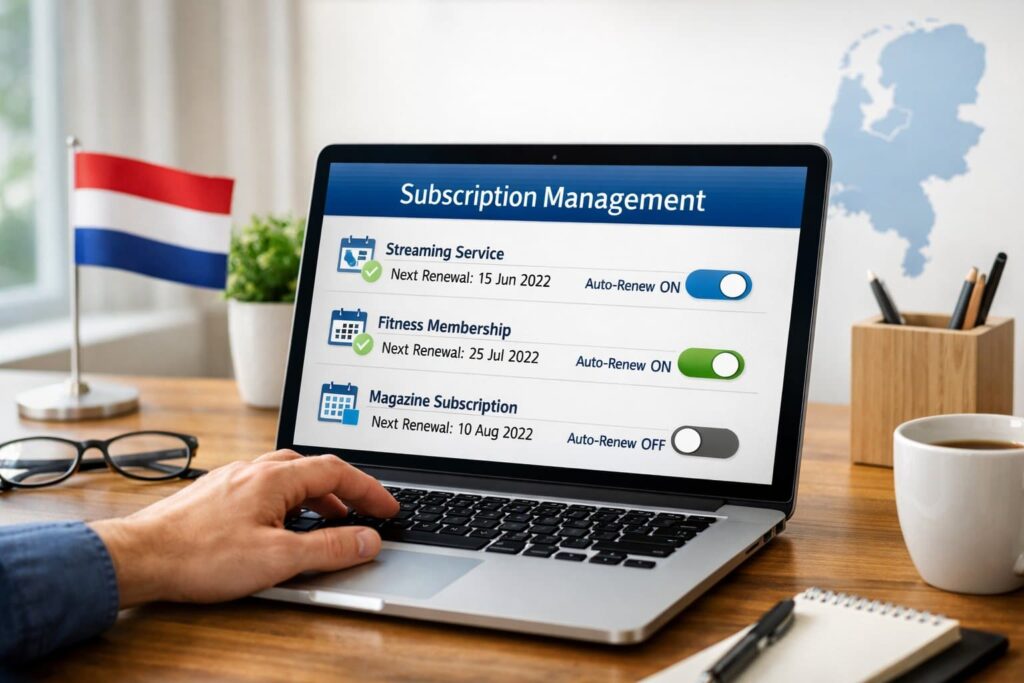
No, a consumer subscription in the Netherlands cannot simply renew for another fixed term. Once the first term ends, it may only continue for an indefinite period, and you can then cancel at any time with no more than one month’s notice. The main exception is for newspapers and magazines, which may renew for up to three months at a time.
These rules come from the Dutch rules on consumer protection in contracts, mainly Articles 6:236 and 6:237 of the Dutch Civil Code (Burgerlijk Wetboek, BW). They apply to gym memberships, streaming services, software licences, magazines and most other subscriptions you take out as a private individual. Below we explain when a renewal binds you, how to cancel and what you can do if a business does not follow the rules.

When may a subscription renew automatically?
A subscription may renew automatically only into a contract for an indefinite period that you can end at any time with at most one month’s notice. A clause that tacitly extends the contract by another fixed term, for example another year, is not allowed.
Under Article 6:236(j) BW, a clause in a contract for the regular delivery of goods or services that leads to tacit renewal (stilzwijgende verlenging) is considered unreasonably onerous. The exception is a renewal after which you may cancel at any time, with a notice period of no more than one month. This clause is on the so-called black list: the law regards it as unfair in every case, and you do not have to prove anything more.
In practice this means that a one-year gym contract may continue after the first year, but only as an open-ended contract. The gym may not bind you to a second year simply because you did not cancel in time. If the general terms and conditions say otherwise, you can have that clause set aside (annulled) and end the contract with one month’s notice.
How long may the first term be?
The first term itself is limited as well. Under Article 6:237(k) BW, a clause that binds you for more than one year is presumed to be unreasonably onerous, unless you can cancel at any time after the first year with no more than one month’s notice. This provision is on the grey list: the business may try to show that the clause is reasonable in the specific case, but the starting point is in your favour.
For telephone, internet and television contracts, a first term of one or two years is common. After that term, the contract continues for an indefinite period and the notice period is one month.
What notice period may a business require?
In most cases, a business may not require more than one month’s notice. Article 6:237 BW presumes that a longer notice period, or a notice period that is longer than the one the business itself must observe, is unreasonably onerous. A business also may not require that you cancel only at a fixed moment, such as in a particular month of the year.
You can read more about notice periods and the general framework in our article on contract law in the Netherlands.
What are the special rules for newspapers and magazines?
Newspapers and magazines may renew a subscription tacitly for up to three months at a time, or convert it into a subscription for an indefinite period. The notice period is at most one month, or three months for a publication that appears less than once a month.
This is a deliberate exception for the press, which relies on predictable subscription income. If your subscription is renewed in blocks of three months, you must be able to cancel at the end of each block. If it continues for an indefinite period, you can cancel at any time, again with a notice period of one month or, for a quarterly or other infrequent publication, three months.
Trial subscriptions to newspapers and magazines are treated differently. The publisher may not renew them tacitly. A trial subscription ends automatically when the trial period is over, and you do not need to cancel it. If the publisher wants you to continue, it has to ask you to take out a new subscription.

Can a free trial turn into a paid subscription?
Outside newspapers and magazines, a free or discounted trial may convert into a paid subscription, but only if the business told you so clearly before you signed up. If the conversion was hidden or unclear, the business may be engaging in a misleading commercial practice.
Before you accept the trial, the business must tell you when the trial ends, what the subscription will cost afterwards, how often you will pay and how you can cancel. That information must be clear and visible before you enter your payment details. A line in small print, or a price that only appears after checkout, does not meet that standard.
The law focuses on the information you receive at the start. Many providers send a reminder before the first payment, and that is good practice, but you should not rely on it. Note the end date of the trial yourself and cancel in good time if you do not want to continue. Once the trial has converted, the normal rules apply: you can cancel with a notice period of no more than one month.
What must a business tell you before you subscribe online?
When you subscribe online, you enter into a distance contract (overeenkomst op afstand). Before you are bound, the business must give you clear information about, among other things, the total price, the duration of the contract, the conditions for cancellation and your right of withdrawal.
These information duties are set out in Article 6:230m BW, which implements the EU Consumer Rights Directive. The Netherlands incorporated that directive into the Dutch Civil Code in 2014, in the section on distance and off-premises contracts (Articles 6:230g to 6:230z BW). The same rules apply whether the business is based in the Netherlands or in another EU country and sells to consumers here.
For an online order, the business must also make clear that you are committing to pay. The final button must say so in plain words, for example “order with obligation to pay”. Additional paid options may not be switched on by default with a pre-ticked box; you have to choose them yourself. If the business charged you for such an option without your express consent, you can ask for a refund.
Many of these duties overlap with the ban on unfair commercial practices, which we discuss below. For goods, the business must also deliver a product that meets the contract; see our article on seller liability for hidden defects.
How does the 14-day right of withdrawal work?
For most online purchases and subscriptions you have a right of withdrawal (herroepingsrecht) of 14 days. During that period you can cancel the contract without giving a reason.
Under Article 6:230o BW, the period for goods starts on the day after you, or someone you have designated, receive the product. For a service, such as a subscription, it starts on the day after the contract is concluded. If the business did not inform you about your right of withdrawal, the period is extended by up to twelve months.
You must tell the business within the 14 days that you are withdrawing. A clear email or the model withdrawal form is enough. Under Article 6:230r BW, the business must then refund what you paid, including the standard delivery costs, within 14 days. You usually pay the cost of returning goods yourself, if the business told you so in advance.
When does the right of withdrawal not apply?
Article 6:230p BW lists exceptions. You cannot withdraw from a purchase of products made to your specifications, perishable goods, or sealed audio, video or software that you have unsealed. For digital content that is not supplied on a physical carrier, such as a download, the right of withdrawal lapses once delivery has started with your express consent and your acknowledgement that you lose the right.
If you asked for a service to start during the withdrawal period and then withdraw, you may have to pay for the part already provided. The business can only charge you for this if it informed you properly beforehand.

How do you cancel a subscription that has already renewed?
You can cancel in the same way as you took out the subscription. If you signed up online, the business must let you cancel online as well, for example through your account or by email.
A business may not make cancelling harder than signing up. It cannot insist on a registered letter when you subscribed with a few clicks, or refer you to a telephone line that is never answered. You do not have to give a reason for cancelling. The contract ends once the notice period, of no more than one month, has passed.
Always cancel in a way that you can prove later. Keep the confirmation email, take a screenshot of the cancellation page or send an email yourself and save it. If the business keeps collecting payments after the contract has ended, you can reverse a direct debit through your bank within the period your bank allows, and claim back any other amounts paid without a legal basis.
If a business breaches its obligations more seriously, you may also be able to end the contract by dissolving it (ontbinding). Our article on dissolving a contract under Dutch law explains when that is possible.
Do the same rules apply to business subscriptions?
No. The black list and the grey list in Articles 6:236 and 6:237 BW protect consumers. Between businesses, the contract and the general terms and conditions largely determine how and when a subscription renews.
A company that signs up for software, a lease plan or a media subscription is therefore bound by what it agreed. A tacit renewal for another year can be valid in a business contract. Check the renewal and notice clauses before you sign, and diarise the latest date for cancelling.
There is one important exception for small businesses. Under the Telecommunications Act (Telecommunicatiewet), small businesses and self-employed professionals have the same protection as consumers for telephone and internet contracts. After the first term, such a contract continues for an indefinite period and can be cancelled at any time with no more than one month’s notice.
What if a business uses misleading renewal practices?
Hiding renewal terms, leaving out the real price or giving false information about your right to cancel can be an unfair commercial practice. If you entered into the contract because of such a practice, you can ask for it to be annulled.
The rules on unfair commercial practices are set out in Articles 6:193a to 6:193j BW. A practice is misleading if the business gives incorrect or unclear information, or leaves out essential information, and this leads you to make a decision you would not otherwise have made. Examples are a price that excludes mandatory costs, a renewal clause tucked away in the small print or false claims that you cannot cancel. Under Article 6:193j BW, a contract concluded as a result of an unfair commercial practice can be annulled.
What can the ACM do?
The Authority for Consumers and Markets (ACM) supervises compliance with consumer law. It can order a business to stop a practice and can impose fines. Under the Consumer Protection Enforcement Act (Wet handhaving consumentenbescherming), the maximum fine is EUR 900,000 or, if higher, a percentage of the business’s turnover.
The ACM does not decide individual disputes. It does use reports from consumers to decide where to intervene. You can report a problem through ConsuWijzer, the ACM’s information service for consumers, which also explains your rights and provides model letters.
How do you resolve a dispute about a renewal or a charge?
Start by contacting the business in writing. Explain why the renewal or the charge is incorrect, refer to the rules above and ask for a refund within a reasonable period, such as 14 days.
Keep all relevant documents: the confirmation of your subscription, the general terms and conditions that applied when you signed up, your cancellation and any replies. If the business is affiliated with a disputes committee (De Geschillencommissie), you can submit your complaint there. That procedure is usually quicker and cheaper than going to court, and the business’s terms will state whether it is affiliated.
If that does not lead to a solution, you can start proceedings before the subdistrict court (kantonrechter). The subdistrict court hears claims up to EUR 25,000, and you do not need a lawyer there. In consumer cases, the court must also check on its own initiative whether a clause in the general terms and conditions is unfair.
What about your personal data when you subscribe?
A business may process the personal data it needs to run your subscription, such as your name, address and payment details, without asking for separate consent. For other purposes, such as marketing, stricter rules apply under the General Data Protection Regulation (GDPR).
Under Article 6(1)(b) GDPR, processing that is necessary to perform a contract with you is lawful in itself. Marketing emails to you as a customer are only allowed under strict conditions, and you must always be able to object. After you cancel, you can ask the business which data it holds about you and ask it to erase data that it no longer needs. The business must respond within one month.
If a business does not respect your rights, you can complain to the Dutch Data Protection Authority (Autoriteit Persoonsgegevens). For more background, see our article on the General Data Protection Regulation.
What should you check when you buy through an online marketplace?
Check whether you are buying from a business or from a private individual. Online marketplaces must tell you this, and it matters: the consumer rules in this article only apply when you buy from a business.
If the seller is a business, it is responsible for complying with the information duties, the right of withdrawal and the renewal rules. The marketplace itself must make clear who the seller is and whether consumer rights apply. If you are unsure, look for the seller’s name, address and Chamber of Commerce (KvK) number before you pay.
In summary
- After the first term, a consumer subscription may only continue for an indefinite period, cancellable at any time with at most one month’s notice (Article 6:236(j) BW).
- Newspapers and magazines may renew for up to three months at a time; trial subscriptions to periodicals end automatically.
- For most online purchases you have a 14-day right of withdrawal, with exceptions for items such as custom-made goods and digital content.
- You can cancel in the same way as you signed up, and a business may not make cancelling harder than subscribing.
- Misleading renewal practices can make the contract voidable, and the ACM can fine the business.
The government’s page on tacit renewal of subscriptions and the text of Book 6 of the Dutch Civil Code contain the official rules.
Frequently asked questions
May a Dutch subscription renew for another fixed term?
No. After the first term, a consumer subscription may only continue for an indefinite period, which you can cancel at any time with no more than one month’s notice (Article 6:236(j) BW). Newspapers and magazines may renew for up to three months at a time.
How do I cancel a subscription I took out online?
You can cancel in the same way as you signed up. If you subscribed online, the business must let you cancel online, for example through your account or by email. You do not need to give a reason. Keep proof of your cancellation.
What is the maximum notice period for a subscription?
In most cases one month. For a newspaper or magazine that appears less than once a month, the notice period may be three months. A longer notice period in the general terms and conditions is presumed to be unfair.
What must a business tell me about automatic renewal?
Before you sign up, the business must tell you clearly how long the contract runs, what it costs, whether and how it renews and how you can cancel. For a trial, it must state when the trial ends and what you will pay afterwards.
Can a trial subscription continue automatically?
A trial subscription to a newspaper or magazine ends automatically and may not be renewed tacitly. Other trials may convert into a paid subscription, but only if the business told you so clearly in advance. You can then cancel with no more than one month’s notice.
What can I do about a renewal charge I did not agree to?
Contact the business in writing, explain why the charge is wrong and ask for a refund. If that fails, you can go to a disputes committee if the business is affiliated, or to the subdistrict court (kantonrechter). You can also report the practice to the ACM through ConsuWijzer.
Law & More advises consumers and businesses on subscription terms, general terms and conditions and disputes about renewals and charges. Unsure where you stand? Tell us about your situation. We will let you know your options within one working day.