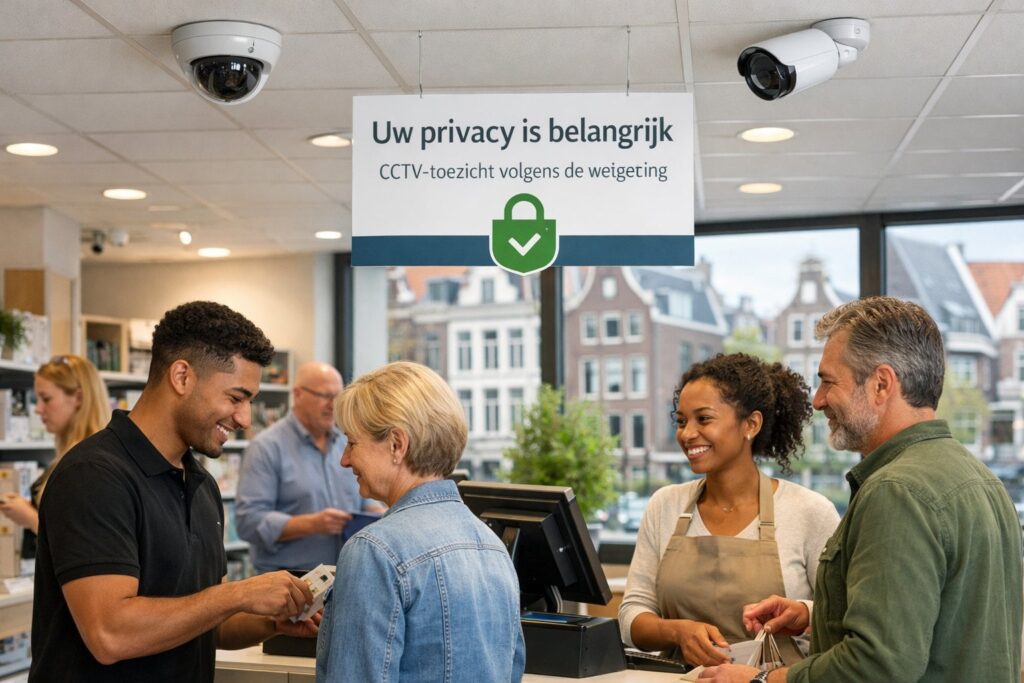
Many businesses in the Netherlands use CCTV cameras to protect their property and staff. However, you cannot simply install cameras wherever you want.
Dutch privacy laws set clear limits on how and where you can use surveillance in your workplace or retail shop.

In the Netherlands, you must have a valid legal reason to use CCTV, ensure it is truly necessary, inform people they are being filmed, and follow strict rules about storing and protecting the footage. You also cannot use cameras primarily to watch your employees, as this violates their privacy rights.
If you get it wrong, you could face serious penalties from the Dutch Data Protection Authority.
This guide explains what you need to know about using CCTV legally in the Netherlands. You will learn about the legal requirements, when you need special assessments, how to notify people properly, and what rights your employees and customers have regarding camera surveillance.
Legal framework for CCTV use in the Netherlands

CCTV use in the Netherlands is governed by the General Data Protection Regulation (GDPR), known locally as the AVG (Algemene Verordening Gegevensbescherming), with oversight from the Autoriteit Persoonsgegevens.
Your use of security cameras must balance your legitimate business interests against employee privacy rights and customer personal data protection.
Applicable privacy legislation and GDPR
The GDPR serves as the primary privacy legislation controlling CCTV surveillance in Dutch workplaces and retail environments. AVG is simply the Dutch name for the Regulation itself; the national statute that fills in the room the Regulation leaves to member states is the Uitvoeringswet AVG (UAVG), which is where you will find, among other things, the rules on processing criminal-law data.
Under this privacy law, CCTV footage counts as personal data because it can identify individuals. You need a valid legal basis before installing cameras.
The most common legal basis is “legitimate interest“, but your reasons must outweigh the privacy rights of those you film. You cannot use cameras to monitor employee performance or productivity.
Your purpose must be specific and justifiable, such as preventing theft, protecting property, or ensuring safety. You must also demonstrate that CCTV is necessary and that no less intrusive alternative exists to achieve your goal.
Role of the Autoriteit Persoonsgegevens (Dutch DPA)
The Autoriteit Persoonsgegevens is the Dutch Data Protection Authority that enforces privacy legislation and GDPR compliance. This body has the power to investigate complaints, conduct audits, and impose fines for violations of privacy law.
You must consult the Dutch DPA through a prior consultation process if your Data Protection Impact Assessment (DPIA) reveals high privacy risks that you cannot mitigate. The Autoriteit Persoonsgegevens provides guidance on camera surveillance regulations and publishes policy rules that clarify your obligations.
The Dutch DPA can issue warnings, reprimands, or substantial fines if you fail to meet GDPR requirements. You should review their published guidance documents to ensure your CCTV system complies with current Dutch law.
Fundamental privacy rights and balancing interests
Privacy rights under Dutch law require you to respect the personal data of employees and customers. You must inform people clearly that cameras are in use through prominent signs or stickers that explain the purpose of surveillance.
Your employees have the right to know why you’re filming, how long you’ll keep recordings, and who can access the footage. You must keep camera images only as long as necessary.
If you record an incident, you can retain that footage until the matter is resolved. You need to conduct a DPIA when camera surveillance is extensive, continuous, or poses high privacy risks.
If your company has a works council, you must obtain their consent before implementing CCTV. Employee privacy takes precedence unless you can prove your legitimate interest is more compelling.
Conditions and requirements for workplace and retail CCTV

Installing CCTV in Dutch workplaces and retail environments requires meeting specific legal conditions under the GDPR and Dutch privacy law. You must demonstrate a valid legal basis, ensure your surveillance is necessary and proportionate, and involve the works council when applicable.
Establishing a legitimate interest and legal basis
You need a clear legal basis before installing CCTV cameras. Most employers rely on legitimate interest as their legal basis, which allows surveillance to protect property, prevent theft, or ensure safety.
You must prove your legitimate interest outweighs employees’ and customers’ privacy rights. This requires documenting specific security concerns or risks that justify camera use.
Generic claims about wanting better security are not sufficient. The data controller—typically the employer or business owner—bears responsibility for establishing this legal basis.
You cannot use consent as your legal basis for workplace CCTV because the power imbalance between employer and employee means consent cannot be freely given. Consent is rarely appropriate in employment contexts.
Public authorities face stricter requirements and must identify a specific legal provision that permits their use of CCTV. They cannot rely on legitimate interest alone.
Necessity, proportionality, and subsidiarity
Your CCTV system must meet three key principles. Necessity means cameras address a real, specific problem that requires surveillance to solve.
You cannot install cameras “just in case” or without identifying concrete risks. Proportionality requires balancing your security needs against privacy intrusion.
You must limit camera coverage to essential areas only. Avoid pointing cameras at spaces where people expect high privacy, such as toilets, changing rooms, or break areas.
Subsidiarity means CCTV must be a last resort. You need to consider and try less invasive alternatives first, such as improved lighting, security guards, or access controls.
Document why these alternatives proved insufficient before implementing cameras. You should also limit retention periods to what is truly necessary—typically no more than four weeks for most business purposes.
Works council participation and consent
If your organisation has a works council (ondernemingsraad), you must involve them before installing CCTV. For a camera scheme the right at stake is the right of consent, and a scheme introduced without it can be declared void at the works council request.
Article 27 of the Works Councils Act (Wet op de ondernemingsraden) gives the works council a right of consent, not merely of advice, over any arrangement concerning facilities for observing or monitoring the presence, conduct or performance of staff. A camera system is such an arrangement. This means the council can block your CCTV plans if they object.
You cannot proceed without reaching agreement or following formal dispute procedures. The works council will evaluate whether your plans respect employee privacy rights and comply with proportionality requirements.
They may request changes to camera placement, viewing access, or retention periods. Even without a works council, you must inform employees about camera use before installation.
This notification requirement applies to all workplaces regardless of size.
Implementation: transparency and notification
Employers in the Netherlands must inform employees and customers about CCTV monitoring through visible signage and proper documentation. This transparency requirement protects data subject rights and ensures compliance with GDPR regulations.
Providing clear signage and information
You must display prominent signs or stickers at all entrances and locations where CCTV cameras operate. These signs need to clearly state that video surveillance is active in the area.
Your signage must include specific information about the monitoring. This includes the purpose of the cameras, such as preventing theft or protecting property.
You should also indicate who is responsible for the CCTV system and how people can contact you with questions. The signs need to be placed where people can easily see them before entering the monitored area.
This gives employees and customers proper notice and allows them to understand they are being recorded. You cannot hide the fact that surveillance is taking place, except under very strict conditions for hidden cameras.
CCTV privacy notices and documentation
You must create detailed privacy notices that explain your CCTV policies. These documents should outline why you use cameras, what footage you collect, and how long you keep recordings.
Your privacy notice needs to inform data subjects about their rights. This includes the right to access their personal data, request corrections, or object to processing.
You must explain how people can exercise these rights and submit requests. You should keep internal records of your CCTV system and its purpose.
If you have a works council, you must discuss your camera surveillance plans with them and obtain their consent. Your documentation should demonstrate that CCTV is necessary and that no less privacy-intrusive alternatives exist.
Data protection, security measures and retention
Protecting CCTV footage requires strong technical safeguards and clear policies on how long you can keep recordings. You need to secure personal data against unauthorised access whilst ensuring you only retain footage for as long as necessary.
Secure processing of personal data
You must implement appropriate technical and organisational measures to protect CCTV footage from data breaches. The processing of personal data through CCTV systems requires safeguards proportionate to the risks involved.
Your security measures should address both physical and digital threats. Keep servers and storage devices in locked, access-controlled rooms.
Use firewalls and anti-malware software to protect against cyber attacks. You need to document your security procedures in writing.
This includes protocols for handling footage, responding to data breaches, and managing system maintenance. Regular security audits help identify vulnerabilities before they become problems.
Train all staff who handle CCTV footage on data protection requirements. They must understand their responsibilities and the consequences of mishandling personal data.
Limit staff access to footage based on their specific job roles.
Access controls, encryption, and monitoring
Access controls ensure only authorised personnel can view or retrieve CCTV footage. You must assign unique login credentials to each user and maintain logs of who accesses the system and when.
Encryption protects footage during storage and transmission. Encrypt data both at rest (on storage devices) and in transit (when transferring between systems).
Use industry-standard encryption protocols to prevent unauthorised viewing. Implement multi-factor authentication for accessing CCTV systems.
This adds an extra layer of security beyond passwords. Consider using biometric authentication or security tokens for high-security environments.
Monitor your CCTV systems continuously for unusual activity. Set up alerts for unauthorised access attempts, system failures, or tampering.
Regular system audits help detect security weaknesses and ensure compliance with data protection rules.
Retention periods and deletion of footage
You cannot keep CCTV footage longer than necessary for its intended purpose. Most routine surveillance footage should be deleted within one to four weeks unless there is a specific reason to retain it.
The retention period depends on why you installed the cameras. Security footage typically requires shorter retention than footage documenting a specific incident.
If footage captures theft, vandalism, or workplace accidents, you may keep it until the matter is resolved. You must establish clear deletion procedures.
Set your CCTV systems to automatically overwrite old footage after the retention period expires. Document any decisions to keep footage beyond normal retention periods.
Create a retention schedule that specifies how long different types of footage are kept. Include this information in your privacy notices so people know how long their data is stored.
Review retention periods regularly to ensure they remain appropriate and compliant with GDPR requirements.
Impact assessments and high-risk processing
CCTV systems in workplaces and retail environments often qualify as high-risk processing under GDPR rules. Businesses must complete a Data Protection Impact Assessment before installing cameras and may need to consult with the Dutch Data Protection Authority in certain situations.
Data protection impact assessments (DPIA)
You must perform a DPIA when your CCTV system creates a high privacy risk for employees or customers. This requirement always applies if you use camera surveillance on a large scale, over a longer period, or permanently.
A DPIA helps you identify and document privacy risks before you start filming. You need to assess whether the cameras are truly necessary and if there are less invasive alternatives.
The assessment should describe what data you collect, why you need it, and how you will protect it. You must include several key elements in your DPIA:
- The purpose and scope of the camera system
- The necessity and proportionality of filming
- Privacy risks to individuals being recorded
- Measures to reduce or eliminate those risks
Hidden cameras require a DPIA in all cases. You cannot skip this step even for temporary installations.
Prior consultation with the Dutch DPA
You must consult with the Dutch Data Protection Authority (Autoriteit Persoonsgegevens) before installing cameras if your DPIA shows a high privacy risk that you cannot reduce. This process is called prior consultation.
Prior consultation is mandatory when you plan to use hidden cameras and your DPIA indicates serious privacy concerns. The Authority will review your plans and advise whether you can proceed.
You cannot start filming until you receive their response. This requirement protects employees and customers from excessive surveillance.
You should factor in extra time for this consultation process when planning your CCTV installation.
Special considerations: covert and systematic camera surveillance
Dutch law imposes strict limitations on hidden cameras and continuous monitoring systems, requiring employers to demonstrate exceptional circumstances and follow specific procedural requirements before implementing such measures.
Rules governing hidden and covert cameras
Hidden camera use in Dutch workplaces is exceptional, and the constraint is not only a data protection one. Filming someone covertly with a concealed device is a criminal offence in its own right: article 139f of the Criminal Code covers images made unlawfully in a non-public place, and article 441b covers a publicly accessible place where the presence of the camera has not been made clear. An employer who films staff or customers without any prior announcement therefore risks more than a fine from the supervisory authority.
The route the Dutch Data Protection Authority accepts is a narrow one: the employer states in advance, in its camera policy or staff regulations, that hidden cameras may be deployed temporarily where there is a concrete suspicion, and then deploys them only in that situation. Announcing the possibility in general terms is what keeps the deployment out of the criminal provisions, and it is the step most often skipped.
You can only deploy covert camera surveillance when you have concrete suspicions of serious misconduct and no other reasonable means exist to gather evidence.
Strict requirements for covert surveillance:
- You must have a specific, documented suspicion of criminal activity or serious policy violations.
- The surveillance must be targeted and time-limited.
- You cannot use hidden cameras for routine monitoring of employee performance.
- You must notify the works council or employee representatives beforehand when possible.
The Dutch Data Protection Authority considers covert surveillance a severe intrusion on privacy rights.
You need to document your justification thoroughly and ensure the surveillance is proportionate to the suspected wrongdoing.
Systematic camera surveillance—continuous, automated monitoring of employees—faces similar restrictions.
You cannot implement systems that track every movement or activity without clear security justifications and transparent policies.
Handling suspected theft or fraud
When you suspect theft or fraud, you may use covert camera surveillance under specific conditions.
The suspicion must be concrete and based on tangible evidence rather than general concerns about losses.
You should exhaust alternative investigation methods first, such as inventory audits, witness interviews, or access control reviews.
Document why visible cameras or other measures would prove ineffective or compromise the investigation.
Key legal requirements:
- Limit camera placement to areas where the suspected activity occurs.
- Set a defined timeframe for the covert surveillance period.
- Restrict access to footage to designated investigation personnel.
- Delete recordings promptly once the investigation concludes.
The Dutch courts scrutinise covert surveillance cases carefully and may rule evidence inadmissible if you fail to follow proper procedures.
Any footage obtained through covert camera surveillance can be used in disciplinary proceedings or criminal complaints, but only if you’ve complied with all legal requirements.
Employee and data subject rights
Employees and customers captured on CCTV have specific legal rights under GDPR.
You must understand how to handle requests for footage access and respect rights to object or request deletion of recordings.
Subject access requests (SAR) and footage access
Employees have the right to submit a Subject Access Request to view CCTV footage that shows them.
You must respond to SARs within one month of receiving the request.
When an employee asks for CCTV footage, you need to provide only the parts that show the requesting person.
You must blur or edit out other individuals in the recording to protect their privacy.
This can be time-consuming if multiple people appear in the footage.
You cannot charge a fee for standard SARs unless the request is clearly excessive or repetitive.
Keep detailed records of all access requests and your responses.
If you cannot identify the person in the footage or the recordings have already been deleted, you must explain this to the employee.
Objection, erasure and other data rights
Data subjects can object to CCTV surveillance if they believe your legitimate interest does not outweigh their privacy rights.
You must assess each objection seriously and stop processing their data unless you can demonstrate compelling legitimate grounds.
The right to erasure allows employees to request deletion of CCTV footage in certain situations.
You must delete recordings once they are no longer necessary for the purpose for which they were made, and where a successful objection has removed the basis for keeping them.
However, you can refuse erasure if you need the footage for legal claims or to comply with legal obligations.
Employees also have a right to rectification of any associated data that is inaccurate. The right to data portability, by contrast, does not apply to camera footage held on the basis of a legitimate interest: it exists only where the processing rests on consent or on a contract.
You must inform all data subjects about their rights through clear privacy notices displayed near your cameras.
Audio recording and special cases
Audio recording in Dutch workplaces requires stricter compliance than video surveillance alone.
Certain types of personal data demand additional safeguards under GDPR regulations.
Restrictions on audio capture in surveillance
You cannot record audio in most workplace situations in the Netherlands.
The processing of personal data through audio recording is significantly more intrusive than video surveillance alone, as it captures conversations and voice patterns that reveal intimate details about individuals.
Dutch privacy law, aligned with the GDPR, treats audio recording as a serious interference with privacy rights.
Consent will rarely help you here. Because of the power imbalance in an employment relationship, consent given by staff is not regarded as freely given, so an employer cannot build audio recording on it. That leaves the legitimate interest test, and audio very seldom survives it: the interference is large and the security purpose can almost always be achieved with images alone. In practice, audio surveillance is impractical in retail and workplace settings.
The criminal law draws a different line, and it is often misunderstood. Articles 139a and 139b of the Criminal Code prohibit recording a conversation with a technical device by someone who is not taking part in it. A participant in the conversation may record it, and does not commit an offence by doing so. That is why an employee who records a meeting with their manager is not acting criminally, even though the employer may object.
What the employer cannot do is record conversations it is not a party to, whether between staff or between staff and customers.
You face potential criminal penalties, including fines and imprisonment, for unauthorised interception of communications.
The Dutch Data Protection Authority (Autoriteit Persoonsgegevens) has consistently ruled against workplace audio recording except in extraordinary circumstances with proper legal justification and transparent notification.
Handling special categories of personal data
Special category data refers to sensitive information that receives enhanced protection under Article 9 GDPR.
CCTV systems may inadvertently capture such data, requiring you to implement additional safeguards.
Special categories include:
- Racial or ethnic origin
- Religious or philosophical beliefs
- Trade union membership
- Health information
- Biometric data used for identification
You must avoid positioning cameras where they might capture employees in medical rooms, prayer spaces, or trade union meetings.
If your CCTV system uses facial recognition or other biometric processing, you need explicit consent or another Article 9 exemption.
Document your measures to minimise capturing special category data.
This includes camera placement decisions, viewing angle restrictions, and privacy masking technology.
You should conduct a Data Protection Impact Assessment (DPIA) before deploying systems that may process sensitive personal data.
Frequently asked questions
Employers and retailers in the Netherlands must follow strict GDPR requirements when using CCTV.
This includes establishing legitimate interest, conducting impact assessments for high-risk monitoring, and clearly informing people through visible signage that cameras are in operation.
What are the legal requirements for installing CCTV in a workplace within the Netherlands?
You must establish a legal basis before installing CCTV in your workplace.
This usually means demonstrating a legitimate interest, such as preventing theft or protecting property.
Your legitimate interest must outweigh the privacy rights of your employees and customers.
You need to prove that CCTV is necessary and that no less intrusive alternative exists.
If your company has a works council, you must obtain their agreement before installing cameras.
You cannot use CCTV to monitor employee performance or productivity.
You must conduct a data protection impact assessment (DPIA) when your surveillance creates high privacy risks.
This assessment is always required for large-scale, long-term, or permanent camera monitoring.
How should employers balance employee privacy with security when using CCTV?
You must clearly indicate where cameras are operating through prominently placed signs or stickers.
These notices should explain the purpose of the surveillance.
Keep camera recordings only for as long as necessary.
If you record an incident, you may retain that footage until the matter is resolved.
You cannot place cameras in areas where employees have a high expectation of privacy, such as changing rooms or toilet facilities.
You must choose camera positions that minimise the impact on employee privacy whilst still achieving your security objectives.
Hidden cameras are only permitted under strict conditions.
You need a clear suspicion of theft or fraud, and the hidden surveillance must be temporary.
What guidelines must retailers adhere to when implementing CCTV surveillance in their stores?
You must demonstrate that CCTV is necessary for legitimate purposes like preventing theft or antisocial behaviour.
The surveillance must be proportionate to the risk you face.
Your cameras should focus on areas where security concerns are highest, such as entrances, exits, and till points.
You need to avoid filming areas unnecessarily or capturing footage beyond your property boundaries.
You must inform customers that CCTV is in operation through clear signage.
The signs should be visible before people enter monitored areas.
Store your footage securely and limit access to authorised personnel only.
You cannot keep recordings longer than necessary for your stated purpose.
Which legislation governs CCTV in commercial settings in the Netherlands?
The General Data Protection Regulation (GDPR), known in the Netherlands as the AVG, governs all CCTV use, supplemented by the Uitvoeringswet AVG and, for covert filming, by articles 139f and 441b of the Criminal Code.
You must comply with these data protection rules when processing video footage containing personal data.
You need to document your legal basis for surveillance and maintain records of your processing activities.
This includes details about what you record, why you record it, and how long you keep the footage.
You must implement appropriate technical and organisational measures to protect the footage.
This includes preventing unauthorised access, accidental loss, or unlawful processing of the recordings.
The Dutch Data Protection Authority (Autoriteit Persoonsgegevens) can investigate your CCTV use and issue fines for non-compliance.
If your DPIA shows high privacy risks that you cannot reduce, you must consult with this authority before proceeding.
Are there any specific signage obligations for areas under CCTV surveillance in the Netherlands?
You must display clear signs or stickers indicating that CCTV cameras are in use.
These notices need to be prominently placed so people can see them before entering monitored areas.
Your signage should state the purpose of the surveillance.
People have the right to know why you are recording them.
You need to provide information about who is responsible for the camera system.
This typically includes your company name and contact details.
The signs should be easy to understand and visible from a reasonable distance.
You cannot rely on hidden or unclear notices to meet your transparency obligations.
What steps should be taken if an individual requests access to footage containing their image from workplace or retail CCTV?
You must respond to access requests within one month of receiving them. The requester needs to provide enough information for you to locate the relevant footage.
You should verify the identity of the person making the request before releasing any footage. This prevents unauthorised disclosure of personal data.
When providing footage, you must ensure that other individuals visible in the recordings are not identifiable unless you have a legal basis to share their images. You may need to blur or redact faces of third parties.
You cannot charge a fee for providing access unless the request is manifestly unfounded or excessive. You must explain your reasons if you refuse to comply with a request.
How Law & More can help you with this is explained on our IT lawyer page.