Cassation (cassatie) is the appeal to the Supreme Court of the Netherlands (Hoge Raad), the last stage of a Dutch case: in a civil case you must lodge it within three months of the appeal judgment, in a criminal case within 14 days. The Supreme Court does not re-examine the facts; it only reviews whether the lower court applied the law correctly and gave adequate reasons.
A party who simply disagrees with the facts as established has no case in cassation. This article explains what the Supreme Court reviews, the deadlines, who may act for you and how the procedure ends.
Table of contents
What does the Supreme Court review in cassation?
The Supreme Court checks two things: whether the court of appeal applied the law correctly and whether its judgment is understandable and sufficiently reasoned. It takes the facts as the lower court established them.
Grounds of cassation (cassatiemiddelen) must therefore point to a specific legal error or a defect in reasoning, such as a wrong interpretation of a statutory article, a breach of an essential procedural rule or a finding that does not follow from the evidence. Rearguing the facts or offering new evidence is not possible.
Strictly speaking a Supreme Court ruling only binds the parties, because a court may not lay down general rules (Article 12 of the General Provisions Act, Wet algemene bepalingen). In practice lower courts follow its interpretation. Like every Dutch court, the Supreme Court may not review acts of parliament against the Constitution (Article 120 of the Constitution).
Where does cassation fit in the Dutch court system?
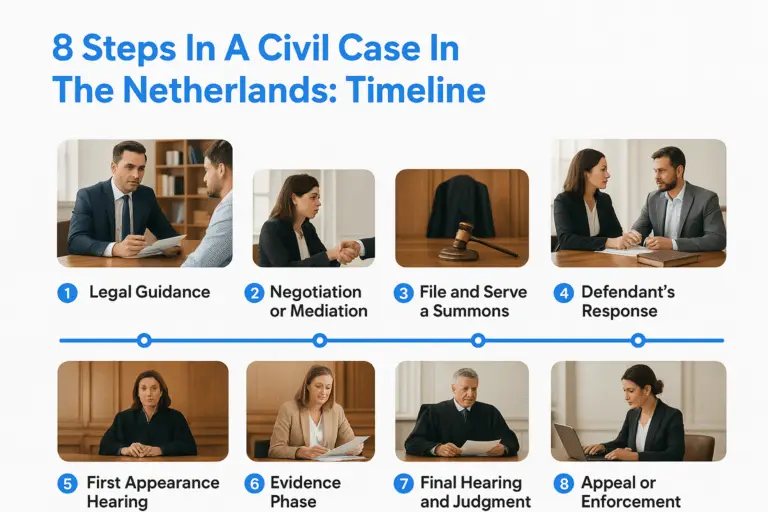
Most cases start at one of the eleven district courts (rechtbanken) and can then go to one of the four courts of appeal (gerechtshoven), which review both facts and law. Cassation is the third and final level.
In civil cases you appeal to the court of appeal within three months of the district court judgment; in criminal cases within 14 days. Only after that do you reach the Supreme Court. In some cases you can go straight from the district court to the Supreme Court if both parties agree (sprongcassatie).
What are the deadlines for cassation?
In civil cases, Article 402 of the Dutch Code of Civil Procedure (Rv) sets a period of three months from the date of the judgment. After a judgment in summary proceedings (kort geding) the period is eight weeks.
The civil appeal is lodged by a writ of summons or a petition that must already contain all grounds of cassation. There is no second chance to add grounds later.
In criminal cases you lodge the appeal in cassation at the court registry within 14 days of the judgment. Your lawyer then has two months, counted from the notice sent on behalf of the Supreme Court, to file the statement of grounds (schriftuur, Article 437 of the Code of Criminal Procedure). If it is late, the appeal is declared inadmissible. In tax cases different rules and periods apply.
Who may file a cassation appeal for you?
In civil and criminal cases you need a lawyer (advocaat) who meets the special requirements for practice before the Supreme Court. In tax cases a lawyer is not compulsory.
Even an experienced trial lawyer may not be admitted to cassation practice. Cassation work requires a specialist: the grounds must be precise, and the Supreme Court can reject vague complaints without detailed reasoning.
How does the cassation procedure run?
After the grounds are filed, the other party can respond in writing. Both parties can then explain their positions in writing, and an advocate general (advocaat-generaal) of the Office of the Procurator General gives an independent advisory opinion (conclusie) in most cases.
The Supreme Court then decides. Under Article 80a of the Judiciary Organisation Act (Wet op de rechterlijke organisatie, RO), in force since 1 July 2012, it can declare an appeal inadmissible at an early stage if the complaints clearly cannot succeed or the party has too little interest. Under Article 81 RO it can dismiss a complaint with short reasoning if it raises no question of law that needs answering.
What happens if the cassation appeal succeeds?
If a complaint succeeds, the Supreme Court quashes (vernietigt) the judgment. It usually refers the case to another court of appeal, which decides it again within the limits of the Supreme Court’s ruling.
Where no further investigation of the facts is needed, the Supreme Court can decide the case itself. After the Supreme Court, the only remaining route for an alleged human rights violation is a complaint to the European Court of Human Rights, within four months of the final decision.
What does cassation cost?
Cassation involves a court fee (griffierecht), the fees of a specialised lawyer and, in civil cases, the risk of an order to pay the other side’s legal costs on the fixed scale. The current court fees are published on rechtspraak.nl.
Weigh those costs against the realistic chance of success. A substantial share of civil and criminal cassation appeals ends with an Article 80a or 81 RO decision.
What should you check before filing cassation?
- The date of the judgment and the deadline: three months (civil), eight weeks (civil summary proceedings) or 14 days (criminal).
- Whether your complaint is about the law or the reasoning, not about the facts.
- Whether you raised the legal point before the lower court; new points are rarely accepted.
- Whether the judgment is provisionally enforceable, because cassation does not automatically suspend enforcement.
- The total costs and the risk of a costs order.
What should you check if the other party files cassation?
- The date on which the summons or the cassation notice was served on you.
- Whether you need to appear through a cassation lawyer to defend the judgment.
- Whether you want to file a cross-appeal (incidenteel cassatieberoep) against parts of the judgment.
- Whether you can already enforce the judgment, and the risk if it is later quashed.
What can we do for you with cassation before the Supreme Court?
Law & More is itself authorised to act before the Supreme Court in criminal cases. More on our approach in civil matters is on our civil lawyer page.
- We assess the appeal judgment for legal errors and defects in reasoning.
- We calculate the cassation deadline and record it the day the judgment is given.
- We lodge a criminal cassation appeal within 14 days and draft the statement of grounds.
- We explain the advisory opinion and the Supreme Court’s ruling to you.
Summary
- Cassation is the final appeal to the Supreme Court and only covers questions of law and reasoning, not facts.
- The period is three months in civil cases (eight weeks after summary proceedings) and 14 days in criminal cases.
- A specialised lawyer is required in civil and criminal cases; not in tax cases.
- If the appeal succeeds, the Supreme Court usually refers the case to another court of appeal.
Frequently asked questions
What is the deadline for cassation in the Netherlands?
In civil cases three months from the date of the appeal judgment, or eight weeks after a judgment in summary proceedings. In criminal cases the appeal in cassation must be lodged within 14 days.
Can the Supreme Court look at the facts again?
No. The Supreme Court takes the facts as the court of appeal established them and only reviews whether the law was applied correctly and the judgment is adequately reasoned.
Do I need a special lawyer for cassation?
In civil and criminal cases you need a lawyer who meets the special requirements for practice before the Supreme Court. In tax cases a lawyer is not compulsory.
What happens after the Supreme Court quashes a judgment?
The Supreme Court usually refers the case to another court of appeal, which decides it again within the limits of the ruling. Sometimes the Supreme Court decides the case itself.