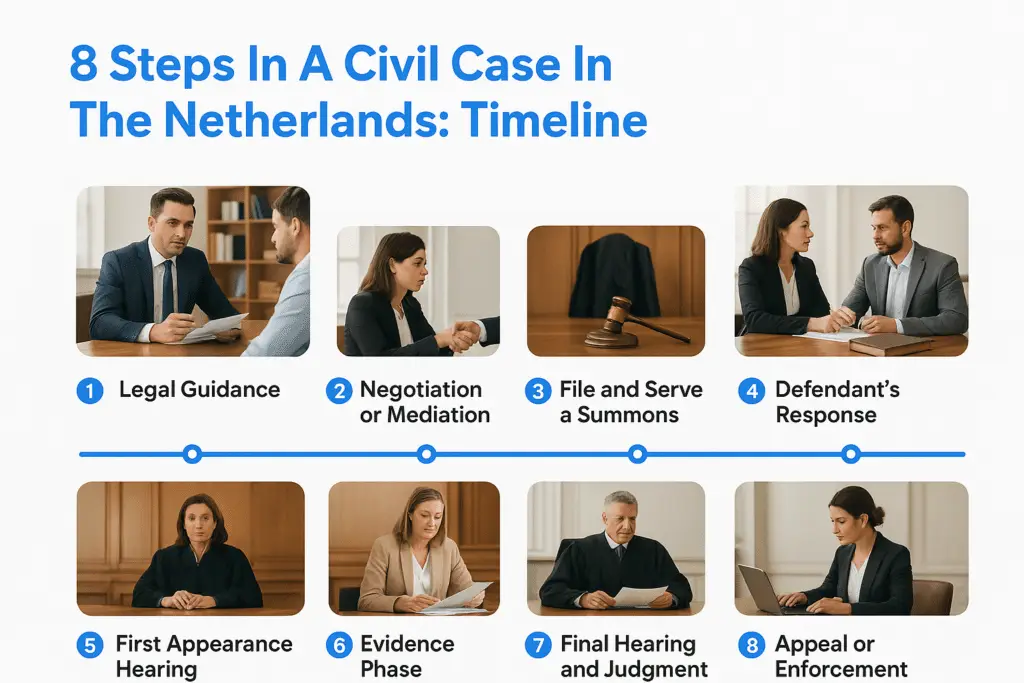
A civil case in the Netherlands starts with a writ of summons (dagvaarding) served by a bailiff, or with a petition (verzoekschrift) for certain matters such as dismissal or divorce. The defendant responds in writing, the court holds an oral hearing, and a judgment follows, against which you can usually appeal within three months; in urgent cases summary proceedings (kort geding) give you a decision within weeks.
Below we walk you through the steps in the order in which they happen, with the rules under the Dutch Code of Civil Procedure (Wetboek van Burgerlijke Rechtsvordering, Rv) and an indication of how long each step takes.
Which court will hear your case?
Small claims and certain types of cases go to the subdistrict court (kantonrechter); all other cases go to the civil section of the district court (rechtbank). At the subdistrict court you do not need a lawyer; at the district court you do.
Under Article 93 Rv, the subdistrict court hears claims of up to 25,000 euros and, whatever the amount, employment cases, tenancy cases and most consumer credit and consumer purchase cases. Under Article 79 Rv, parties before the district court must be represented by a lawyer (advocaat). Which district court has territorial jurisdiction usually depends on where the defendant lives or has its registered office, although contracts often contain a choice-of-court clause.
Most claims for payment or damages start with a writ of summons. The termination of an employment contract by the subdistrict court, family law cases and many corporate law matters start with a petition. We explain the differences on our page about our civil procedural lawyers.
What should you do before you go to court?
Get your facts and documents in order, have your position assessed, and put the other party formally on notice. Many disputes are settled at this stage.

A lawyer first looks at three questions: is your claim legally sound, can you prove the facts, and can the other party pay? A judgment against a company without assets is worth little. Bring the contract, the general terms and conditions, the correspondence, invoices and any evidence of your loss to the first meeting.
Sending a demand letter
Before litigation you normally send a demand letter (sommatie) in which you state your claim and give a reasonable deadline. In many cases this letter also serves as a notice of default (ingebrekestelling) under Article 6:82 of the Dutch Civil Code (BW), which is needed before the other party is in default and owes damages.
If the debtor is a consumer and you want to recover extrajudicial collection costs, the law requires a specific reminder that gives the consumer fourteen days to pay (Article 6:96(6) BW). Without that letter the court will not award those costs.
Trying to settle
Dutch courts expect parties to have tried to resolve their dispute before going to court. Negotiation, or mediation with a neutral mediator, is voluntary; a few weeks for this phase is common.
If you reach agreement, record it in a settlement agreement (vaststellingsovereenkomst, Article 7:900 BW). You can read more about these routes in our article on alternative dispute resolution.
How do you start the case in court?
In a summons case, a bailiff (gerechtsdeurwaarder) serves the writ of summons on the defendant and it is then filed with the court. In a petition case, your lawyer files the petition with the court, which then notifies the other party.

The writ of summons must contain your claim, the facts and grounds on which it is based, and the defence the other party has already raised with the evidence you have (Article 111 Rv). It also states the date on which the defendant must appear. Between service and that date there must be at least one week. Once served, the writ must be filed with the court registry in time, otherwise the case does not proceed.
Both parties pay a court fee (griffierecht). The amount depends on the value of the claim and on whether the party is a natural person or a legal entity, and the rates are adjusted every year. Preparing and serving the writ usually takes two to four weeks.
What happens after the defendant has been summoned?
The defendant submits a written defence (conclusie van antwoord), possibly with a counterclaim. If the defendant does not appear at all, the court can give judgment by default.
The period for the defence is set by the court’s procedural rules and can be extended on request. The defendant must respond to your claim and set out the evidence available to it. Preliminary defences, for example that the court has no jurisdiction because the contract contains an arbitration clause, must be raised at the same time as, or before, the defence on the merits.
If the defendant does not appear, the court grants a default judgment (verstek) unless the claim seems unlawful or unfounded (Article 139 Rv). The defendant can then still file an objection (verzet), in principle within four weeks (Article 143 Rv).
The oral hearing
After the defence the court almost always schedules an oral hearing (mondelinge behandeling) under Article 131 Rv. The judge uses it to obtain information, to explore whether a settlement is possible and to discuss how the case should proceed.
The judge asks questions about the facts, so you should attend in person and know your file. Many cases are settled at the hearing, with the settlement recorded in an official record that can be enforced like a judgment. If there is no settlement, the judge may give judgment or order a party to prove certain facts. The hearing usually takes place a few months after the case has started, depending on the workload of the court.
How do you prove your case?
The party that invokes a fact must prove it if the other side disputes it (Article 150 Rv). You do this with documents, witnesses and, where needed, experts.

Documents carry the most weight: the contract, e-mails, invoices, photographs and reports. If the court orders a party to prove a fact, that party can call witnesses, who are heard by the judge under oath or affirmation. The other party then gets the opportunity to call its own witnesses to prove the contrary.
For technical questions, such as the cause of a construction defect or the amount of the loss, the court can appoint an expert (Article 194 Rv). The parties can comment on the draft report. Reports from party-appointed experts are allowed, but a court-appointed expert usually carries more weight.
There is no general obligation to disclose all documents. You can, however, ask the court to order the other party to produce specific documents that are relevant to a legal relationship to which you are a party (Article 194a Rv). If evidence could be lost, you can ask for a provisional examination of witnesses before the case starts. The evidence phase easily adds several months to a case, and more if an expert has to investigate.
When does the court give its judgment?
After the hearing or the evidence phase the court sets a date for its written judgment (vonnis). In most cases that date is a few weeks after the last step in the proceedings, and the court may postpone it if it needs more time.
The losing party is usually ordered to pay the legal costs of the winning party. These are calculated on the basis of fixed rates (liquidatietarief), not on the actual fees, so they normally cover only part of what you paid your lawyer.
Should you appeal or enforce the judgment?
If you lost, you can usually appeal to the court of appeal (gerechtshof) within three months of the date of the judgment. If you won, you can enforce the judgment through a bailiff, often even while an appeal is pending.

The appeal period of three months follows from Article 339 Rv for summons cases and Article 358 Rv for petition cases. For a claim of 1,750 euros or less, appeal is not possible (Article 332 Rv). After the court of appeal, an appeal in cassation to the Supreme Court (Hoge Raad) is possible within three months, but only on points of law. An appeal typically adds a year or more to the dispute.
Enforcement
Many judgments are declared provisionally enforceable (uitvoerbaar bij voorraad), so the winning party may enforce even if the other party appeals. Before enforcement, a bailiff must serve the judgment on the losing party.
If the losing party still does not pay, the bailiff can attach its bank accounts, wages or assets. If a provisionally enforceable judgment you enforced is later overturned on appeal, you may have to pay back what you received.
What if your case cannot wait?
You can then start summary proceedings (kort geding) before the preliminary relief judge (voorzieningenrechter). A hearing is often scheduled within a few weeks, and in very urgent cases even faster.
Summary proceedings are available if you have an urgent interest in a provisional measure (Article 254 Rv), for example an order to stop an infringement, to resume deliveries or to pay an advance on a clear debt. Either party can still start proceedings on the merits. You can also ask the preliminary relief judge for leave to attach the other party’s assets before judgment (conservatoir beslag, Article 700 Rv); you must then start proceedings on the merits within the period set by the judge.
Which costs should you take into account?
There are four cost items: your own lawyer, the court fee, the bailiff and, if you lose, a contribution to the other party’s legal costs. Only the court fee and the costs order follow fixed rules.
The court fee is due when the case starts and is set by the Court Fees in Civil Cases Act (Wet griffierechten burgerlijke zaken), with lower rates for natural persons and for small claims. The largest item is usually the time your lawyer spends. Ask your lawyer at the start for an estimate per stage, so that you can weigh the costs against what is at stake and against a settlement offer.
How long does a civil case take in total?
A simple case at the subdistrict court can be decided within a few months. A district court case with witnesses or an expert can easily take a year or longer at first instance.
The duration depends on the workload of the court, the number of written rounds, and whether evidence has to be taken. A writ of summons that already contains all relevant documents reduces the chance of an evidence phase. The Dutch judiciary publishes information about procedures on rechtspraak.nl; the rules themselves are in the Dutch Code of Civil Procedure.
What should you check as the claimant?
As the party starting the case, you carry the burden of proof for the facts you rely on (Article 150 Rv). Check these points before the writ is served:
- Has the other party been put in default in writing (Article 6:82 BW), and for a consumer debtor, did you send the fourteen-day letter (Article 6:96(6) BW)?
- Is the claim above 25,000 euros, so that you need a lawyer at the district court?
- Does the contract contain a choice-of-court or arbitration clause?
- Can you prove each disputed fact with documents attached to the writ?
- Does the other party have assets, and is prejudgment attachment (Article 700 Rv) needed?
What should you check as the defendant?
If you receive a writ of summons, the appearance date in the writ is your first deadline. Check these points straight away:
- On which date must you appear, and do you need a lawyer to do so (district court)?
- Does the court have jurisdiction, or should you raise an arbitration or choice-of-court clause before your defence on the merits?
- Do you have a counterclaim that should be filed with your defence?
- Which documents and witnesses support your version of the facts?
- If a default judgment has already been given, is the four-week period for objection (Article 143 Rv) still running?
What can we do for you with civil proceedings?
Our lawyers handle civil litigation for Dutch and international clients at the subdistrict court, the district court and the court of appeal.
- We assess your claim or defence, the evidence and the other party’s ability to pay.
- We draft and send the demand letter and notice of default.
- We draft the writ of summons or petition and arrange service by a bailiff.
- We prepare you for the oral hearing and attend it with you.
- We apply for prejudgment attachment or start summary proceedings in urgent cases.
- We file an appeal within the three-month period, or arrange enforcement of the judgment.
Summary
- Claims up to 25,000 euros, employment and tenancy cases go to the subdistrict court, where you do not need a lawyer; other cases go to the district court, where you do.
- Most cases start with a writ of summons served by a bailiff; some start with a petition.
- After the written defence the court holds an oral hearing, where many cases are settled.
- If facts are disputed, the party relying on them must prove them with documents, witnesses or experts.
- Appeal is usually possible within three months, and a provisionally enforceable judgment can be enforced in the meantime.
Frequently asked questions
Do I need a lawyer for a civil case in the Netherlands?
Not at the subdistrict court, which hears claims up to 25,000 euros and all employment and tenancy cases. At the district court and in appeal you must be represented by a lawyer (Article 79 Rv).
Can I conduct the case in English?
In principle Dutch courts work in Dutch, so documents in other languages may need to be translated. For international commercial disputes the parties can agree to bring their case before the Netherlands Commercial Court (NCC), which works in English.
Will the other party pay my legal fees if I win?
Usually only in part. The court awards legal costs on the basis of fixed rates (liquidatietarief), which are often lower than the actual costs.