
Remote work has become a standard part of employment in the Netherlands, but it brings specific legal requirements that both employers and employees must understand.
As of 2025, Dutch law does not grant employees an automatic right to work from home, but workers who have been employed for at least six months at companies with 10 or more employees can formally request remote work arrangements.
Employers must have valid reasons to refuse such requests.
Once remote work begins, numerous legal obligations come into effect.
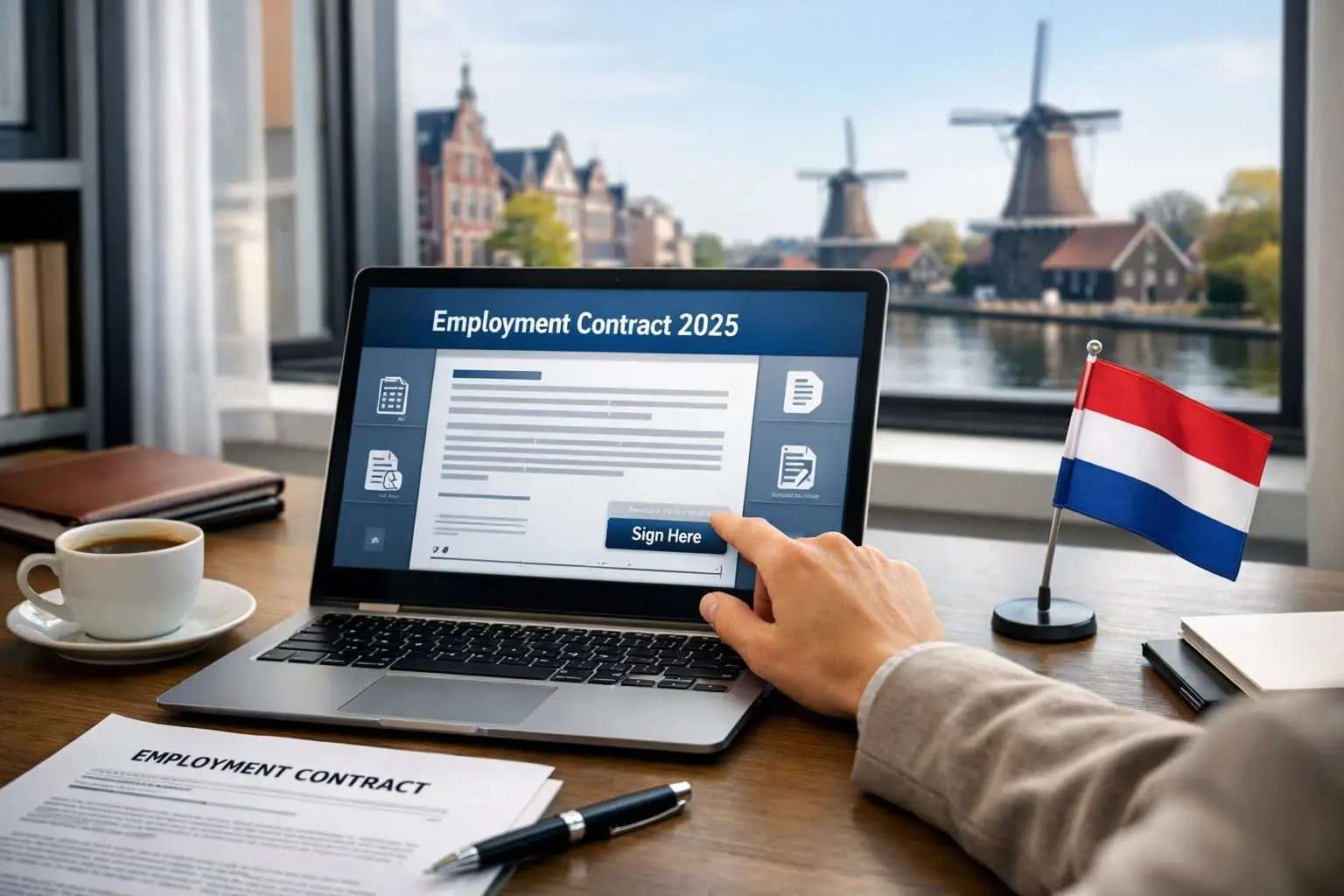
Whether you employ remote workers in the Netherlands or work remotely yourself, you need to navigate employment contracts, health and safety regulations, tax implications, and data protection rules.
The Working Conditions Act applies to home workplaces just as it does to traditional offices, and employers must ensure remote workers have safe, ergonomic setups.
Privacy rules limit how you can monitor employees, whilst cross-border remote work adds layers of complexity around social insurance and taxation.
Remote Work Legislation and Employee Rights in 2026

The Netherlands has established clear legal frameworks governing remote work through the Work Where You Want Act, which grants employees specific rights to request flexible working arrangements.
Dutch employers must navigate structured processes for evaluating and responding to these requests, with defined grounds for approval or refusal.
Work Where You Want Act and Its Impact
The Work Where You Want Act (Wet werken waar je wilt) represents a significant update to the Netherlands’ approach to flexible working arrangements.
This legislation builds upon the earlier Flexible Working Act (Wet flexibel werken) by strengthening employee rights to work remotely.
Under this Act, your employees gain the legal right to request changes to their working location, including full remote work or hybrid arrangements.
The legislation affects all employment contracts in the Netherlands, requiring you to consider remote work requests seriously and respond within specific timeframes.
The Act creates binding obligations for employers with ten or more employees.
If your organisation meets this threshold, you must handle remote work requests through a formal process.
Smaller employers still face obligations under the broader Flexible Working Act, though the requirements differ slightly.
Employee Right to Request Remote or Hybrid Work
Your employees can submit formal requests to work remotely or adopt hybrid work schedules after being employed for at least 26 weeks.
They must submit their request in writing at least two months before the desired start date.
The request must include:
- The preferred working location
- The number of days they wish to work remotely
- The proposed start date
- Whether the arrangement is temporary or permanent
You have one month to respond to the request.
During this period, you must engage in consultation with your employee to discuss the proposal.
If you need additional time to make a decision, you can extend the response period by one month, but you must inform your employee within the initial month.
Employees can submit a new request if circumstances change, though they must wait at least one year after a previous request unless significant changes in their role or personal situation occur.
Grounds for Granting or Refusing Remote Work Requests
You can refuse a remote work request, but you must base your decision on legitimate business interests.
The Dutch legislation recognises specific grounds for refusal, including operational requirements, security concerns, or the nature of the work itself.
Valid grounds for refusal include:
- The work requires physical presence due to its nature
- Remote work would create serious operational difficulties
- Security or confidentiality requirements cannot be met remotely
- Customer or client service would be significantly impacted
You must provide your refusal in writing with clear reasoning.
Your explanation needs to demonstrate why the specific business interests outweigh your employee’s request.
General statements about preferring in-office work are insufficient.
If you approve the request, you must document the arrangement in writing.
This includes specifying working hours, location details, equipment provision, and any conditions attached to the remote work arrangement.
These terms become part of the employment contract.
Essential Elements of Dutch Employment Contracts for Remote Work

Dutch employment contracts for remote workers must include specific mandatory elements defined by law, regardless of whether employees work from home or an office.
These contracts can be open-ended or fixed-term, and they must clearly outline remote work arrangements and incorporate any applicable collective labour agreements.
Mandatory Clauses and Terms
The Dutch Civil Code requires employers to provide written documentation of key employment terms within one month of starting work.
This applies to all employees, including those working remotely.
Your employment contract must include your personal details and those of your employer, your job title, and a clear job description of your responsibilities.
Additional mandatory elements include your starting date, the type of employment contract, your agreed salary and payment frequency, and your working hours.
The contract must specify any probation period, typically up to two months for contracts under two years.
Notice periods for termination must be clearly stated, along with the location where you will perform your work.
For remote workers, employers must document whether you work from home full-time or split time between home and office.
The terms and conditions should address who provides necessary equipment and how work-related expenses are handled.
Dutch law expects this information in writing to protect both parties and prevent misunderstandings.
Types of Employment Contracts
You can work remotely under different contract structures in the Netherlands.
An open-ended employment contract provides the most job security with no predetermined end date.
This permanent arrangement offers comprehensive legal protections and predictable employment terms.
A fixed-term contract has a specific duration and automatically ends on the agreed date.
Employers can only offer three consecutive fixed-term contracts within a total period of three years before they must convert your position to permanent.
This rule protects remote workers from indefinite temporary arrangements.
Part-time contracts are common for remote work, specifying exact hours and days you must be available.
On-call contracts provide flexibility but must guarantee minimum hours after you work certain periods.
Temporary agency contracts involve working for client companies whilst being employed by a staffing agency.
Each contract type affects your rights regarding dismissal protection, holiday entitlement, and access to benefits.
Remote workers receive the same legal protections as office-based employees under Dutch employment law.
Incorporating Remote Work Arrangements
Your employment agreement must specify your remote work arrangements if you work from home regularly.
This includes documenting your primary work location, whether that is your home address, the employer’s office, or a combination of both locations.
Dutch employees who work for companies with at least 10 employees for six months have the legal right to request remote work.
Employers must respond to these requests and can only refuse based on legitimate business reasons.
Once approved, the remote work arrangement should be documented in your contract or a formal addendum.
The contract should detail health and safety obligations for your home workspace.
Employers must ensure remote employees have safe and ergonomic workplace setups.
This includes providing necessary equipment or reimbursement for approved purchases.
Data protection requirements must be addressed, particularly regarding confidentiality and secure handling of company information from home.
Your contract should specify expectations for internet security, data storage, and protecting sensitive business information.
Collective Bargaining Agreements
A collective labour agreement (CAO) may apply to your employment if one exists for your industry or company.
These agreements between employers and unions establish minimum terms and conditions that often exceed basic legal requirements.
Your individual employment contract cannot offer less favourable terms than those in an applicable CAO.
Collective bargaining agreements frequently include specific provisions about remote work, such as allowances for home office expenses, equipment provision, and flexible working hours.
Some CAOs specify maximum percentages of time employees can work remotely or require regular office attendance.
If your employer establishes or changes a remote work policy, they may need prior consultation with or consent from the works council.
This requirement applies to companies meeting certain employee thresholds.
The works council ensures employee interests are considered when implementing remote work arrangements.
Your employment contract should reference any applicable collective labour agreement and explain how it affects your terms and conditions.
Employers must comply with both the CAO and individual contract terms, applying whichever provision is most favourable to you as the employee.
Employer Obligations and Working Conditions
Employers in the Netherlands must meet specific legal duties when employees work remotely, particularly under the Working Conditions Act (Arbowet).
These obligations cover health and safety requirements, proper home workplace setup, and employee well-being considerations that differ from traditional office environments.
Health and Safety Duties Under the Working Conditions Act
The Arbowet applies to home workplaces just as it does to office environments.
You must conduct a risk inventory and evaluation (RI&E) that includes the specific risks of working from home.
These risks differ from office-based work and include issues like the extra strain employees experience when combining work with home responsibilities.
You are required to provide information about how employees can work safely and healthily from their homes.
This includes clear guidance on ergonomic practices and potential hazards in a home setting.
Your employees also share responsibility for maintaining a safe home working environment.
They must use the information and resources you provide properly.
You cannot simply transfer all health and safety obligations to your employees, as the Arbowet places primary responsibility on you as the employer.
Home Workplace Assessments and Equipment
You must ensure that employees have a proper and safe home workplace.
This means providing appropriate work equipment that meets ergonomic standards.
Typical equipment you should consider providing includes:
- Ergonomic office chairs
- Proper desks at correct heights
- Ergonomic keyboards and mice
- External monitors
- Adequate lighting solutions
You can offer a working-from-home allowance to cover additional costs employees incur.
For 2025, this allowance is set at €2.40 per day and is tax-free.
This covers extra expenses for heating, water, electricity, and basic supplies like tea and coffee.
You need to assess whether the home workplace is suitable for the work being performed.
If the home environment is not safe or appropriate for the work tasks, this can be a valid reason to refuse a remote working request under the Flexible Working Act.
Work-Life Balance and Well-Being
Working remotely creates unique challenges for employee well-being that you must address.
The blending of work and private life at home can lead to increased stress and difficulty maintaining boundaries.
Your RI&E should specifically identify risks related to work-life balance when employees work from home.
This includes evaluating how working remotely affects mental health and the ability to disconnect from work responsibilities.
You should establish clear policies about working hours and availability expectations.
Employees need to know when they are expected to be available and when they can fully disconnect from work duties.
Information security measures also affect employee well-being.
You must create clear policies about what is and is not allowed when working remotely.
This clarity helps employees work confidently without fear of inadvertently breaching company rules.
Data Protection, Privacy, and Monitoring Requirements
Remote work in the Netherlands requires strict compliance with data protection laws, particularly GDPR, whilst employers must balance legitimate monitoring needs against employee privacy rights.
Dutch employers face specific obligations around secure data access, transparent monitoring practices, and maintaining robust information security measures.
GDPR and Privacy Law Compliance
The General Data Protection Regulation governs how you must handle employee personal data in remote work settings. You need to implement adequate technical and organisational measures to protect personal information, regardless of where your employees work from.
Your privacy policies must clearly explain what data you collect, how you process it, and who has access to it. You should conduct a Data Protection Impact Assessment (DPIA) when implementing new remote work systems or software that processes personal data.
This is especially important when deploying monitoring tools or cloud-based systems. The Dutch Data Protection Authority (Autoriteit Persoonsgegevens) enforces GDPR compliance in the Netherlands.
You face significant fines if you fail to protect employee data properly or breach transparency requirements. You must also appoint a Data Protection Officer if you process large amounts of employee data or conduct regular monitoring activities.
Monitoring Employees Remotely
You can monitor remote employees in the Netherlands, but only within strict legal boundaries. Your monitoring must serve a legitimate business purpose and be proportionate to that purpose.
You need explicit consent from employees or a valid legal basis before implementing monitoring software. You must inform your employees in advance about what monitoring tools you use, what data you collect, and why.
This includes keystroke logging, screen recording, or time-tracking software. The Works Council (if applicable) must approve your monitoring policies before implementation.
You cannot use monitoring data to make employment decisions without proper justification. Excessive or covert monitoring violates Dutch privacy laws and can result in legal action from employees.
Information Security and Secure Access
You must provide secure access methods for remote employees to connect to company systems. This includes implementing Virtual Private Networks (VPNs), multi-factor authentication, and encrypted communication channels.
Your employees need clear guidelines on data security practices when working remotely. You should provide company devices with pre-installed security software rather than allowing uncontrolled use of personal devices.
If employees use their own devices, you need a comprehensive Bring Your Own Device (BYOD) policy that addresses security requirements. You must regularly update security software and conduct security audits of remote work systems.
Your employees require training on recognising phishing attempts, securing their home networks, and handling sensitive data properly.
Payroll, Salary, and Taxation Implications
Employers hiring remote workers in the Netherlands must navigate specific payroll requirements, social security obligations, and tax withholding rules. Dutch law mandates particular employee benefits and allowances that affect total compensation costs.
Payroll and Social Security Contributions
When you employ remote workers in the Netherlands, you must register with the Dutch tax authorities and process payroll according to local regulations. You need to withhold income tax and social security contributions from each salary payment through the payroll system.
Social security contributions cover several insurance schemes. These include state pension (AOW), unemployment insurance (WW), and long-term care insurance (WLZ).
You share these costs with your employees, typically splitting contributions between employer and employee portions. The total social security burden ranges between 25% and 35% of gross salary.
You must remit these contributions monthly to the Dutch Tax and Customs Administration alongside income tax withholdings. Failure to comply results in penalties and interest charges.
Holiday Pay and Employee Benefits
Dutch employment law requires you to pay a minimum holiday allowance of 8% of gross annual salary. You must pay this amount at least once per year, typically in May or June.
This payment comes on top of regular salary, not as a substitute. Your employees are entitled to a minimum of 20 days of paid holiday per year based on a full-time work schedule.
Part-time workers receive proportional holiday days. You cannot replace statutory holiday entitlement with monetary compensation except upon termination of employment.
Beyond minimum requirements, you may offer supplementary employee benefits such as:
- Pension contributions
- Travel allowances
- Health insurance subsidies
- Professional development budgets
Tax Implications and Double Taxation
Remote workers physically present in the Netherlands must pay Dutch income tax on their salary. Tax rates are progressive, starting at 36.97% for income up to €75,518 and reaching 49.5% for higher brackets.
You must determine tax residency status for each remote worker. Employees who spend more than 183 days per year in the Netherlands typically become Dutch tax residents.
Tax residents pay tax on worldwide income, whilst non-residents only pay tax on Dutch-sourced income. The Netherlands has tax treaties with over 90 countries to prevent double taxation.
These treaties allow employees to claim foreign tax credits or exemptions when they pay tax in multiple jurisdictions. You should advise employees to seek professional tax advice for their specific situations.
Remote Work Allowances and Thuiswerkvergoeding
You can provide tax-free reimbursements for remote work expenses through the thuiswerkvergoeding (home working allowance). The Dutch tax authorities permit up to €2.35 per day without requiring proof of actual costs for 2025.
This allowance covers expenses such as electricity, heating, internet, and office supplies. You can pay this reimbursement for each day an employee works from home.
The payment does not count as taxable income and requires no social security contributions. Alternatively, you may reimburse actual documented costs instead of using the fixed daily rate.
You need proper administration and receipts to support these reimbursements. Many employers prefer the fixed rate because it reduces administrative burden for both parties.
Cross-border Remote Work and Immigration Considerations
When employees work remotely from the Netherlands for foreign employers or vice versa, distinct legal frameworks govern labour rights, immigration status, and tax implications. Dutch authorities closely monitor these arrangements to ensure compliance with local regulations and prevent unlawful establishment of business operations.
Labour Law and Social Security for Cross-Border Workers
Dutch labour law applies to cross-border workers based on where they habitually perform their work, not just where their employer is located. If you work from the Netherlands for at least 40% of your working time, Dutch employment law typically governs your contract, regardless of any choice-of-law clause your employer includes.
This means you gain access to Dutch statutory protections. These include minimum wage requirements, maximum working hours, and strict dismissal procedures.
Social security contributions follow EU coordination rules for cross-border workers within the EU/EEA. Your employer must obtain an A1 certificate to determine which country’s social security system applies.
Without proper certification, you may face double contributions or gaps in coverage. For workers outside the EU/EEA, bilateral social security agreements determine applicable systems.
The Netherlands has treaties with countries including the United States, Australia, and Canada. If no agreement exists, both jurisdictions may require contributions.
Residence and Work Permit Requirements
Non-EU/EEA nationals working remotely from the Netherlands require both a residence permit and a work permit (TWV – tewerkstellingsvergunning), even when employed by foreign companies. Your employer must apply for these permits, which typically takes 2-3 months to process.
The Netherlands offers specific permit categories for remote workers:
- Highly Skilled Migrant scheme for salaries above €5,008 monthly (2025 threshold for workers under 30)
- Self-employment residence permits for freelancers
- Orientation year permits for recent graduates
EU/EEA citizens maintain freedom of movement rights and don’t require permits. However, you must register with the municipality (gemeente) within five days of arrival if staying longer than four months.
Immigration authorities scrutinise whether remote work arrangements disguise actual employment relationships that require standard permits. Digital nomad visas don’t currently exist in Dutch law, though proposals are under consideration.
Permanent Establishment Risks
Your remote work activities can trigger permanent establishment (PE) status for your foreign employer in the Netherlands. This creates significant tax and regulatory obligations, including Dutch corporate tax liability and VAT registration requirements.
PE typically arises when you maintain a fixed place of business or habitually conclude contracts on behalf of your employer. Courts examine factors including workspace control, client interactions, and decision-making authority.
The risk increases if you represent your employer to Dutch clients, negotiate contracts, or maintain dedicated office space. Even working from home can establish PE if your activities constitute core business functions rather than auxiliary support.
Your employer should conduct regular PE risk assessments, particularly if multiple employees work from the Netherlands. Professional tax advisers can help structure arrangements to minimise exposure whilst maintaining compliance with Dutch employment law.
Frequently Asked Questions
Dutch employment law in 2025 requires specific contract provisions for remote work arrangements, health and safety compliance at home workplaces, and clear data protection measures. Employers must follow established procedures for working hours, equipment provision, and contract termination when managing remote workers.
What are the primary legal requirements for remote work stipulated in Dutch employment contracts as of 2025?
Your employment contract must explicitly define the terms of remote work. The contract needs to clarify whether remote work is an option and specify the conditions under which you can work from home or other locations outside the traditional office.
You should include details about work location, working hours, and any hybrid arrangements in the contract. The agreement must comply with Dutch labour laws even if your business lacks a legal entity in the Netherlands.
If you have worked for a company with at least 10 employees for six months or more, you have the legal right to request remote work arrangements. Your employer must provide a good reason for refusing such a request, such as scheduling problems, work that cannot be done elsewhere, or an unsafe home workplace.
How does Dutch legislation regulate working hours and breaks for remote employees?
The Working Conditions Act (Arbowet) applies to remote workers in the same way it applies to office-based employees. Your employer must ensure you can work safely and properly at home.
Standard Dutch working time regulations remain in force for remote work arrangements. Your employer cannot simply require unlimited availability because you work from home.
You maintain the same rights to breaks and rest periods as office workers. Your employment contract or collective agreement should specify your working hours and any flexibility arrangements.
Are there specific health and safety regulations for remote work environments in the Netherlands?
Your employer must conduct a risk inventory and evaluation (RI&E) that includes the risks of working from home. This assessment must account for different risks than office work, such as extra strain from combining work and home commitments.
The Working Conditions Act requires your employer to provide information about how you can work safely and healthily at home. Your employer must provide a good and safe home workplace, which can include ergonomic work equipment such as an ergonomic keyboard or office chair.
You also bear responsibility for maintaining a healthy and safe home working environment. This includes using the information and resources your employer provides correctly.
Your employer cannot monitor you without good reason. Any monitoring must be necessary, communicated in advance, and justified by business interests that outweigh your privacy rights.
What are the employer’s responsibilities concerning the provision of equipment for remote workers in the Netherlands?
Your employer must provide equipment that enables you to work safely and healthily from home. This obligation includes ergonomic furniture and tools necessary for your role.
You can receive a tax-free working-from-home allowance to cover additional costs such as heating, water, electricity, and consumables. For 2025, this allowance is set at £2.40 per day.
Your employer must ensure any equipment meets health and safety standards. The provision of proper equipment forms part of their duty of care under the Working Conditions Act.
How is data protection handled for remote workers under Dutch law?
You must comply with privacy law and the General Data Protection Regulation (GDPR) when working remotely. Your employer should create clear policies about what is and is not allowed regarding data handling.
Working from home creates different security risks than office work. Your employer should establish security measures such as secure network connections, anti-virus software, and restrictions on approved apps and services.
You should not leave computers unattended, even at home. Your employer may require you to use company devices rather than personal equipment to maintain proper security settings.
Your employer must clearly explain why any monitoring is necessary. They can only monitor you under specific conditions where business interests clearly outweigh your privacy rights.
What steps must be followed to lawfully terminate a remote work contract in the Netherlands?
Terminating a remote work contract follows the same legal procedures as terminating any Dutch employment contract. Your employer must have valid grounds for dismissal and follow proper notice periods.
The standard dismissal routes apply: mutual consent, termination by the employer with prior permission from the Employee Insurance Agency (UWV), or dissolution by the subdistrict court. Your employer cannot use your remote work status as sole grounds for termination.
You maintain the same protection against unfair dismissal as office-based workers. The transition period and notice requirements in your contract remain binding regardless of work location.
If you have been working remotely for years, your employer cannot suddenly require office attendance without valid business reasons. Recent court rulings have reinforced that established remote work patterns create legitimate expectations.


