A pro forma hearing (pro-formazitting) is a short court hearing in a criminal case where the suspect is in pre-trial detention but the investigation is not yet finished. The court does not decide on guilt: it formally opens the trial within the 90-day limit of the detention order (Article 66 of the Dutch Code of Criminal Procedure, Sv), adjourns the case and decides whether detention continues.
The hearing is not an empty formality. At every pro forma hearing the defence can ask the court to lift or suspend detention and to order further investigation. Without such a hearing, the suspect would have to be released once the statutory detention periods have run out.
Table of contents
Why does a pro forma hearing take place?
Because pre-trial detention before trial has a fixed maximum. The trial must start before the detention order (gevangenhouding) of at most 90 days expires, and in complex cases the file is usually not ready by then.
Pre-trial detention builds up in stages. The police may hold a suspect in custody (inverzekeringstelling) for three days, which can be extended once by three days (Article 58 Sv). The examining magistrate (rechter-commissaris) can then order remand in custody (bewaring) for up to 14 days (Article 64 Sv). After that, the court in chambers (raadkamer) can order continued detention for up to 90 days in total (Article 66 Sv). Together this comes to roughly 110 days.
If the trial has started within those 90 days, the detention order stays in force until 60 days after the final judgment (Article 66(2) Sv). The pro forma hearing is that formal start. From then on, the court reviews detention at each adjourned hearing.

How often is the case adjourned?
While the suspect is detained, the court may adjourn the case for at most one month, or for compelling reasons for at most three months (Article 282 Sv). In complex cases, pro forma hearings therefore usually follow each other at intervals of up to three months.
The law sets no maximum number of pro forma hearings. Each time, however, the court must assess whether detention is still justified. Under Article 67a(3) Sv, detention may not continue if there is a serious chance that the suspect will not receive an unconditional prison sentence, or will spend longer in detention than the likely sentence. The right to a trial within a reasonable time under Article 6 of the European Convention on Human Rights (ECHR) also limits how long the investigation may take.
What happens at the hearing?
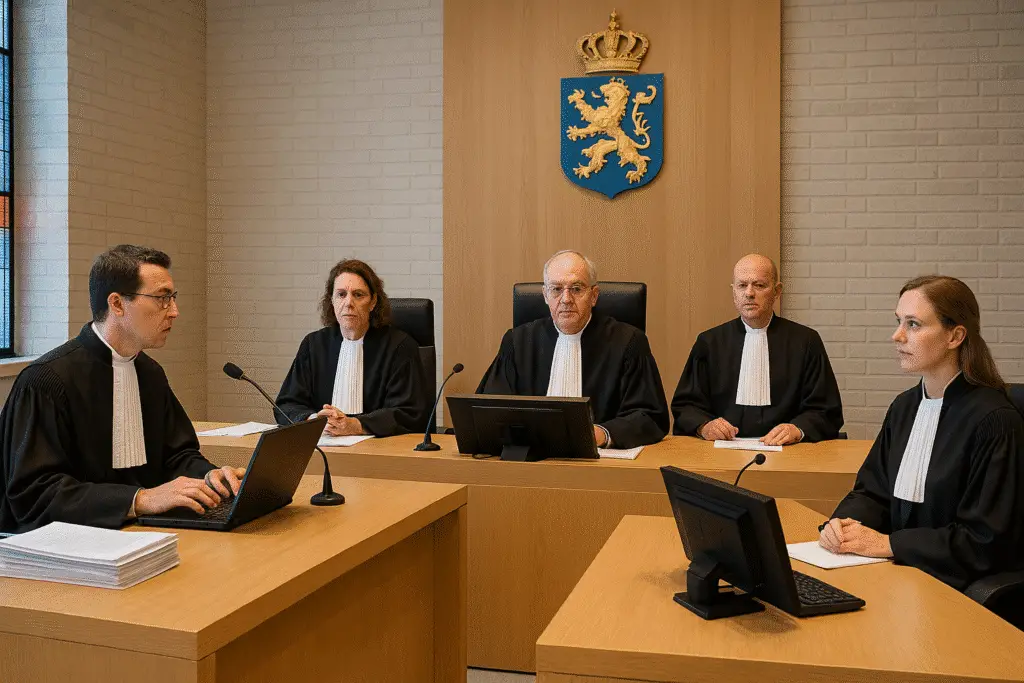
The court checks the suspect’s identity, the public prosecutor (officier van justitie) explains the state of the investigation, and the defence lawyer makes requests. Like any criminal trial, the hearing is in principle public (Article 269 Sv).
- The prosecutor explains which investigative steps are still pending, such as forensic reports, analysis of telephone data or requests for legal assistance abroad.
- The defence can ask for detention to be lifted (opheffing) or suspended (schorsing) under conditions, such as a reporting duty or an electronic ankle monitor (Article 80 Sv).
- The defence can ask for further investigation, such as the hearing of witnesses; the court can refer the case to the examining magistrate for this (Article 316 Sv).
- The court decides on detention and on the requests, and sets the date of the next hearing.
The court does not hear witnesses on the facts and does not rule on guilt or sentence. Victims can exercise their right to speak (spreekrecht, Article 51e Sv) at the substantive hearing, not at a pro forma hearing.
What can the defence achieve at a pro forma hearing?
The defence can use each pro forma hearing to challenge detention and to steer the investigation. Requests made early give the prosecution and the examining magistrate time to carry them out before the substantive hearing.
A request to lift detention argues that the grounds for detention in Article 67a Sv, such as a risk of flight or of reoffending, no longer apply. A request for suspension asks the court to release the suspect under conditions. Against most detention decisions, the defence can appeal to the court of appeal (gerechtshof) within three days.
Witness requests made in time, for example at a pro forma hearing, are in principle assessed against the defence-interest test (verdedigingsbelang). Requests made only at the substantive hearing face the stricter necessity test of Article 315 Sv. That difference is a practical reason to file witness requests at the pro forma stage.
A pro forma hearing does not mean that the prosecution will drop the case. It also does not mean that the case is weak or strong: it only shows that the investigation is not yet complete.
What can we do for you at a pro forma hearing?
Our criminal lawyers assist suspects in detention from the first police interview to the substantive hearing.
- We review the criminal file before each pro forma hearing and identify what is still missing.
- We file requests to lift or suspend detention, with concrete conditions such as a reporting duty.
- We submit witness and investigation requests in time, so that the defence-interest test applies.
- We appeal a detention decision to the court of appeal within the three-day deadline.
- We raise unreasonable delay under Article 6 ECHR when the investigation stalls.
- We explain to family members what each hearing means and when the next one takes place.
Summary
- A pro forma hearing formally starts the trial within the 90-day limit of Article 66 Sv; it does not decide guilt.
- While the suspect is detained, the case may be adjourned for one month, or three months for compelling reasons (Article 282 Sv).
- At each hearing the court reviews detention and decides on requests to lift or suspend it.
- Witness requests made at the pro forma stage are in principle assessed under the more lenient defence-interest test.
- Victims speak at the substantive hearing, not at a pro forma hearing.
Frequently asked questions
Does a pro forma hearing decide guilt or innocence?
No. The court only formally opens the trial, decides whether pre-trial detention continues and deals with requests from the defence. Guilt and sentence are decided at the substantive hearing.
How often is there a pro forma hearing?
While the suspect is detained, the court may adjourn the case for at most one month, or three months for compelling reasons (Article 282 Sv). The law sets no maximum number of pro forma hearings, but detention must remain justified each time.
Can the court release the suspect at a pro forma hearing?
Yes. The court can lift detention if the grounds in Article 67a Sv no longer apply, or suspend it under conditions such as a reporting duty. The defence has to argue this with concrete facts.
Can victims speak at a pro forma hearing?
No. The right to speak under Article 51e Sv applies at the substantive hearing. Victims can submit a written victim statement for the file, and Victim Support Netherlands (Slachtofferhulp Nederland) can help with this.
Are pro forma hearings open to the public?
In principle yes, as every criminal hearing is public under Article 269 Sv. The court can order a closed hearing on the grounds listed in that article, for example to protect the privacy of those involved.