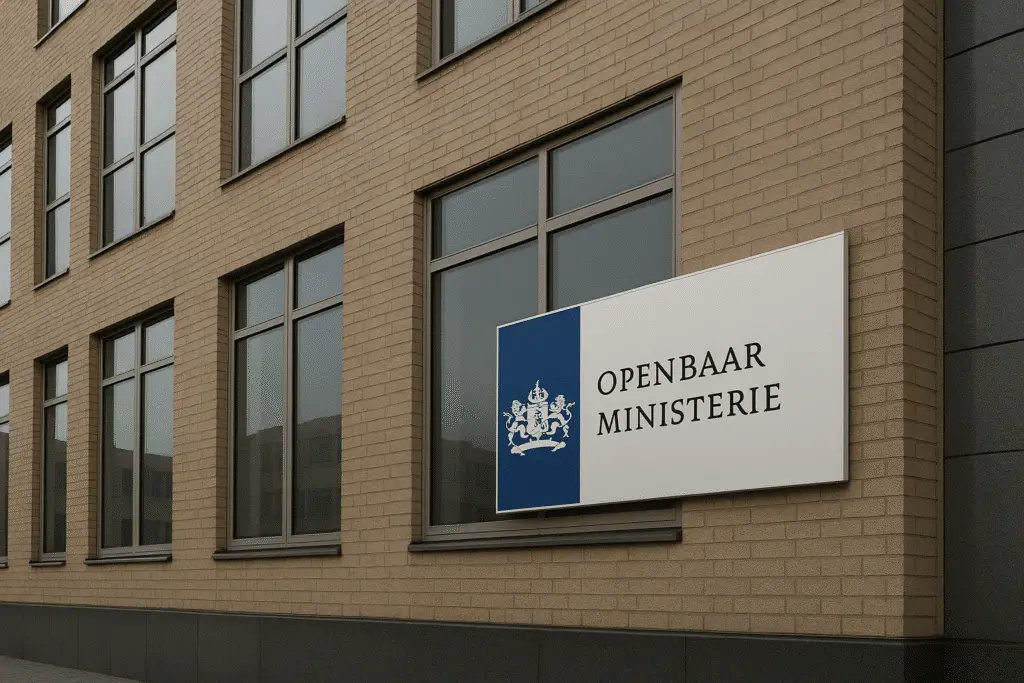
A penalty order (strafbeschikking) is a punishment imposed by the Public Prosecution Service (Openbaar Ministerie) itself, without a judge, for offences carrying a statutory maximum of no more than six years imprisonment. It establishes guilt and is recorded in the judicial documentation, but it can never contain a prison sentence. If you disagree, you must lodge verzet within two weeks of the order being served on you; the case is then reassessed and can be brought before the criminal court.
What a penalty order is
The penalty order was introduced by the Wet OM-afdoening, which entered into force in stages from 1 February 2008 and is set out in article 257a and following of the Wetboek van Strafvordering (Code of Criminal Procedure). It replaced the older transaction (transactie), under which the suspect was offered a payment and could choose to be prosecuted instead. The difference is fundamental. A transaction was an offer; a penalty order is a decision. The punishment is imposed the moment the order is issued, and it takes effect unless the person punished actively objects.
That shift matters for two reasons. First, the Public Prosecution Service both investigates and punishes, which is why the law surrounds the penalty order with safeguards about hearing the suspect and about the right to have the case reassessed by a court. Second, a penalty order is not a conviction handed down by a judge, but it does contain a finding of guilt and it does appear in your judicial documentation. Treating it as a parking ticket is the single most expensive mistake people make with it.
When the Public Prosecution Service may issue one
A penalty order may be issued for overtredingen (minor offences) and for misdrijven (indictable offences) carrying a statutory maximum of not more than six years imprisonment. In practice that covers shoplifting and other minor property offences, simple assault and threats, public order offences, vandalism and a range of driving offences including driving under the influence. Cases in which the prosecutor considers a prison sentence appropriate, and cases that are legally or factually complex, go to court by way of a summons instead.
The public prosecutor is not the only authority. Designated investigating officers may issue a penalty order for certain offences under article 257b of the Code of Criminal Procedure, and specified administrative bodies may issue an administrative penalty order under article 257ba for offences in their own field, such as environmental or waste offences. Whoever issues it, the order is a criminal law instrument and enforcement runs through the Central Judicial Collection Agency (CJIB).
Which penalties a penalty order can contain
The law limits what the Public Prosecution Service may impose without a judge. Article 257a of the Code of Criminal Procedure sets out an exhaustive list, and imprisonment is not on it. The penalties and measures available are:
- a fine, up to the statutory maximum for the offence concerned
- a community service order (taakstraf) of at most 180 hours
- a disqualification from driving motor vehicles for at most six months
- a compensation measure in favour of the victim (schadevergoedingsmaatregel)
- withdrawal from circulation of seized items (onttrekking aan het verkeer)
- instructions the person punished must comply with, such as a stadium ban, a contact prohibition or participation in a course or treatment
An order may combine several of these, and instructions are often attached for a fixed period. Because a driving ban and a community service order interfere with daily life far more than a fine does, they carry additional procedural protection, which is the subject of the next section.

Being heard before the order is issued
Article 257c of the Code of Criminal Procedure requires the prosecutor to hear the suspect before certain penalty orders are issued. In practice the hearing obligation is triggered where the prosecutor intends to impose a community service order, a driving disqualification or behavioural instructions, because the prosecutor has to establish that the suspect is able and willing to comply. This is the OM hearing (OM-hoorzitting), and it is not a formality: what is said there shapes the order that follows.
You may be assisted by a lawyer at that hearing, and for the heavier penalties that assistance is what the safeguard is for. The hearing is also the last realistic moment at which the penalty can be influenced without going to court. Our article on the OM hearing and the penalty order explains how it runs and what to prepare.
What a penalty order means for your criminal record
A penalty order for a misdrijf is recorded in the judicial documentation, the register that most people call the strafblad, from the age of twelve, which is the minimum age of criminal responsibility in the Netherlands. For an overtreding, registration follows only in the cases set by the rules governing that register, which depend on the type and level of the penalty. The registration happens because the penalty order contains a finding of guilt, not because you paid it.
The practical consequence is felt when a Certificate of Good Conduct (Verklaring Omtrent het Gedrag, VOG) is requested. Justis assesses whether the recorded facts, if repeated, would obstruct the duties of the position applied for, so the same entry can be harmless for one job and decisive for another. Entries also matter for regulated professions, for firearms and taxi permits, and for entry requirements of countries that ask about criminal history. For foreign nationals there is a further dimension, because a criminal record can affect a residence application; we discuss that in our article on a criminal conviction and your residence permit. What a record means for work is set out in our article on the criminal record and employment.
How to lodge verzet, and within what term
Verzet must be lodged within two weeks. The term runs from the day the penalty order was served on you in person. Where it was not handed over personally, the term runs from the moment a circumstance shows that you were aware of the order, which is a question that is regularly litigated and which makes it worth keeping the envelope and noting the date of receipt.
Verzet is lodged by letter to the public prosecutor at the address stated on the penalty order; you may do this yourself or through your lawyer. The letter should contain your name and address, the case number (parketnummer) and the CJIB number, the date on which you received the order, the reasons why you disagree, and your signature and the date. Send it by registered post or deliver it against a receipt, so that the timeliness of the verzet cannot be disputed.
One rule overrides everything else here: do not pay if you intend to object. Payment of the fine imposed by the penalty order is treated as execution of the order, and once it has been paid the law no longer allows verzet. If you are unsure whether to object, take advice before the payment leaves your account rather than afterwards.
What happens after you lodge verzet
The public prosecutor reassesses the case. There are three possible outcomes. The order can be withdrawn, which ends the matter. It can be amended, for example because the prosecutor accepts that the facts or your circumstances were different from what the file showed. Or the prosecutor can decide to bring the case before the criminal court by way of a summons, in which case the penalty order lapses and the court decides on the charge from the beginning.
Going to court is a genuine reassessment, not a review of the prosecutor decision, and that cuts both ways. The court may acquit, may impose a lower penalty, and may also impose a higher one or a penalty of a different kind than the prosecutor could have imposed, including a prison sentence within the statutory limits for the offence. That risk is real and is the reason why verzet should rest on arguments about the facts, the evidence or the proportionality of the penalty rather than on general dissatisfaction. What a hearing looks like is described in our article on the criminal court hearing in the Netherlands.
If you cannot pay
A penalty order that is not paid goes to the CJIB for collection. The CJIB sends reminders, and the amount increases with statutory increases at each stage. If reminders do not lead to payment, recovery measures follow, such as attachment of income, of a bank account or of property, and in traffic cases the vehicle registration or the driving licence can be affected.
Where recovery fails, the Public Prosecution Service can ask the subdistrict court for leave to apply coercive detention (gijzeling). That is a means of pressure, not a substitute sentence: the underlying obligation to pay remains, and the detention ends when payment is made or when the court refuses or lifts it. Anyone who genuinely cannot pay should contact the CJIB about a payment arrangement before that stage is reached, because the room for arrangements narrows as the file progresses.
Penalty order, administrative fine and summons compared
Three different letters arrive in Dutch letterboxes and all three are commonly called a fine. They are not the same thing, and they have different routes of challenge and different consequences.
| Aspect | Penalty order | Traffic fine under the Mulder Act | Summons to court |
|---|---|---|---|
| Nature | Criminal; a finding of guilt by the Public Prosecution Service | Administrative sanction for a minor traffic infringement | Criminal charge, decided by a judge |
| Who issues it | Public prosecutor, designated investigating officers or a designated administrative body | Police or other designated officers, collected by the CJIB | Public Prosecution Service |
| Possible penalties | Fine, community service up to 180 hours, driving ban up to six months, compensation measure, instructions. No imprisonment | A fixed sum only | All penalties the law allows for the offence, including imprisonment |
| How to challenge it | Verzet to the public prosecutor within two weeks | Appeal to the public prosecutor, then to the subdistrict court, with a longer time limit | Defend at the hearing; appeal against the judgment |
| Criminal record | Yes for a misdrijf; for an overtreding only in the cases the rules provide | No | Yes on conviction |
Most ordinary speeding and parking fines are Mulder fines and never touch the criminal record, which is why the two-week verzet term does not apply to them. Our article on speeding fines in the Netherlands sets out that separate route, and driving under the influence, which is a criminal offence, is dealt with in our article on alcohol and driving.
Common mistakes with a penalty order
Paying because it seems easiest is the first. Payment closes the door on verzet, and the entry in the judicial documentation stays. If the offence could affect a VOG, a professional registration or a residence application, that consequence is far larger than the amount on the letter, and it deserves to be weighed before the transfer is made.
Missing the two-week term is the second, and it is usually fatal. Verzet lodged out of time is declared inadmissible unless the delay is excusable, which is a narrow exception. An order that arrives while you are abroad or that goes to an old address is precisely the situation in which the date of awareness has to be documented immediately.
Objecting without grounds is the third. Verzet is not an appeal for leniency; it puts the whole case before the prosecutor and possibly before a court that can impose more than the prosecutor did. The question to answer before objecting is not whether the penalty feels high, but whether the facts are wrong, the evidence is thin, the legal classification is incorrect or the penalty is out of proportion to what comparable cases attract.
The fourth is treating the OM hearing as optional. Where the prosecutor summons you to be heard, the intended penalty is one of the heavier ones the law allows without a judge. That is the moment to bring documents, an explanation and, if the stakes justify it, a lawyer.
The new Code of Criminal Procedure
The penalty order is part of a body of law that is about to be renumbered. The bill establishing the new Wetboek van Strafvordering was passed by the Tweede Kamer on 1 April 2025 and by the Eerste Kamer on 24 February 2026, and it was published in the Staatsblad on 13 March 2026. It does not apply yet. Entry into force is to be fixed by royal decree, and the decree may set different dates for different books and parts of the code. Until those dates are set and reached, the current Code of Criminal Procedure and the article numbers used above continue to apply in full.
Frequently asked questions about the penalty order
Can the Public Prosecution Service impose a prison sentence on me through a penalty order?
No, prison sentences can only be imposed by a judge. However, the Public Prosecution Service can impose community service orders of up to 180 hours as an alternative.
Will a penalty order result in a criminal record?
Always for crimes, but only in certain cases for offences. This entry in the judicial documentation may have consequences for your Certificate of Good Conduct (VOG). A criminal record can also cause problems when travelling abroad, for example to the United States. For a criminal offence, you will always receive a criminal record if you are 12 years of age or older at the time.
What if I cannot pay the penalty order?
The CJIB starts a collection procedure with reminders and statutory increases, followed by recovery measures such as attachment of income or property. If recovery fails, the Public Prosecution Service can ask the subdistrict court for leave to apply coercive detention (gijzeling), which is a means of pressure and not a substitute sentence. Contact the CJIB about a payment arrangement before that stage.
Can I still lodge an objection if I have already paid?
No. Once the fine imposed by the penalty order has been paid, the law no longer allows verzet. Take advice before you pay if you intend to contest the order.
Will I receive an amended penalty order if the Public Prosecution Service has made a mistake?
Yes, the Public Prosecution Service can issue an amended penalty order ex officio if there are material errors in the original order.
What is a penalty order (strafbeschikking)?
It is a penalty that the Public Prosecution Service can impose itself for certain criminal offences without the intervention of a judge, introduced in 2008 to relieve the burden on the courts and provide faster justice for common offences such as shoplifting, simple assault and traffic offences.
Does a penalty order count as a court conviction?
No, a penalty order is not a court conviction. Only in exceptional cases, such as an appeal or special circumstances, will the case still be brought before a judge.
Who is authorised to issue a penalty order?
The public prosecutor can issue penalty orders for most criminal offences, police officers for certain traffic offences, and special investigating officers (BOAs) for specific offences they are designated to handle.
How is a penalty order different from an administrative fine?
A penalty order falls under criminal law and is processed by the Central Judicial Collection Agency (CJIB), while an administrative fine is imposed by a municipality or other administrative body rather than through the criminal justice system.
How Law & More can help
A penalty order arrives with a short term and a long shadow. Our criminal lawyers assess whether the file supports the accusation, advise on whether verzet is worth the risk of a court hearing, attend the OM hearing with you and conduct the proceedings if the case goes before the criminal court. Where the order has already been issued, we also advise on what it means for a Certificate of Good Conduct, for a professional registration or for a residence application. Tell us about your situation. We will let you know your options within one working day.
How Law & More can help you with this is explained on our criminal lawyer page.