Dutch intellectual property law gives you exclusive rights to your inventions, brands, designs and creative work, so that others cannot use them without your permission. Some rights, such as copyright and trade name rights, arise automatically, but patents, trademarks and designs only protect you once they are registered.
The Netherlands applies a mix of national, Benelux and EU rules. For a broader overview, see our guide to intellectual property law in the Netherlands.
Table of contents
Why should you protect your intellectual property?
Because without a right, you generally cannot stop a competitor from copying your product, name or look. A registered right gives you a clear legal basis to act, and it makes your company easier to value and to finance.
Investors and business partners usually check whether a company actually owns the rights to its brand, technology and software before they commit. If ownership is unclear, for example because a freelancer wrote the code, that can delay or even block a deal.

Which intellectual property rights exist in the Netherlands?
The main rights are patents, trademarks, designs, copyright and trade names. Each protects something different, and one product can be protected by several rights at the same time.
Patents for technical inventions
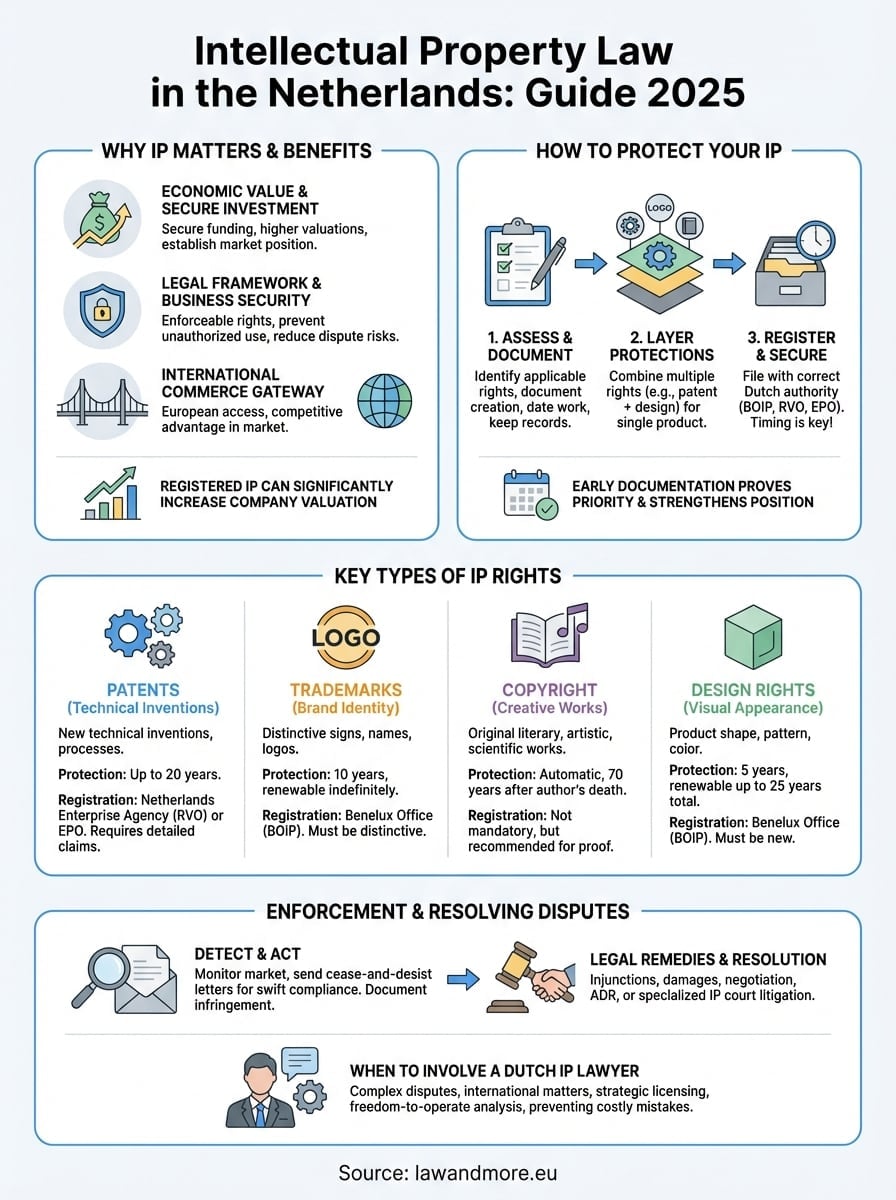
A patent protects a technical invention that is new, involves an inventive step and is industrially applicable. The Dutch Patents Act 1995 (Rijksoctrooiwet 1995) governs Dutch patents, which last up to 20 years from the filing date.
You file a Dutch patent application with the Netherlands Patent Office (Octrooicentrum Nederland), part of the Netherlands Enterprise Agency (RVO). A Dutch patent is granted without a substantive examination of whether the invention is actually new and inventive; a search report is made, but the patent is granted regardless of its outcome. Its validity can therefore still be challenged in court. For protection in several countries, you can file a European patent application with the European Patent Office. Since 1 June 2023, you can also request a European patent with unitary effect, which is enforced before the Unified Patent Court.
A patent gives you the exclusive right to make, use, sell and import the invention. You can also license it to others in return for royalties. Keep an invention confidential until you have filed, because publishing it first can destroy its novelty.
Trademarks for your brand
A trademark protects a sign that distinguishes your goods or services from those of others, such as a name, logo, slogan, colour or shape. In the Netherlands, trademarks are registered for the whole Benelux with the Benelux Office for Intellectual Property (BOIP), under the Benelux Convention on Intellectual Property (BVIE).
A Benelux trademark lasts ten years from the filing date and can be renewed for further ten-year periods without limit. The sign must be distinctive and must not conflict with earlier rights. For protection across the EU, you can register an EU trade mark with the European Union Intellectual Property Office (EUIPO). Check existing registrations before you choose a name, because a conflicting earlier mark can force you to rebrand.

Designs for the appearance of a product
A design right protects the appearance of a product, such as its shape, pattern, colours or ornamentation. The design must be new and have individual character, meaning that it gives a different overall impression from existing designs.
A Benelux design registered with the BOIP is protected for five years and can be renewed up to a maximum of 25 years. An EU design registered with the EUIPO has the same maximum term. An unregistered EU design protects you for three years from the moment the design is first made available to the public in the EU, but only against copying.
Copyright for creative works
Copyright protects original literary, scientific and artistic works, such as texts, software, photographs, music, films and architectural designs. It arises automatically when the work is created; there is no registration in the Netherlands.
Under the Dutch Copyright Act (Auteurswet), protection generally lasts until 70 years after the death of the author. Copyright gives you control over publication and reproduction, including adaptations. Because no register exists, you should keep evidence of when and by whom a work was made, such as dated files and version histories. The BOIP offers a dated deposit, the i-DEPOT, which can help to prove that you had a work or idea on a certain date, but it does not create a right.
Trade names
A trade name (handelsnaam) is the name under which you run your business. Under the Trade Names Act (Handelsnaamwet), the right arises from actual use of the name, not from registration with the Chamber of Commerce (KvK).
Registration with the KvK is required for your business, but it does not by itself give you a trade name right or check whether someone else already uses the name. A trade name and a trademark are different: if you also want to protect the name as a brand for your products or services, register it as a trademark.
Who owns the rights: you, your employee or your freelancer?
For work made by employees in the course of their job, the employer is generally the owner. For work made by freelancers or agencies, the maker keeps the rights unless they are transferred in writing.
Under Article 7 of the Copyright Act, the employer is regarded as the author of works an employee makes in the course of their duties, unless the parties agree otherwise. Under Article 12 of the Patents Act, an invention made by an employee whose job involves inventing belongs to the employer; the employee may then be entitled to fair compensation in certain cases. A freelancer, a software developer or a design agency is not an employee. Copyright only passes to you through a written deed of transfer. Check your contracts before you raise funds or sell the business.
How do you protect your intellectual property?
Start by working out which rights apply to each part of your product or business, then register the rights that require registration before you go to market. Timing matters: the first to file generally has priority.
Assess what needs protection
Look at each element separately. A product may qualify for a patent for its technical function and a design right for its appearance. Your brand name needs trademark protection, while your software code is protected by copyright.
You can combine several rights for one product where that makes sense. Keep records with dates, sketches, prototypes and development notes, so that you can show when and by whom something was created. Commercially valuable know-how that you cannot or do not want to patent can be protected as a trade secret under the Trade Secrets Act (Wet bescherming bedrijfsgeheimen), provided you take reasonable measures to keep it secret, such as confidentiality clauses and restricted access.
Register with the right authority
Trademarks and designs for the Benelux are registered with the BOIP, which also offers the i-DEPOT. Dutch patents are filed with the Netherlands Patent Office, and European patents with the European Patent Office.
Applications are made online and must describe exactly what you claim, with drawings or images where required. A trademark registration can be completed within a few months if nobody objects, while patent procedures take considerably longer. Register your trademark before you invest heavily in marketing, and file a patent application before you present the invention to the outside world.

How do you enforce your rights?
Usually with a cease-and-desist letter first, and if that does not work, with summary proceedings (kort geding) or proceedings on the merits in court. Many disputes are settled after the letter, but only if it is backed by a right you can actually prove.

Detecting and stopping infringement
Monitor the market, online marketplaces and trademark registers for signs, products or designs that come too close to yours. BOIP and EUIPO registers are public, and watching services can alert you to new applications that conflict with your trademark.
When you find an infringement, record it with dated screenshots, test purchases and invoices. Then send a letter setting out your right, the infringement and what you require, such as stopping the use, destroying stock and signing an undertaking with a contractual penalty. Against a conflicting new trademark application, you can file an opposition with the BOIP within two months of publication. That is usually faster and cheaper than court proceedings.
What can a court order?
The court can order the infringer to stop, and can award damages or order the infringer to hand over the profit made from the infringement. It can also order a recall and destruction of infringing goods.
In urgent cases, summary proceedings can lead to an order within weeks. The District Court of The Hague has exclusive jurisdiction in patent cases and in cases on EU trade marks and EU designs, and the Court of Appeal of The Hague hears the appeals. In IP cases, the losing party usually has to pay the reasonable and proportionate legal costs of the winning party (Article 1019h of the Dutch Code of Civil Procedure). That makes a weak case costly, and a strong case more effective. Read more about handling intellectual property disputes. Mediation or arbitration can offer a faster and confidential alternative if both parties are willing.
What should you check as a rights holder?
- Which elements of your product need a patent, trademark, design or copyright, and which rights must be registered first.
- That freelancers and agencies have transferred their copyright to you by written deed.
- Whether a new conflicting trademark application has been published, so you can oppose within two months.
- That you have dated evidence of the infringement before you send a cease-and-desist letter.
What should you check if you are accused of infringement?
- Whether the claimed right is valid, registered for the relevant goods or territory and still in force.
- Whether your own use falls outside the scope of that right, or predates it.
- The deadline in the letter, and whether the undertaking and penalty it asks you to sign are proportionate.
- Your exposure to a full costs order under Article 1019h of the Code of Civil Procedure if the case goes to court.
What can we do for you with intellectual property?
Our intellectual property lawyers advise companies on protecting, licensing and enforcing their intellectual property.
- We map which rights protect your product, brand and software, and register them with the BOIP or EUIPO.
- We check employment, freelance and agency contracts for the transfer of rights before an investment or sale.
- We file an opposition with the BOIP within the two-month period.
- We draft or answer a cease-and-desist letter and negotiate the undertaking.
- We conduct summary proceedings or proceedings on the merits, including before the District Court of The Hague.
Summary
- Copyright and trade name rights arise automatically; patents, trademarks and designs require registration.
- Benelux trademarks last ten years and can be renewed indefinitely; Dutch patents last up to 20 years; registered designs up to 25 years.
- Work by employees generally belongs to the employer, but rights created by freelancers need a written transfer.
- Register before you launch or publish, and keep dated evidence of your creations.
- Enforce with a letter first; the court can order an injunction, damages and a reasonable costs award.