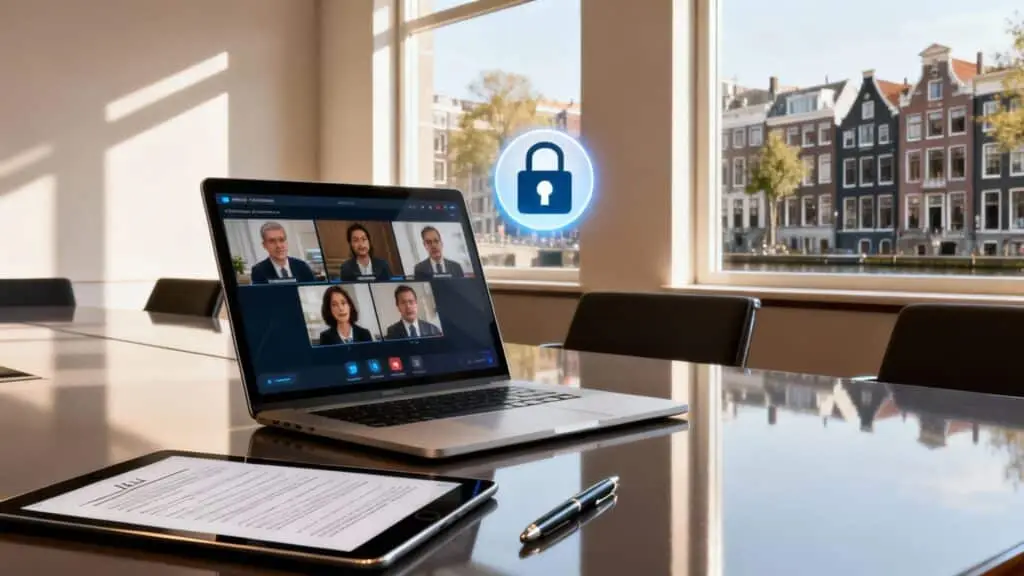
A digital shareholders meeting is a general meeting of an NV or BV at which shareholders take part, speak and vote online. Until 31 December 2026 Dutch law only allows a hybrid meeting: a physical meeting with electronic participation added, and only if the articles of association provide for it. From 1 January 2027 the Digital General Meeting Act also permits a fully virtual meeting, again only where the articles of association allow it.
Table of contents
What does Dutch law allow until 1 January 2027?
Until the end of 2026, a general meeting needs a physical venue; online participation can only be added on top. The legal basis is Article 2:117a of the Dutch Civil Code (BW) for the NV and Article 2:227a BW for the BV.
Under these articles, the articles of association (statuten) can allow every shareholder to attend, speak and vote by electronic means of communication, in person or through a written proxy. The law sets three conditions: the shareholder can be identified through the electronic means, can follow the proceedings directly, and can exercise the voting right. The articles of association may add a fourth condition: that the shareholder can also take part in the deliberations.
The venue rules differ per company type. An NV must hold its meetings in the Netherlands, at the place stated in the articles or in the municipality of its registered office (Article 2:116 BW). A BV meets at the place stated in its articles, which may be outside the Netherlands, or otherwise in the municipality of its registered office (Article 2:226 BW).
The temporary COVID-19 emergency rules that allowed fully virtual meetings during the pandemic have expired. A board that holds a virtual-only meeting before 1 January 2027 takes resolutions that can be challenged.

Can shareholders vote before the meeting?
Yes, if the articles of association say so. Votes cast in advance then count as votes cast at the meeting, but the earliest moment differs for the NV and the BV.
- BV: votes may be cast electronically from the thirtieth day before the meeting (Article 2:227b BW).
- NV: votes may be cast electronically or by letter, but not before the registration date (dag van registratie), which is the twenty-eighth day before the meeting. The notice must state that date (Article 2:117b BW).
Can shareholders decide without any meeting?
Yes. For a BV, Article 2:238 BW allows decision-making outside a meeting if all persons with meeting rights consent to that way of deciding. Unless the articles provide otherwise, that consent and the votes may be given electronically.
Before the vote, the directors and any supervisory directors must have the opportunity to give advice. For closely held BVs this is often the quickest and most robust route, and it does not depend on the meeting format at all.
An NV only has this option if its articles of association provide for it and no bearer shares or depositary receipts issued with the company’s cooperation exist. The resolution then requires a unanimous vote of all shareholders with voting rights, cast in writing (Article 2:128 BW).
What changes with the Digital General Meeting Act on 1 January 2027?
The Act on the digital general meeting of private-law legal persons (Wet digitale algemene vergadering privaatrechtelijke rechtspersonen) of 3 June 2026 allows a meeting that is accessible only online. It was published as Stb. 2026, 161, and a royal decree of 8 September 2026 (Stb. 2026, 259) sets its entry into force at 1 January 2027.
From that date, the articles of association of a BV can provide that the general meeting is accessible “also or exclusively” by electronic means (new Article 2:227a BW); the NV rules are amended in the same way. The notice must then describe the procedure for taking part online and for voting electronically.
The Act sets a stricter technical test for online participation. The participant must be identifiable, must be able to vote directly, and must be able to follow the proceedings and take part in the deliberations through two-way audiovisual communication. A one-way livestream with a chat function no longer meets the test. Conditions on the use of the technology that are not in the articles of association must be announced with the notice.
The Act also covers associations, cooperatives and apartment owners associations (vereniging van eigenaars, VvE). In a VvE, owners representing at least a quarter of the votes can ask, within seven days after the notice, that the meeting is also physically accessible. The Minister must report to Parliament on how the Act works within five years after its entry into force.

Which meeting formats can you choose?
There are four formats; which ones you can use depends on your articles of association and, for a fully digital meeting, on the date. The table sums up the position.
| Format | What it means | Legal position |
|---|---|---|
| Physical | All shareholders attend at the venue in the notice. | Always permitted (Articles 2:116 and 2:226 BW). |
| Hybrid | Physical meeting with online participation. | Permitted if the articles allow it (Articles 2:117a and 2:227a BW). |
| Out-of-meeting resolution | No meeting; votes are cast in writing or electronically. | BV: all persons with meeting rights consent (Article 2:238 BW). NV: only on the conditions of Article 2:128 BW. |
| Fully digital | No physical venue at all. | Permitted from 1 January 2027 if the articles allow it (Stb. 2026, 161 and 259). |
What happens if the meeting is not held correctly?
A defect in how a meeting is convened or held makes the resolutions voidable under Article 2:15 BW. A resolution whose content conflicts with the law or the articles of association is void under Article 2:14 BW.
Anyone with a reasonable interest in compliance can ask the district court of the company’s registered office to annul a resolution. That right lapses one year after the end of the day on which the resolution was sufficiently made known, or on which the claimant learned of it or was notified (Article 2:15(5) BW). For an appointment, a share issue or an amendment of the articles, a year of uncertainty is a long time.
How do you prepare the articles of association?
Every electronic route depends on the articles of association. If they are silent, the company is limited to a physical meeting, whatever the technology can do.
Three questions decide what your company can do. Do the articles allow electronic participation under Article 2:117a or 2:227a BW? Do they allow electronic voting in advance under Article 2:117b or 2:227b BW? And do they contain a clause that allows a fully digital meeting from 1 January 2027? A clause that lets the board choose the format, within the statutory conditions in force at the time, lasts longer than a clause tied to one technology.
Amending the articles requires a resolution of the general meeting, with the majority the articles prescribe, and a notarial deed executed by a Dutch civil-law notary. Our article on the articles of association in the Netherlands explains the procedure. Our overview of a sound corporate governance framework places it in the wider governance picture.

Which notice periods apply?
The statutory minimum notice periods are the same for every meeting format. If the period is too short, no valid resolutions can be taken, subject to narrow exceptions.
- BV: notice no later than the eighth day before the meeting (Article 2:225 BW). A late notice is only cured if all persons with meeting rights agree to the decision-making and the directors and supervisory directors could first give advice.
- NV: notice no later than the fifteenth day before the meeting (Article 2:115(1) BW). A late notice is only cured by a unanimous vote in a meeting where the entire issued capital is represented.
- Listed NV: notice no later than the forty-second day before the meeting (Article 2:115(2) BW), combined with a registration date that determines who may vote.
For a hybrid or digital meeting, the notice must also explain how online participation works: the platform, how shareholders are identified, how to ask for the floor, how and until when votes can be cast, and how a written proxy is submitted. The company must be able to check that each proxy comes from the shareholder in the shareholders register.
Which technical requirements must the platform meet?
The platform must make the statutory test possible: identification, direct participation and verifiable voting. From 1 January 2027 a fully digital meeting also requires two-way audiovisual communication.
- Identification: access credentials linked to the entry in the shareholders register, ideally with multi-factor authentication or a trusted digital identity service.
- Participation: real-time audio and video, a moderated question function and a visible speaking queue.
- Voting: votes attributed to identified shareholders, weighted according to the shareholders register and reproducible from the system logs.
- Data protection: processing of personal data must comply with the GDPR and the Dutch GDPR Implementation Act (UAVG), with a processor agreement and a fixed retention period for recordings.
Record the choice in a short technology memorandum: why the platform was chosen, how it meets Article 2:117a or 2:227a BW, and what happens if the system fails. Keep it with the notice, the proxies and the logs. That file is your answer to an annulment claim within the one-year period of Article 2:15 BW.
How do you chair an online meeting?
The chair must make sure, and be able to show, that every shareholder had a real opportunity to speak and to vote. A breach of reasonableness and fairness (Article 2:8 BW), for example unequal treatment of participants, makes a resolution voidable under Article 2:15 BW.
Open with the rules: how to request the floor, how questions sent in advance are handled, how the vote works and what happens if the connection fails. Work through the speaking queue in the announced order, and announce each result in full: votes for, votes against and abstentions.
If a technical failure stops a significant number of shareholders from voting, suspend the meeting. If the problem cannot be fixed, adjourn and convene again with a new notice within the statutory period of eight days (BV) or fifteen days (NV). Give the chair an explicit mandate in the articles or meeting rules to suspend or adjourn for technical reasons.
What must you do after the meeting?
The minutes (notulen) are the evidence that the meeting complied with the law. For an online meeting they must also record how shareholders were identified, the full voting results from the platform logs and any technical problems.
Some resolutions need follow-up. The appointment or dismissal of a director must be registered with the Chamber of Commerce (Kamer van Koophandel, KVK), and an amendment of the articles requires a notarial deed that the notary files. Where documents are signed remotely, our article on the legal value of digital signatures explains which signature to use.
What should you check as a board?
- Do the articles of association allow hybrid participation, advance voting and, from 1 January 2027, a fully digital meeting?
- Is the notice sent on time: eight days (BV), fifteen days (NV) or forty-two days (listed NV)?
- Does the notice explain the online procedure, the identification method, proxy submission and any conditions on the technology?
- Does the platform offer two-way audiovisual communication and logged, attributable voting?
- Is there a fallback plan and a chair’s mandate to suspend or adjourn?
- Are the minutes, logs and proxies kept together for at least the one-year annulment period?
What should you check as a shareholder?
- Do the articles of association allow the format the board has chosen?
- Was the notice sent within the statutory period, and does it state the registration date where required?
- Could you be identified, follow the meeting and vote without obstruction?
- Were you given the floor in the announced order, and were the voting results announced in full?
- Have you noted the date on which you learned of the resolution, so you stay within the one-year period of Article 2:15(5) BW?
What can we do for you with a digital shareholders meeting?
Our corporate law team supports boards and shareholders before, during and after the meeting.
- We review your articles of association against Articles 2:117a, 2:117b, 2:227a, 2:227b and 2:238 BW and the rules applying from 1 January 2027.
- We draft the amendment of the articles and coordinate the notarial deed with the civil-law notary.
- We draft the notice, meeting rules and proxy forms for a hybrid or fully digital meeting.
- We check the platform set-up and the technology memorandum against the statutory test.
- We assess whether a resolution is void or voidable and, if needed, start or defend annulment proceedings within the one-year period.
Summary
- Until 31 December 2026, NVs and BVs can only hold a physical or hybrid meeting; the hybrid route requires a basis in the articles of association (Articles 2:117a and 2:227a BW).
- From 1 January 2027 the Digital General Meeting Act (Stb. 2026, 161) allows a fully digital meeting, if the articles provide for it.
- Online participation then requires identification, direct voting and two-way audiovisual communication.
- A BV can avoid a meeting with an out-of-meeting resolution under Article 2:238 BW if all persons with meeting rights consent.
- Procedural defects make resolutions voidable under Article 2:15 BW; the claim lapses after one year.
Frequently asked questions
Can a Dutch BV hold a fully virtual shareholders meeting today?
Not before 1 January 2027. Until then a physical venue is required, with online participation possible if the articles of association allow it. From 1 January 2027 a fully digital meeting is allowed if the articles provide for it.
Can access be refused if a shareholder cannot be identified?
Yes. Only persons entitled to attend may take part and vote, and identification through the electronic means is a statutory condition (Articles 2:117a and 2:227a BW). The notice should state the identification method and a fallback route, so that a refusal follows an announced procedure.
What if a technical failure disrupts a vote?
Suspend the meeting and establish how many shareholders were affected. If the problem cannot be fixed, adjourn and convene again with a new notice. A resolution adopted while many shareholders could not vote is vulnerable to annulment under Article 2:15 BW.