Commercial agreements under Dutch law are formed by offer and acceptance under Article 6:217 of the Dutch Civil Code (BW) and usually need no particular form. Drafting is therefore not about making the contract valid, but about making it precise, binding on the right party and robust against the way a Dutch court will read it; the main exceptions are share transfers and real estate, which need a notarial deed.
This article follows the order in which contract problems appear in practice: who is bound and under which law, how the deal is described, whose general terms and conditions apply, how risk is allocated, and which drafting habits cause most disputes.
Table of contents
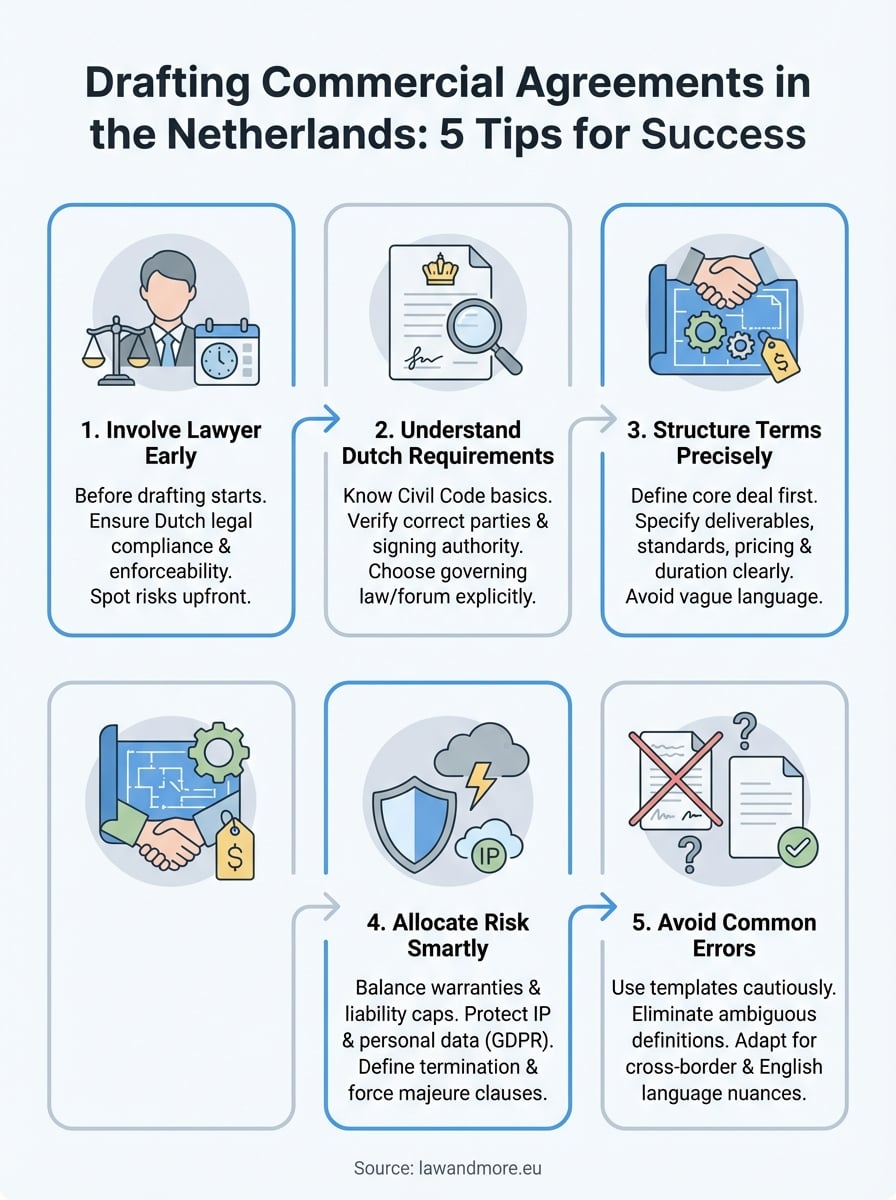
When should you involve a lawyer?
Legal advice is worth most before the commercial terms are fixed in a term sheet or letter of intent. Under Dutch case law, negotiations that have reached an advanced stage cannot always be broken off freely, and the party that walks away may have to pay the other side’s costs or, in exceptional cases, its lost profit.
A contract lawyer involved at that stage can still shape the deal. After signature, the same lawyer can only assess the damage.

Typical moments for legal advice on a contract are when the other party puts forward its own general terms, when value or duration is significant, when personal data or intellectual property changes hands, and when the contract crosses a border. In those cases a review costs a fraction of the exposure.
Who is bound, and which law applies?
First check that the parties named in the contract are the parties you think you are dealing with. Use the full legal name and legal form, take the registration number from the Chamber of Commerce (KVK) trade register, and check that the signatory may represent the company.
Under Article 2:240 BW the board represents a private limited company (BV), and each director may also represent it alone, unless the articles of association provide otherwise. A restriction registered with the KVK can be used against you, so check the register before signing; if authority is missing, the company is in principle not bound.

How do you choose governing law, forum and language?
For international contracts, the Rome I Regulation (Regulation (EC) No 593/2008) respects the parties’ choice of law, and the Brussels I bis Regulation (Regulation (EU) No 1215/2012) respects a valid choice of court between EU member states. Make both choices explicitly and in separate clauses, or you may first have to litigate about where the case belongs.
In an international sale of goods, the Vienna Sales Convention (CISG) applies automatically between parties in different contracting states. If you do not want it, exclude it expressly.
A contract may be in English and governed by Dutch law, but a Dutch court will then read it with Dutch eyes: what the parties could reasonably expect from each other weighs more than the literal wording. Common-law terms such as “indemnity”, “consequential loss” or “best endeavours” have no fixed Dutch meaning, so define them in the contract.
Which form requirements apply?
Most commercial agreements are valid without any formality, and an oral agreement is binding. But the party that relies on a term must prove it, so writing remains the safer route.
Some transactions do require a specific form. Real estate is transferred by notarial deed under Article 3:89 BW, and shares in a BV by a deed executed before a Dutch civil-law notary under Article 2:196 BW. A transfer of copyright or an exclusive licence must be agreed in writing under Article 2(3) of the Dutch Copyright Act (Auteurswet).
How do you describe the deal itself?
Write the commercial core before the boilerplate: who delivers what, by when, to which standard, and what the other party pays. A definitions clause only helps if the defined terms are then used consistently throughout the contract.
For services and development work, the acceptance procedure carries most value: what is delivered, who tests it, against which criteria, within how many days, and what happens if acceptance is refused. Service levels only work if the contract also states the consequence of missing them, such as a service credit or a right to terminate.

What should you agree on price, payment terms and duration?
State the price, currency, VAT treatment and due date. If no payment term is agreed between businesses, statutory commercial interest is due from 30 days after receipt of the invoice under Article 6:119a(2) BW.
Under Article 6:119a(5) BW an agreed payment term may not exceed 60 days, unless a longer term is expressly agreed and is not grossly unfair to the creditor. Under Article 6:119a(6) BW a large company buying from a small or medium-sized supplier may not agree a term longer than 30 days; a longer term is void.
Late payment carries the statutory commercial interest of Article 6:119a BW, which is set every six months, plus collection costs. For contracts of indefinite duration, say expressly how they may be terminated: Dutch case law allows termination in principle, but reasonableness and fairness may require a notice period or compensation, depending on the length of the relationship and the investments made.
Whose general terms and conditions apply?
If both parties refer to their own general terms (algemene voorwaarden), Article 6:225(3) BW gives priority to the first reference, unless the second party expressly rejects the first set. A short, explicit rejection in your order confirmation therefore settles a question many businesses think is decided by whoever spoke last.
Under Articles 6:233(b) and 6:234 BW, general terms can be annulled if the user did not give the other party a reasonable opportunity to read them, in principle by handing them over before or when the contract is made, or electronically in a form that can be stored. A reference to terms filed with the KVK or a court registry is only enough if handing them over was not reasonably possible.
Under Article 6:235 BW, companies that publish annual accounts and businesses with 50 or more employees cannot invoke these annulment grounds at all. They must rely on reasonableness and fairness under Article 6:248(2) BW instead.
How do you allocate risk?
Warranties fix the facts each party guarantees, such as ownership of the intellectual property supplied or compliance with product regulations. Indemnities allocate third-party claims; because the term has no settled Dutch meaning, the clause must state what triggers it, what it covers and how it is invoked.
A liability cap, often a multiple of the contract value or of the fees paid in the last twelve months, is valid in principle. A court can set it aside under Article 6:248(2) BW if relying on it would be unacceptable by standards of reasonableness and fairness, especially in case of intent or deliberate recklessness by the debtor or its management. Good caps carve out those cases expressly.

How do you deal with intellectual property, confidentiality and personal data?
State who owns what is created during the contract and what the other party receives: a transfer, an exclusive licence or a limited right of use. Under Article 2(3) Auteurswet, a transfer of copyright must be agreed in writing, so a clause that only says “the customer owns the results” may not achieve the transfer it describes.
Confidentiality clauses should define what is protected and for how long. Under the Dutch Trade Secrets Act (Wet bescherming bedrijfsgeheimen), information is only protected if the holder took reasonable measures to keep it secret, and the contract helps to prove those measures. Where personal data is exchanged, decide whether one party processes data on behalf of the other; if so, the GDPR requires a data processing agreement.
What about change control, termination and force majeure?
Agree a written change procedure and name who may approve changes on each side, because most scope disputes start with an informal instruction. Termination clauses should separate termination for convenience, for breach and for insolvency, and state the notice period and which clauses survive.
Article 6:75 BW provides a general force majeure rule: a failure cannot be attributed to the debtor if it is not his fault and is not for his account under the law, the contract or common opinion. A clause that lists which events qualify and what happens to continuing obligations is more useful than a general reference to “circumstances beyond our control”.
Which drafting mistakes cause disputes?
Templates are a starting point, not a solution. Clauses imported from other legal systems often do nothing under Dutch law, such as consideration recitals, or do less than expected, such as an entire agreement clause: under the Haviltex standard of the Dutch Supreme Court (ECLI:NL:HR:1981:AG4158), interpretation looks at what the parties could reasonably expect from each other, including pre-contractual communication.
The second problem is internal inconsistency: loosely used definitions, an annex that contradicts the main text without an order-of-precedence clause, or working days in one clause and calendar days in another. Vague standards such as “reasonable efforts” or “as soon as possible” leave the decision to a judge; a date, a number or a named person keeps it with the parties.
The third is limitation periods and notice duties. A claim for performance lapses five years after it became due (Article 3:307 BW), a damages claim five years after you knew of the damage and the liable party (Article 3:310 BW), and under Article 7:23 BW a buyer must report a defect within a reasonable time after discovering it. Contracts often shorten these periods, so check whether a defect can realistically be found within the agreed window.
What should you check as a supplier?
- Your general terms are handed over before or at signing, and you rejected the buyer’s terms expressly.
- Your liability cap is clear and carves out intent and deliberate recklessness.
- The acceptance procedure has fixed test criteria and a deadline.
- Your payment term complies with Article 6:119a BW.
- Intellectual property you keep is reserved, and any licence is limited in scope.
What should you check as a customer?
- The supplier’s legal name, KVK number and signatory authority are correct.
- Service levels have a consequence, such as a service credit or a termination right.
- Intellectual property that must be transferred to you is transferred in writing.
- Notice periods for defects are realistic for the product or service.
- The contract states how and when you may terminate, and what happens to your data.
What can we do for you with commercial agreements?
Our civil lawyers draft, review and negotiate commercial contracts in Dutch and English; see also our overviews of commercial law in the Netherlands and drafting Dutch agreements.
- We draft supply, distribution, licence and cooperation agreements under Dutch law.
- We review the other party’s contract and mark the clauses that need negotiation.
- We draft or update your general terms and conditions and the way you hand them over.
- We check liability caps, warranties and indemnities against Dutch case law.
- We negotiate with the other party or its lawyer on your behalf.
Summary
- A contract is formed by offer and acceptance (Article 6:217 BW); form requirements are the exception.
- Check the counterparty and its signatory in the KVK trade register before signing.
- In a battle of forms the first reference to general terms prevails unless expressly rejected (Article 6:225(3) BW).
- Payment terms between businesses are limited to 60 days, and to 30 days for large buyers of SME suppliers (Article 6:119a BW).
- Define common-law terms and avoid vague standards; a Dutch court reads the contract by the Haviltex standard.
Frequently asked questions
Is an oral agreement binding under Dutch law?
Yes. Under Article 6:217 BW a contract is formed by offer and acceptance, without any form requirement in most cases. The party that relies on a term must prove it, which is why a written contract remains the safer choice.
Can I draft a Dutch-law contract in English?
Yes. The language does not affect validity. A Dutch court will interpret the contract by the Haviltex standard, so define common-law terms such as indemnity or consequential loss in the contract itself.
What is the maximum payment term between businesses?
Under Article 6:119a(5) BW an agreed term may not exceed 60 days unless a longer term is expressly agreed and is not grossly unfair to the creditor. A large company buying from an SME supplier may not agree more than 30 days (Article 6:119a(6) BW).
Whose general terms apply if both parties refer to their own?
Under Article 6:225(3) BW the first reference prevails, unless the second party expressly rejects the first set of terms.