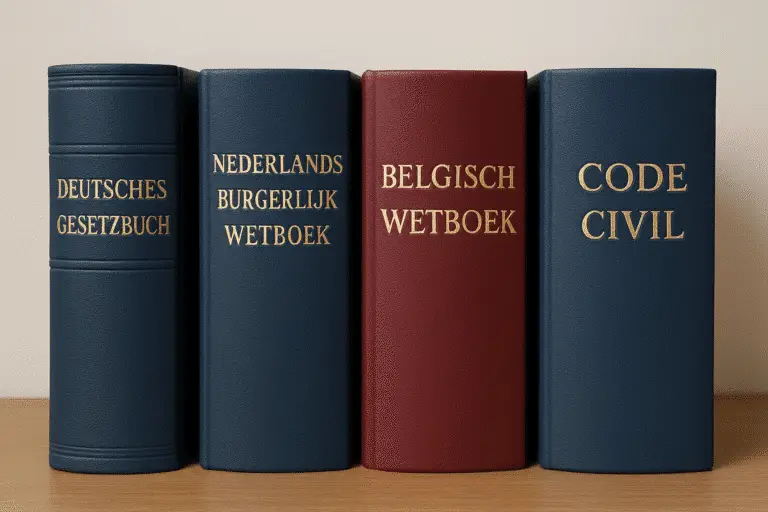
Under Article 3:92 of the Dutch Civil Code (BW), a retention of title (eigendomsvoorbehoud) lets you, as a supplier, stay the owner of delivered goods until the buyer has paid, so you can take them back if payment does not come. Under Dutch law it only works for a limited set of claims, it must be agreed no later than delivery, and it ends as soon as your goods are processed, mixed or resold.
That makes retention of title the simplest and cheapest security in Dutch commercial law, but not a complete one. Where it stops working, the right of reclamation, a pledge or a guarantee can close the gap.
Table of contents
What does a retention of title cover under Article 3:92 BW?
A retention of title may secure only the price of goods and work under the contract, and claims for the buyer’s failure to perform that contract. Anything wider is void to that extent.
Dutch law treats a retention of title as a transfer of ownership under a suspensive condition. The buyer receives the goods and may use them, but ownership passes only when the condition, full payment, is met. Until then you can reclaim the goods from the buyer and, if the buyer goes bankrupt, from the trustee in bankruptcy (curator).
Article 3:92(2) BW limits the claims that a retention of title may secure to:
- the price of goods you have delivered or will deliver to the buyer under the contract or a similar contract;
- the price of work you have carried out or will carry out for the buyer under such a contract;
- claims arising from the buyer’s failure to perform such contracts.
An all-monies clause, which secures every claim that you or any group company may ever have against the buyer, is standard drafting in several neighbouring countries. It does not survive in Dutch law. Only the reservation that goes too far falls away; the rest of the contract stands. If you use a group-wide template, have the clause checked against Article 3:92 BW rather than assume it travels.
When must the clause be agreed?
The clause must be agreed no later than the moment of delivery. A retention of title that first appears on the invoice comes too late. If the clause sits in your general terms and conditions, those terms must have been validly accepted and made available to the buyer. Our article on why copying general terms and conditions costs you dearly explains what often goes wrong there.
When does a retention of title stop working?
Your ownership ends the moment the goods stop being the goods you delivered, or when the buyer resells them in the ordinary course of business. What remains then is an ordinary claim against the buyer.
If your steel is welded into a machine, your resin is mixed into a compound or your components are built into a product, Dutch property law treats the result as a new or composite item. Your ownership is absorbed into it. The same applies when the buyer resells to a third party who acquires in good faith: the buyer was allowed to dispose of the goods in the ordinary course of business, and you are left with your claim for the price.
The extended retention of title used in Germany and elsewhere, which follows the goods into their proceeds or into the manufactured product, has no equivalent in Dutch property law. A clause that tries to create one is either void or simply ineffective against a trustee. The solution is a different instrument, such as a pledge, and it has to be arranged in advance.
Which country’s law decides whether your retention of title is valid?
Under Article 10:128 BW, the property effects of a retention of title are governed by the law of the country where the goods are located at the time of delivery. The law you chose for the contract does not decide this. A German supplier whose contract is governed by German law, delivering into a Dutch warehouse, is therefore assessed under Dutch property law. The CISG deliberately leaves property effects aside, so choosing it changes nothing here.
For goods intended for export, the same article allows the parties to agree that the law of the country of destination applies, provided that law keeps ownership with the seller until full payment. That choice only takes effect if the goods actually arrive in that country. A Dutch exporter delivering to Germany can use this to rely on German rules.
Can you reclaim unpaid goods without a retention of title?
Yes, through the right of reclamation (recht van reclame) in Article 7:39 BW. It works even if nobody agreed a retention of title, but the deadline is short.
With a written notice you dissolve the sale and recover ownership of the goods you delivered. The conditions are that the buyer has not paid, the requirements for dissolution are met, and the goods are still with the buyer in essentially the state in which you delivered them. Because it is a statutory right, it also protects suppliers whose terms were never validly agreed.
The right is rarely used because of its deadline. Under Article 7:44 BW it lapses once six weeks have passed since the price became payable and sixty days have passed since the buyer took the goods into its possession. The right ends only when both periods have expired, but in practice that is often within a few months. A supplier who spends three months sending reminders before calling a lawyer has usually lost the right without knowing it existed. When a customer starts missing payments on delivered stock, check the reclamation deadline first.
How does a pledge protect you where retention of title fails?
A pledge (pandrecht) gives you a right of recourse over receivables, stock or equipment of the buyer, including goods and proceeds that a retention of title cannot reach. In a bankruptcy you may, in principle, enforce it as though there were no bankruptcy.
A non-possessory pledge over receivables is created by a notarial deed or by a private deed registered with the Dutch Tax Administration (Belastingdienst). It can be renewed at regular intervals to cover new receivables as they arise. As long as you do not notify the buyer’s customers, the pledge stays undisclosed and the buyer keeps collecting. Once you give notice, you collect directly. A pledge can also be created over stock and equipment.
In insolvency a pledgee is a secured creditor who may enforce outside the bankruptcy, although the trustee can set a reasonable period after which the trustee takes over the sale. Two limits are worth knowing before you rely on a pledge. Banks usually already hold a first-ranking pledge over the same assets, so you are often taking second rank over an already encumbered pool. And the Tax Administration has a special right of recovery (bodemvoorrecht) over certain assets located on the debtor’s premises, which can outrank a non-possessory pledge over machinery and equipment there. Neither point makes a pledge pointless. Both mean you should price and negotiate it with open eyes.
When is a guarantee the better choice?
For higher-value or longer-running relationships, a bank guarantee, a parent company guarantee or a suretyship (borgtocht) does something a pledge cannot. It adds a second solvent party instead of a claim on the same struggling one. Our overview of types of commercial agreements explains where each of these usually sits in a contract.
Which payment terms, interest and collection costs apply between businesses?
Between businesses, the default payment term is 30 days after receipt of the invoice, and statutory commercial interest runs automatically once that term has passed. A large company buying from a small or medium-sized supplier may not agree a term longer than 30 days.
Under Article 6:119a BW, parties may agree a longer term, but a term of more than 60 days is valid only if it is not grossly unfair to the creditor. Since 1 July 2022, a large company contracting with a small or medium-sized supplier may agree a payment term of at most 30 days. A longer term in such a contract is replaced by 30 days by operation of law, and statutory commercial interest runs from the day after that period expires.
The statutory commercial interest rate is set by the government and adjusted twice a year. In your contract, refer to the statutory rate rather than stating a number. The interest runs on a late business payment without a reminder or notice of default. You can also recover reasonable costs of out-of-court collection. In consumer contracts these costs are fixed by regulation and cannot be increased. Between businesses you are free to agree your own arrangement, which makes a short, explicit costs clause worth having.
What happens to your goods when the buyer goes bankrupt?
A valid retention of title survives the bankruptcy: the goods remain yours and do not fall into the estate. The trustee can, however, delay your access to them for a period.
Under Article 63a of the Dutch Bankruptcy Act (Faillissementswet), the court can order a cooling-off period (afkoelingsperiode) of up to two months, which can be extended once by up to two months. During that period, third parties may not take their goods away without permission from the supervisory judge (rechter-commissaris). Your claim is not lost, but your access is suspended while the goods keep losing value.
In practice, three things decide whether a supplier recovers anything. First, whether the goods can still be identified as yours. That depends on numbering, labelling and delivery records rather than on law. Second, whether you assert your rights to the trustee immediately and in writing. Third, whether the trustee plans to continue the business. In that case a commercial arrangement, for instance continued use against payment, is often better than a legal battle over stock that will be worth less by the time it ends. Our article on the bankruptcy of your contract partner takes you through the steps in more detail.
How can you enforce payment before it gets that far?
Stop further deliveries, send a notice of default and, if needed, attach the debtor’s assets before the debtor knows a claim is coming. Take each step in writing and in the right order.
If the buyer fails to perform, you may suspend your own performance (Article 6:52 and Article 6:262 BW). For a supplier this means stopping the next delivery rather than financing the debtor further. You can dissolve the contract for breach under Article 6:265 BW, in most cases after a written notice of default (ingebrekestelling) that gives a reasonable period to perform. If a strict deadline (fatale termijn) was agreed, the buyer is in default automatically once that date passes. A supplier who stops delivering without a proper basis becomes the party in breach, so the order matters.
If the debtor can pay but will not, a pre-judgment attachment (conservatoir beslag) is the sharpest instrument in Dutch practice. You ask the preliminary relief judge (voorzieningenrechter) for leave. Leave is usually granted on the papers, often within a day. The attachment freezes bank accounts, receivables or goods. You must then start proceedings on the merits within the period the court sets. Our article on asset freezing and pre-judgment attachment explains the procedure and its risks, because a wrongful attachment can make you liable for the damage it causes.
What should you check as a supplier?
Four provisions do most of the work, and each should be written for Dutch law rather than copied from a foreign template. Check them before the next delivery.
- Is your retention of title drafted within the limits of Article 3:92(2) BW, without an all-monies extension?
- Were your general terms and conditions accepted and made available to the buyer no later than delivery?
- Does your payment clause state the term, refer to the statutory commercial interest of Article 6:119a BW and deal with collection costs?
- Can you demand a pledge, a guarantee or advance payment if the customer’s credit position deteriorates?
- When payments stop, have you checked the reclamation deadline of Article 7:44 BW and marked the delivered goods so they can be identified?
What should you check as a buyer?
As a buyer you may hold goods that are not yet yours. Check these points before you process, resell or pledge them.
- Which deliveries are still subject to a retention of title, and for which unpaid invoices?
- Do your purchase terms or the supplier’s terms apply, and which retention of title did you actually accept?
- Are you allowed to resell the goods in the ordinary course of business before you have paid?
- Do you know that you cannot validly pledge goods to your bank while the supplier still owns them (Article 3:84 BW)?
- If you are a large company buying from an SME, is your payment term no longer than 30 days?
What can we do for you with retention of title and payment security?
Our contract lawyers draft and review supply, distribution and standard terms for businesses trading in and with the Netherlands.
- We check your retention of title and general terms against Article 3:92 BW and Article 10:128 BW.
- We send the written notice for the right of reclamation within the deadline of Article 7:44 BW.
- We assert your ownership to the trustee in bankruptcy and negotiate the release or use of your goods.
- We draft a pledge deed or a guarantee and arrange its registration with the Tax Administration.
- We apply for leave for a pre-judgment attachment and start the proceedings on the merits.
Summary
- A retention of title keeps you the owner until payment, but under Article 3:92 BW it may only secure the price of goods and work under the contract and claims for non-performance.
- The clause must be agreed no later than delivery; it ends when the goods are processed, mixed or resold in the ordinary course of business.
- The right of reclamation (Article 7:39 BW) works without a clause, but lapses quickly under Article 7:44 BW.
- A pledge or a guarantee covers what a retention of title cannot reach, such as receivables and proceeds.
- Since 1 July 2022, large companies may agree a payment term of at most 30 days with small and medium-sized suppliers.
Frequently asked questions
Is an all-monies retention of title valid in the Netherlands?
No. Under Article 3:92(2) BW it is void to the extent that it secures claims other than the price of goods and work under the contract and claims for non-performance. The rest of the clause and the contract remain valid.
Does a retention of title on the invoice work?
No. The retention of title must be agreed no later than the moment of delivery. A clause that first appears on the invoice comes too late.
Can I use a German extended retention of title for goods delivered in the Netherlands?
Not if the goods are in the Netherlands at delivery. Dutch property law then applies under Article 10:128 BW, and it does not recognise a retention of title that extends to proceeds or new products.