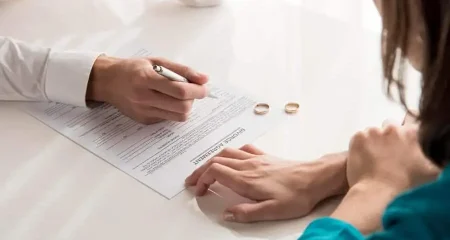
A mortgage after divorce does not follow the person who keeps the house; it follows both names on the loan until the bank formally says otherwise. In the Netherlands co-borrowers are jointly and severally liable, which means the lender may claim the entire debt from either of you. Moving out, agreeing that your ex will pay, or even signing a divorce covenant changes nothing towards the bank. Only a release from joint and several liability, granted by the lender, ends that exposure.
This article deals with the home and the loan: how liability works, how a release is obtained, what happens if the bank refuses, and how the property is transferred at the notary. The wider settlement of assets is covered in our article on the limited community of property, and the question of who is entitled to stay in the house is dealt with in divorce and the marital home.
Ownership and liability are two different questions
Start by separating two things that are constantly confused. Ownership is recorded in the deed of transfer registered with the Land Registry (Kadaster) and says who owns the property and in what proportion. Liability follows from the loan agreement and the mortgage deed and says who owes the bank. The same two people usually appear in both, but not always, and the answers can differ.
How ownership is shared depends on the relationship. Spouses and registered partners who married or registered from 1 January 2018 are in a limited community of property, so a home acquired during the relationship is jointly owned in equal shares, while a home one of them owned beforehand in principle stays private. For marriages before that date the older, all-embracing community usually applies. Marriage settlements can change all of it, and a marriage concluded abroad may be governed by foreign property law, which a civil-law notary can establish. Our article on property within and after marriage sets out the regimes.
Unmarried partners who bought together own the property in a simple co-ownership under Book 3 of the Civil Code, in the proportions stated in the deed of transfer. Those proportions are not necessarily fifty-fifty, and they do not automatically follow who paid what. If one partner contributed more of the purchase price than the deed reflects, the claim for that has to be based on something else, such as a cohabitation agreement, a loan or an unjust enrichment claim, and it is precisely the sort of point that should have been recorded at the time.
What joint and several liability actually means
Where two people take out a mortgage together, each of them owes the bank the whole debt, not half of it. That is joint and several liability (hoofdelijke aansprakelijkheid) under Book 6 of the Civil Code. The lender may choose which debtor to pursue and may pursue one for everything. Between the two of you, the internal split may well be fifty-fifty, and whoever pays more than their internal share has a right of recourse against the other. But recourse is a claim against a private individual, which is worth exactly as much as that person’s ability to pay.
Three consequences follow, and they surprise people every time. Missed payments affect both credit records at the national credit register, whoever caused them. A joint mortgage counts as a liability in the assessment of any new loan you apply for, which is why an ex-partner who has moved out often cannot buy a home of their own until the release comes through. And an agreement between the two of you that one will bear the mortgage has effect only between you: the bank is not a party to your covenant and is not bound by it.
Release from joint and several liability
Release from joint and several liability (ontslag uit de hoofdelijke aansprakelijkheid) is a decision of the lender, and only the lender can give it. No court can order a bank to release a borrower, and no divorce judgment does it automatically. The bank will grant it only if the remaining borrower can carry the whole loan alone, which is assessed in much the same way as a fresh mortgage application: income, other obligations, the value of the property and the applicable lending standards.
The practical problem is that a separation usually reduces borrowing capacity on both sides at once. Two incomes become one, and maintenance obligations are counted as a liability for the payer and, within limits and if sufficiently secured, as income for the recipient. That is one reason to settle maintenance and the mortgage in the same exercise rather than one after the other.
Banks generally want to see a signed divorce covenant or separation agreement recording who takes the property and on what terms, a recent valuation report, proof of income, and the current loan statement. Where the takeover is financed by increasing the mortgage, that increase is assessed as new borrowing and, under the rules that have applied since 2013, has to be repaid on an annuity or linear basis for interest relief to be available. Whether and how interest relief applies to your situation is a tax question; put it to a tax adviser rather than assuming the answer, because the consequences of getting it wrong last for years.
If the release is refused, you have not run out of options, but the remaining ones are narrower: sell the property, find additional income or security that satisfies the lender, ask a different lender to refinance the whole loan in one name, or stay co-liable for a defined period with clear written arrangements. What you should not do is treat a refusal as a reason to leave matters unresolved, because the liability simply continues.
The three routes and what each of them costs you
Almost every case ends in one of three ways. In a takeover, one partner keeps the home and buys out the other’s share; the bank releases the departing partner and a civil-law notary passes a deed of division that is registered with the Land Registry. This is the cleanest outcome, and also the one that depends most on affordability.
In a sale, the property goes on the market, the mortgage is repaid from the proceeds and what remains is divided, or the shortfall is shared. A sale requires both owners to cooperate at every step, from the estate agent’s instruction to the deed of transfer, which is why a refusal to sign has such disruptive force.
The third route, staying co-owners for a period, is sometimes unavoidable, for instance while children finish a school year. It is also the riskiest, because liability continues in full, neither party can move on financially, and disputes about maintenance costs and missed payments accumulate. If you choose it, fix the end date and the exit mechanism in writing: what triggers a sale, who instructs the agent, what happens if one party will not sign, and how the costs are shared until then.
Working out the overvalue or the residual debt
The buyout figure rests on the value of the property and the balance of the loan. For negotiations the WOZ value gives a rough indication, but banks and notaries work from a recent valuation report (taxatierapport), and if the parties cannot agree on a valuer, appointing one jointly or asking three agents for a view is cheaper than litigating about it.
Deduct the outstanding mortgage from the value. A positive difference is the overvalue (overwaarde), which is shared in the proportions in which the property is held, normally half each for a jointly owned home. A negative difference is a residual debt (restschuld), which is shared in the same way unless something else has been agreed. That is worth stressing: a residual debt is divided, it does not simply attach to whoever leaves.
Two adjustments come up regularly. Where one partner paid the purchase price from private funds or from an inheritance or gift, a reimbursement claim against the community may exist, and its size depends on the rules in force at the time of the payment. And where one partner has been paying the full mortgage while both remain liable, a settlement between them may be due for the period concerned, set off against any compensation for the exclusive use of the home. Both points are settled in the covenant, not left to the notary.
Who may live in the home while matters are settled
Ownership does not decide occupation during a divorce. While the proceedings run, either spouse can ask the court for provisional measures, and one of those is the exclusive use of the marital home for the duration of the case. The court weighs the interests of both parties and, where there are children, the stability of their situation. Our article on provisional measures in divorce proceedings explains how that application works.
After the divorce has been registered there is a further rule: the spouse who was living in the marital home at that moment can claim continued use of it for six months against the other, under Article 1:165 of the Civil Code, even where the other is the sole owner. It is a breathing space, not a permanent right, and it does not affect who owes the mortgage.
For unmarried partners none of this applies. There is no statutory right of continued use, and no provisional-measures procedure attached to a divorce, so occupation follows from ownership, from the cohabitation agreement, or from what the parties agree. In practice a co-owner who is being kept out of the property can ask the court in interim relief proceedings for access or for arrangements about the use of the property, and the co-owner who does have exclusive use may owe the other a usage compensation.
When the other party will not cooperate
A refusal to sign is the most common deadlock, and Dutch law has an answer for it. No one can be forced to remain in a co-ownership: Article 3:178 of the Civil Code allows any co-owner to demand division at any time, and where the parties cannot agree, Article 3:185 allows the court to order how the division takes place, including a sale and the distribution of the proceeds. In urgent cases Article 3:174 allows the court to authorise one co-owner to sell the property, so that the sale can proceed without the other’s signature.
These are real remedies, but they take time and cost money, so the sensible sequence is to try to reach agreement first. Mediation, or negotiation through two lawyers, converts the valuation and the loan statement into commitments with dates attached. Where that fails, interim relief proceedings can produce a decision within weeks on the points that cannot wait, such as the instruction of an estate agent, access for viewings or the payment of the monthly instalment.
Whatever route you take, keep paying the mortgage. Arrears harm both parties, weaken the case for a release from liability, and in the worst case lead to enforcement by the lender, in which the property is sold on the lender’s terms rather than yours.
National Mortgage Guarantee and a residual debt
If the loan is covered by the National Mortgage Guarantee (Nationale Hypotheek Garantie, NHG), a residual debt after a forced sale may be waived. Relationship breakdown is one of the recognised situations, but waiver is conditional: the sale must be handled with the guarantee fund’s involvement and approval, both former partners must cooperate, and the borrowers must not have acted culpably. The guarantee limit and the conditions are set each year by the guarantee fund and published on its website, so check the version that applies to your loan rather than relying on general figures.
Where there is no NHG cover, the residual debt is an ordinary joint debt. It remains after the sale, it can be pursued against either borrower in full, and it has to be settled between the parties in the covenant. Agreeing who pays what, on what schedule, and what happens if one of them defaults, is the difference between a closed file and a claim that resurfaces years later.
The right order of steps
Sequence matters more than speed. Establish first who owns the property and in what proportions, and which property regime governs the relationship. Obtain the current loan statement and a recent valuation, so that the overvalue or shortfall is a figure rather than an opinion. Only then negotiate the terms: who takes the house, what the buyout is, how the costs of valuation, notary and bank are shared, from which date the occupant bears the running costs, and by when everything must be completed.
Record those terms in a written agreement. For spouses and registered partners that is the divorce covenant, which also deals with maintenance, pension rights and the rest of the settlement; our article on the marital home after divorce shows how the housing paragraph fits into it. For unmarried partners it is a separation agreement recording the division of the co-ownership. Take the signed agreement to the lender, obtain the release in writing, and only then instruct the notary, who draws up the deed of division and, where the buyout is financed, the new mortgage deed. The departing partner is free from the moment the release takes effect and the deed is registered, and not a day earlier.
Two loose ends are worth closing at the same time. Update any term life insurance linked to the mortgage, because policies often name the former partner as beneficiary or as policyholder. And check what happens to a new partner who joins the loan later: a co-signing partner becomes jointly and severally liable in the same way, which is a decision to take deliberately rather than as part of a moving-in weekend.
When to involve a lawyer
Straightforward cases with a comfortable income and a cooperative ex-partner can often be handled by the mortgage adviser and the notary. Legal advice earns its keep where the figures are contested, where the property regime is unclear or foreign, where reimbursement claims or a business are involved, where one party refuses to sign or to leave, or where arrears have started to build up.
Law & More advises spouses, registered partners and cohabitants on the housing side of a separation: the settlement of the co-ownership, the release from joint and several liability, the covenant, and proceedings where cooperation fails. If your name is still on a mortgage for a house you no longer live in, or you want to keep the home and need to know whether that is realistic, our family law team will map out the position with you.