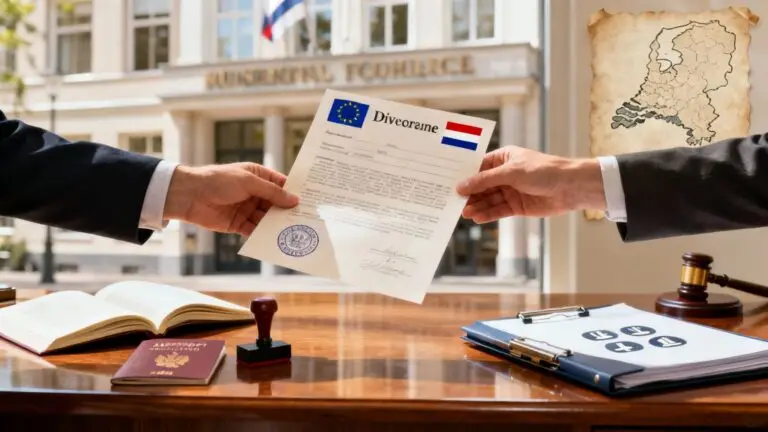
Yes, you can get divorced in the Netherlands even if your spouse does not agree. The court dissolves the marriage at the request of one spouse once it has broken down irretrievably; your spouse can contest the arrangements and slow the process down, but cannot stop the divorce itself.
Under Article 1:151 of the Dutch Civil Code (BW), the court dissolves a marriage on the ground of irretrievable breakdown (duurzame ontwrichting) at the request of one or both spouses. Almost all of the real work lies in the arrangements around the divorce: the children, maintenance, the house and the division of property.
Table of contents
Does your spouse have to agree to the divorce?
No. Dutch law has only one ground for divorce, irretrievable breakdown, and the court accepts it when one spouse maintains that the marriage is over.
You do not need to prove fault, adultery or any other cause, and there is no separation period to sit out first. A reluctant spouse can file a defence, dispute the arrangements for the children, maintenance and property, ask for postponements and appeal. Each step takes time, but the divorce itself is not in real doubt.
What is the difference between a joint and a unilateral petition?
A joint petition (gemeenschappelijk verzoek) is filed by both spouses, usually with a divorce settlement (echtscheidingsconvenant). A unilateral petition (eenzijdig verzoek) is filed by one spouse and served on the other, who becomes the respondent; many unilateral cases still end in a settlement before the hearing.
How does the unilateral procedure work, step by step?
Your lawyer files a petition with the court, a bailiff serves it on your spouse, and your spouse has six weeks to file a defence. The court then decides, on the papers or after a hearing.
Step 1: the petition
A divorce petition must be filed by a lawyer (advocaat) at the district court where the applicant lives. In cases with an international element, the Brussels IIb Regulation (EU 2019/1111), which has applied since 1 August 2022, decides which court in the European Union has jurisdiction, based on habitual residence or nationality.
The petition sets out the ground for divorce and the ancillary requests: the arrangements for the children, spousal and child maintenance, the use of the family home, the division of property or the settlement under the prenuptial agreement, and pension division.
Step 2: service and defence
A bailiff serves the petition on the other spouse, who then has six weeks to file a defence (verweerschrift); an extension is often granted once. In the defence, the respondent can oppose the ancillary requests and make requests of his or her own in the same case.
Step 3: the decision and appeal
If no defence is filed, the court can decide on the papers, often within a few months. If a defence is filed or there are minor children, the court normally schedules a hearing.
Both parties may appeal against the decision (beschikking) to the court of appeal within three months, and then in cassation to the Supreme Court on points of law. If both spouses sign a deed of acquiescence (akte van berusting), the decision becomes final immediately.
Step 4: registration within six months
The divorce only takes effect once the decision is entered in the civil status registers (registers van de burgerlijke stand) of the municipality where the marriage was concluded. This must happen within six months after the decision has become final (Article 1:163 BW); otherwise the decision loses its force and the procedure has to start again.

What can you arrange while the divorce is pending?
You can ask the court for provisional measures (voorlopige voorzieningen) under Article 821 and following of the Dutch Code of Civil Procedure (Rv). These settle the house, the children and maintenance until the divorce is final.
The court can decide which spouse may use the family home, where the children live, which contact arrangements apply and what maintenance is paid in the meantime. The hearing is normally held within a few weeks and the measures take effect immediately, without deciding the main case. If your spouse refuses to engage, this is usually the first application to make.
What if there is violence or intimidation?
Then the route is faster still. The mayor can impose a temporary restraining order (tijdelijk huisverbod) of ten days, which can be extended to four weeks, and the interim relief judge can impose a contact ban or an order to leave the home. Raise it with your lawyer at the first meeting, because it changes the order of every other step.
How do you arrange the children when your spouse will not cooperate?
You file the petition without a signed parenting plan and explain why one could not be made. The court can then decide the arrangements for the children itself.
Spouses with minor children must submit a parenting plan (ouderschapsplan) with the petition under Article 815 Rv, covering where the children live, the division of care, how the parents inform each other, and the costs of the children. If a plan cannot reasonably be produced, the petition must explain what you did to reach one: written proposals, an invitation to mediation, and the response or silence that followed. Joint parental authority continues after divorce as a matter of course.
How is child maintenance decided?
Child maintenance is based on the needs of the child and what each parent can afford, using standards the family courts update every year. The duty of support runs until the child turns eighteen; for children aged eighteen to twenty-one, Article 1:395a BW obliges parents to contribute to living and study costs.
Before deciding matters concerning a child of twelve or older, the court must give the child the opportunity to give his or her view (Article 809 Rv).
What happens to property, maintenance and pension without agreement?
The court decides on the basis of your matrimonial property regime, the statutory maintenance rules and the pension division rules. The date of your marriage matters a great deal.
What has to be divided?
For marriages entered into on or after 1 January 2018, the default is a limited community of property (beperkte gemeenschap van goederen): what each spouse owned before the marriage, and gifts and inheritances, remain private. Marriages concluded before that date fall under the old general community of property, unless the spouses made a prenuptial agreement (huwelijkse voorwaarden), whose settlement clauses must then be performed.
When is spousal maintenance owed, and for how long?
Spousal maintenance (partneralimentatie) is owed where one former spouse has too little income and the other can afford to contribute. Since 1 January 2020 it lasts half the length of the marriage, with a maximum of five years.
If there are children, maintenance runs at least until the youngest child turns twelve. After a marriage of more than fifteen years, longer periods apply to a recipient who is close to state pension age.
How is pension divided?
Under the Pension Rights Equalisation Act (Wet verevening pensioenrechten bij scheiding), each spouse is in principle entitled to half of the old-age pension the other built up during the marriage. Notify the pension provider within two years of the divorce, using the statutory form; after that the provider no longer pays your share to you directly. The tax consequences of a divorce should be assessed by a tax adviser.
What can you do about delay tactics?
A spouse who does not want the divorce has only a few ways to slow it down, and each has an answer. An invitation to mediation, even if refused, documents your attempt to reach a parenting plan.
Extensions of the defence period are commonly granted once, less readily a second time. A refusal to disclose financial information can be met with an order to produce documents, and not appearing at a hearing does not stop the court from deciding. The court can also pronounce the divorce first and deal with the remaining disputes afterwards.
What if your former spouse does not comply after the decision?
Unpaid maintenance can be collected by the National Maintenance Collection Agency (Landelijk Bureau Inning Onderhoudsbijdragen, LBIO), which can attach wages and benefits; for child maintenance this costs the receiving parent nothing. If your former spouse refuses to sign at the notary, the court can give a decision that replaces the signature, with a penalty payment (dwangsom) if needed. Obstruction of contact arrangements can be brought back before the family court.
What if the marriage has a cross-border element?
A Dutch court can often still hear the divorce, but check jurisdiction, applicable law and recognition abroad before you file. A foreign marriage certificate normally has to be legalised or given an apostille before the divorce can be registered.
When the case is heard in the Netherlands, Dutch law applies to the divorce itself, while the property consequences depend on the regime that applied when the marriage was concluded. A divorce granted in an EU Member State is recognised throughout the EU without a special procedure; outside the EU, recognition depends on the country concerned. A civil divorce does not dissolve a religious marriage.
What does a unilateral divorce cost?
The costs consist of your lawyer’s fees, the court fee (griffierecht), the bailiff’s fee for serving the petition and, where property is involved, valuation and notary fees. The court fee is fixed by law, depends on income and is adjusted every year.
Subsidised legal aid (gefinancierde rechtsbijstand) is available below the income and asset limits of the Legal Aid Board (Raad voor Rechtsbijstand), against a personal contribution. Law & More does not act on the basis of subsidised legal aid; the Juridisch Loket can refer you to firms that do.
What should you check as the spouse who wants the divorce?
- Collect the marriage certificate, the children’s birth certificates, any prenuptial agreement and the last three years of tax returns.
- Gather payslips, bank statements, the mortgage deed, a recent valuation of the home and pension statements from every provider.
- Put your proposals for a parenting plan and an invitation to mediation in writing.
- Decide whether provisional measures are needed for the house, the children or maintenance.
- Do not move money or leave the home without an arrangement.
What should you check as the spouse who receives the petition?
- Note the date of service: the six-week period for your defence starts then.
- Instruct a lawyer, because the defence must also be filed by an advocaat.
- Decide which ancillary requests you oppose and which requests of your own you want to add.
- Check whether the marriage was concluded before or after 1 January 2018, as this determines what is divided.
- Check whether a request for provisional measures has been filed against you, as its hearing comes within weeks.
What can we do for you with a unilateral divorce?
Our divorce lawyers represent clients in Dutch divorce proceedings, including cases in which one spouse does not want the divorce. Our family law guides cover the individual subjects in more detail.
- We draft and file the unilateral petition, or the defence within the six-week period.
- We apply for provisional measures for the house, the children and maintenance.
- We draft the parenting plan and the divorce settlement.
- We calculate child and spousal maintenance and litigate the division of property and pension.
- We arrange the deed of acquiescence and registration within six months.
- We check jurisdiction and recognition where the marriage has a cross-border element.
Summary
- Your spouse cannot block a divorce: the court grants it on irretrievable breakdown at the request of one spouse (Article 1:151 BW).
- A lawyer files the petition; your spouse has six weeks to file a defence, and either party can appeal within three months.
- Have the decision registered within six months after it becomes final, or it loses its force.
- Provisional measures settle the house, the children and maintenance while the case is pending.
- Without a signed parenting plan, show your attempts to reach one; the court can then decide the arrangements itself.
Frequently asked questions
Can my partner prevent the divorce?
No. Your partner can delay a divorce, but not prevent it. Dutch law does not require the consent of both spouses, and the court grants the divorce once the marriage has broken down irretrievably (Article 1:151 BW).
How long can the process take?
If no defence is filed, the court can decide on the papers within months. A contested case needs one or more hearings, and an appeal adds a further stage. Separating the divorce from the ancillary matters usually shortens the process.
How do I tell the children?
Try to tell them together with your partner, even if he or she does not cooperate with the divorce itself. Be honest, explain it in a way that suits their age, and make clear that both parents will stay involved.
Can I get subsidised legal aid?
Yes, if your income and assets fall below the limits of the Legal Aid Board (Raad voor Rechtsbijstand), against a personal contribution that is set each year. Law & More does not work on this basis.